You spend three months building content around a trending niche. Traffic starts coming in. Then you check your commissions — $47 total. The niche was hot. The math just never worked.That is the mistake most beginners make. They choose a niche based on popularity, not profitability.
The right affiliate niche is not always the one everyone is talking about. It is the one with real buyer intent, strong commission potential, enough content ideas, and products people are already willing to pay for. In this article, you will find 7 affiliate niche options for 2026, real program examples, a simple 3-question framework to choose the right niche for you, and a practical look at how serious affiliates scale once they know what works.
Let’s start with what actually makes an affiliate niche worth your time.

What Makes an Affiliate Niche Worth Your Time in 2026
You spend three months building content around a trending niche. Traffic starts coming in. Then you check your commissions — $47 total. The niche was hot. The math just never worked. That is the mistake most beginners make. They choose a niche based on popularity, not profitability.
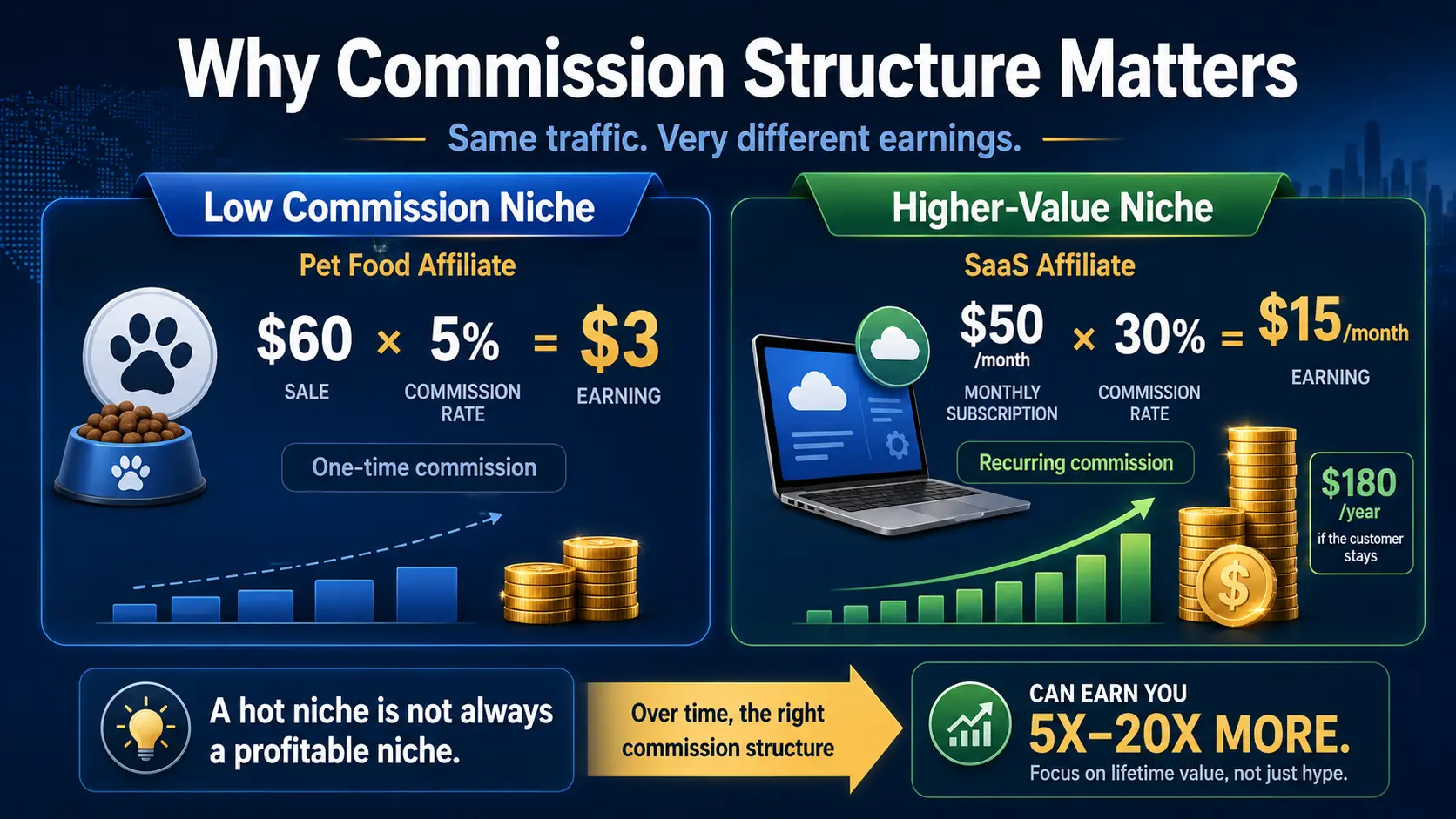
Commission structure matters more than niche popularity
When people search for the best niches for affiliate marketing 2026, they often look for big markets first. Health, pets, travel, and finance all look attractive because many people spend money there. But the real question is: how much can you earn per sale, and can you earn again from the same customer?
For example, a pet food affiliate program may pay around 5% per sale. If someone buys a $60 bag of dog food, you earn $3. That can work at high traffic volume, but it is hard for a beginner.
Now compare that with a SaaS affiliate program that pays 30% recurring commission. If the software costs $50 per month, you earn $15 every month as long as the customer stays subscribed. One sale can become $180 per year. That is why SaaS, finance tools, and AI software often appear in lists of the highest paying affiliate niches.
This does not mean low-ticket niches are bad. It means you need to understand the math before you commit months of content, ads, and testing.
The difference between a "hot niche" and a scalable niche
A hot niche gets attention fast. A scalable niche gives you room to grow.
For example, “AI writing tools” may be hot because many people are searching for them. But it becomes scalable only if you can create many types of content around it, such as reviews, tutorials, comparisons, use cases, and buyer guides.
A strong affiliate niche should have three things: clear buyer intent, enough products to promote, and repeat content angles. If you can only think of 10 article ideas, you may run out quickly. If you can think of 50 or more, you have room to build traffic over time.
With that in mind, let’s look at the 7 best affiliate marketing niches beginners should consider in 2026.
7 Best Affiliate Marketing Niches for Beginners in 2026
The list below is not just about which niche sounds popular. For each niche, we will look at why it works in 2026, real affiliate program examples, and the biggest mistake beginners should avoid.
SaaS & Software Tools
If you want a niche where one good referral can keep paying after the first sale, software is hard to ignore. Many businesses now pay monthly for tools that help with email, SEO, sales, design, automation, and customer support. Fortune Business Insights projects the global SaaS market to reach $375.57 billion in 2026, which shows how much money is still moving into software subscriptions.
The best part for beginners is that SaaS products solve clear problems. A small business owner may need an email tool. A blogger may need an SEO tool. A freelancer may need a CRM. That makes content easier to plan because you can write reviews, comparisons, tutorials, and “best tools for” guides.
Two real programs to look at are HubSpot and Semrush. HubSpot’s affiliate program offers 30% recurring commission, with some sales reaching $1,000+ depending on the product. Semrush is also a strong example in the SEO software space, with commissions for new paid subscriptions listed through its affiliate program.
The biggest mistake I see beginners make here is writing generic “best software” posts without matching the tool to a real use case. “Best CRM software” is too broad. “Best CRM for solo real estate agents” is much better. It speaks to one buyer, one problem, and one decision.
SaaS can be one of the highest paying affiliate niches, but it rewards useful content more than hype. Next, let’s look at another niche where trust, timing, and buyer intent matter even more: personal finance.
Personal Finance
People do not stop caring about money when trends change. They still want help with budgeting, saving, credit cards, taxes, loans, and investing basics. That is why this niche still has strong demand in 2026. The personal finance apps market alone is projected to grow from $165.9 billion in 2025 to $207.69 billion in 2026.
Finance also has a clear reason to convert. A reader searching “best budgeting app for couples” or “best credit card for groceries” is not just browsing. They are close to making a decision.
For affiliate programs, Quicken is one beginner-friendly example. Its affiliate program is often listed at around 10% per sale, and it works well for content about budgeting, expense tracking, and money management software. YNAB is another strong brand in budgeting. Its affiliate program is invite-only, so it may not be the first one you join, but it is worth watching if you build a trusted finance audience.
One thing to understand: personal finance is a YMYL niche, which means “Your Money Your Life.” Google holds this kind of content to a higher standard because bad advice can hurt someone’s financial life. That sounds scary, but it can help serious affiliates. Many beginners leave when they realize they need real examples, clear disclosures, and careful wording. That creates space for people who do the work properly.
The biggest mistake I see beginners make in this niche is writing broad advice without proof. For example, “save more money every month” is weak. “How I would cut $120 from a monthly subscription budget using Rocket Money, YNAB, and a simple spreadsheet” is much stronger.
Finance rewards trust and detail. Next, we will move into a faster-growing niche where new tools appear almost every week: AI Tools & Automation
AI Tools & Automation
Beginners have a real opening here because buyers are still trying to figure out which tools are worth paying for. People search things like “does Jasper actually work,” “Writesonic vs ChatGPT,” or “best AI tool for YouTube scripts” because they want honest tests before they spend money.
Why it still works in 2026
The AI market is still growing fast. Grand View Research estimates the global artificial intelligence market will reach $539.45 billion in 2026. That growth creates demand for tools in writing, design, video editing, coding, customer support, SEO, and workflow automation.
This niche is beginner-friendly because you do not need to be a machine learning expert. You can test tools as a normal user and show real results. For example, you can compare two AI writing tools by creating the same blog intro, email subject line, or product description in both tools.
Best affiliate programs to join
Writesonic is a good example. Its affiliate program offers 20% recurring commission every month for up to 12 months per customer. Jasper is another major AI marketing tool. Its affiliate terms say commissions can increase to 30% after affiliates hit specific lead and customer goals.
Biggest mistake beginners make in this niche
The biggest mistake I see beginners make is publishing tool reviews once and never updating them. AI tools change fast. A feature that was weak in March may be much better by September. A pricing plan can also change overnight.
So do not write “best AI tools” and leave it untouched for a year. Add update dates, retest tools, include screenshots, and explain what changed. That is how you build trust in a niche where hype moves faster than facts.
Health & Wellness
Why it still works in 2026
Health and wellness keeps working because people buy products to solve daily problems: sleep, energy, fitness, digestion, stress, and nutrition. The global health and wellness market is projected to grow from $6.83 trillion in 2025 to $7.43 trillion in 2026.
But beginners should not start with “health” as one huge topic. That is too broad. Smaller sub-niches are easier to rank and easier to trust. Good examples include sleep optimization, gut health, women’s fitness, home workouts, and healthy meal planning.
Best affiliate programs to join
MyFitnessPal is a practical program for beginners because it fits fitness, weight tracking, and nutrition content. Its affiliate program offers up to $20 commission per annual subscription.
For wellness products, iHerb is another option. Its affiliate program says partners can earn up to 25% commission on referred sales. Myprotein also lists commissions as high as 8%, which can work for fitness and nutrition creators.
Biggest mistake beginners make
The biggest mistake I see beginners make is giving health advice they are not qualified to give. For example, “this supplement fixes sleep problems” is risky and weak. A better angle is “5 sleep-tracking habits I tested for 30 days,” then mention products as tools, not medical solutions.
Health content needs proof, disclaimers, and careful wording. If that feels too strict, the next niche may be easier because people are already looking for tutorials and skill-based learning.
Online Education & Courses
Why it still works in 2026
Online education works because people keep paying to learn job skills, side hustles, software, design, marketing, languages, and creative skills. The worldwide online education market is projected to reach $221.71 billion in 2026.
This niche is also strong because it fits content platforms beginners already use. Pinterest works well for topics like “free study planner,” “best online courses for remote jobs,” and “learn graphic design at home.” YouTube works well because people want to see course reviews, lesson previews, and real student results before buying.
Best affiliate programs to join
Coursera is one of the clearest examples. Its affiliate program offers baseline commissions between 15% and 45% on eligible purchases.
Teachable is strong if your audience includes creators, coaches, or small business owners. Its partner program offers 30% recurring commission for one year on each sale you refer. Skillshare is another beginner-friendly option, offering 20% commission, up to $34, for each new customer.
Biggest mistake beginners make
The biggest mistake I see beginners make is promoting random courses without matching them to a clear outcome. “Best online courses” is too broad. “Best Google Analytics courses for beginner marketers” is much easier to sell because the reader knows exactly why they need it.
Education content should help the reader choose faster. Once you understand that, travel feels similar: people want help making a decision before they book.
Travel
Why it still works in 2026
Travel is still a strong affiliate niche because people research a lot before spending money. Statista projects worldwide travel and tourism revenue to reach $1.07 trillion in 2026.
This niche also has a big Pinterest angle. From keyword research, Pinterest travel content is still strong in 2026 because people save trip ideas early. Posts like “3-day Rome itinerary,” “best hotels near Tokyo Station,” and “family packing list for Hawaii” can bring traffic for months.
Best affiliate programs to join
Booking.com is one of the most common travel affiliate programs. Booking.com's affiliate program offers around 4% on completed hotel stays and 6% on car rentals.
Tripadvisor is another strong option. Its affiliate program says partners earn at least 50% of the commission Tripadvisor receives from hotel booking partners when users click out through affiliate links.
Travel credit card offers can also pay well, but they usually have stricter approval rules and compliance requirements. Beginners should start with hotels, tours, and itinerary content first.
Biggest mistake beginners make
The biggest mistake I see beginners make is writing pretty destination posts with no buyer intent. “My trip to Paris” may get attention, but “best hotels in Paris near the Eiffel Tower under $250” is closer to a booking.
Travel rewards useful, specific content. Next, let’s move into a niche where the audience is highly engaged and often ready to buy gear, guides, and digital products.
Gaming & Esports
Why it still works in 2026
Gaming works because the audience is huge, active, and used to spending money on gear, games, subscriptions, and digital items. Statista projects worldwide games market revenue to reach $577.91 billion in 2026. Newzoo also reported global games revenue of $188.8 billion in 2025, with growth toward $206.5 billion by 2028.
For beginners, the key is to avoid covering “gaming” as one giant topic. Sub-niches work better. Examples include streaming gear, game guides, controller setups, gaming laptops, in-game currency, and beginner esports equipment.
Best affiliate programs to join
Razer is a strong gaming gear example. Its affiliate program says partners can earn up to 15% commission on sales.
Alienware can also fit gaming laptop and setup content. Affiliate listings commonly show Alienware commissions around 1% to 6% per sale. That may sound lower, but a $1,500 gaming laptop at 3% still earns $45.
Biggest mistake beginners make
The biggest mistake I see beginners make is chasing only new game releases. That traffic can spike fast, then disappear. A better plan is to mix news content with evergreen posts like “best headset for Valorant,” “budget streaming setup under $500,” or “best settings for low-end gaming laptops.”
Gaming can scale well, but only if you choose a focused angle. Now that we have covered the seven niche options, let’s use a simple 3-question framework to decide which one actually fits you.
How to Pick YOUR Niche: 3-Question Framework
At this point, it is easy to overthink everything. One niche pays more, another feels easier, and another looks trendy right now. Use these three questions to stop spinning and make a real decision.
Do you have any existing knowledge or audience?
Start with what you already understand. It can save you months of research because you already know the language, pain points, and common products in that space.
For example, if you already follow fitness creators on Instagram, track workouts, and understand meal planning, you have a head start in health and wellness. You know what beginners ask, what products they compare, and what content gets attention. That is much easier than starting from zero in personal finance, where you may need to learn credit scores, budgeting tools, and compliance before writing anything useful.
You do not need to be an expert. But you should not feel lost every time you open a blank page.
Can you create 50+ content ideas without repeating yourself?
This is the content runway test. A niche only works if you can keep publishing without saying the same thing every week.
Here is the simple 5-minute version. Open a Google Doc. Set a timer for five minutes. Write your niche at the top, then combine it with content formats like reviews, comparisons, tutorials, mistakes, checklists, case studies, beginner guides, and tool roundups.
For example, “best AI tools for bloggers,” “Jasper vs Writesonic,” “how to use AI for email marketing,” and “AI writing tools for YouTube scripts” are all different angles.
If you hit 50 ideas easily, that is a good signal. If you struggle at 15, the niche may be too narrow or not interesting enough for you.
Does the math work at your current traffic level?
Traffic matters, but commission size changes everything.
Let’s say your site gets 1,000 visitors per month. If 2% of those visitors buy, that gives you 20 sales. At a $3 commission, you earn $60 per month. At a $30 commission, you earn $600 per month from the same traffic.
That is why niche choice matters. It can multiply or shrink the value of every visitor you bring in.
This does not mean you should only chase the highest commission. It means you should compare traffic potential, buyer intent, and payout together. A smaller niche with strong commissions can beat a huge niche with weak earnings.
Once you pick a niche that passes these three tests, the next challenge is scaling it without mixing up accounts, campaigns, and platforms.
How Serious Affiliates Manage Multiple Niches at Scale
Picking a niche is only the first step. Once you start testing offers, traffic sources, and campaigns, you need a clean system so your work does not turn into a mess.
Why multi-account management is non-negotiable
Imagine you are testing 3 different affiliate offers at the same time. One is a SaaS offer for small business owners. One is a finance app. One is an online course. You are running traffic through Facebook Ads and Google Ads, and each offer has different creatives, landing pages, GEOs, and budgets.
If everything sits under one account, your data gets messy fast. You cannot clearly see which offer works, which audience converts, or which creative is wasting money. Many platforms also limit how accounts can be created and used, so serious affiliates usually need a structured way to manage different accounts, clients, campaigns, and tests without mixing results.
How to keep accounts isolated and avoid bans
Platforms do not only look at your login email. They also read your device’s digital signature. This is called browser fingerprinting.
In simple terms, your browser fingerprint can include your browser type, screen size, fonts, timezone, system language, cookies, and other settings. If two accounts share the same fingerprint and behavior pattern, platforms may connect them. If one account has a problem, the other account may be affected too.
That is why each account needs its own isolated identity. You want a unique fingerprint, separate cookies, and an independent session for every account. This does not replace platform rules, but it helps keep approved workflows cleaner and reduces the risk of accounts being linked by mistake.
Setting up separate browser profiles with DICloak
With DICloak, you can create a separate browser profile for each affiliate account, so each profile has its own working environment. You can run bulk accounts for different affiliate networks from one device — Facebook Ads, Google Ads— each with its own unique fingerprint, reducing the risk of bans while reaching broader audiences.
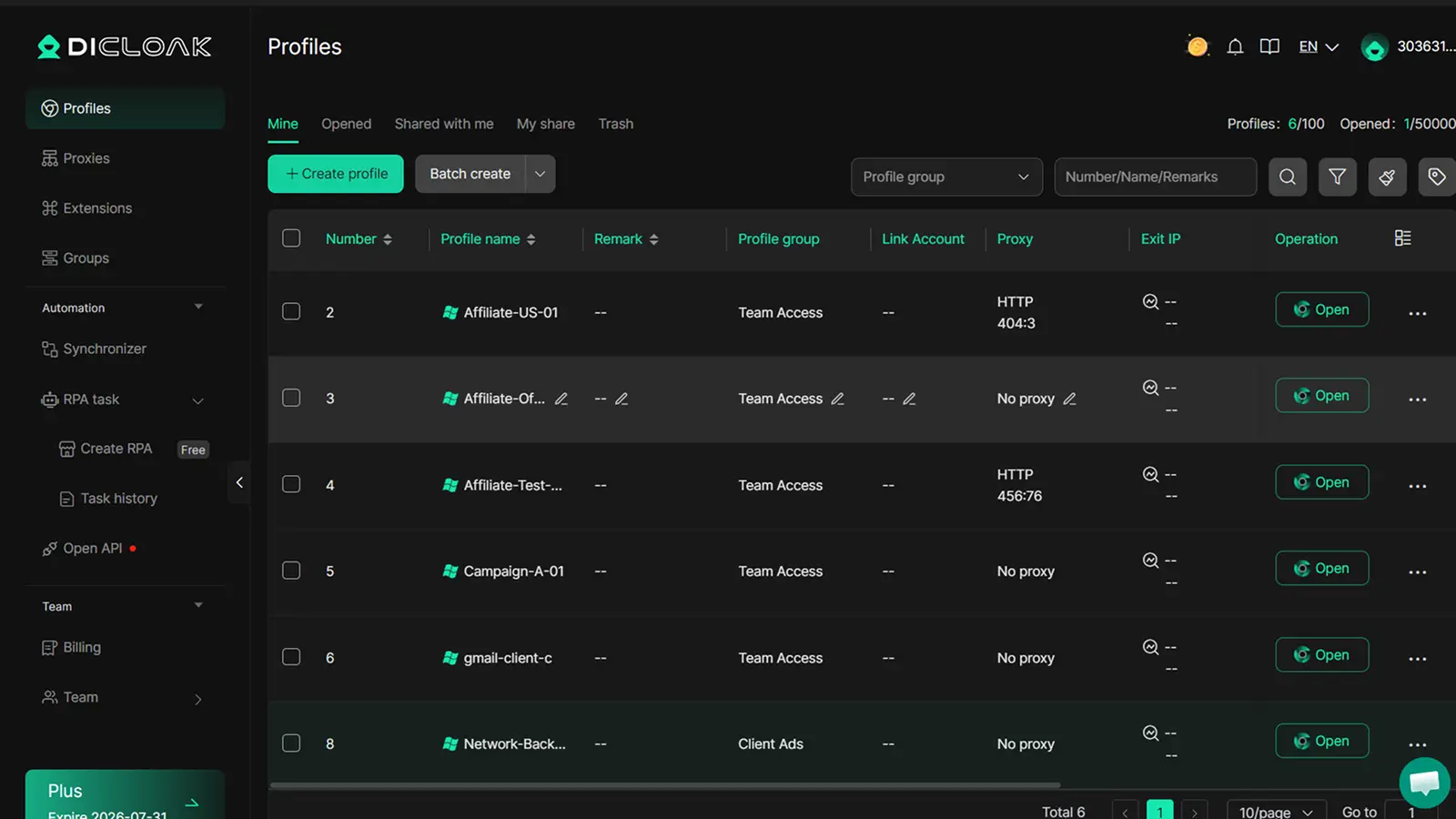
You can also use RPA workflow support to automate repetitive daily tasks like managing hundreds of affiliate profiles, scaling campaigns across social media, and running market research, without doing it manually every time. This matters when you are no longer testing one offer, but several campaigns across multiple traffic sources.
For traffic growth, you can simulate human-like visits that scroll, click, and browse naturally using DICloak's Traffic Bot, which helps boost SEO and drive targeted traffic to your affiliate offers.
Frequently Asked Questions about affiliate niche
What is the best affiliate niche for beginners in 2026?
The best affiliate niche for beginners is usually one that has clear buyer intent, real products to promote, and enough content ideas to keep publishing. SaaS, AI tools, online education, and health sub-niches are strong options because people actively search for reviews, comparisons, and beginner guides before buying.
What are the highest paying affiliate niches?
The highest paying affiliate niches often include SaaS, personal finance, AI tools, and online education. These niches can pay higher commissions because the products usually have strong customer value. For example, a software tool may pay recurring commissions, while a low-ticket product may only pay a small one-time commission.
How do I know if an affiliate niche is profitable?
An affiliate niche is profitable when the traffic, conversion rate, and commission make sense together. For example, 1,000 monthly visitors at a 2% conversion rate means 20 sales. If each sale pays $30, that is $600 per month. If each sale pays $3, that is only $60.
Should I choose a broad or narrow affiliate niche?
Beginners should usually start with a narrow affiliate niche. “Health” is too broad, but “sleep tools for busy professionals” is easier to target. A focused niche helps you create specific content, attract the right audience, and promote products that match one clear problem.
Can I work in more than one affiliate niche?
Yes, but it is better to start with one affiliate niche first. Build content, test offers, and learn what converts before adding another niche. Once you understand your workflow, you can expand into related niches, separate your campaigns, and manage different traffic sources more clearly.
Choosing the right affiliate niche is the foundation. But scaling it takes the right setup. You can createisolated browser profiles, automate campaign management, and protect your accounts from day one.Try DICloak For Free
 Web Proxy Tools
 Free Tools
 Cookie Plugin
 UA Generator
 MAC Address Generator
 IP Generator
 IP Address List
 2FA Code Generator
 World Clock
 Anonymous Check
 WebRTC Leak Test
 UUID Generator
 Free Web Proxy Site
 Proxy Checker
 FB Ad Checker
 AI Web Scraping
 Free SMM Tools
 Twitter Shadowban Checker
 Instagram Name Checker
 UTM Generator
 Username Generator
 AI Hashtag Generator
 LinkedIn Headline Generator
 Social Media Image Resizer