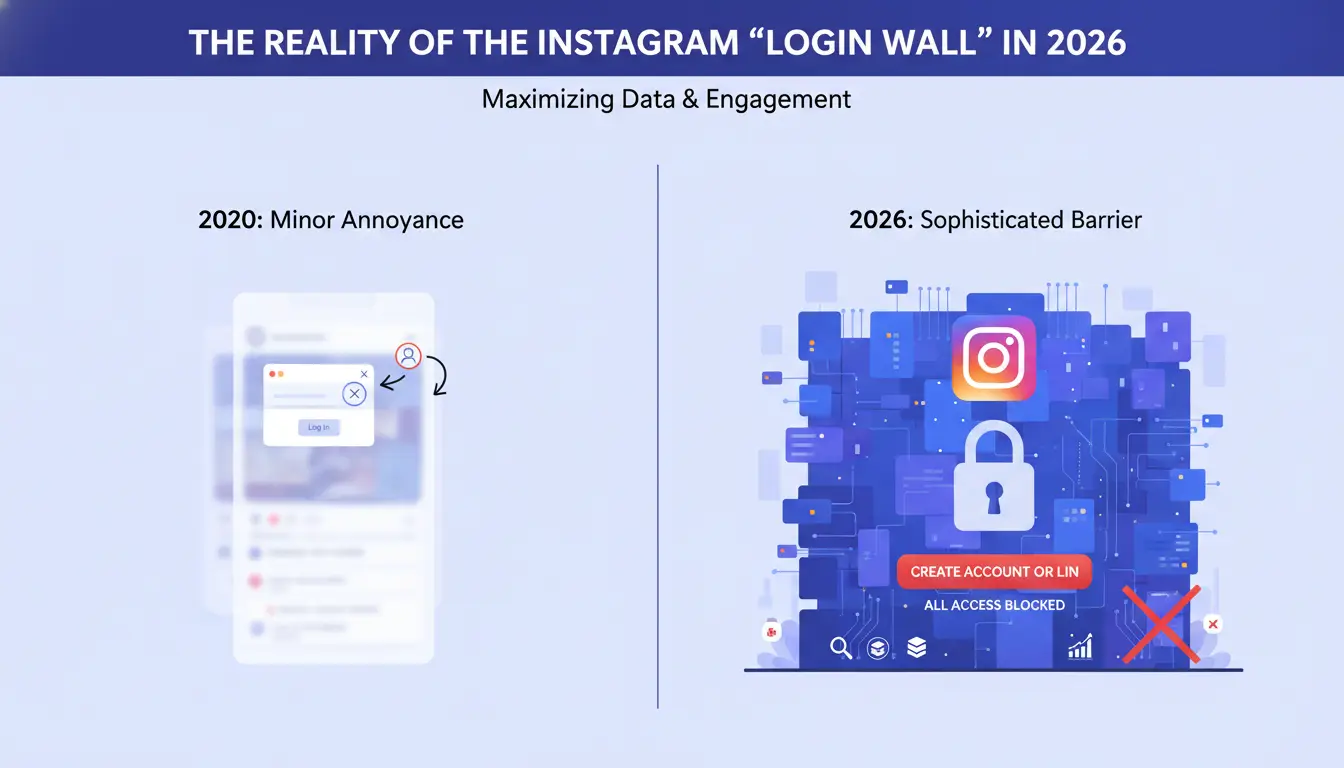
The Reality of the Instagram "Login Wall" in 2026
Meta has spent years fortifying the Instagram "login wall," transforming it from a minor annoyance into a sophisticated barrier. This isn’t a technical oversight; it is a deliberate strategy to maximize data collection and engagement metrics. By forcing every visitor into an account, Meta can link browsing behavior to a persistent identity, serving targeted ads while padding their active user counts.
For practitioners—whether you are a digital marketer conducting competitor research or a privacy-conscious user—this wall is a major obstacle. Bypassing it is not just about convenience; it’s about avoiding "seen" receipts that tip off competitors and preventing Meta’s tracking scripts from building a permanent profile on your digital habits.
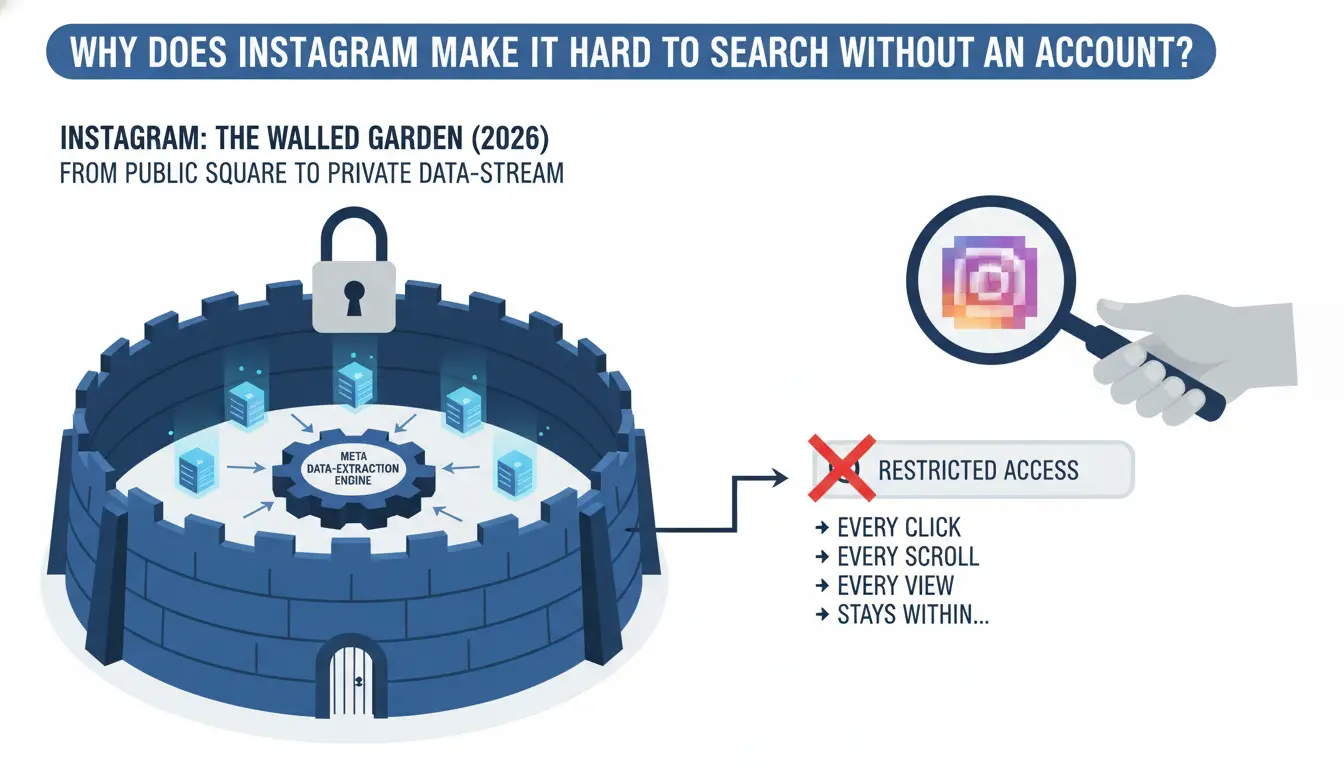
Why Does Instagram Make It Hard to Search Without an Account?
Instagram has successfully completed its transition from a public square to a "walled garden." In 2026, the platform functions more as a data-extraction engine than a social network. By restricting access, Meta ensures that every click, scroll, and view remains within its controlled ecosystem, where it can be monetized.
The Limitations of Native Web Browsing
When you attempt to browse the Instagram web interface without a login, you are immediately throttled. You might see the first three to six posts on a public profile, but as soon as you attempt to scroll further or view a Reel, a mandatory login pop-up blocks the screen. This is a hard-coded server-side restriction designed to make unregistered browsing effectively impossible for anything more than a cursory glance.
How Instagram Tracks Unregistered Visitors
Do not mistake "not logged in" for "anonymous." Even without an account, Instagram employs aggressive browser fingerprinting. They track a combination of your User-Agent strings, Canvas fingerprints, WebGL configurations, installed fonts, and time zones to create a unique identifier for your device. Coupled with IP tracking, Meta can recognize an unregistered visitor across multiple sessions, linking your "anonymous" research back to your hardware and location.
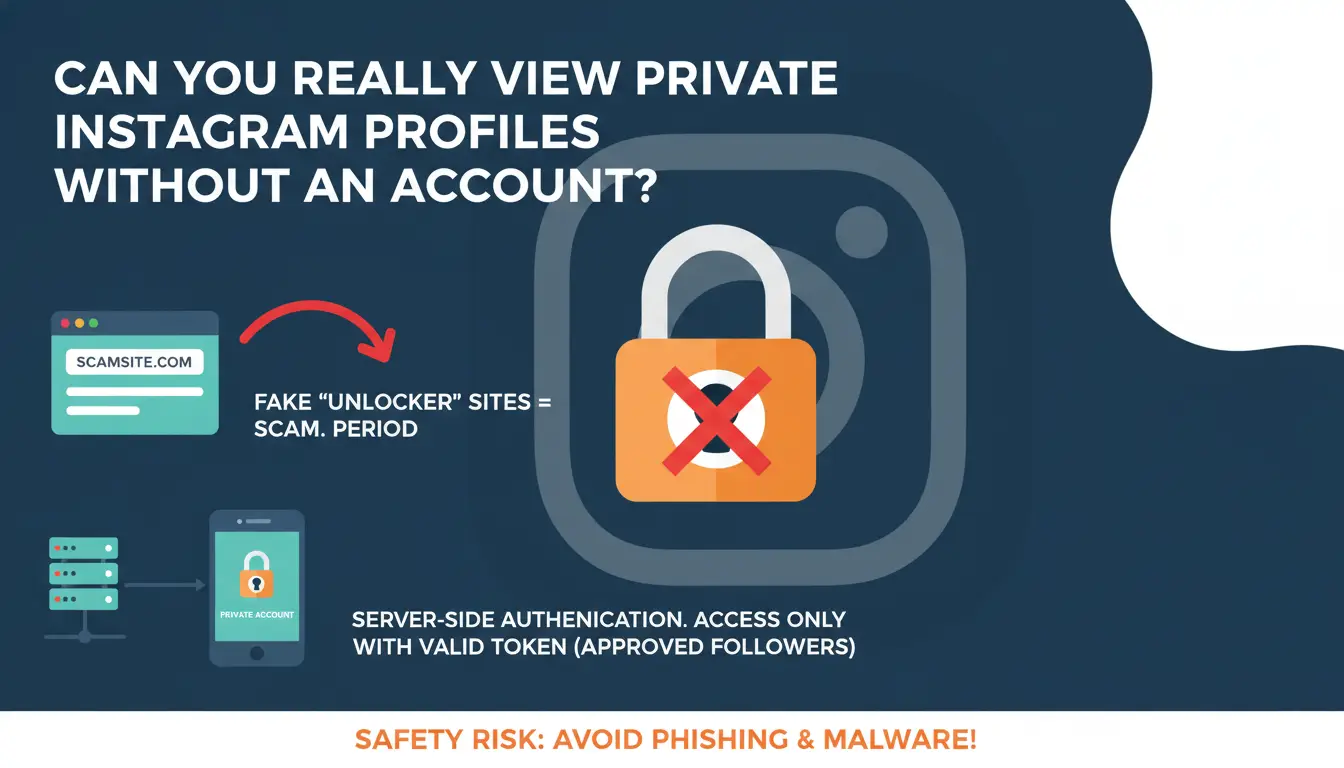
Can You Really View Private Instagram Profiles Without an Account?
Let’s be clear: any site claiming to "unlock" a private profile is a bottom-tier scam. Period.
Instagram utilizes server-side authentication. Content for private accounts is only delivered to the client-side app once a valid authentication token—granted only to approved followers—is verified by the server. No third-party viewer can magically generate this token. These "private viewer" sites are almost always traps designed to funnel users into:
- Human Verification Loops: Surveys that generate affiliate revenue for the scammer but never reveal the profile.
- Malicious Software: Prompts to download "viewing tools" that are actually credential-stealing malware or spyware.
- Credential Phishing: Deceptive forms asking for your own Instagram password to "access" the target account.
Tested Methods for Instagram Search and Viewing in 2026
The "Burner Account" Strategy
- Expert Tip: To prevent Meta from immediately linking your burner to your main identity via IP or device ID, always use a protected network environment or mobile data during the registration process.
- Use a dedicated, non-linked email address and avoid providing a phone number if possible (or use a burner SIM).
- Never sync your contacts or link this profile to other Meta platforms like Facebook or Threads.
Browser-Level Workarounds: Legacy and Obsolete Hacks
- The "Slide and Peek": By swiping halfway to a neighboring story and holding it, you can glimpse the first frame. This is a manual gimmick, not a research tool; it doesn’t work for video and is prone to accidental "seen" triggers.
- Airplane Mode Caching: This involve loading stories, going offline, viewing, and force-closing the app.
- Warning: This is a legacy method and is largely obsolete in 2026. Modern app builds are designed to sync view data the moment the device reconnects to the internet, rendering this trick unreliable for anyone requiring 100% certainty.
The Technical and Security Risks of "Free" Viewing Tools
In the world of online privacy, "free" is a red flag. These sites must monetize somehow, and it’s usually at the expense of your security.
- Malicious Redirects and Captcha Loops: Many free viewers utilize "click-jacking" or fake "Download" buttons that trigger redirects to affiliate offer scams or malware-laden sites.
- Data Scraping: These tools may claim to offer anonymity, but they are often logging your IP address and browser fingerprint for their own data-brokerage purposes. You are essentially trading Meta's tracking for that of an unregulated third party.
How to Maintain Total Anonymity While Doing Professional Instagram Research
Standard browsers are insufficient for professional research because they share cookies and hardware identifiers across tabs and windows. To avoid "chain-bans" and multi-account cross-contamination, professionals must move away from "hacks" and toward dedicated infrastructure.
DICloak as a Professional Workflow Option
For agencies and marketers managing multiple research accounts, an anti-detect environment like DICloak is a common approach. This is not a "viewer" but a secure operating environment.
- Unique Fingerprinting: DICloak generates distinct, isolated browser fingerprints (including Canvas, WebGL, and User-Agent strings) for every profile. This helps prevent Instagram from linking your various research activities to a single device.
- Proxy Integration: DICloak can integrate with user-configured residential and mobile proxies, allowing you to mask your real IP and appear as a user from any geographic location.
- Cookie and profile data management: DICloak helps keep cookies, sessions, local storage, and browsing data separate within each browser profile. This allows users to build and maintain a more consistent profile environment for research, testing, or multi-account management, instead of mixing data across different accounts.
Common Mistakes to Avoid When Browsing Instagram Privately
- Reusing Passwords: If your burner account or a third-party service is breached, using a recycled password invites credential-stuffing attacks on your primary identity.
- Falling for "Verification" Loops: If a site asks you to install a mobile app or verify your "humanity" through a survey to see a profile, it is a scam. Exit the tab immediately.
- Ignoring Local Privacy Laws: Even when anonymous, you are bound by copyright and data protection regulations (GDPR/CCPA). Scraping and redistributing content without consent can carry significant legal risks for businesses.
Frequently Asked Questions: Instagram Viewing in 2026
Does Instagram notify users when I view their story through a third-party tool?
No. These tools typically fetch data server-side using their own credentials or scraping protocols. Your identity never reaches Instagram's "Seen by" database.
Why can't I see the "Followers" list without logging in?
Follower lists are highly restricted relational data. Most anonymous viewers only have access to the public media CDN (Content Delivery Network), not the deeper database tables that house follower counts and names.
Are Instagram viewer apps on the App Store/Google Play safe?
Generally, no. Mobile apps require deep device permissions that web-based viewers don't. They are frequently loaded with hidden trackers and aggressive push-notification advertisements.
Can I view "Close Friends" stories anonymously?
No. This is a server-side authentication token issue. No browser hack can generate a token for a list you aren't on.
What should I do if a viewer site asks for my Instagram password?
Close the site. There is no technical reason a legitimate anonymous viewer would ever need your login credentials. This is 100% a phishing attempt.
The Future of Anonymous Access on Meta Platforms
The era of easy, anonymous web-browsing on social platforms is ending. As Meta refines its anti-scraping AI and strengthens its "walled garden," temporary web-based hacks will continue to break. For those who rely on Instagram data for professional purposes, the shift is clear: prioritize robust infrastructure over temporary workarounds. Utilizing anti-detect browsers and isolated environments can be a key strategy to support long-term, stable, and more isolated access to the platform in 2026.
 Web Proxy Tools
 Free Tools
 Cookie Plugin
 UA Generator
 MAC Address Generator
 IP Generator
 IP Address List
 2FA Code Generator
 World Clock
 Anonymous Check
 WebRTC Leak Test
 UUID Generator
 Free Web Proxy Site
 Proxy Checker
 FB Ad Checker
 AI Web Scraping
 Free SMM Tools
 Twitter Shadowban Checker
 Instagram Name Checker
 UTM Generator
 Username Generator
 AI Hashtag Generator
 LinkedIn Headline Generator
 Social Media Image Resizer