Agencies and marketers routinely manage dozens of client accounts across platforms with strict policies against multiple logins. This isn't just a challenge; it's a constant battle against sophisticated platform algorithms where a single mistake can cost a client's account. To navigate this high-stakes environment, the modern, effective solution are the antidetect browsers.
The purpose of this article is to explore the various alternatives to antidetect browsers, analyze their respective pros and cons, and demonstrate why a dedicated solution like the DICloak antidetect browser remains the superior choice for professional use in 2026. With the increasing demands of antidetect browsers in managing multiple accounts securely and efficiently, DICloak stands out for its high fingerprint accuracy, scalability, and ease of use.
What Are Antidetect Browsers and Why Are They Essential for Teams?
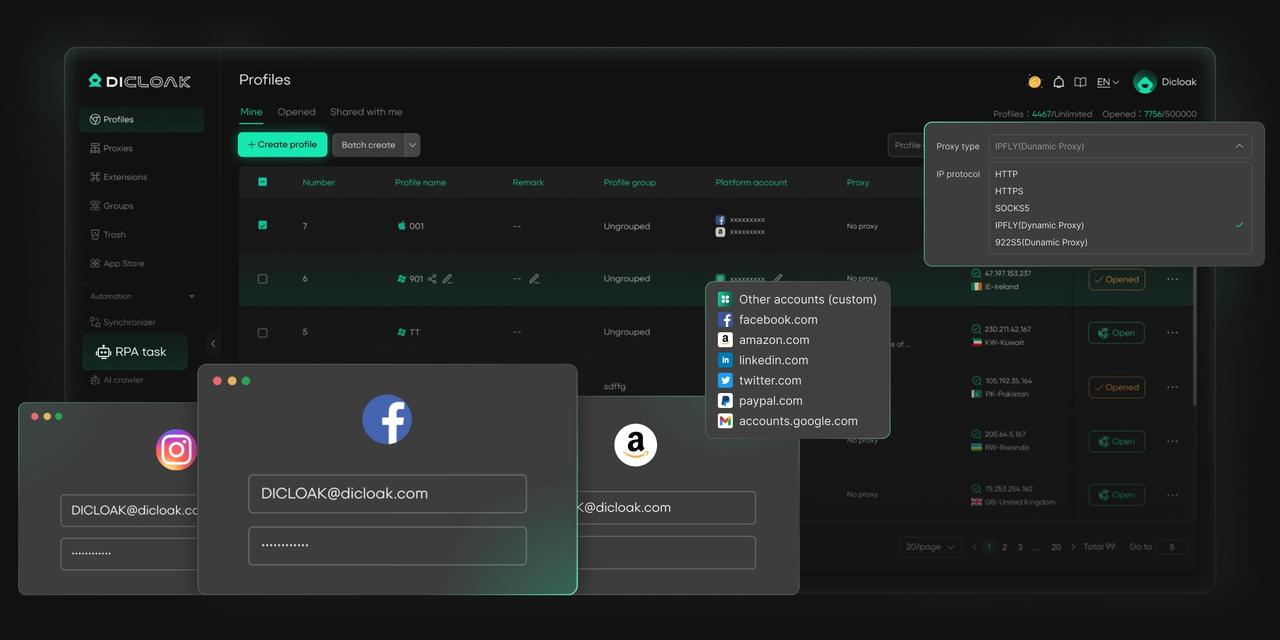
An antidetect browser is a specialized tool that masks a user's digital identity to keep their browsing activity anonymous. It accomplishes this by creating unique browser profiles, each operating in its own isolated cloud environment. Every profile is assigned a distinct device fingerprint (including its WebGL signature, MAC address, fonts, and OS) and can be connected to a separate IP address via a proxy.
The concept is simple: if you use ten different browser profiles to manage ten social media accounts, the platforms see them as ten unique, real devices accessing their services. This method effectively bypasses even the most advanced detection systems.
How Teams Leverage Antidetect Browsers for Productivity
The primary use case for teams is managing and sharing multiple client accounts securely without getting flagged. An antidetect browser allows team members to collaborate on the same account seamlessly.
For example, a social media manager can log into a client's Instagram account from a specific browser profile. They can then share that profile with other team members, who can continue working from their own devices. All activity is synced, and to the platform, it appears as if a single, consistent device is being used. Tools like DICloak have become the standard solution for agencies needing to manage a widespread online presence efficiently.
How Platforms Detect Users Bypassing Antidetect Browsers
To understand why antidetect browsers are so effective, it's important to know how platforms identify and block users managing multiple accounts. They look for anomalies and patterns that suggest a single entity is operating multiple profiles.
IP Address Tracking
Operating several accounts from the same IP address is the most obvious red flag for platforms. This activity signals that a single user may be managing multiple accounts, often for spam or other policy violations.
Device Fingerprinting
Advanced detection systems track a user's unique device fingerprint. This digital signature is composed of various elements, including the operating system, browser version, installed fonts, screen resolution, and WebGL signature. If multiple accounts share the same fingerprint, they can be linked together. Platforms also look for unrealistic or suspicious fingerprints, such as a browser reporting a Linux user agent with Windows-only fonts.
Cookies and Behavioral Analysis
Platforms use cookies to track user history, which can reveal when a user is rapidly switching between multiple accounts on the same device. Beyond cookies, they monitor for unnatural user behavior, such as multiple accounts posting the same link simultaneously or performing other synchronized actions. These patterns are strong indicators of automation or policy violation.
Platforms enforce these rules because multiple accounts are frequently used for spamming. This makes it difficult for legitimate users, such as agency managers, to perform their jobs without facing potential penalties.
A Deep Dive into Alternatives to Antidetect Browsers
While dedicated antidetect browsers offer the most comprehensive solution for multi-account management, several other methods exist. We have tested each one to document its pros, cons, and ideal use cases to help you make an informed decision.
1. Official Platform Tools & Business Permissions
This method involves using a platform's native tools, such as Meta Business Suite for Facebook and Instagram. It allows agencies to gain access to client accounts through official channels without sharing login credentials.
Pros:
- Full compliance with platform rules and terms of service.
- Built-in collaboration features like shared inboxes, analytics, and reporting tools.
- Centralized control with the ability to assign specific roles to team members.
- No need to share sensitive login credentials, enhancing security.
Cons:
- Limited to supported platforms and features (e.g., no TikTok, limited actions like joining groups).
- Cannot be used for personal or non-business accounts.
- Does not bypass platform limits on actions or bulk account creation.
- Requires active client participation to grant and manage access permissions.
2. Using Real Physical Devices
This old-school but highly effective method, often called a "phone farm," involves dedicating a separate physical device to each account. Every device has its own hardware, SIM card, and internet connection, ensuring complete isolation.
Pros:
- The highest level of realism and authenticity, as each account uses genuine hardware.
- Unique hardware IDs, fingerprints, and IP addresses for each account.
- Generates authentic GPS, SIM, and accelerometer signals that are impossible to fake.
- Strong isolation between accounts with no risk of data crossover.
Cons:
- Extremely expensive to scale due to the cost of hardware, SIM cards, and electricity.
- Operationally complex and requires significant physical space to manage.
- Inefficient for multitasking or quickly switching between accounts.
- A subscription to an antidetect browser like DICloak is significantly cheaper.

3. Cloud Phones and Virtual Mobile Devices
A virtual alternative to a phone farm, this method involves renting cloud-based mobile devices or using emulators like Bluestacks. Services like Geelark and VMOS Cloud provide access to virtual Android devices that can be used to manage mobile app accounts from a PC. This is particularly useful for apps with limited web functionality; for example, a lot of WhatsApp features are missing on the web version, so logging in with a cloud phone comes in handy.
Pros:
- Scalable without the need to purchase and manage physical hardware.
- Provides realistic Android IDs and authentic app behavior.
- Allows team members to access accounts without shipping physical devices.
Cons:
- Can be costly, with hourly or monthly subscriptions that add up quickly.
- May experience lag or performance issues, especially with a slow internet connection.
- Some applications and platforms can detect and block emulators or virtual devices.
- Relies on a third-party provider for privacy and uptime.
4. Per-Account Proxies
Using a dedicated residential or mobile proxy for each account can effectively hide a user's real IP address. However, this method only solves the IP tracking problem and does not address the issue of device fingerprinting.
Pros:
- Makes accounts appear to be from different geographic locations.
- Reduces the frequency of IP-related login verifications and blocks.
- Can be scaled by leveraging large pools of available proxies.
Cons:
- Only changes the IP address, not the underlying device fingerprint.
- High cost for high-quality residential or mobile proxies that are not already flagged.
- Cheap or shared proxies are often blacklisted and ineffective.
- Does not prevent account linking on its own.
5. Isolated Virtual Machines or VPS
This method involves using virtual machines (VMs) with software like VirtualBox or Virtual Private Servers (VPS) to create fully isolated operating system environments for each account. This is a highly technical, manual, and often overkill version of what an antidetect browser does automatically.
Pros:
- Strong isolation with no cookie or local storage crossover between accounts.
- Highly customizable environments, including the OS, timezone, and language.
- Free software like VirtualBox is available for DIY setups.
Cons:
- Very resource-heavy, consuming significant CPU and RAM.
- Does not scale well on a single computer.
- Time-consuming manual setup, configuration, and maintenance.
- Default VM fingerprints are often easily detectable by platforms.
6. Browser Containers or Hardened Privacy Browsers
Features like Firefox Containers can isolate cookies for different accounts within the same browser, but this is only suitable for 2-3 accounts at max. Privacy-focused browsers like Tor and Brave offer some fingerprint protection, but this comes with a critical trade-off: it's not enough to have a different fingerprint; it must be a credible one. Generic fingerprints, like those from Tor, can look suspicious to platforms, making you stand out as an abnormal user rather than blending in.
Pros:
- Quick and easy to set up for basic session isolation.
- Privacy browsers can block some trackers and scripts by default.
Cons:
- The core device fingerprint remains the same or becomes suspicious across all containers.
- Does not fully prevent account linking by sophisticated detection systems.
- Not scalable for managing more than a few accounts.
- Lacks essential team collaboration and profile-sharing features.
7. Managed Multi-Account SaaS Platforms
This category includes third-party tools (e.g., Publer) that use official platform APIs to manage tasks like scheduling posts and replying to messages across multiple accounts from a single dashboard.
Pros:
- Operates through official and compliant API channels, making it safe.
- Safe from bans as long as actions adhere to platform rules.
- Enables powerful automation for reporting, scheduling, and analytics.
Cons:
- Functionality is strictly limited to what the official API allows (e.g., no liking or following).
- Cannot be used to create new accounts.
- Subscription costs can be high, especially as account volume increases.
- Vulnerable to sudden platform API policy changes that can break functionality.
8. Human Operators & Distributed Team Model
This strategy involves outsourcing account management to remote freelancers, with each person using their own real device and IP address to manage a specific account.
Pros:
- Authentic human behavior is difficult for automated systems to flag.
- Naturally diverse device fingerprints and IP addresses.
- Greatly reduces the risk of automated bans related to account linking.
Cons:
- Major security risks associated with sharing sensitive account credentials.
- More expensive than using automation tools or antidetect browsers.
- Lacks centralized control, auditing, and oversight.
- The problem is only shifted to the freelancer, who may need their own solution to manage multiple clients.
Comparison: Why Antidetect Browsers Like DICloak Outperform the Rest
After reviewing all the alternatives, it is clear that a specialized tool offers the best balance of security, efficiency, and scalability for professional use. While other methods have their place, they often come with significant trade-offs in cost, complexity, or protection. The table below provides a quick recap of how each method compares.
| Method |
Realism of Identity |
Best For |
Scalability |
Setup Ease |
| Antidetect Browser (DICloak) |
Very High |
Teams & agencies managing multiple accounts |
Highly scalable through cloud-based architecture |
Very Easy |
| Official Platform Tools |
Very High |
Managing client assets within platform terms |
Bound by platform limits; not for user accounts |
Very Easy |
| Physical Devices |
Very High |
A few highly critical accounts needing max security |
Impractical beyond a few accounts; expensive |
Moderate |
| Cloud Phones |
Moderate |
Managing many mobile-app-only accounts |
Scalable via cloud, but cost increases per device |
Complex |
| Proxies |
Moderately Low |
Supporting other methods; basic IP isolation |
Scalable, but proxy management gets harder |
Very Easy |
| Virtual Machines |
Moderate |
Technical users needing native app environments |
Low scale on one machine; resource-heavy |
Complex |
| Browser Containers |
Low |
Casual users managing 2-3 personal accounts |
Not scalable; becomes messy fast |
Easy |
| Human Operators |
High |
Extremely sensitive accounts needing human input |
Does not scale well; expensive and hard to manage |
Complex |
| Third-Party SaaS |
High |
Agencies managing content/analytics via API |
Medium scale, dependent on tool limits |
Easy |
The table makes the trade-offs clear. While Physical Devices offer maximum realism, their scalability is nonexistent and cost-prohibitive for any agency. Conversely, lightweight solutions like Browser Containers are easy to set up but offer low realism, exposing accounts to detection.
DICloak occupies the critical sweet spot: offering the high realism of physical devices with the ease and scalability required for professional team management, directly solving the core challenges marketers face.
Frequently Asked Questions About Antidetect Browsers
How do social networks know if I have multiple accounts?
Social networks use a mix of data, including your IP address, your unique device fingerprint (OS, browser, fonts), and behavioral patterns. They flag unnatural activity like rapid account switching or performing synchronized actions across different accounts. Antidetect browsers help mask these fingerprints, ensuring your accounts appear independent from each other.
Are proxies by themselves enough to run multiple accounts safely?
No. Proxies only hide your IP address and do not mask your device fingerprint. While helpful, they are not a complete solution and should be paired with an antidetect browser for maximum security against advanced detection systems. Antidetect browsers are specifically designed to alter these fingerprints, making each account appear as if it's being accessed from a unique device.
Is it legal to use cloud phones or emulators for account management?
Yes, using these tools is legal, similar to renting a virtual phone for QA testing. The legality depends on the user's activity; it is perfectly fine as long as the tools are not used for spam or to violate a platform's Terms of Service. Antidetect browsers ensure that even if cloud phones or emulators are used, the accounts appear distinct and compliant with platform rules.
What is the safest alternative if I don't use antidetect browsers?
The absolute safest method is using official platform tools like Meta Business Suite because it is fully compliant with platform rules. If managing separate personal accounts is necessary, using real physical devices is the next safest but is very expensive and impractical. Antidetect browsers like DICloak offer a safer, more scalable alternative at a fraction of the cost of physical devices.
Is it expensive to get started with antidetect browsers?
Antidetect browsers are a cost-effective solution. Their subscription plans are often significantly cheaper than buying multiple physical devices or paying for a team of freelancers, especially when considering the time saved and security provided. Tools like DICloak provide a scalable solution at an affordable price point for businesses of any size.
Conclusion: The Smart Choice for Multi-Account Management in 2026
While many alternatives to antidetect browsers exist, each comes with significant drawbacks related to cost, complexity, security, or scalability. Official tools are restrictive, physical devices are prohibitively expensive, and lightweight solutions fail to provide adequate protection for professional use.
While a niche workflow might involve pairing official API tools with an antidetect browser for maximum compliance, for the core challenge of secure, scalable, and collaborative multi-account management, a dedicated solution like DICloak has become the essential industry standard. By investing in a professional tool, you protect your clients' assets, eliminate the risk of account bans, and boost your team's productivity. Antidetect browsers are no longer just an option—they're a necessity for the modern SMM workflow.
 Web Proxy Tools
 Free Tools
 Cookie Plugin
 UA Generator
 MAC Address Generator
 IP Generator
 IP Address List
 2FA Code Generator
 World Clock
 Anonymous Check
 WebRTC Leak Test
 UUID Generator
 Free Web Proxy Site
 Proxy Checker
 FB Ad Checker
 AI Web Scraping
 Free SMM Tools
 Twitter Shadowban Checker
 Instagram Name Checker
 UTM Generator
 Username Generator
 AI Hashtag Generator
 LinkedIn Headline Generator
 Social Media Image Resizer