Understanding the Architecture of a Discord Ban
A Discord ban represents a sophisticated, platform-wide restriction that transcends simple account deactivation. In the cybersecurity landscape, we define this as a comprehensive enforcement action designed to maintain platform integrity by targeting specific network and hardware identifiers. Unlike a standard server-level "kick," a global Discord ban restricts access for an entire entity, typically triggered by violations of Community Guidelines or Terms of Service. It is commonly observed industry practice for platforms to utilize these multi-dimensional blocks to deter persistent abuse and sophisticated ban evasion.
How Discord Ban Technology Analyzes Connection Data
Discord’s Trust & Safety team employs a multi-layered detection stack that scrutinizes every handshake and interaction. To the uninitiated, it looks like an IP block; to a specialist, it is a complex array of hardware and behavioral telemetry.
Network Layer Identification and IP Tracking
Discord monitors incoming requests to identify suspicious patterns originating from specific IP ranges. Static identifiers are high-risk because they allow the platform to aggregate traffic data and flag an entire subnet. If an IP address is associated with repeated violations, Discord implements a network-wide block, preventing any account—new or existing—from accessing the platform from that gateway.
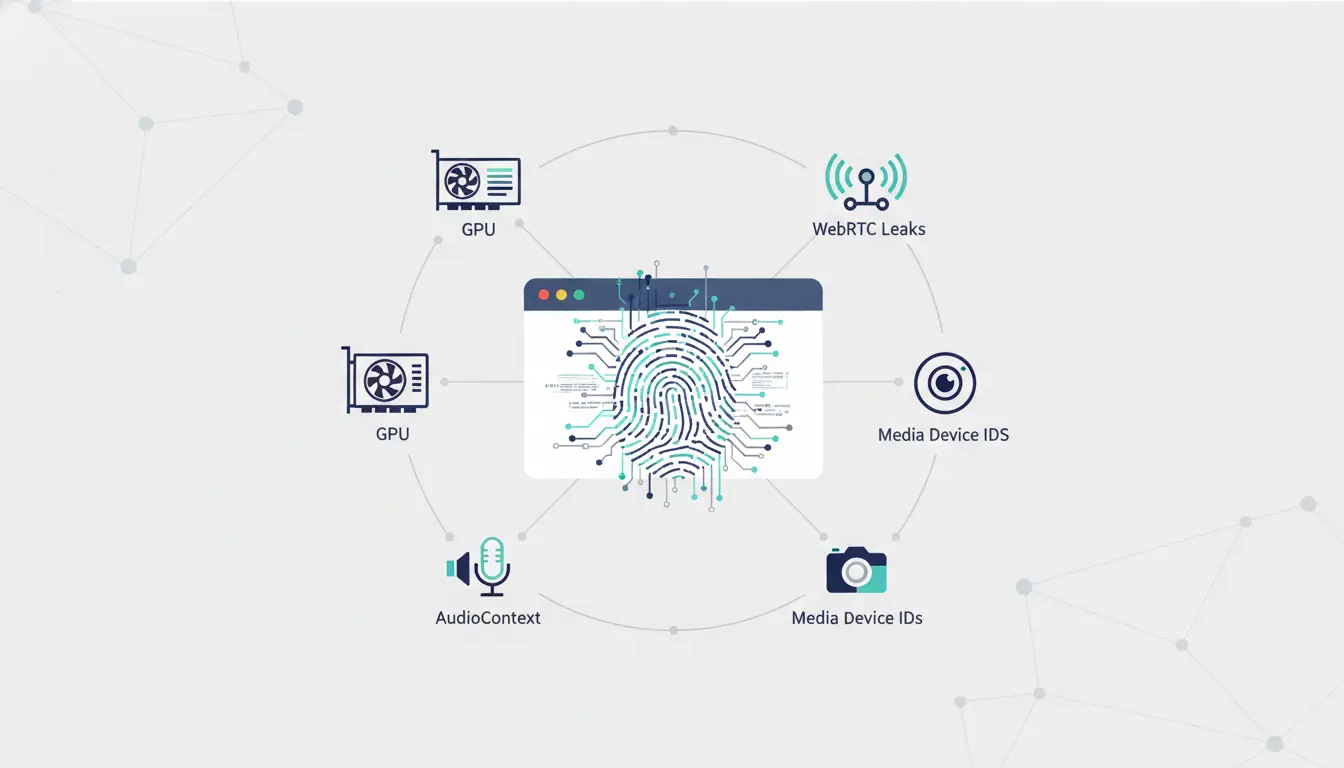
Beyond the IP, Discord utilizes advanced "Browser Fingerprinting." This process involves harvesting granular data points to create a unique ID. Key vectors include:
- Canvas and WebGL Metadata: Analyzing how your GPU renders images to identify hardware specificities.
- AudioContext Fingerprinting: Measuring the subtle variations in how your system processes audio.
- Media Device IDs: Tracking the specific IDs of your microphones, cameras, and speakers.
- WebRTC Leaks: Exploiting vulnerabilities to reveal the real local IP behind a proxy.
Behavioral Heuristics and Pattern Recognition
Automated systems analyze user interaction via behavioral heuristics. These algorithms detect non-human cadences—such as perfectly timed messaging intervals or rapid-fire account switching. To remain undetected, automated operations must simulate human delays and varied interaction paths to avoid triggering these heuristic alarms.
The Critical Difference Between Account and Platform Bans
Distinguishing between localized restrictions and global enforcement is vital for infrastructure planning.
Server-Level Restrictions vs. Global Enforcement
A server-level restriction is a localized action issued by a server owner. This merely prevents access to a specific community. Crucially, server owners do not have access to user IP addresses; this data remains strictly within Discord’s internal systems. Global bans are handled exclusively by Discord’s Trust & Safety team and affect the user’s ability to use the platform entirely.
Account-Specific vs. Network-Wide Identifiers
While an account ban targets a specific login, a network-wide block targets the environment. Discord uses a combination of the IP address and the unique device fingerprint to lock out entire machines. In these scenarios, even creating a new account will lead to an immediate "shadowban" or a secondary block as the backend recognizes the banned hardware signature.
Why Standard Proxy Management Often Fails to Prevent a Discord Ban
Basic privacy tools are insufficient against modern entropy analysis.
Pro Tip: Relying solely on a rotating proxy without addressing the underlying browser fingerprint often leads to immediate account flagging. Discord’s backend uses cross-session linking to associate the new IP with the old, banned device signature.
A significant risk signal is data inconsistency. For example, presenting a US-based residential IP while the system clock, OS language, and WebRTC leak reveal a European hardware environment creates a high-entropy signal. This mismatch is a primary trigger for automated security reviews.
Professional Infrastructure Requirements to Mitigate Discord Ban Risks
Managing high-stakes operations like Airdrop Farming or Ticket Scalping requires technical standards that ensure complete environment isolation.
Complete Browser Profile Isolation
Each account must reside in a dedicated sandbox. This ensures that caches, cookies, and local storage are never shared. Isolation prevents Discord from "linking" accounts via shared data remnants left in the browser's local storage or IndexDB.
Fingerprint Customization and OS Simulation
To blend into organic traffic, one must simulate various environments at the kernel level. This includes mimicking Windows, Mac, iOS, Android, and Linux. This simulation must be deep enough to mask TCP/IP fingerprinting—the method platforms use to guess your OS based on how your network packets are structured.
Advanced Proxy Integration Protocols
Connection integrity is paramount. Professional-grade operations utilize high-quality residential proxies via SOCKS5 or HTTP/HTTPS protocols to ensure the traffic is indistinguishable from a standard home user.
Implementing Scalable Operations with DICloak
DICloak is engineered as a professional-grade solution to address the aforementioned detection vectors, providing a secure, scalable multi-account environment.
Managing Massive Account Volumes on Single Devices
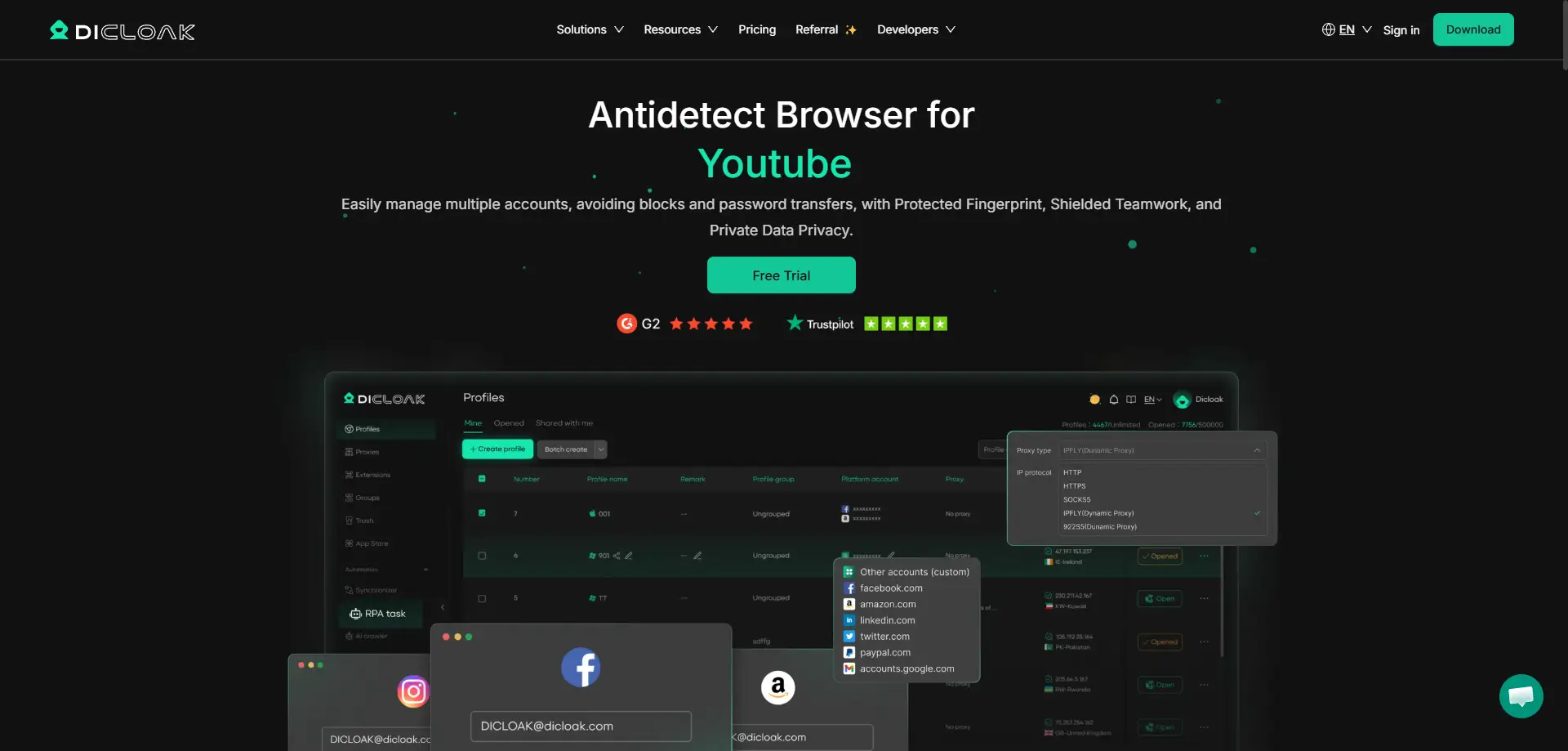
Built on the Chrome core, DICloak allows users to run 1,000+ accounts on a single device. Because it is based on the same engine as the most popular browser, its footprints appear organic to Discord’s detection scripts. It isolates each profile's environment, eliminating hardware overhead while maintaining total security.
Automating Workflows with RPA and Bulk Tools
DICloak’s built-in Robotic Process Automation (RPA) and bulk tools are designed to counter behavioral heuristics. By utilizing synchronizers and RPA, users can automate repetitive tasks across thousands of profiles—such as account farming or social media engagement—while maintaining the human-like cadences necessary to avoid detection.
Team Collaboration and Data Isolation
For growth teams, DICloak provides secure profile sharing and permission settings. This allows teams to collaborate on accounts (e.g., for traffic arbitrage or affiliate marketing) without the risk of account linking, as the browser profile remains consistent regardless of which team member accesses it.
Technical Comparison: Standard Browsing vs. DICloak Infrastructure
| Feature |
Standard Browsing / Basic Proxies |
DICloak Infrastructure |
| Profile Isolation |
Shared cookies and local storage |
Independent, isolated sandbox profiles |
| Fingerprint Control |
Fixed, real hardware signature |
Customizable (Canvas, Audio, WebGL) |
| Browser Engine |
Standard (High Detection) |
Optimized Chrome Core |
| IP Management |
Manual or basic rotation |
Integrated SOCKS5/HTTP Bulk Management |
| Automation |
Manual or basic scripts |
Professional RPA & Synchronizers |
| Hardware Entropy |
Real hardware exposed |
Simulated Kernel-level hardware masks |
| Team Access |
Shared login credentials (High Risk) |
Secure sharing with permission logs |
Objective Analysis of Anti-Detection Tools
Advanced browser technology is a powerful tool for scaling operations, but it requires strategic implementation.
Benefits of Advanced Anti-Detection
- Mitigates Sybil Detection: Essential for Airdrop Farming and Ticket Scalping where account linking is the primary failure point.
- Scalability: Centralizes management for massive Social Media and E-commerce operations.
- Cost Efficiency: Replaces the need for thousands of physical mobile devices or PCs.
Operational Considerations
- Configuration Curve: Success requires a deep understanding of how to configure WebRTC and Media Device masks.
- Proxy Dependency: Even the best browser cannot compensate for a low-quality, blacklisted proxy IP.
- Behavioral Norms: Users must still adhere to platform-specific behaviors; automated tools should always mimic human interaction patterns.
Strategic FAQ Regarding the Discord Ban
Can you get IP banned on Discord?
Yes. However, a "Discord IP Ban" is rarely just an IP block. It is typically a combination of an IP ban and a device fingerprint block. Discord uses this dual-layer approach to ensure that even if you change your IP, your machine remains flagged.
Does Discord ban specific hardware?
Discord does not physically disable your hardware, but they create a unique "hardware signature" based on your components (GPU, CPU, etc.). If this signature is flagged, any account accessed from that machine will likely be restricted.
How do I manage multiple Discord accounts safely?
Use an antidetect solution like DICloak to create isolated environments. Ensure each profile has a unique browser fingerprint (masking WebGL and AudioContext) and is paired with a high-quality residential proxy.
Can a server owner see my IP?
No. Server owners and moderators have no visibility into your IP address or hardware metadata. This data is processed exclusively by Discord’s backend for Trust & Safety enforcement.
Final Summary for Growth Infrastructure Experts
A Discord ban is a multi-dimensional challenge requiring a multi-layered defense. For professionals in traffic arbitrage, affiliate marketing, or airdrop farming, long-term success depends on infrastructure that addresses both the network layer and the browser fingerprint. By utilizing DICloak’s Chrome-based isolation and RPA automation, organizations can achieve the scale necessary for modern digital operations while remaining invisible to Discord's detection heuristics. Successful execution is a matter of professional-grade isolation and "industry practice" fingerprint management.
 Web Proxy Tools
 Free Tools
 Cookie Plugin
 UA Generator
 MAC Address Generator
 IP Generator
 IP Address List
 2FA Code Generator
 World Clock
 Anonymous Check
 WebRTC Leak Test
 UUID Generator
 Free Web Proxy Site
 Proxy Checker
 FB Ad Checker
 AI Web Scraping
 Free SMM Tools
 Twitter Shadowban Checker
 Instagram Name Checker
 UTM Generator
 Username Generator
 AI Hashtag Generator
 LinkedIn Headline Generator
 Social Media Image Resizer