In the hyper-competitive digital landscape of 2026, robust network isolation is no longer optional—it is a foundational requirement for operational integrity. Proxysrape functions as a sophisticated intermediary within this infrastructure, serving as the primary shield that masks a user’s true location and network identity. By routing traffic through an expansive global network, the mechanism of IP spoofing provides the essential layer of IP protection required to operate at scale.
For practitioners engaged in intensive web scraping or high-volume social media management, the reason behind IP rotation is clear: modern platforms monitor request frequency with extreme prejudice. A single IP address sending hundreds of concurrent requests is an immediate red flag, leading to instant rate-limiting or permanent blacklisting. However, as a senior analyst, I must caution that while provides the network layer needed to circumvent these basic blocks, it is merely one component of a broader, more complex security posture.
Why IP Protection Alone Cannot Prevent Account Bans
The industry has evolved past the era where a simple proxy was sufficient for anonymity. Modern security engines now employ digital fingerprinting to profile users with terrifying accuracy. Platforms look far beyond the IP address provided by proxyscrape, analyzing a constellation of telemetry data including device language, screen resolution, persistent cookies, and system time zones. If these variables do not achieve perfect environmental consistency with the network location, the profile is immediately flagged for manual review.
Websites collect deep hardware and software telemetry to generate a unique identity for every visitor. A primary method is Canvas Fingerprinting, which forces the browser to render a hidden image. Because every combination of graphics hardware and driver renders pixels with subtle, distinct variations, the resulting pixel "hash" creates a unique hardware signature. Similarly, WebGL telemetry probes the graphical processing unit's capabilities to refine this profile. For an analyst, these are not just data points; they are the forensic markers that platforms use to de-anonymize your operations.
How Platforms Associate Multiple Profiles
The single greatest point of failure in digital growth infrastructure is passive negligence in browser isolation. Platforms use "account association" logic to link seemingly unrelated accounts. If multiple profiles exhibit identical Canvas hashes or overlapping hardware signatures—even while utilizing different Proxysrape IPs—the platform identifies them as a single entity. When one account in this cluster triggers a policy violation, it initiates a catastrophic chain reaction, resulting in the systematic termination of the entire network.
Evaluating Proxysrape Proxy Types for Different Business Needs
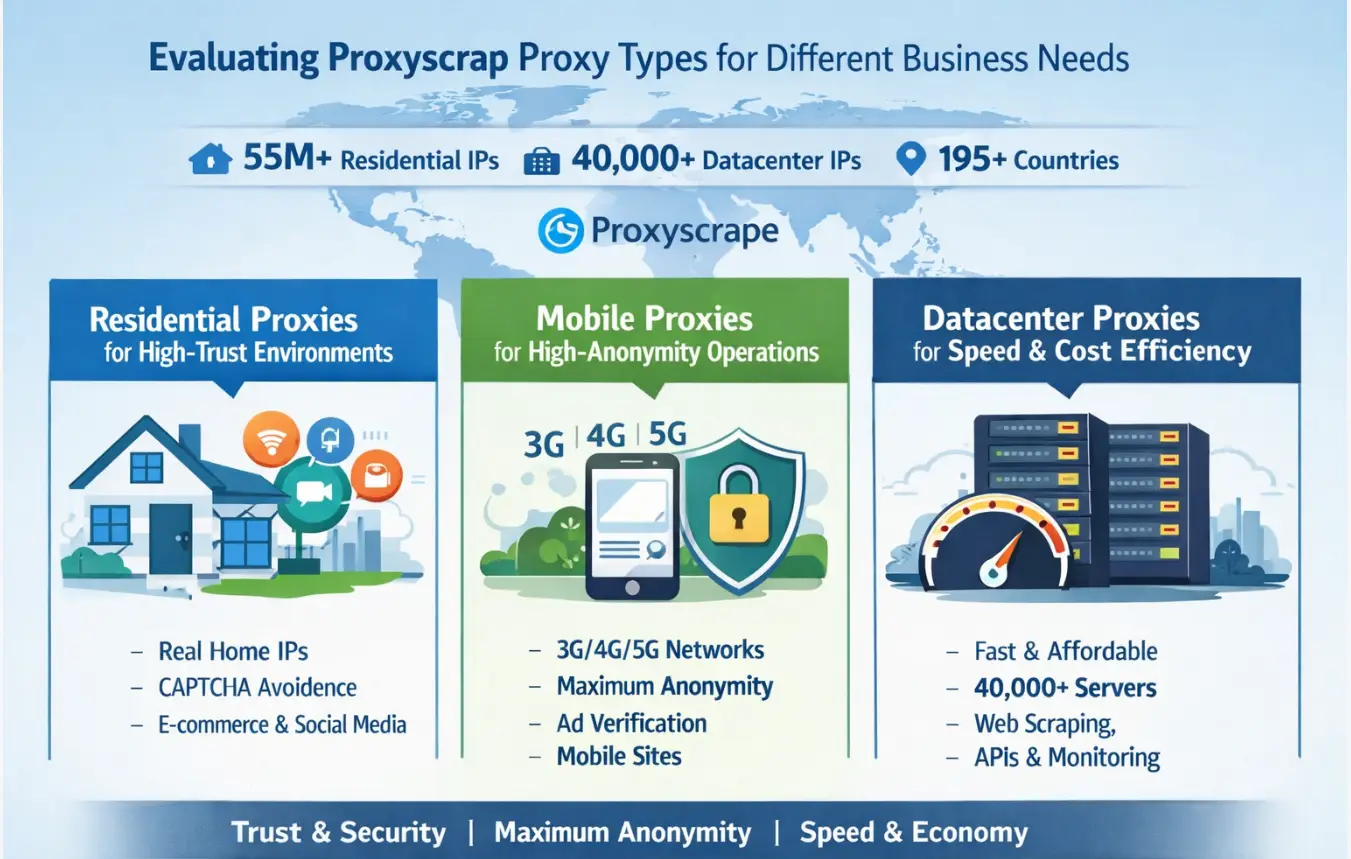
Selecting the correct proxy type is a strategic technical decision. Proxysrape maintains a massive infrastructure of over 55 million residential IPs and 40,000 datacenter addresses across 195 countries to facilitate these varied requirements.
Residential Proxies for High-Trust Environments
Residential proxies utilize IP addresses assigned to real home users by legitimate Internet Service Providers (ISPs). Because these 55 million addresses are ethically sourced with user consent, they carry the highest possible trust scores. This makes them indispensable for managing e-commerce store-fronts or high-value social media accounts where avoiding CAPTCHAs is critical for efficiency.
Mobile Proxies for High-Anonymity Operations
For platforms with the most aggressive anti-bot protections, Proxysrape offers 3G/4G/5G mobile proxies. These provide an elite level of anonymity because mobile operators frequently assign the same IP to thousands of legitimate users simultaneously. Platforms are hesitant to block these IPs for fear of collateral damage to real customers. They are the gold standard for advertising tasks and managing mobile-specific site versions.
Datacenter Proxies for Speed and Cost Efficiency
Datacenter proxies offer high-speed, 99.9% uptime and lower costs but come with the trade-off of higher detection rates by sophisticated security systems. Within a professional infrastructure, these 40,000 US-based addresses are best reserved for public data scraping, price monitoring, or high-load API requests where the target does not employ advanced behavioral profiling.
Operational Scenarios for Integrating Proxysrape with Anti-Detect Browsers
Scaling a digital operation requires an "85/15" strategy: 85% of success is dictated by the methodology of environment isolation, and 15% by the specific actions taken. When managing 50 Facebook Ads accounts, simply rotating the IP via Proxysrape is insufficient. Each profile must exist in a digitally sterile profile to prevent cross-contamination. You can use DICloak to provide with this isolation by ensuring each profile maintains unique local storage and cookies. Furthermore, for account management, one must utilize the "sticky session" feature—offering windows from 3 minutes to 12 hours—to ensure the IP does not change mid-session, which is a common trigger for security checkpoints.
Pro-Tip: To maximize account longevity, strictly avoid the cross-contamination of proxy types. Moving an account from a high-trust residential IP to a datacenter IP within the same lifecycle is a high-risk action that often triggers an immediate security challenge.
Comparative Analysis: Standard Methods vs. DICloak
The following analysis demonstrates the gap between traditional browser setups and a professional-grade integrated solution like DICloak.
| Feature |
Standard Browser + Proxy |
DICloak Integrated Solution (Source B) |
| Fingerprint Isolation |
Shared hardware signatures; high ban risk |
Unique, isolated profiles with custom hardware hashes |
| Account Capacity |
Requires additional hardware; high cost/overhead |
hundreds of accounts managed on a single device |
| Team Collaboration |
Manual credential/IP sharing; high risk |
Advanced permission settings and data isolation |
| Automation (RPA) |
Dependent on external scripts/manual work |
Built-in RPA for automated workflow execution |
| OS Simulation |
Restricted to the host operating system |
Windows, Mac, iOS, Android, and Linux support |
| Action Execution |
Manual, one-by-one execution |
Synchronizer: Execute one action across all windows |
Advanced Security: Isolating Canvas and Hardware Fingerprints
A critical advantage is that you can use DICloak to configure device-level fingerprint parameters within isolated browser profiles. By adjusting Canvas and related fingerprint settings, you can reduce the exposure of your device’s original graphics signature and present a more consistent, natural-looking digital profile instead.
Customizing Fingerprints for Specific Operating Systems
Profile consistency is a key part of staying stable at scale. If a Proxysrape mobile IP suggests a user in London, but your browser signals look like a Windows desktop, many platforms will treat that mismatch as a warning sign. You can use DICloak to align your profile settings through OS and device fingerprint simulation (Windows/macOS/iOS/Android/Linux-like profiles), so details like language, time zone, and OS indicators better match the region your proxy IP represents. This helps keep your profile signals more consistent—from the IP layer to the device and browser attributes—and reduces avoidable “mismatch” flags.
Streamlining Workflows with RPA and Bulk Management Tools
As operations scale, it’s easy for small mistakes to add up. When you’re juggling hundreds of accounts, doing everything by hand can slow the team down and create inconsistent actions across profiles. In many cases, adding some automation is the practical way to scale without hiring one person for every new batch of work.
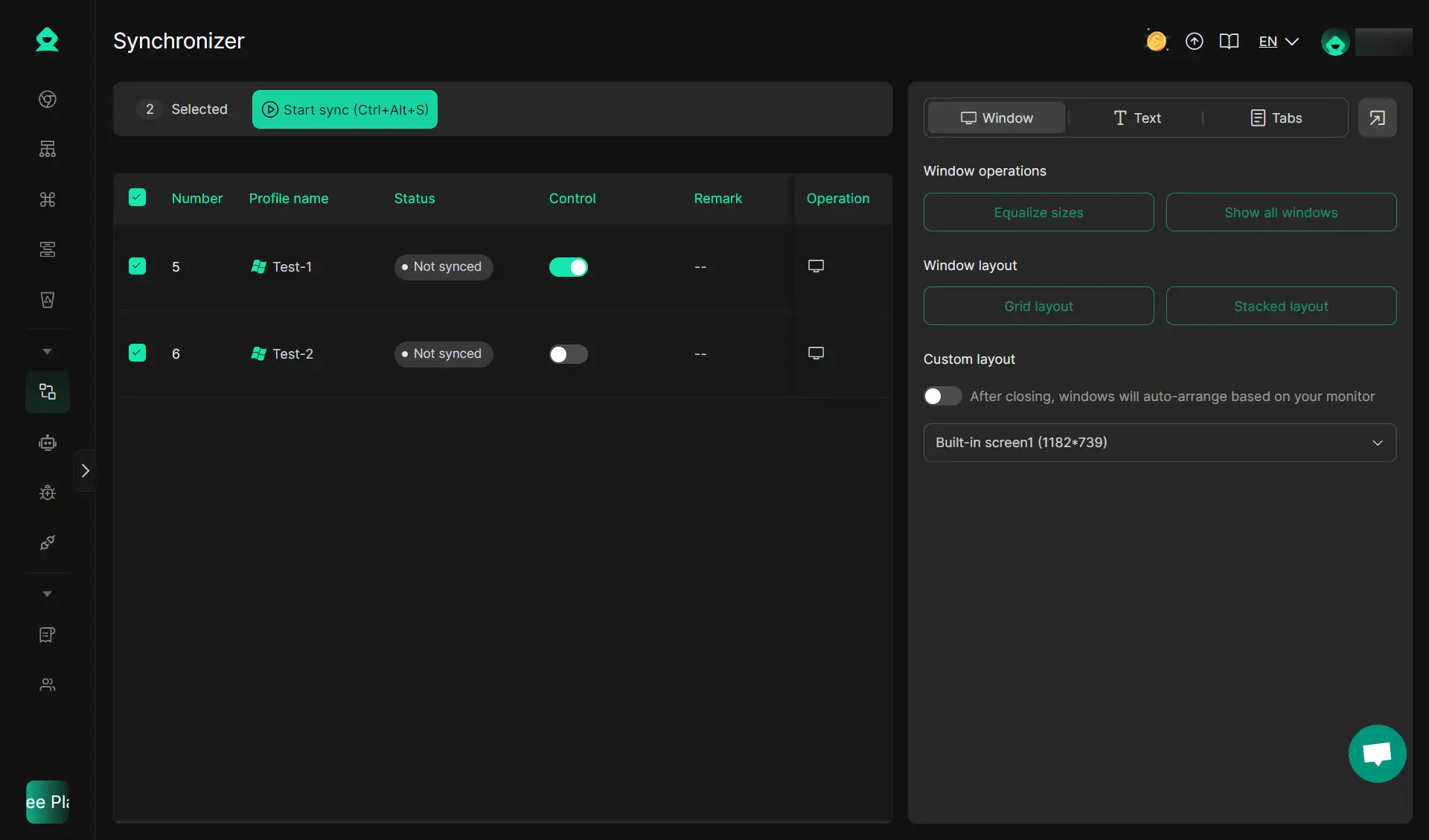
You can use DICloak’s RPA and Synchronizer to reduce repetitive manual steps. With the Synchronizer, you can perform an action in one window—like clicking a button or typing a query—and mirror that action across multiple active profiles, which can make routine workflows much more manageable. Combined with bulk profile creation and batch launching, this setup can help a small team handle large profile sets more consistently, while keeping daily operations organized.
Objective Analysis of DICloak for Professional Use
If you run affiliate marketing campaigns or manage large sets of accounts, you can use DICloak as a structured workspace—but you’ll get the best results only when you deploy it with consistent rules and disciplined operations.
Professional Advantages
- Scalable operations: You can manage large profile sets on a single machine (often hundreds or more, depending on your hardware and workflow), which can reduce the need for extra devices.
- Synchronizer efficiency: You can use the Synchronizer to mirror routine actions across multiple profiles, cutting down repetitive manual work.
- Team control: You can organize collaboration with member permissions and operation logs, which helps teams share access more safely and keep workflows accountable.
Operational Considerations
- Learning curve: To use RPA and the Synchronizer well, you’ll likely need some time to learn the workflow logic and build reliable routines.
- Proxy constraints depend on the provider: Your available protocols and IP options depend on the proxy service and plan you choose (for example, whether IPv6 or specific proxy types are supported).
- Proxy quality matters: Your stability is strongly influenced by proxy quality—low-quality or overused IPs can lead to more verification challenges, blocks, and inconsistent sessions.
FAQs Regarding Proxysrape and Profile Management
Is proxyscraper legal to use for web scraping?
Using proxyscraper itself is legal as it is a proxy service. However, whether your scraping activity is legal depends on what data you collect, whether it is public, and whether your actions comply with platform terms of service and regional data regulations such as GDPR or CFAA-related rulings. The responsibility lies with the user’s operational practices.
Can I use proxyscraper for managing multiple social media accounts?
Yes, proxyscraper can support multi-account management by assigning different IPs to different profiles. However, since platforms also monitor browser fingerprints and device consistency, many professionals use proxyscraper alongside anti-detect browsers to keep both network and browser profiles separated.
Is using a proxy enough for account farming?
Absolutely not. While a proxy masks your network location, it does nothing to hide your browser's hardware fingerprints. Successful account farming requires both high-quality proxies for network isolation and an anti-detect browser like DICloak to provide hardware and software isolation.
What is the difference between sticky and rotating sessions?
Rotating sessions change your IP address with every new request, which is the optimal configuration for web scraping. Sticky sessions maintain the same IP for a set duration, ranging from 3 minutes to 12 hours. Sticky sessions are mandatory for managing accounts on social media or e-commerce platforms to avoid being flagged for "suspicious" location jumping during a single session.
Can I manage a team using these tools?
Yes. If you work in a team, you can use DICloak to keep profiles separated with data isolation and permission settings. As an admin, you can assign specific profiles to specific team members, which helps protect sensitive operational data and reduces the chance of cross-workflow contamination.
 Web Proxy Tools
 Free Tools
 Cookie Plugin
 UA Generator
 MAC Address Generator
 IP Generator
 IP Address List
 2FA Code Generator
 World Clock
 Anonymous Check
 WebRTC Leak Test
 UUID Generator
 Free Web Proxy Site
 Proxy Checker
 FB Ad Checker
 AI Web Scraping
 Free SMM Tools
 Twitter Shadowban Checker
 Instagram Name Checker
 UTM Generator
 Username Generator
 AI Hashtag Generator
 LinkedIn Headline Generator
 Social Media Image Resizer