The 2026 AI market has matured past the hype of "natural-sounding" chatbots and into a brutal era of latency-arbitrage and token-burn optimization. We are no longer evaluating which model writes better poetry; we are calculating inference-scaling costs and debugging autonomous agents that fail because of aggressive security interceptors. While ChatGPT remains the incumbent with its massive ecosystem, DeepSeek has exploited the bloated overhead of ChatGPT’s safety layers to offer a leaner, more aggressive logic engine. For any serious practitioner, the choice between these two is now a strategic calculation of technical resilience versus enterprise stability.
Why is DeepSeek being called the "ChatGPT Killer" for developers?
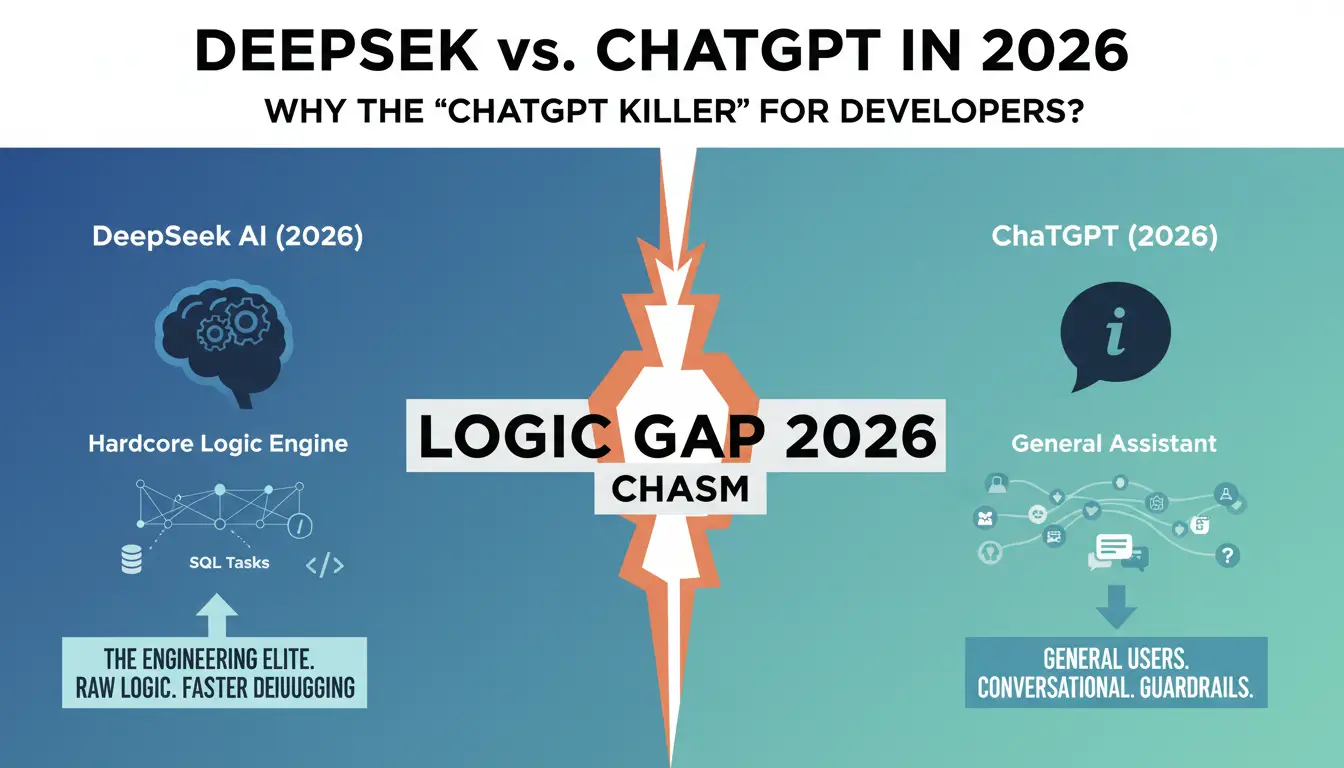
DeepSeek has gained significant ground by catering to the engineering elite who prioritize raw logic over conversational guardrails. In 2026, the gap between a "general assistant" and a "hardcore logic engine" has widened into a chasm.
Analyzing the logic gap in complex coding and SQL tasks
DeepSeek’s dominance in technical workflows stems from its refined Mixture-of-Experts (MoE) architecture, which, by 2026, has been hyper-calibrated for specific SQL standards and complex recursive programming. However, a superior logic engine creates its own set of friction points. When these models generate highly efficient code for live environment testing, they frequently run into 2026-era security barriers. Security services now treat AI-generated SQL commands or malformed data packets as "online attacks." DeepSeek’s ability to generate valid, non-malformed data is its greatest asset, but it also means its output is scrutinized more heavily by site-protection layers that view high-efficiency scripts as bot-driven threats.
The cost-per-token reality in 2026
DeepSeek’s aggressive pricing has forced a massive shift in how we budget for AI agents. However, a skeptical practitioner knows that these low costs often come at the price of rate-limit instability. While ChatGPT offers predictable, albeit expensive, enterprise-grade uptime, DeepSeek's lower cost-per-token is a high-reward, high-risk play. If your workflow requires millions of tokens daily, DeepSeek is the clear winner for your bottom line, provided you have the infrastructure to handle its less transparent data-handling practices and occasional API jitter.
What are the hidden risks of using ChatGPT for automated workflows?
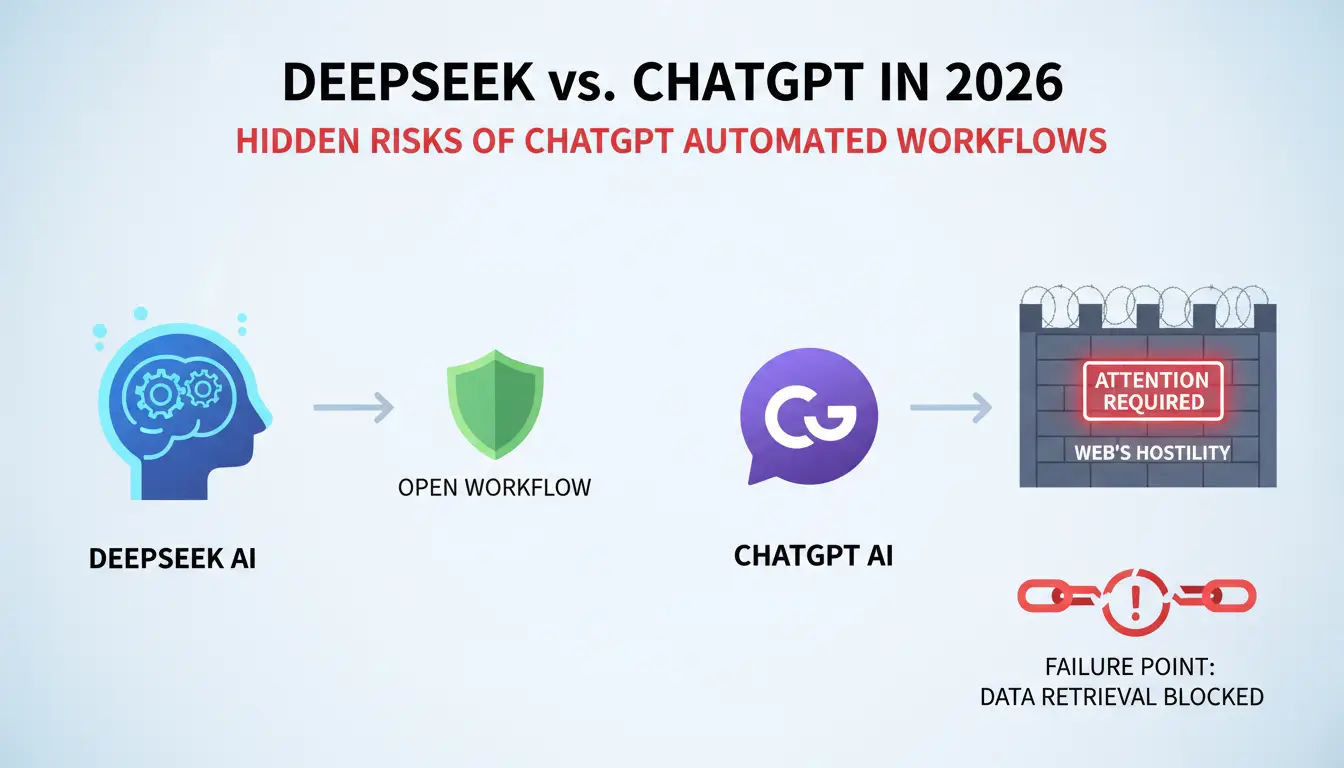
Deploying ChatGPT-driven agents in 2026 is an exercise in navigating "walled garden" security. The primary friction point is no longer the model's intelligence, but the web's hostility toward its traffic patterns.
Dealing with "Attention Required" blocks during data retrieval
A frequent failure point for ChatGPT-based agents is the "Attention Required!" landing page. Modern security services detect the predictable fingerprint of ChatGPT’s data retrieval methods and immediately serve a "Sorry, you have been blocked" message. These blocks are tied to a specific Cloudflare Ray ID and the server’s IP address. If your agent isn't equipped to interpret these headers or log the Ray ID for post-mortem analysis, your automated workflow becomes a black hole of failed requests.
Why security services trigger during AI-driven sessions
In 2026, security layers have evolved to flag LLM-signature phrases or specific system prompt leakage patterns. When an agent submits a "certain word or phrase" that aligns with known AI behavioral templates, the session is killed. Furthermore, many sites now use cookie-less detection to force a "Please enable cookies" loop, a secondary verification layer that standard headless browsers struggle to bypass without manual intervention or sophisticated fingerprinting.
Is DeepSeek's API more resilient for high-frequency requests?
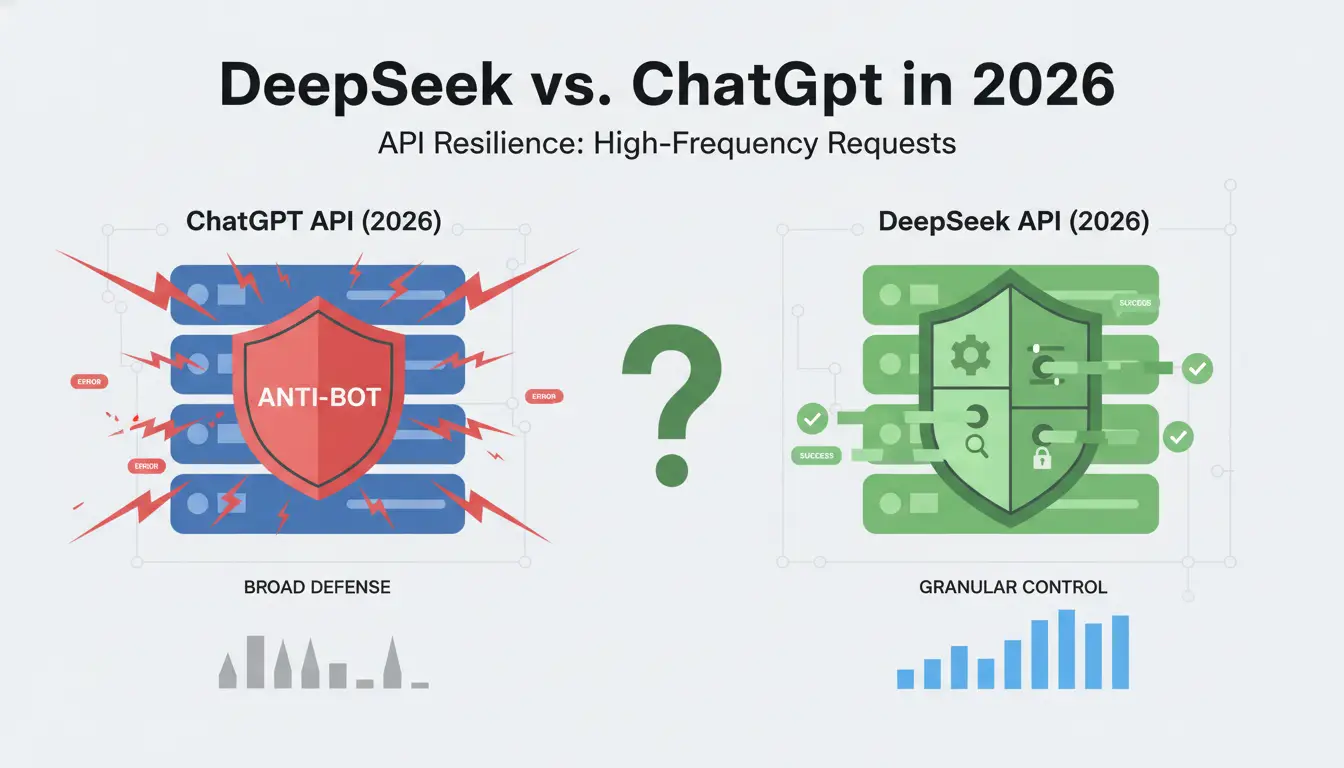
API resilience is the difference between a functional product and a support-ticket nightmare. Both platforms claim high uptime, but their defensive posture varies.
ChatGPT’s API traffic is easily identified by broad-spectrum anti-bot measures. DeepSeek, conversely, offers more granular control over request headers, allowing developers to inject "human-like jitter" and obfuscate the automated nature of the request. This can make DeepSeek’s API more resilient for high-frequency scraping or real-time data monitoring where ChatGPT would likely trigger a site-wide block. However, building 24/7 agents on DeepSeek requires a more robust error-handling stack to manage its more volatile global redundancy.
How does data privacy and censorship vary between these models?
Enterprise-grade security vs. open-source flexibility
ChatGPT has leaned into its role as the "safe" enterprise choice, integrating deeply with corporate security suites. This comes at the cost of flexibility; you are operating within their constraints. DeepSeek offers more deployment options, including open-weight models that allow for local processing—a critical feature for teams that cannot risk their proprietary logic being intercepted by a third-party security service.
Where is your data actually stored in 2026?
Data residency is a minefield. Security services now use "IP Reveal" traps—elements like "Your IP: Click to reveal" that are designed to trick headless browsers into exposing their true origin. If your AI agent’s IP doesn't match the expected regional compliance standards or is flagged as a known data-center IP, the "Attention Required!" block can become permanent.
What are the biggest mistakes when switching from ChatGPT to DeepSeek?
The most common error is assuming prompt parity. A prompt calibrated for ChatGPT's safety-first logic will often produce malformed data when processed by DeepSeek’s leaner engine. For example, DeepSeek may include markdown backticks inside a raw SQL query, which a live database will reject, triggering a security block for an "attack-like" phrase.
What to check before you migrate:
- Validate Ray ID logging: Ensure your stack logs the Cloudflare Ray ID from every 403 error to debug which "malformed data" triggered the block.
- Syntax recalibration: Test all SQL and code-generation prompts for raw output integrity; avoid backtick leakage.
- Cookie-handling logic: Modern sites require cookies to be active to bypass initial security handshakes; verify your agent can maintain session state.
- IP Reputation: Confirm that the IP range used by your provider isn't pre-flagged by major security services as a bot-origin.
How to scale your AI accounts without getting blocked by security services?
Scaling AI automation in 2026 requires a Security Abstraction Layer. If you run multiple accounts from a single environment, you are essentially painting a target on your back. Security services look for "unusual activity" by linking browser cookies and digital fingerprints.
DICloak serves as a valuable bridge between your AI’s logic and the web’s defensive layers. It supports practitioners in maintaining isolated, high-integrity environments.
DICloak Practical Features:
- Multi-account Isolation: Strategists use DICloak to help reduce the risk of platforms linking multiple research accounts. Each account operates in a distinct environment, which is designed to help mitigate "online attack" flags caused by cross-account fingerprinting.
- Fingerprint Customization: DICloak supports fingerprint customization, which can help agents appear as legitimate users rather than bot-driven scripts, potentially assisting in navigating cookie-based verification challenges that standard headless Chrome instances might encounter.
- Custom Proxy Configuration: Some security pages may show the IP address of your current browser session. In DICloak, you can configure your own proxy for each browser profile. This helps keep different profiles in separate and more consistent network environments for account management, testing, and daily browsing.
- Team Collaboration: DICloak supports secure sharing of browser profiles with team members. This is designed to help reduce "unusual activity" blocks that might occur when an account is accessed from multiple global coordinates simultaneously.
The final verdict: Which should you invest in for 2026?
The 2026 landscape demands interoperability. The most resilient stacks use both models as a hybrid solution.
Choose ChatGPT if:
- You need high-level enterprise support and a "walled garden" that handles its own baseline security.
- Your workflow prioritizes complex natural language nuances over raw technical execution.
- A polished mobile interface is a non-negotiable requirement for your field team.
Choose DeepSeek if:
- Your primary goal is high-volume SQL generation, logic-heavy coding, and technical automation.
- You need to maximize token-burn efficiency and minimize cost-per-request.
- You require a flexible API that can be tuned to help navigate aggressive security interceptors.
FAQ
Why do I keep getting blocked by Cloudflare when using AI agents?
Security services identify your agent's activity as a potential online attack. Triggers include "malformed data" (like backticks in SQL), specific LLM-signature phrases, or the use of data-center IPs that fail the "IP Reveal" honeypot.
Is DeepSeek really cheaper than ChatGPT in 2026?
Yes, but with a caveat. While the cost-per-token is lower, you must factor in the engineering overhead required to manage its rate-limit instability and calibrate prompts to avoid malformed output.
Can I use both models simultaneously in one project?
This is the 2026 standard. Use ChatGPT for user-facing synthesis and DeepSeek for the back-end logic-heavy lifting.
What should I do if I get the "Attention Required!" block while using an AI browser?
Log the Cloudflare Ray ID (e.g., 9fa9520fd8036cc2) and examine the action you were performing. Identify if a "certain word or phrase" in your prompt triggered the block, and then leverage DICloak's proxy integration capabilities to help manage your IP and clear compromised cookies.
Which model is better for non-English programming languages?
DeepSeek’s MoE architecture provides a slight edge in 2026 for non-English logic, as it is less constrained by the Western-centric safety tuning found in ChatGPT.
Does ChatGPT still have a better mobile app experience?
Unquestionably. DeepSeek remains a developer-first tool, while ChatGPT has maintained the lead in mobile accessibility and cross-device synchronization.
 Web Proxy Tools
 Free Tools
 Cookie Plugin
 UA Generator
 MAC Address Generator
 IP Generator
 IP Address List
 2FA Code Generator
 World Clock
 Anonymous Check
 WebRTC Leak Test
 UUID Generator
 Free Web Proxy Site
 Proxy Checker
 FB Ad Checker
 AI Web Scraping
 Free SMM Tools
 Twitter Shadowban Checker
 Instagram Name Checker
 UTM Generator
 Username Generator
 AI Hashtag Generator
 LinkedIn Headline Generator
 Social Media Image Resizer