- ResourcesOnline Tools



EN

For e-commerce professionals and affiliate marketers, a restriction on platform access is a critical failure point that threatens revenue streams and operational stability. In the current digital landscape, platforms like Facebook Marketplace employ aggressive security heuristics to monitor user behavior and enforce compliance. Regaining control requires more than a simple appeal; it necessitates a dual-pronged approach involving immediate tactical recovery and long-term digital infrastructure hardening. As a Senior Digital Infrastructure Strategist, the objective is to move beyond temporary fixes toward a resilient, isolated environment that withstands the most advanced algorithmic scrutiny.
Platform restrictions are rarely the result of isolated events. Instead, they are typically triggered by "Suspicious Activity" detection mechanisms rooted in heuristic analysis. These algorithms identify correlation attacks—patterns across multiple data points that deviate from standard human behavior.
Commonly observed risk patterns include:
When a restriction occurs, it is essential to follow a structured appeal process to demonstrate compliance while maintaining technical hygiene.
Expert Warning: Do not attempt to create a new account on the same device immediately following a ban. Platforms utilize persistent storage, including Flash cookies and local storage persistence, to link new accounts to restricted hardware. Creating a secondary account on the same machine will result in an instantaneous secondary restriction, effectively "burning" your new assets.
Modern platforms track users far beyond simple IP addresses. They utilize browser fingerprinting to create a unique hardware profile of your device, enabling them to link multiple accounts to a single identity.
Websites query the browser to collect granular data, including GPU glsl shaders, media device IDs, font enumeration, and MAC address hashing. This process, known as Canvas fingerprinting, creates a digital signature based on how your hardware renders graphical elements. If multiple accounts share the same signature, they are associated in the platform’s database, making them vulnerable to "chain bans." Mitigating this requires a strategy of digital footprint attenuation, where each account is granted its own unique hardware identity.
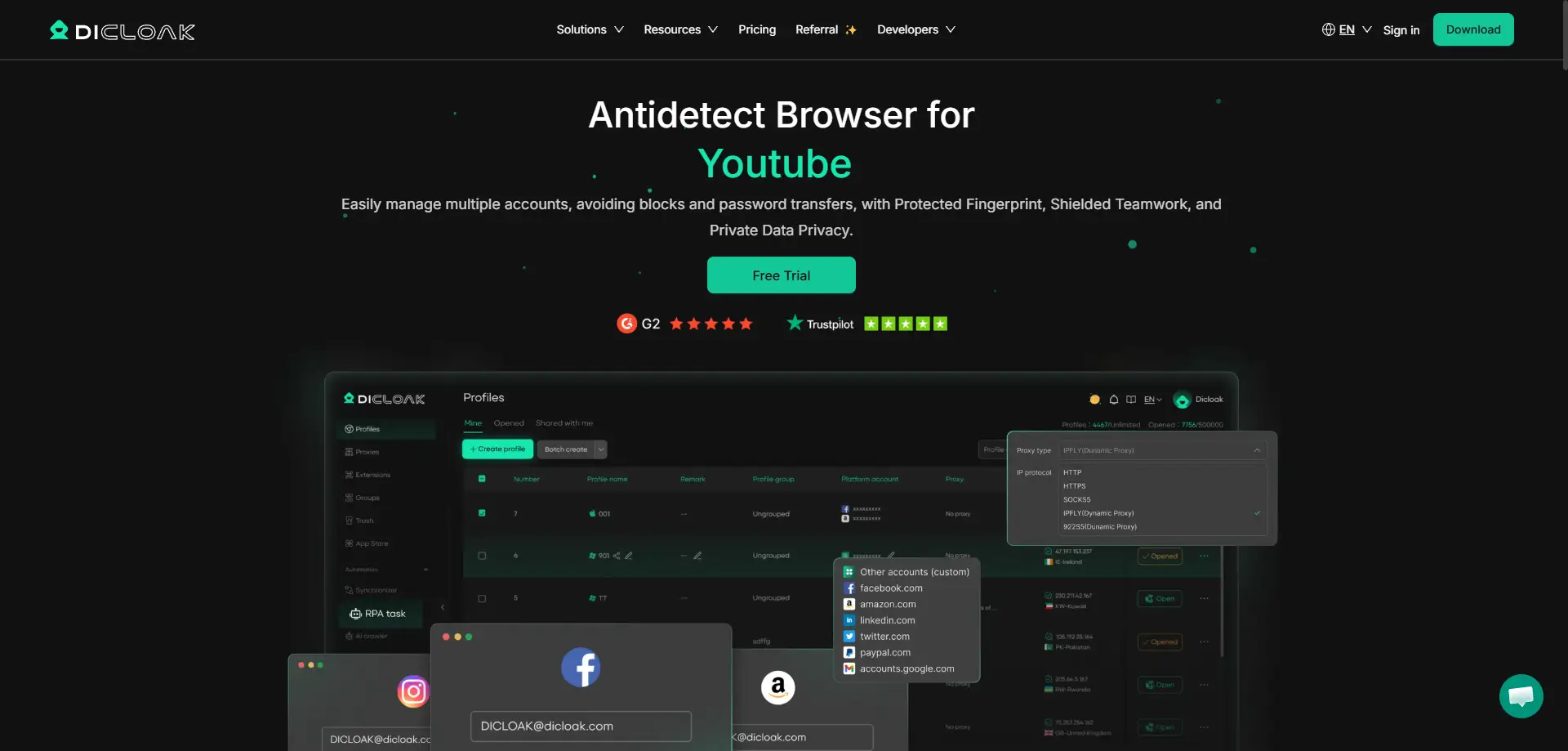
To manage a fleet of accounts successfully, the environment must simulate distinct operating systems. By utilizing advanced browser technology like DICloak, professionals can modify the User-Agent and underlying API returns to match the entropy of genuine devices. Simulating Windows, Mac, iOS, Android, and Linux prevents platforms from linking a high volume of accounts to a single machine type—a common red flag for account farming.
Resiliency in high-stakes e-commerce is built through isolation. Each account must exist within a "Digital Silo" where cookies, cache, and hardware signatures are never shared between sessions.
Effective isolation requires the integration of specific network protocols to mask your physical location and avoid detection via association.
| Feature | Standard Browser (Chrome/Safari) | DICloak Antidetect |
|---|---|---|
| Foundation | Standard Webkit/Blink | Chrome-core base |
| Account Isolation | Shared cookies and local storage | Completely isolated "Digital Silos" |
| Fingerprint Customization | Static/Standardized | Full control of GPU, Fonts, and Media IDs |
| Synchronizer Support | No | Synchronizer for multi-window control |
| OS Simulation | Limited to host machine | Windows, Mac, iOS, Android, Linux |
| Bulk Operations | Manual only | One-click profile creation and launch |
Scaling to manage 1,000+ accounts introduces the risk of human error and internal data leaks. Operational security at this level requires centralized control over decentralized execution.
Infrastructure such as DICloak allows for advanced team management through profile sharing and permission settings. This allows team leaders to assign accounts to members without exposing sensitive credentials, ensuring that data is isolated and the risk of cross-contamination is minimized. Detailed operation logs provide an audit trail to identify the specific actions that might lead to a restriction.
Manual management often leads to erratic activity, such as high-speed clicking, which triggers "bot" flags. DICloak’s built-in Robotic Process Automation (RPA) allows for the automation of repetitive tasks, ensuring account activity mimics natural human intervals. Furthermore, the Synchronizer feature allows a single operator to control multiple browser windows simultaneously, ensuring consistency across a large-scale fleet while maintaining individual account isolation.
To maintain operational continuity, implement the following checklist:
The Pros and Cons of Antidetect Technology:
Pro-Tip: Always match your browser profile’s time zone and language settings to the specific location of your proxy. Geolocation mismatches between the IP and the browser's internal clock are primary triggers for automated security reviews.
The duration is determined by the severity of the infraction. Some restrictions are temporary, lasting from a few days to several weeks. However, industry practice suggests that frequent temporary bans often precede a permanent restriction.
Yes. Serious offenses or repeated violations of platform policies can result in a permanent loss of Marketplace privileges. In these cases, regaining access to the original account is unlikely, necessitating the transition to a new, isolated infrastructure.
Algorithmic errors are common. In these instances, a polite, evidence-based appeal through the Help Center—backed by transaction records—may help mitigate the risk and restore access.
Operational security in the e-commerce sector requires a sophisticated technical foundation. By combining platform compliance with technical isolation tools like DICloak, professionals can protect their digital assets from aggressive automated detection. For those looking to scale safely and manage 1,000+ accounts without the risk of hardware-based association, implementing isolated profiles, RPA, and OS simulation is the industry standard. To explore scalable multi-account management solutions and secure your operational future, visit the DICloak website.