Understanding the Mechanics to See Facebook Account Without Logging In
Social media platform accessibility remains bifurcated between public data and authenticated silos. As a standard industry practice, Facebook maintains a strict "log in to continue" authentication wall for private profiles, closed groups, and stories. However, public business pages and posts with global privacy settings remain accessible via unauthenticated sessions.
The primary challenge for the cybersecurity professional is not the wall itself, but the persistent tracking mechanisms that monitor unauthenticated visitors. Even without a logged-in session, the platform aggregates "identity signals" to de-anonymize traffic. These signals include IP addresses, browser fingerprints, and hardware identifiers. It is commonly observed that platforms utilize these data points to build shadow profiles of visitors, often linking disparate browsing sessions back to a single device or network through hardware entropy analysis.
Real-World Use Cases for Anonymous Platform Access
Operational requirements for anonymous access typically fall into three risk-sensitive categories, each necessitating a specific strategy for infrastructure isolation:
- Candidate Research for HR Professionals: An HR analyst utilizes an isolated browser profile configured with a simulated iOS fingerprint and a residential IP matching the candidate’s locale. This workflow allows the recruiter to verify a candidate's public activity without triggering the "People You May Know" algorithm, which could otherwise alert the candidate to the analyst’s personal or corporate identity.
- Competitive Intelligence for Marketers: A marketing intelligence team deploys multiple profiles to monitor competitor ad transparency libraries and public event engagement. By maintaining environment isolation, they prevent competitors from identifying corporate IP ranges in their visitor analytics, thereby protecting strategic intent.
- Investigative Journalism: Reporters investigating public-interest stories use sandboxed environments to review public profile data and community groups. This prevents their professional identity from being compromised by tracking pixels that follow users across the web, ensuring the safety of the investigator and the integrity of the lead.
The Technical Barriers: How Platforms Track Unauthenticated Research
Modern platforms do not rely solely on cookies. They employ sophisticated "identity signals" that bypass traditional privacy settings.
The Impact of Canvas and WebGL Fingerprinting
Canvas and WebGL fingerprinting are hardware-level tracking techniques that exploit the unique way a device's graphics card renders images and text. This rendering process produces a signature based on the specific hardware, drivers, and OS version. Because this signature is derived from physical hardware characteristics, it creates a "Global Unique Identifier" (GUID) that remains constant even if a user clears their browser history. In professional research, failing to randomize these hardware signatures leads to immediate session linking.

Identity Isolation through Individual Profile Cookies
Platforms use cross-site tracking and embedded pixels to build a profile of unauthenticated users. Tracking only fails when there is zero cross-pollination between the local OS hardware identifiers and the browser’s presented environment. Standard browsers inherently leak these signals. Therefore, true isolation requires a system where the "cookie jar" and the browser’s digital fingerprint are entirely unique and unlinked from the host machine’s actual hardware signature.
Traditional Methods and Why They Fail
Commonly observed user approaches often fail because they lack the technical depth required to mitigate modern tracking.
- Incognito/Private Mode: This mode only protects local history. It does nothing to mask the IP address or prevent hardware-level fingerprinting. To the platform, an incognito user still presents a recognizable GUID.
- Headless Browsers: While industry practice often involves headless browsers for scraping to reduce system resource consumption, these are easily detected by advanced bot-mitigation scripts unless they are specifically modified to simulate real user behavior.
- Basic Proxy Management: Simple proxies mask the IP but do nothing to address the hardware-level data leaking through the browser.
Pro-Tip: Security Warning for "Anonymous Viewer" Sites Digital infrastructure architects strongly advise against the use of "anonymous viewer" websites. These platforms are frequently observed as vectors for phishing and session hijacking. Because they require a gateway to the platform, they often expose the researcher's local network to malware. No third-party site can bypass internal authentication walls; those claiming to do so are high-risk security threats.
Advanced Strategies to See Facebook Account Without Logging In Safely
To achieve a reliable level of anonymity, professionals utilize antidetect technology to ensure infrastructure isolation and hardware randomization.
Integrating Residential Proxies for Geographical Consistency
Subnet isolation is critical. High-quality residential proxies provide IPs from actual home users rather than data centers. Using a residential IP that matches the target profile’s region may help mitigate security flags. Professionals ensure that the proxy’s geolocation, time zone, and WebRTC data align perfectly with the browser’s presented profile to avoid "mismatch" triggers.
Simulating Mobile Environments for App-Level Visibility
In 2026, the digital landscape is mobile-first. Platforms often serve different content layouts or data to mobile OS visitors. By simulating an iOS or Android operating system on a desktop device, researchers can access mobile-specific perspectives. This practice involves not just changing the User-Agent, but simulating the unique hardware signatures associated with mobile chipsets.
Implementing a Scalable Infrastructure with DICloak
For organizations requiring scalable research without the risk of account linking, DICloak provides an enterprise-grade solution based on the Chrome core. This ensures that every profile is indistinguishable from a standard, legitimate user.
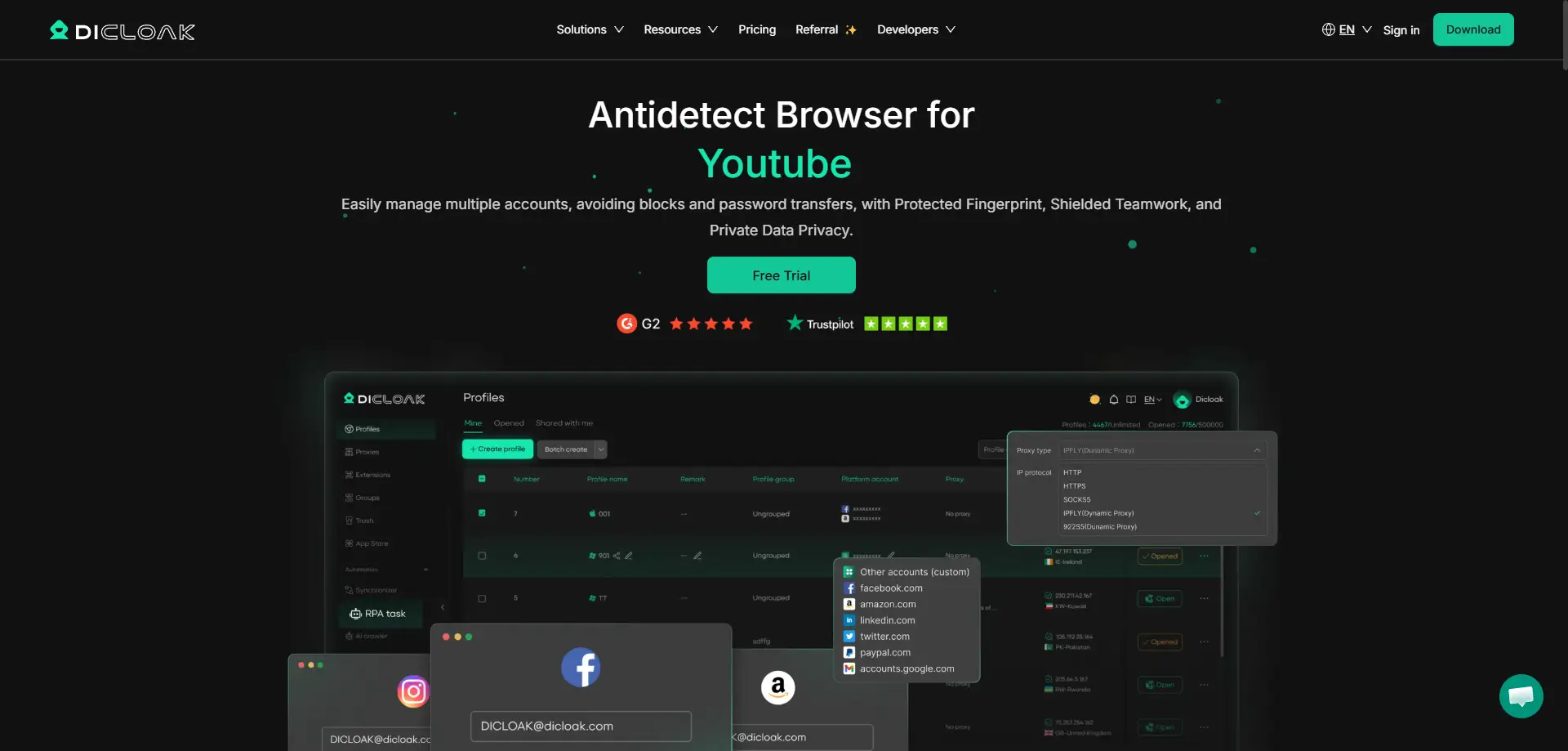
Standard Browsing Methods vs. DICloak Infrastructure
| Feature |
Standard Browser |
DICloak Infrastructure |
| IP Isolation |
Shared/Local IP |
Configuring Individual Proxy per Profile |
| Fingerprint Randomization |
Fixed/Leaked |
Fully Customizable (Canvas, WebGL, Audio) |
| Multi-account Safety |
High Risk (Hardware GUID) |
Complete Profile Isolation |
| OS Simulation |
Local OS Only |
Windows, Mac, iOS, Android, Linux |
| RPA/Automation Capabilities |
None |
Built-in RPA & AI Quick Actions |
| Scaling Toolset |
Manual |
Bulk Import, One-Click Launch, Synchronizer |
Scaling Research Workflows via RPA and Synchronizers
DICloak incorporates a "Synchronizer" tool, which is essential for managing multiple profiles simultaneously. This allows a single operator to mirror actions across hundreds of profiles in real-time. Additionally, the built-in RPA (Robotic Process Automation) and AI-driven automation allow for the transformation of text prompts into automated action sequences, significantly reducing the manual overhead required for large-scale data gathering.
Team-Based Permissions and Data Isolation
Professional agencies require granular control. DICloak’s infrastructure supports team-based permissions, allowing leads to share profiles without exposing underlying credentials. Operation logs and data isolation ensure that research conducted by one team member does not compromise the security or anonymity of the broader organizational infrastructure.
Strategic Operational Scenarios for Multi-Account Teams
Large-scale operations, such as market research or reputation management, often require managing over 1,000 isolated profiles on a single device. DICloak enables this by optimizing system resources through its Chrome-core architecture and bulk management tools.
Pros of Professional Infrastructure Isolation:
- Reduced Hardware Overhead: Managing 1,000+ profiles on one machine eliminates the need for vast physical device farms.
- Elimination of Account Linking: Fingerprint randomization prevents "cascading bans" where one flagged account leads to the termination of all others on the network.
- Automation Efficiency: RPA saves thousands of man-hours by handling repetitive navigational tasks.
Cons of Professional Infrastructure Isolation:
- Technical Entry Barrier: Requires knowledge of proxy protocols and fingerprint settings.
- Proxy Maintenance: The necessity of maintaining high-quality residential proxy pools to prevent subnet flagging and ensure high-speed performance.
Pro-Tip: Consistency in Proxy Protocols To maximize session persistence and minimize detection, do not mix different proxy protocols (e.g., HTTP and SOCKS5) within the same operational workflow. Maintaining protocol consistency within a profile is a standard industry practice to ensure the connection appears stable to the platform's security monitors.
Frequently Asked Questions about Browsing Without Authentication
Can I see private profiles without an account?
No. Content designated as "Private" or "Friends Only" is protected by an internal authentication wall. Attempting to bypass this using "viewer tools" is a primary risk vector for session hijacking and local network intrusion.
Is it possible to view Stories anonymously?
Facebook Stories require an authenticated session for delivery. Because the platform tracks view-logs for account owners, these are not served to unauthenticated visitors. To view these anonymously, professionals use isolated, non-identifiable research profiles.
How does an antidetect browser differ from a standard browser?
A standard browser transmits your actual hardware entropy and GUID. An antidetect browser like DICloak masks these via hardware-level randomization, providing each session with a unique, isolated digital identity. This ensures that even if the platform tracks the session, it cannot link it to your real identity or other research profiles.
 Web Proxy Tools
 Free Tools
 Cookie Plugin
 UA Generator
 MAC Address Generator
 IP Generator
 IP Address List
 2FA Code Generator
 World Clock
 Anonymous Check
 WebRTC Leak Test
 UUID Generator
 Free Web Proxy Site
 Proxy Checker
 FB Ad Checker
 AI Web Scraping
 Free SMM Tools
 Twitter Shadowban Checker
 Instagram Name Checker
 UTM Generator
 Username Generator
 AI Hashtag Generator
 LinkedIn Headline Generator
 Social Media Image Resizer