Why Modern Platforms Demand Antidetect Browsers for Anti-Fingerprinting
In 2026, running a business with multiple accounts on a standard browser is a guaranteed way to lose revenue. Platforms like Meta, Amazon, and Google have evolved far beyond simple tracking. They now use artificial intelligence to link and ban accounts that share even the smallest details. This hostile environment is exactly why Antidetect browsers for Anti-Fingerprinting are now mandatory infrastructure, not just optional tools. Without them, you expose your entire operation to immediate suspension.
The Fall of IP-Based Security and the Rise of Sybil Detection
Years ago, you could simply switch your IP address to look like a new user. Today, that strategy fails 100% of the time. Modern security systems use "Sybil detection" to find networks of fake identities.
They do not just look at your connection. They scan your hardware. They check your screen resolution, installed fonts, battery status, and even your graphics card driver (WebGL Renderer). If you log into five different accounts using the same computer, the hardware "fingerprint" stays the same. The platform sees this match and instantly flags all five accounts as suspicious. To survive, you must replace your real hardware data with unique, digital fingerprints for every single profile.
Behavioral Biometrics: How Platforms Track Typing Speed and Mouse Curvature
Hardware is only half the battle. Platforms now track how you interact with their websites. This technology is called behavioral biometrics.
Security algorithms record thousands of data points per session:
- Typing Cadence: How fast you type and the rhythm between keystrokes.
- Mouse Curvature: Whether your mouse moves in a perfect straight line (bot-like) or a natural curve (human-like).
- Touch Events: On mobile, they measure the angle and pressure of your tap.
If your staff pastes text too quickly or moves the mouse the exact same way across fifty accounts, the system detects a pattern. Advanced antidetect browsers now inject "human noise" into these actions to trick these sensors.
The Financial Impact of Cross-Contamination on Multi-Account Fleets
The ultimate threat to multi-accounting revenue is the "chain ban." This occurs when a platform links your healthy accounts to a banned one.
Imagine you run 50 ad accounts. If you make one mistake—like leaking a WebRTC IP address—on just one profile, the platform can link that error back to your device fingerprint. Once they find the link, they do not just ban one account; they ban all 50.
In 2026, a chain ban does not just mean losing a login. It means losing weeks of "warming up" data, thousands of dollars in ad credit, and your entire cash flow. The financial risk is total devastation. You must use tools that guarantee total isolation to protect your assets from these account bans.
How Advanced Antidetect Browsers for Anti-Fingerprinting Restore Privacy
To stop chain bans and protect your revenue, you need to change your digital DNA. This is where Antidetect browsers for Anti-Fingerprinting become essential infrastructure. These tools do more than just hide your IP address. They build a complete, verified digital identity for every single account you manage.
By controlling every data point your computer sends, these browsers act as a shield. They separate your real hardware from the platform's tracking sensors. This allows one physical computer to appear as fifty distinct, unrelated devices to security algorithms.
Profile Isolation and Sandbox Architecture
The primary defense mechanism in these tools is browser profile isolation. Standard browsers like Chrome or Safari store all your cookies, cache, and history in one shared folder. If you log into five different accounts in the same browser, the platform can easily link them because they share this local storage.
Antidetect browsers solve this using a "Sandbox" approach. Every profile you create acts as a completely separate digital container.
- Separate Storage: Each profile has its own cookies and local storage. Data from Profile A cannot touch Profile B.
- Process Isolation: The browser runs each session independently. Even if one tab crashes or gets flagged, it does not affect the others.
- Leak Protection: Advanced tools prevent WebRTC leaks, which often reveal your real local IP address even behind a proxy.
This architecture ensures that if one account is banned, the damage stops there. The "toxic" data remains trapped in that specific sandbox, saving your other accounts from a chain ban.
Intelligent Vector Masking vs. Generic Noise Injection
In the past, privacy tools used a method called "Canvas Noise." They added random invisible pixels to your screen readout to confuse trackers. In 2026, this strategy is dangerous. Modern security AI knows that real graphics cards do not make random errors. If your browser "lies" poorly, the platform flags it as a bot immediately.
Top-tier software now uses Intelligent Vector Masking. instead of adding random noise, the software uses fingerprint emulation based on real-world data.
- Database Matching: The browser pulls a fingerprint from a database of real, valid user sessions.
- Consistency Checks: It ensures all parts of the fingerprint match. If you claim to be on an iPhone, the software ensures your screen resolution, font list, and battery API all match a real iPhone.
- Natural Blending: Your profile hides in plain sight by looking exactly like thousands of other legitimate users.
This approach passes the platform's "consistency check." You are not just hiding; you are mimicking a trusted user.
Mobile Fingerprint Emulation: Mimicking Android and iOS Touch APIs
Desktop traffic is becoming less trusted by major platforms like TikTok and Instagram. They prefer mobile users. However, you cannot simply change your browser setting to "Android" while using a mouse on a Windows PC. The platform will detect that you are clicking instead of tapping, and they will ban you.
Advanced Antidetect browsers for Anti-Fingerprinting now simulate the entire mobile environment.
- Touch Events: They convert your mouse clicks into touch API events. The server sees a "tap" or a "swipe" instead of a mouse click.
- Hardware Sensors: The browser feeds fake data for battery life, screen orientation (gyroscope), and accelerometer movements.
- Processor Masking: The software masks your PC's Intel or AMD chip to look like a mobile ARM processor (like a Snapdragon or Apple A-series chip).
For tasks like Crypto Airdrop farming or mobile-first advertising, this deep emulation is the only way to prove you are a human user on a physical phone.
Top 10 Antidetect Browsers for Anti-Fingerprinting Reviewed for 2026
In 2026, your choice of software determines your revenue stability. We have tested the market leaders against our "Relay" criteria: TLS fingerprinting consistency, mobile emulation, and team scalability. A simple IP change is no longer enough. You need full profile isolation to prevent chain bans.
Below is our breakdown of the Antidetect browsers for Anti-Fingerprinting that passed our tests. These are the 2026 browser reviews you need to read before investing in your infrastructure. Here is the best antidetect software to protect your business assets.
| Browser |
Best Use Case |
Starting Price |
Free Plan? |
| DICloak |
Enterprise Multi-Accounting |
$8/mo |
Yes |
| Multilogin |
Premium TLS Compliance |
€99/mo |
No |
| GoLogin |
Remote Cloud Teams |
$49/mo |
No |
| Browser.lol |
Disposable Sessions |
$9/mo |
Yes |
| Octo Browser |
High-Speed Performance |
€29/mo |
No |
| MoreLogin |
Mobile Cloud Phones |
$9/mo |
Yes |
| Hidemium |
Crypto Automation |
Custom |
No |
| BitBrowser |
Low-Cost E-commerce |
$10/mo |
Yes |
| Undetectable |
Hybrid Local/Cloud |
$49/mo |
Yes |
| Hidemyacc |
Affiliate Marketing |
$29/mo |
No |
DICloak: Isolated Environments for Enterprise Multi-Accounting
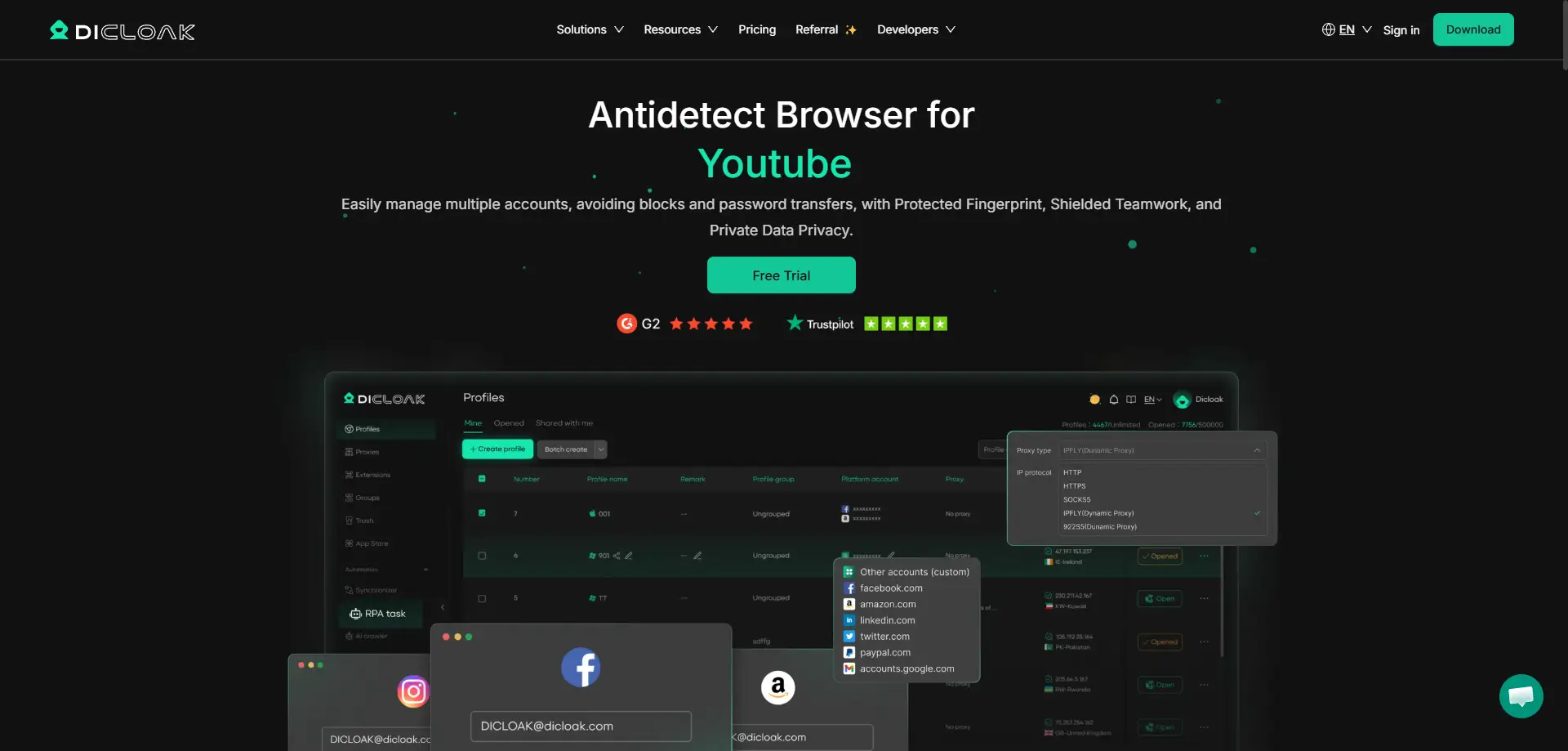
DICloak is the premier choice for businesses that cannot afford downtime. It focuses on "pure isolation." This means every profile you create acts as a completely separate digital device. It is built for teams that need to scale operations without triggering chain bans on sensitive platforms like Meta or Amazon.
Key Features:
- True Profile Isolation: Prevents data leaks between accounts effectively.
- Built-in RPA: You can automate repetitive tasks, like account warm-up, without writing code.
- Team Collaboration: Share profiles with staff safely without revealing passwords.
- Advanced Fingerprint Customization: Gives you deep control over hardware parameters.
Pricing:
- Free: $0/mo (5 Profiles).
- Base: $8/mo.
- Plus: $28.8/mo (Includes RPA bots).
- Share+: $138/mo (Unlimited team members).
Pros:
- Strong protection against chain bans.
- Affordable entry price for startups.
- No-code automation saves hours of manual work.
Cons:
- Advanced automation features have a slight learning curve.
Verdict: DICloak is the best antidetect software for 2026. It balances enterprise-grade security with accessible pricing. If you manage high-value assets, this is your safest bet.
Multilogin: The Premium Standard for TLS JA4 Compliance
Multilogin was one of the first tools to solve the TLS Fingerprinting issue. They use two custom browsers, Mimic and Stealthfox, to replace Chrome and Firefox cores. This ensures your data packets look exactly like a regular user's traffic.
Key Features:
- Native Browser Cores: Mimic and Stealthfox significantly reduce detection rates.
- Automation API: Supports Selenium and Playwright for developers.
- Team Roles: Granular control over who accesses which profile.
Pricing:
- Pro 10: €9/mo (Limited features).
- Pro 100: €79/mo.
- Business: €159/mo.
Pros:
- High success rate on strict platforms.
- Excellent documentation and support.
Cons:
- Significantly more expensive than competitors.
- No permanent free plan.
Verdict: If budget is not an issue, Multilogin delivers top-tier performance. It is ideal for large agencies that need guaranteed uptime.
GoLogin: Cloud-Based Versatility for Decentralized Teams
GoLogin shines when your team is distributed globally. Unlike tools that rely on your local machine, GoLogin offers strong cloud integration. It even features a functional Android app, allowing you to manage profiles directly from your phone.
Key Features:
- Cloud Launch: Run profiles on their servers, not just your PC.
- Android App: Manage accounts on the go.
- Free Proxies: Includes some free traffic for testing purposes.
Pricing:
- Professional: $49/mo (50 Profiles).
- Business: $119/mo (300 Profiles).
- Enterprise: $199/mo (1,000 Profiles).
Pros:
- Great for remote and decentralized teams.
- Mobile app provides unique flexibility.
Cons:
- Free proxies can be slow.
- Interface may lag during heavy usage.
Verdict: GoLogin is perfect for remote teams. If you need to access your farm from different devices, this is a strong contender.
Browser.lol: Disposable Sessions for High-Speed Arbitrage
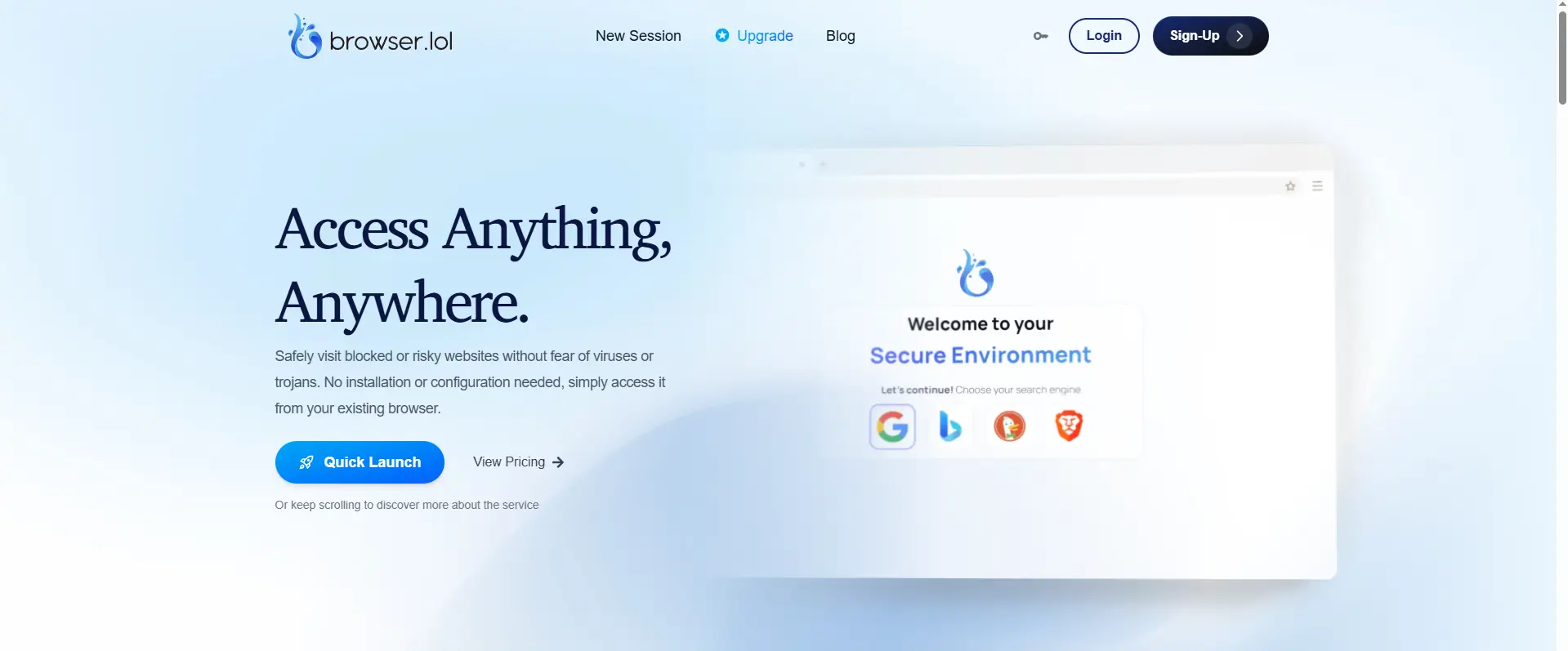
Sometimes you do not need a permanent profile. You just need a quick, disposable identity. Browser.lol provides instant virtual browsers in the cloud. It is excellent for checking how ads appear in different regions without setting up a complex profile.
Key Features:
- No Installation: Runs entirely in your web browser.
- Instant Sandbox: Sessions are destroyed immediately after use.
- Global Locations: Spin up a browser in different countries instantly.
Pricing:
- Free: Basic features.
- Premium: $9/mo.
- Lifetime: $24 one-time fee.
Pros:
- Extremely fast and lightweight.
- Zero footprint on your local machine.
Cons:
- Not suitable for long-term account farming.
- Limited customization options.
Verdict: Best for ad verification and quick testing. It is a utility tool rather than full business infrastructure.
Octo Browser: High-Performance Kernel Customization for Power Users
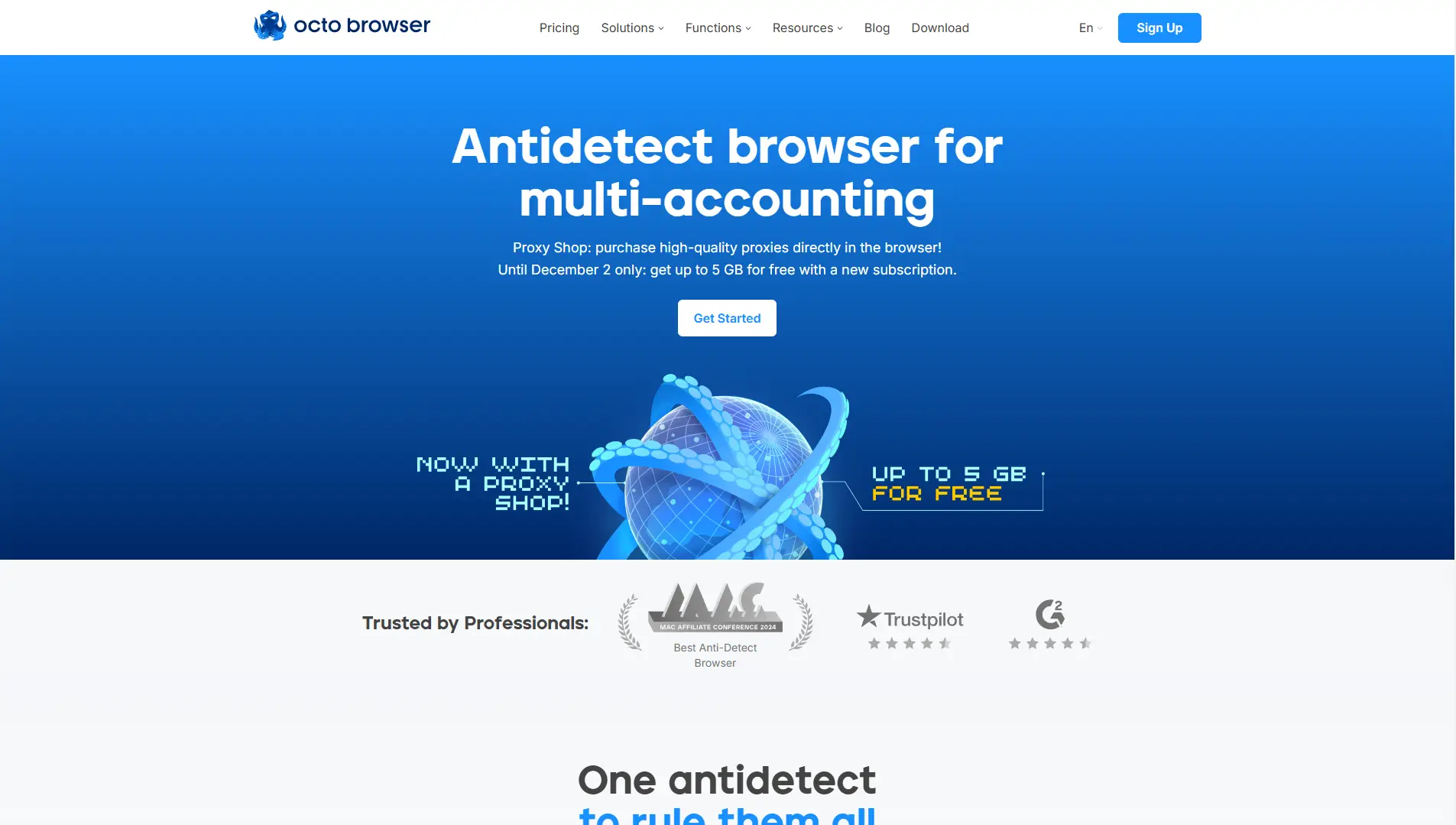
Octo Browser is built for speed. It uses a highly optimized Chromium kernel that mimics real devices effectively. It is popular among affiliate marketers who need to run hundreds of profiles simultaneously without crashing their computers.
Key Features:
- Real Device Fingerprints: Uses data from actual systems.
- Tag Management: Organizes thousands of profiles easily.
- API-First Design: Great for custom scripts.
Pricing:
- Lite: €10/mo.
- Starter: €29/mo.
- Base: €79/mo.
Pros:
- Fast and stable with many open tabs.
- Strong support for European markets.
Cons:
- The interface can be overwhelming for beginners.
- Pricing scales up quickly.
Verdict: A solid choice for power users who understand technical configurations. It handles high volume well.
MoreLogin: Leading the Market with 'Cloud Phone' Emulation
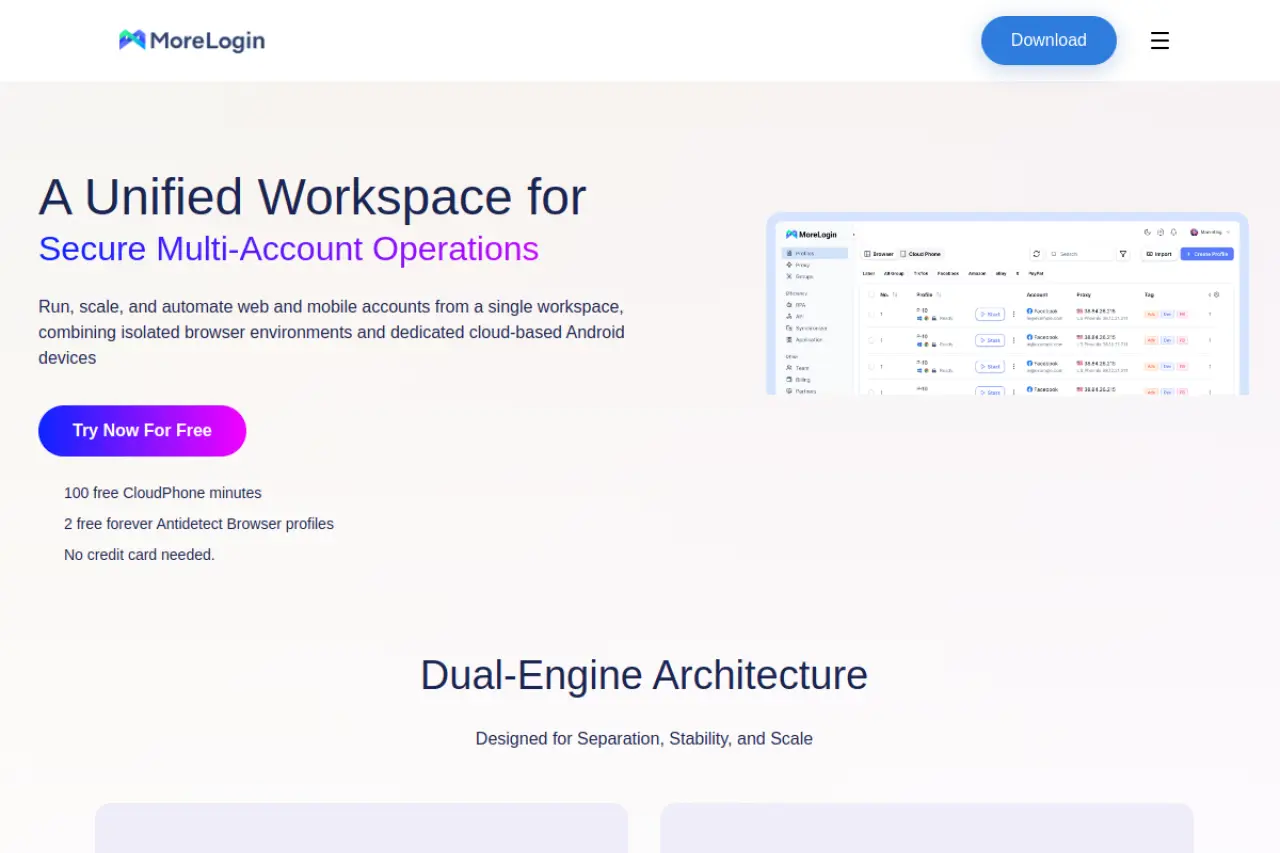
Mobile traffic is often trusted more than desktop traffic. MoreLogin specializes in this by offering "Cloud Phones." These are not just mobile user agents; they are virtualized Android environments.
Key Features:
- Cloud Phone: Real Android system emulation.
- Synchronizer: Control multiple profiles with one mouse.
- Anti-Canvas Fingerprinting: Advanced masking technology.
Pricing:
- Free: 2 Profiles.
- Pro: Starts at $9/mo.
Pros:
- Best for TikTok and Instagram automation.
- Very affordable starting price.
Cons:
- Cloud phone usage can lag on slow connections.
Verdict: If your business relies on mobile apps like TikTok, MoreLogin is essential. It provides the mobile footprint you need.
Hidemium: Automation-Centric Workflows for Crypto Airdrop Farming

Hidemium is designed for the grinder. It focuses heavily on automation support for crypto airdrops and whitelist grinding. It offers both cloud and local storage options, giving you flexibility in how you manage your data.
Key Features:
- Mobile and PC Emulation: Covers all device types.
- Batch Creation: Create 100 profiles in minutes.
- Automation Support: Native support for Puppeteer and Selenium.
Pricing:
- Cloud/Local/Custom: Pricing varies based on usage.
Pros:
- Excellent for bulk account creation.
- Flexible data storage options.
Cons:
- Pricing structure can be complex.
- Smaller community than Multilogin.
Verdict: A top pick for crypto farmers who need to automate thousands of actions across many wallets.
BitBrowser: Cost-Effective Scaling for E-commerce Micro-Sellers
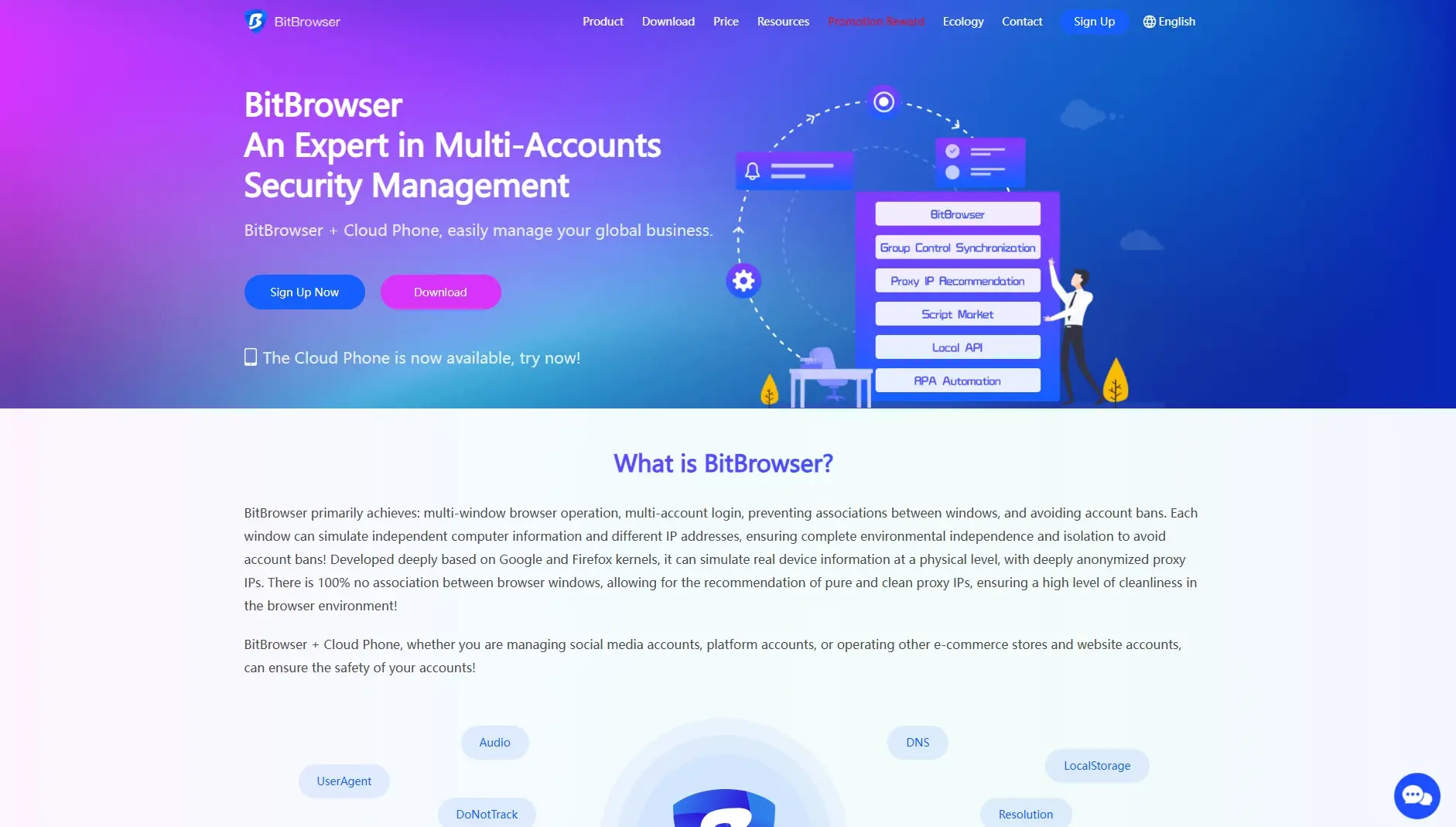
BitBrowser is the budget leader. It offers a generous free plan and very low-cost paid tiers. It is widely used by smaller e-commerce sellers on platforms like eBay and Etsy who need to separate a few accounts without high overheads.
Key Features:
- Group Control: Sync actions across windows.
- Extension Support: Easy Chrome extension installation.
- RPA Automation: Basic automation included.
Pricing:
- Free: 10 Profiles.
- Base: $10/mo (50 Profiles).
Pros:
- Unbeatable price.
- Simple interface for beginners.
Cons:
- Security features are less advanced than DICloak.
- Support can be slower.
Verdict: The best entry-level tool. If you are just starting and have a tight budget, BitBrowser gets the job done.
Undetectable: Hybrid Local/Cloud Flexibility for Large Operations
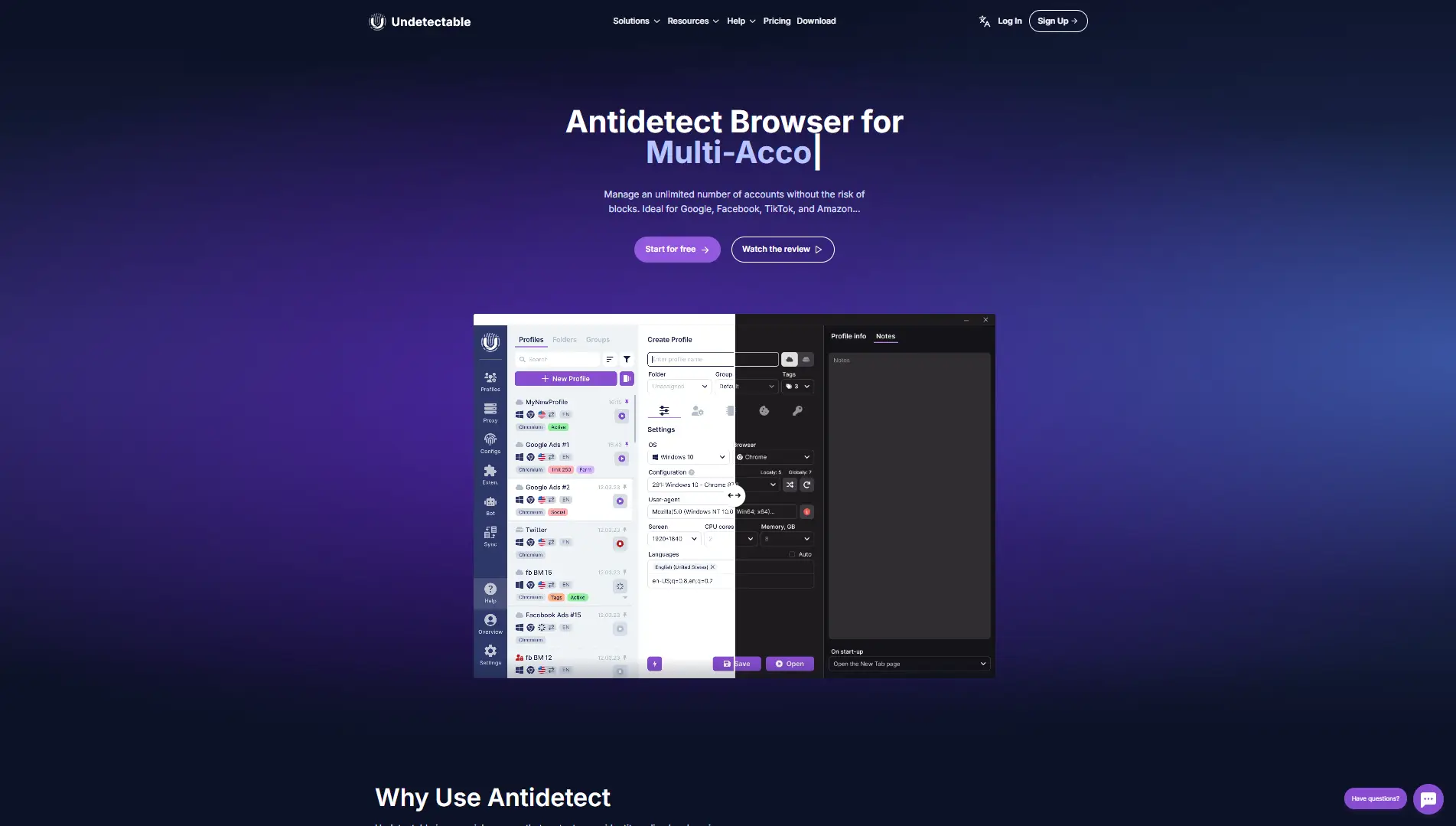
Undetectable offers a unique hybrid model. You can store profiles in the cloud for team access or keep them local for maximum speed and privacy. This flexibility is great for agencies that have strict data handling policies.
Key Features:
- Local & Cloud Storage: You choose where data lives.
- Cookie Bot: Automatically warms up accounts.
- Mass Creation: Bulk tools for large fleets.
Pricing:
- Free: 5 Cloud Profiles.
- Base: $49/mo.
- Professional: $99/mo.
Pros:
- Local profiles load instantly.
- Unlimited local profiles on paid plans.
Cons:
- Cloud storage limits are stricter than others.
Verdict: Great for teams that want the speed of local hosting with the option to sync via the cloud.
Hidemyacc: Precision Identity Management for Affiliate Marketers
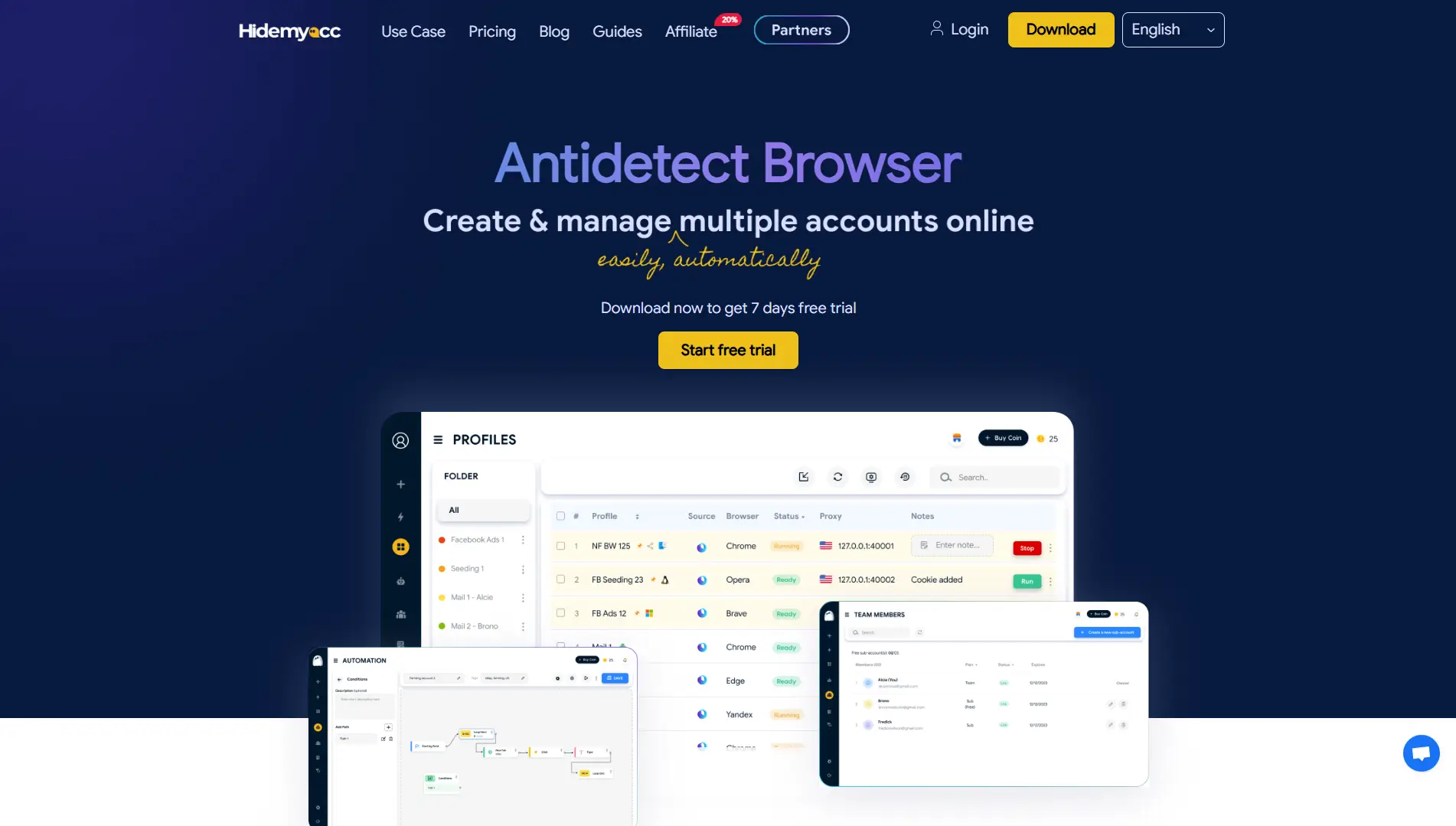
Hidemyacc focuses on simplicity and effectiveness for affiliate marketers. It uses a "Magic Link" feature that allows you to transfer a browser profile to a buyer or team member instantly without sharing login credentials.
Key Features:
- Magic Link: Transfer profiles easily.
- Auto-Scripts: Free automation for Facebook and Amazon.
- Canvas Fingerprinting: Reliable masking technology.
Pricing:
- Mini: $10/mo.
- Starter: $29/mo.
- Base: $49/mo.
Pros:
- Very user-friendly.
- Built-in scripts save time.
Cons:
- Fewer advanced developer features.
Verdict: Ideal for affiliate marketers who buy and sell accounts. The transfer features make handovers seamless.
FAQ regarding Antidetect Browsers for Anti-Fingerprinting
Investing in Antidetect browsers for Anti-Fingerprinting FAQ requires understanding how these tools protect your revenue. Many business owners hesitate because they fear technical complexity or account bans. This section resolves the most common multi-accounting questions and operational concerns we see in 2026.
Do I still need a separate proxy with an antidetect browser?
Yes, this is non-negotiable for security. An antidetect browser spoofs your device fingerprint (hardware and software data), but it does not hide your IP address. If you run 50 accounts from a single IP, platforms will flag them immediately. You must pair every browser profile with a high-quality residential proxy to ensure full anonymity.
Can I share browser profiles with virtual assistants without being banned?
Absolutely, provided you use an enterprise-grade tool like DICloak. These browsers sync the entire digital session—including cookies, tabs, and fingerprints—to the cloud. When your VA accesses the profile, the website sees the exact same "device" and session, preventing "Suspicious Login" triggers or security checklists.
What is the difference between canvas noise and intelligent vector masking?
Old-school "Canvas Noise" adds random errors to your graphics readout, which modern AI fraud systems now easily detect as fake. Intelligent Vector Masking is the superior standard for 2026. It ensures your graphics output matches real, common hardware configurations perfectly, allowing your accounts to hide in plain sight among legitimate users.
 Web Proxy Tools
 Free Tools
 Cookie Plugin
 UA Generator
 MAC Address Generator
 IP Generator
 IP Address List
 2FA Code Generator
 World Clock
 Anonymous Check
 WebRTC Leak Test
 UUID Generator
 Free Web Proxy Site
 Proxy Checker
 FB Ad Checker
 AI Web Scraping
 Free SMM Tools
 Twitter Shadowban Checker
 Instagram Name Checker
 UTM Generator
 Username Generator
 AI Hashtag Generator
 LinkedIn Headline Generator
 Social Media Image Resizer