Have you ever wondered if your collection could be more than just a hobby? It's not a daydream but a way you can try. Finding the right platform to turn your passion into a paycheck is crucial. In this article, we will discover the legitimacy of Whatnot, a live-commerce platform for sellers. Learn about fees, scaling strategies, and how to succeed in this dynamic marketplace.
Is Whatnot Legit for New Sellers?
Whatnot is a legitimate, US-based live shopping platform that has fundamentally restructured the e-commerce landscape since its inception in 2019. Backed by significant venture capital investment, the platform provides a high-security profile for real-time video commerce, operating as a hybrid between a high-energy auction house and a social marketplace.
From a risk management perspective, Whatnot's legitimacy is underscored by its expansion from a niche focus on collectibles (Funko Pops and Pokémon cards) into over 250 categories, including high-value sectors like vintage clothing, luxury jewelry, and electronics. For new sellers, the platform offers a dual-revenue stream: high-urgency live auctions and static, fixed-price marketplace listings. While the infrastructure is robust, the "legitimacy" of individual transactions often depends on seller integrity, which the platform mitigates through internal review systems and historical rating data.

Is Whatnot Legit for High-Volume Flipping?
For professional resellers, Whatnot serves as a primary destination for "flipping" strategies—researching high-demand trends, sourcing inventory at low cost via clearance or garage sales, and reselling to a captive, high-energy audience.
The transition from hobbyist to professional requires a strategic shift toward niche specialization. Consider a hobbyist selling off a personal Pokémon collection; upon realizing the higher margins in the "Coins & Money" category (which carries a lower 4% commission), they may choose to scale into a multi-category enterprise. To do this legitimately without triggering account association flags, the professional must architect an infrastructure that treats their "Numismatics" store and "Funko" store as entirely separate digital entities. This allows for scaling into a full-time business, as evidenced by case studies like reseller Becky Park, who generated $5,501.25 in sales and $2,727.24 in net profit over a mere 10-day experimental period.
Is Whatnot Legit Regarding Seller Fees and Payouts?
A critical component of assessing platform legitimacy is the transparency of the financial architecture. Whatnot’s fee structure for US, Canadian, and Australian sellers is competitive but requires precise calculation to maintain margins:
- Commission Fee: A flat 8% commission on the final sale price.
- Reduced Category Commissions: Specific high-volume categories like Coins & Money (4%) and Electronics (5%) offer lower rates to incentivize professional liquidation.
- Payment Processing Fee: 2.9% + $0.30 per transaction. It is vital to note that this is calculated on the gross total (including item price, shipping costs, and taxes), a detail often misunderstood by novice sellers.
Payouts are processed via Stripe and typically become available for withdrawal 48–72 hours after the delivery of the item is confirmed, ensuring a steady cash flow for scaling operations.
Six Methods to Generate Revenue
To scale beyond a single stream, professional sellers utilize a multi-faceted revenue model:
- Live Shopping Auctions: Generating competitive bidding profiles to drive prices above traditional marketplace averages.
- Marketplace "Buy It Now" Listings: Establishing a "passive" storefront that generates sales 24/7, even when the seller is offline.
- Sourcing and Flipping: Exploiting price inefficiencies between local physical markets and Whatnot’s global audience.
- Niche Following: Establishing "Expert" status in a category to foster community trust and repeat buyers.
- Giveaways for Engagement: While the seller absorbs the shipping costs, giveaways are a strategic loss-leader used to acquire followers and boost the algorithm's viewership metrics.
- Joint Shows and Collaboration: Actively networking with other sellers for cross-promotions and shared live streams to tap into established audiences.
Is Whatnot Legit When Operating at Scale?
As a business moves into high-volume territory, it encounters Whatnot’s "One Seller Account" policy. While the platform permits up to eight buyer accounts, selling permissions are strictly limited to one identity. Operating multiple niche-specific storefronts from a single device or unshielded IP address triggers "Checkpoints"—risk-engine flags that identify account association.
Analyst Warning: Managing multiple seller identities without professional Network Isolation or browser fingerprint obfuscation leads to immediate account termination. Security engines detect identical digital signatures across supposedly "separate" logins.
Professional scaling requires a strategy that isolates each account's digital identity to ensure the platform views them as unique, unrelated users.
Browser Fingerprinting and Account Association
Platform security (often powered by third-party risk engines) identifies users through fingerprinting, a collection of technical signals that form a unique ID.
Security scripts use the browser's Canvas API to force the GPU to render hidden images. Because every hardware/driver combination renders pixels slightly differently, the resulting "Canvas Hash" serves as a hardware-level serial number. Even if you change your IP, the hardware remains the same, linking your accounts.
Digital Identity and OS Simulation
Detection engines look for inconsistency. For instance, if a browser's User Agent claims the device is "Windows," but the JavaScript Runtime reveals font rendering or emojis specific to "MacOS," the account is flagged for spoofing. True isolation requires simulating a consistent Operating System profile (Windows, Mac) that aligns with the fingerprint.
Using a standard data center IP is a red flag for bot detection. Professionals utilize "residential proxies" to maintain distinct regional identities. This level of Network Isolation ensures that each store profile appears to be originating from a legitimate household connection, preventing the mass-banning of associated accounts.
Is Whatnot Legit for Automated Workflows?
To manage these technical hurdles, professionals use antidetect browsers like DICloak to facilitate secure, multi-account scaling.
Isolating profiles with DICloak Profiles
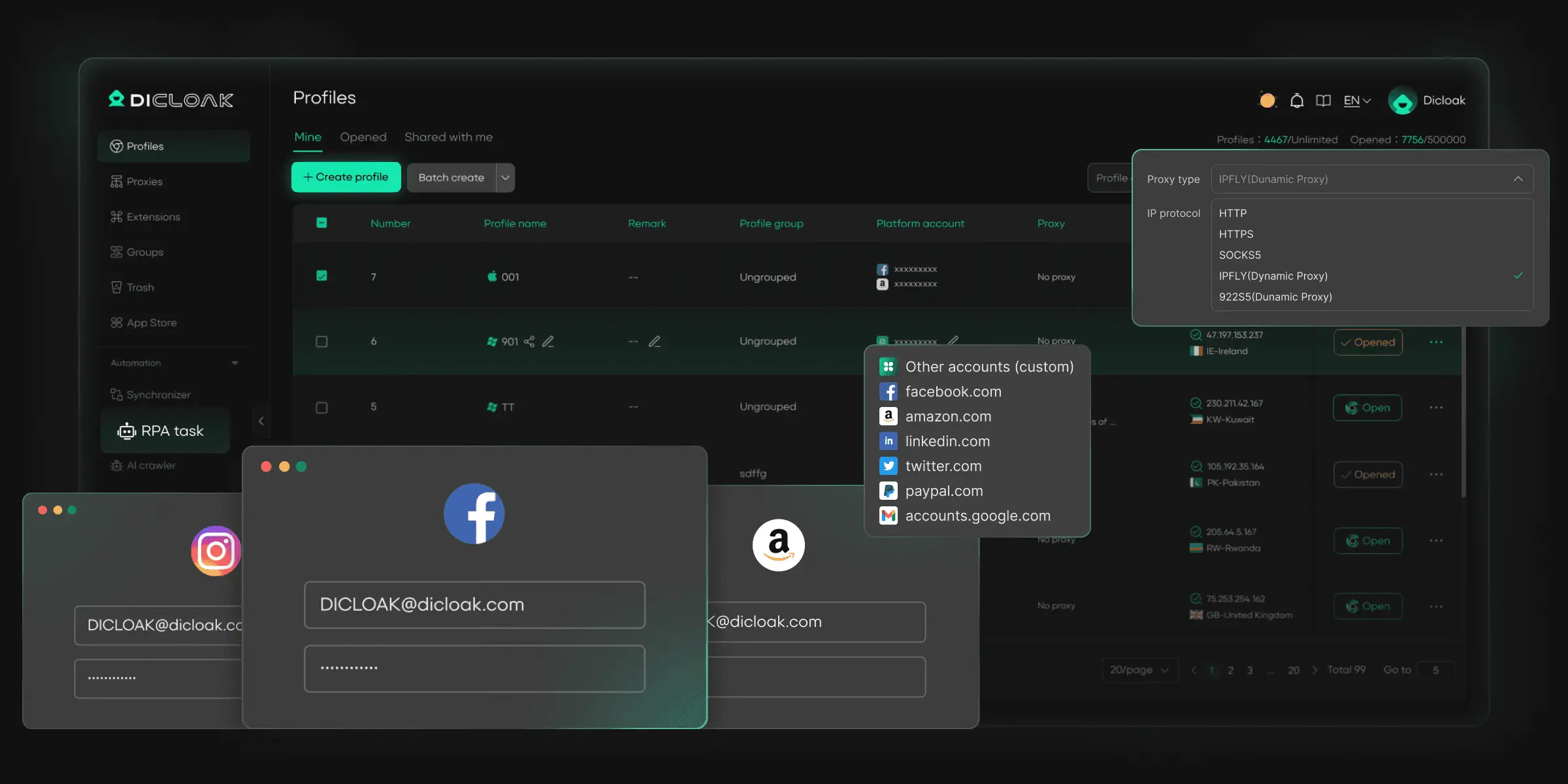
DICloak functions by creating strictly isolated browser profiles. Each profile contains its own cookie jar, cache, and generated fingerprint. By masking the Canvas, WebGL, and AudioContext signatures, DICloak ensures that each Whatnot store operates in a seperate profile effectively mitigating the risk of account association.
Workflow Efficiency through RPA and Bulk Tools
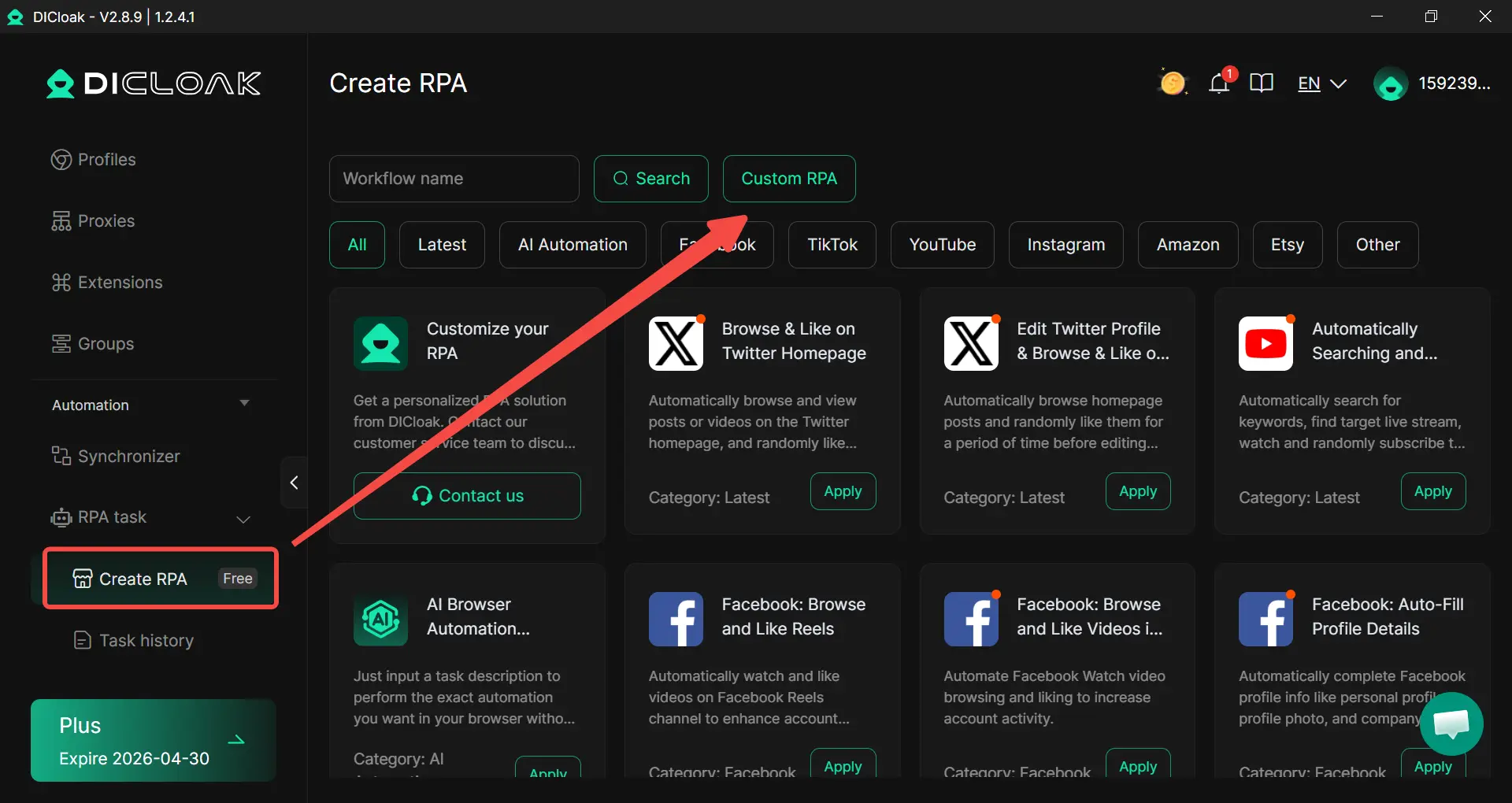
At scale, manual account management is a bottleneck. DICloak’s Robotic Process Automation (RPA) allows for the automation of repetitive tasks, such as "warming" new accounts to establish a credible history or bulk-loading marketplace listings. The bulk profile management tools allow an operator to launch hundreds of unique profiles in a single click, providing the infrastructure necessary for an enterprise-level operation.
Team-Based Infrastructure and Permissions
High-volume operations often involve multiple employees. You can manage team memebers effectively by watching this guide, which allows the business owner to monitor all employee actions, preventing internal fraud or the accidental leak of master credentials, which is essential for maintaining the security of a large-scale Whatnot enterprise.
Comparative Analysis: Standard Browsing vs. DICloak Infrastructure
| Feature |
Standard Browser |
DICloak Antidetect |
| Account Isolation |
Shared cookies/cache/local storage |
Strictly isolated browser profiles |
| Fingerprint Control |
Static/Real (leaked to platform) |
Customizable/Masked (Canvas, WebGL) |
| OS Simulation |
Limited to host machine |
Win, Mac |
| IP Management |
Single/Shared (High risk) |
Bulk Proxy Integration |
| Scalability |
Limited by physical hardware |
100+ accounts on one device |
| Automation |
Manual interaction only |
Built-in RPA & Synchronizer |
Strategic Pros and Cons of Scaling on Whatnot
Pros:
- Aggressive buyer engagement and high conversion rates during live shows.
- Access to a massive, established audience across 250+ categories.
- Lower commission fees for specific professional categories (Coins/Electronics).
Cons:
- Substantial energy and time requirements to maintain a live presence.
- Strict "One Seller" policy necessitates advanced isolation for multi-store growth.
- Heavy manual overhead for inventory management without RPA and professional automation tools.
FAQ: Is Whatnot Legit and Secure for Professionals?
Is Whatnot legit for buyers?
Yes. Whatnot is a venture-backed corporate entity with standardized dispute resolution. However, as it is a marketplace of independent sellers, professionals should always maintain high ratings to signal their own legitimacy.
Can I have more than one Whatnot account?
Platform policy allows multiple buyer accounts (up to 8), but selling is generally restricted to one. To manage multiple niche-specific stores (e.g., separating a vintage toy store from a high-end watch store), professionals utilize DICloak to create distinct digital identities, ensuring each store remains isolated and protected from association flags.
Does DICloak prevent bans?
DICloak is an infrastructure tool that mitigates technical association triggers by isolating browser fingerprints and IPs. However, it does not override Whatnot's Community Guidelines; sellers must still adhere to the platform's behavioral rules and shipping policies to ensure long-term account health.
Can you actually make money on Whatnot?
Yes, many sellers do make money on Whatnot, especially in fast-moving categories like collectibles, fashion, and resale goods. But profits depend on sourcing, pricing, audience trust, and how well you manage your live shows and fulfillment.
How safe is Whatnot for sellers handling larger volumes?
Whatnot can work for higher-volume sellers, but scale brings more risk. As operations grow, sellers need better control over accounts, devices, IP consistency, team access, and daily workflows to keep everything stable and organized.
 Web Proxy Tools
 Free Tools
 Cookie Plugin
 UA Generator
 MAC Address Generator
 IP Generator
 IP Address List
 2FA Code Generator
 World Clock
 Anonymous Check
 WebRTC Leak Test
 UUID Generator
 Free Web Proxy Site
 Proxy Checker
 FB Ad Checker
 AI Web Scraping
 Free SMM Tools
 Twitter Shadowban Checker
 Instagram Name Checker
 UTM Generator
 Username Generator
 AI Hashtag Generator
 LinkedIn Headline Generator
 Social Media Image Resizer