What is Ticket Scalping in the Modern Digital Economy?
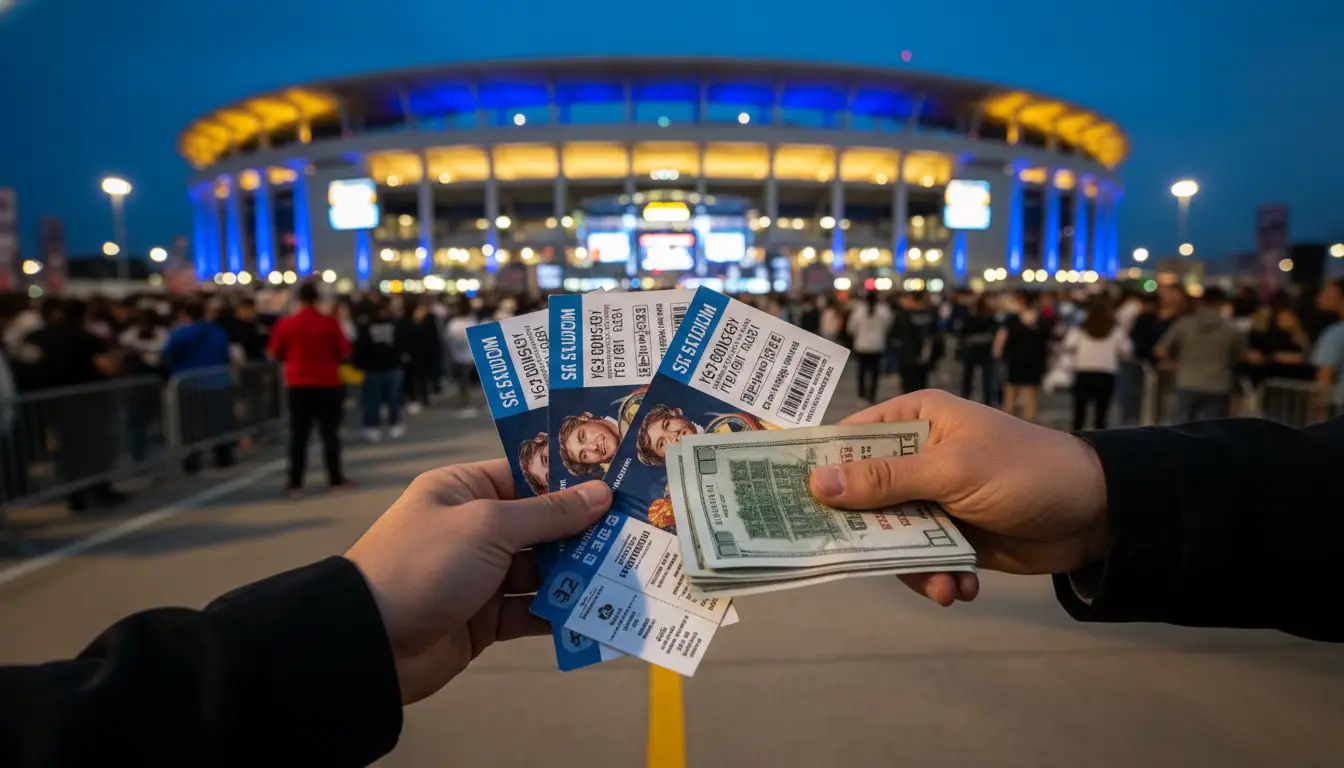
Ticket scalping, or ticket reselling, is the professional practice of market arbitrage: acquiring high-demand event inventory at face-value pricing and liquidating it when secondary market demand reaches its peak. This industry operates within the delta between artificial price ceilings set by primary vendors and the true market valuation driven by scarcity.
Consider a concrete operational scenario: A top-tier artist like Taylor Swift announces a global tour. A mid-tier ticket with a face value of $200 may sell out within seconds. Due to a 100:1 demand-to-supply ratio, that same ticket can instantly command $1,500 on secondary markets. This "liquidity gap" is the primary profit engine for professional scalpers. By securing multiple units of inventory during the initial drop, an operator manages a portfolio of assets that appreciate rapidly as the event date approaches and primary supply is exhausted.
Understanding the Legality and Risk Landscape of Ticket Scalping
While ticket reselling is a legitimate form of commerce in many global regions, it is subject to a fragmented regulatory landscape. In the United States, state laws vary significantly; some jurisdictions allow uncapped markups, while others—along with regions in the UK, Canada, and Australia—may impose specific percentage caps on resale premiums.
The primary "Condition for Failure" in professional operations is the neglect of local markup statutes or the violation of platform-specific terms of service. Major vendors employ sophisticated behavioral analysis to identify commercial-scale buyers. Ignoring regional legal caps or failing to obscure one’s digital footprint can lead to permanent account termination, ticket voiding, or legal exposure.
Pro-Tip: Before deploying capital, perform a jurisdictional audit. Specifically, check for percentage-based markup limits in your target market. Factoring these limits into your pricing strategy is essential for mitigating legal risk and ensuring long-term operational viability.
Identifying High-Demand Events for Ticket Scalping Success
Maximizing Return on Investment (ROI) requires the identification of "blue-chip" events. Professional focus is typically directed toward:
- A-List Music Tours: High-velocity artists with massive fan loyalty.
- Championship Sports: Scarcity-driven events like the Super Bowl, NBA Finals, or FIFA World Cup qualifiers.
- Major Festivals: Internationally recognized gatherings such as Coachella or Glastonbury.
A critical component of modern inventory acquisition is "Presale Access." Professionals do not wait for general sales; they leverage fan clubs, credit card mailing lists, and artist-specific rewards programs. Scaling this requires the management of dozens—or even hundreds—of distinct fan identities. By securing inventory during these restricted windows, operators acquire assets at the lowest possible cost basis before the broader market can participate.
How Ticket Scalping Professionals Use Multi-Account Infrastructure
Relying on a standard browser or a single digital identity is a terminal error for professional scalpers. Platforms utilize "Sybil detection" to identify and ban multiple purchase attempts from a single entity. Beyond simply flagging identical IP addresses, modern security systems analyze patterns of automation and anomalous browser behavior to link disparate accounts to a single operator.
Advanced platforms often rely on browser fingerprinting to evaluate user profiles. These signals can include user agent data, WebRTC exposure, Canvas behavior, fonts, screen parameters, and WebGL metadata. When the same technical setup is reused across multiple accounts, platforms are more likely to associate those accounts and apply restrictions.
This is where browser profile isolation becomes critical. DICloak provides independent browser profiles with separate cookies, cache, purchased proxy settings, and fingerprint parameters. Its official materials describe profile-level fingerprint configuration and isolated sessions built on a browser profile. In practice, this helps ticket scalping teams keep each account in a separate and more consistent operating profile, which is essential when managing large numbers of accounts from one machine or across a team.
Managing Network Identity through Proxy Management
Network separation matters just as much as browser separation. Using the same IP address across many accounts can increase the chance of account linking, especially on platforms that evaluate login consistency and location patterns. DICloak supports proxy configuration, allowing users to assign their purchased proxies to different browser profiles. For ticket scalping teams, this kind of setup makes daily operations more stable and reduces unnecessary overlap between accounts.
Technical Requirements for Scalable Ticket Scalping Systems
Once a ticket scalping operation grows beyond a small number of accounts, manual management quickly becomes inefficient. At that stage, success depends less on opening more accounts and more on building stable infrastructure for profile management, proxy control, workflow repetition, and team coordination.
Using RPA for Repetitive Browser Workflows
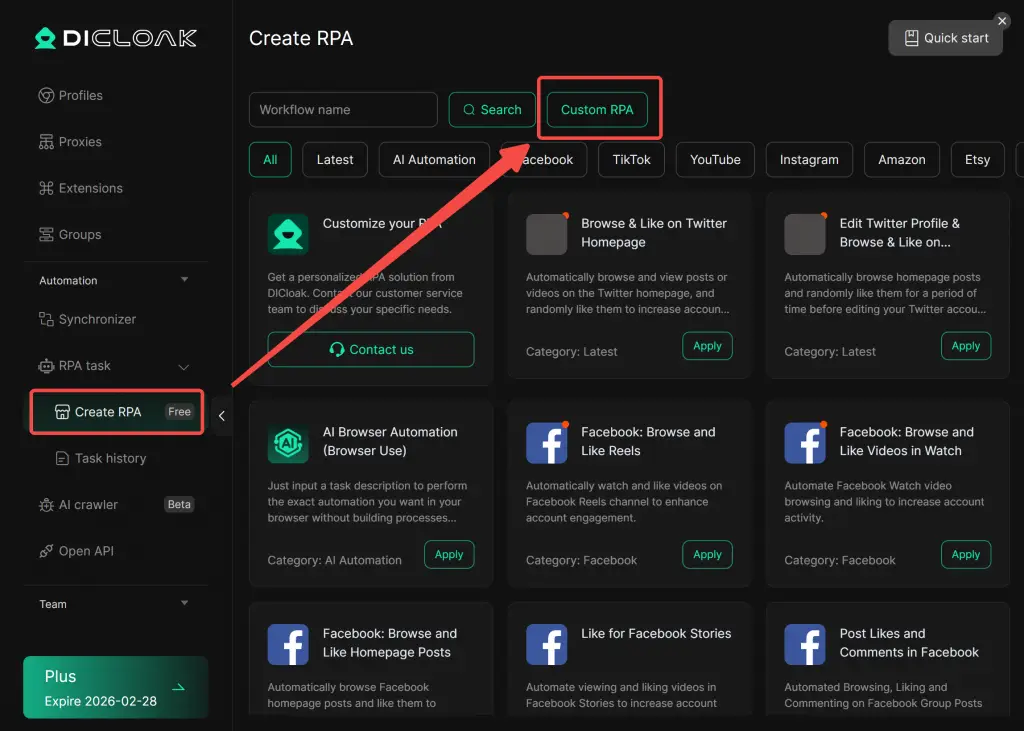
In large ticket scalping workflows, people often spend too much time repeating the same browser actions again and again. Refreshing pages, opening the same sites, moving through the same steps, and checking multiple profiles manually can slow everything down.
To handle that, many teams use automation tools inside their browser workflow. With DICloak, users can reduce repeated manual actions and make routine processes more consistent across multiple profiles. This is especially useful when one person needs to manage a large number of browser profiles in a short period of time.
Scaling with Bulk Profile Management and Synchronizer Tools
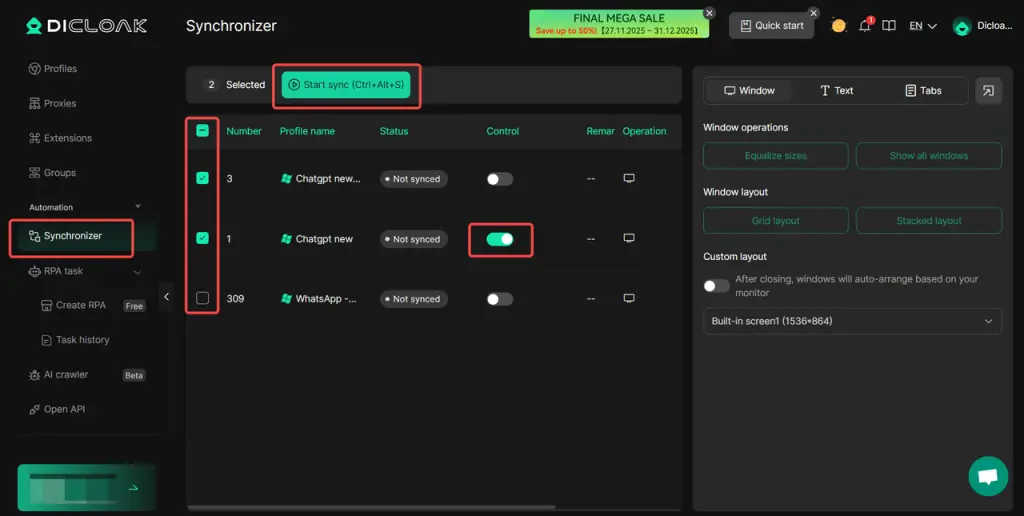
For professional ticket scalping teams, scale comes from centralized control. You can use DICloak to achieve team collaboration, multi-profile management, and synchronized workflow. This makes it useful for operators who need to open, organize, and manage many browser profiles in one system. Instead of claiming that one person can control hundreds of accounts with guaranteed success, it is more accurate to say that synchronizer-style tools can reduce repeated manual work and make large profile groups easier to operate during high-pressure events.
Strategic Pricing and Inventory Management in Ticket Scalping
Once inventory is secured, the focus shifts to strategic liquidation. Successful operators move beyond simple markups to a strategy of monitoring "Price Decay" vs. "Last-Minute Spikes."
Analyzing Market Liquidity on Secondary Resale Platforms
Diversifying the resale outlets is essential for capturing different segments of the market:
- StubHub & Viagogo: Primary outlets for high-volume, international, and "blue-chip" event traffic.
- SeatGeek: The preferred choice for mobile-centric buyers and sports-specific inventory.
- Facebook Marketplace: Useful for local, rapid liquidation and avoiding some of the higher fees associated with major exchanges.
A professional strategy involves monitoring competitor pricing daily. While early sales provide immediate liquidity, holding a portion of inventory for the 48 hours prior to an event often captures "last-minute" premium buyers who are less price-sensitive.
Evaluating the Tools: Professional Infrastructure Analysis
A robust ticket scalping stack includes more than just a browser. It requires a combination of specialized software:
- Antidetect Browser (DICloak): The core infrastructure for account isolation and fingerprint management.
- Specialized Bots: Tools like Ticketmaster bots or SeatGeek bots to handle specific platform protocols.
- High-Quality Proxy Servers: Residential or mobile proxies to provide clean, non-commercial IP addresses.
Pros of DICloak Integration:
- Asset Protection: Isolated fingerprints minimize the risk of mass account bans.
- Hardware Efficiency: Manage thousands of accounts without the cost of physical device farms.
- Team Collaboration: Use permission settings and profile sharing to manage a distributed team of buyers.
Cons:
- Technical Overhead: Requires a deep understanding of fingerprinting and proxy configuration.
- Input Dependency: The system is only as effective as the quality of the third-party proxies and bots integrated into it.
Final Insights on Sustainable Scalability
The transition from a casual side-hustle to a professional ticket scalping operation is defined by the sophistication of the digital infrastructure. Success in the modern era is a contest of technical risk management. By utilizing DICloak to manage browser fingerprints, implementing RPA to handle the operational bottlenecks of checkout, and using Synchronizers to coordinate massive-scale actions, operators can build a resilient and highly profitable business. Longevity in this market requires constant vigilance regarding platform security updates and the persistent evolution of your technical stack.
Frequently Asked Questions About Ticket Scalping and Technical Setup
Is ticket scalping actually profitable in 2025?
Yes. For high-demand events where the demand-to-supply ratio is skewed, the margins remain significant. Success, however, is now gated by the ability to bypass bot detection rather than just speed.
How do I prevent my accounts from being linked and banned?
Avoid "Sybil" behavior. This means using a unique browser fingerprint (User Agent, WebRTC, fonts) and a unique IP address for every single account. Tools like DICloak automate this isolation to prevent "cascading bans."
Is automation necessary, or can I do this manually?
In the professional tier, automation is mandatory. You are competing against sophisticated bots; manual entry is too slow to secure inventory for "instant sell-out" events. RPA and Synchronizers are the only ways to compete at scale.
Can I run 1,000 accounts on a single laptop?
With DICloak, yes. Because it manages virtualized browser profiles rather than requiring virtual machines or separate hardware, you can scale to 1,000+ accounts on a single high-performance device.
What is the most common reason for a failed "drop"?
The most common failure is "fingerprint leakage" or poor proxy quality. If a platform detects that 50 accounts are using the same WebRTC signature or a flagged data-center IP, those tickets will be cancelled before you can resell them.
 Web Proxy Tools
 Free Tools
 Cookie Plugin
 UA Generator
 MAC Address Generator
 IP Generator
 IP Address List
 2FA Code Generator
 World Clock
 Anonymous Check
 WebRTC Leak Test
 UUID Generator
 Free Web Proxy Site
 Proxy Checker
 FB Ad Checker
 AI Web Scraping
 Free SMM Tools
 Twitter Shadowban Checker
 Instagram Name Checker
 UTM Generator
 Username Generator
 AI Hashtag Generator
 LinkedIn Headline Generator
 Social Media Image Resizer