Most “best affiliate network” articles are written for affiliates who want offers to promote. Advertisers have a different problem. A brand is not choosing a network because the payout looks attractive. It is choosing the infrastructure that will help it recruit the right publishers, track conversions, set commissions, review partner quality, handle payments, and keep the program manageable as it grows.
That makes the phrase affiliate network for advertisers more specific than it first appears. A network with a huge publisher count may still be a poor fit if those publishers do not match your market. A low monthly fee may also be misleading if the platform requires more internal work, weak tracking creates attribution gaps, or your team needs a level of support the entry plan does not include.
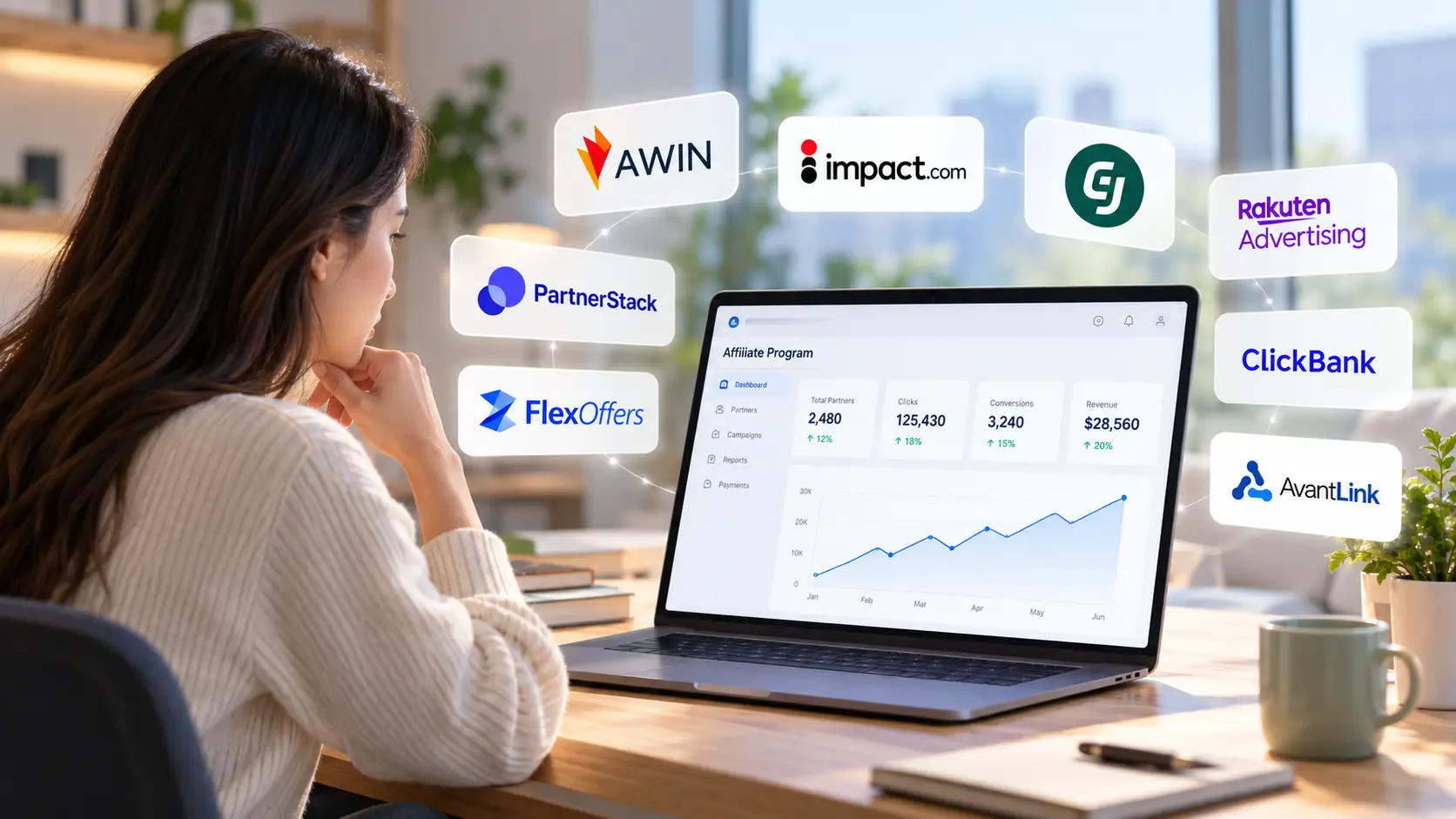
Quick answer: The right affiliate network depends on your business model. Awin is one of the most accessible options for ecommerce advertisers, impact.com is strong when affiliates, creators, and referrals need to live in one platform, CJ Affiliate and Rakuten Advertising are built around larger global programs, PartnerStack is designed for B2B SaaS, FlexOffers offers broad consumer-publisher coverage, ClickBank suits direct-response sellers, and AvantLink emphasizes a more selective publisher network.
This guide compares those platforms from the advertiser side, not the publisher side. It also explains what to check before signing a contract, when a network makes more sense than affiliate software, and how advertiser teams can manage shared access to affiliate dashboards without turning passwords into a team-wide asset.
There is no single network that fits every advertiser. The useful question is which network matches your partner type, market, product, and level of program maturity.
| Network |
Best fit for advertisers that need |
Advertiser-side strength |
Current public scale/positioning |
| Awin |
Ecommerce, DTC, international growth, accessible entry |
Large partner directory, self-service and managed tiers, public entry pricing |
1M+ partners and 30K+ brands |
| impact.com |
Affiliates + creators + referrals in one system |
Broad partner discovery, flexible contracts, tracking, fraud protection |
300K+ vetted global partners in Marketplace |
| CJ Affiliate |
Enterprise retail, finance, travel, technology |
Recruitment, situational commissioning, analytics, compliance |
Global enterprise-oriented network |
| Rakuten Advertising |
Established brands that value curated publisher relationships |
Global affiliate services, tracking, reporting, strategic support |
25+ years in affiliate marketing |
| PartnerStack |
B2B SaaS affiliate, referral, reseller, and co-sell programs |
B2B-specific partner ecosystem and program management |
131K+ active partners; 660+ B2B companies |
| FlexOffers |
Consumer brands that want broad publisher coverage |
AdvertiserMax, publisher reach, compliance, campaign support |
75K publishers and 12K advertisers |
| ClickBank |
Direct-response digital or physical products |
Marketplace distribution, ecommerce tools, affiliate management |
Nearly 100K active affiliates |
| AvantLink |
Retail brands that prefer a more selective network |
Vetted publishers, strong reporting, ecommerce integrations |
Says it accepts about 30% of publisher applicants |
Key takeaway: Publisher count matters, but it should not be the first filter. An advertiser should start with vertical fit, partner quality, tracking, total program cost, and the amount of management support required.
What Is an Affiliate Network for Advertisers?
An affiliate network connects an advertiser with publishers that can promote the advertiser's product or service. The network sits between the two sides and provides the operational layer that would otherwise need to be built or managed directly.
For an advertiser, that usually means the network helps with:
- publisher discovery and applications;
- affiliate tracking links and attribution;
- commission rules;
- transaction validation;
- reporting;
- publisher payments;
- policy and compliance workflows;
- campaign communication and creative distribution.
This is different from simply installing affiliate tracking software. Software can track referrals and calculate commissions, but a true network also gives the advertiser access to an existing partner ecosystem.
Affiliate Network vs Affiliate Platform vs Tracking Software
The terms are often used interchangeably, which makes comparison harder.
| Type |
Main purpose |
Built-in partner marketplace? |
Best when |
| Affiliate network |
Connect advertisers and publishers while handling tracking and payments |
Usually yes |
You want access to an existing publisher base |
| Partnership platform |
Manage affiliates, creators, referrals, resellers, and other partner types |
Sometimes |
You need broader partnership workflows and more control |
| Affiliate tracking software |
Track links, conversions, commissions, and payouts |
Often no |
You already know who your partners are |
Some companies now sit between categories. impact.com, for example, combines marketplace access with broader partnership-management tools. PartnerStack combines a B2B partner marketplace with software for affiliate, referral, reseller, and co-sell programs. The label matters less than whether the platform actually gives your team the partner supply and workflow it needs.
How an Affiliate Network Works for an Advertiser
The basic flow is easier to understand when viewed from the brand side.
- The advertiser creates a program. The brand defines the product, target market, conversion event, commission rules, approved traffic sources, and program terms.
- Tracking is connected. The advertiser integrates the network with its website, app, ecommerce platform, or backend so conversions can be attributed correctly.
- Publishers discover or are recruited into the program. The advertiser reviews partner applications or actively recruits publishers that fit the audience.
- Approved publishers promote the offer. They use network-generated tracking links, codes, product feeds, or other approved assets.
- The network records conversions. Sales, leads, subscriptions, or other actions are tied back to the referring partner.
- The advertiser validates results and pays commissions. The network handles reporting and, in many cases, partner payment operations.
A network reduces operational friction, but it does not remove the need for program management. Advertisers still need to recruit good partners, answer applications, provide useful creative assets, tune commission rates, review conversion quality, and enforce program rules.
How We Evaluated These Affiliate Networks for Advertisers
This comparison focuses on the questions a brand should ask before putting its program on a platform.
Partner fit. Does the network contain the types of publishers, creators, agencies, technology partners, or B2B partners the advertiser actually wants?
Tracking and reporting. Can the advertiser see where conversions come from and use the data to change commissions, recruitment, or campaign strategy?
Program control. Can the team set different payout rules, approve partners, enforce restrictions, and separate different markets or offers?
Support and scalability. Can a small team self-manage the program, and is there a path to more service when the program becomes larger?
Cost visibility. Does the network publish its advertiser pricing, or will the brand need a sales conversation before it can model total cost?
The platforms below are not ranked from “best” to “worst.” Each one is stronger for a different type of advertiser.
1. Awin: Accessible for Ecommerce and International Programs
Awin is a practical starting point for advertisers that want broad publisher access without an enterprise-only sales process. It connects 30,000+ brands with more than 1 million partners across content, influencer, cashback, technology, and other affiliate models.
As of September 2026, Awin lists Access at $49/month + a 3.5% tracking fee, Accelerate at $99/month + 2.5%, and custom pricing for Advanced. Affiliate commissions are separate.
Source: https://www.awin.com/us/pricing/advertisers
Why an Advertiser Might Choose Awin
- large global partner directory;
- self-service entry for smaller advertisers;
- managed-service and advanced reporting options as programs grow.
Good fit when: You sell online, want broad publisher access, and need a clear path from a small program to a more advanced one.
Before joining, calculate the full cost, including platform fees, affiliate commissions, and internal management time. Also check whether relevant partners are active in your category.
2. impact.com: Strong for Affiliate, Creator, and Referral Programs
impact.com is designed for advertisers that want affiliate, creator, and referral programs in one system. Its Marketplace includes 300K+ vetted global partners, with filters for audience, category, traffic, location, and other attributes.
Sources: https://impact.com/affiliate-marketing/ and https://impact.com/discover-recruit/
Why an Advertiser Might Choose impact.com
- one platform for several partnership types;
- large partner discovery marketplace;
- flexible contracts, payouts, tracking, and fraud monitoring.
Good fit when: Affiliate is part of a wider partnership strategy and you want creators, referrals, and publishers in one platform.
The main question is whether you need that breadth. Smaller advertisers running a simple publisher program may not use enough of the platform to justify a more advanced stack.
3. CJ Affiliate: Built for Mature, Data-Heavy Programs
CJ Affiliate is better suited to established programs that need deeper recruitment, commissioning, analysis, and compliance. Its tools include Partnership Discovery, Situational Commissioning, cross-device tracking, fraud monitoring, ecommerce integrations, and customer-journey reporting.
Source: https://www.cj.com/advertiser
Why an Advertiser Might Choose CJ
- advanced publisher recruitment;
- flexible commission rules;
- strong analytics, compliance, and tracking options.
Good fit when: You already have meaningful affiliate volume and need more advanced commissioning, reporting, or program management.
CJ works best when the advertiser already understands its target publishers, customer value, commission logic, and reporting needs.
4. Rakuten Advertising: Curated Global Programs With Strategic Support
Rakuten Advertising focuses on curated publisher relationships, global program support, tracking, reporting, forecasting, and strategic service. It may appeal more to established brands that value partner quality and hands-on support over a low-cost self-service entry.
Source: https://rakutenadvertising.com/brands/
Why an Advertiser Might Choose Rakuten Advertising
- curated publisher relationships;
- global coordination and strategic support;
- strong fit for mature consumer brands.
Good fit when: Publisher quality, global support, and service matter more than finding the lowest-cost entry point.
Public advertiser pricing is not presented as a simple self-service package, so brands should request a full cost breakdown before comparing options.
5. PartnerStack: Purpose-Built for B2B SaaS Partnerships
PartnerStack is built around B2B SaaS distribution. The company says its ecosystem includes 131K+ active partners and supports affiliate, referral, reseller, co-sell, and influencer programs.
Sources: https://partnerstack.com/ and https://partnerstack.com/platform/affiliates
Why an Advertiser Might Choose PartnerStack
- B2B SaaS-focused partner marketplace;
- support for recurring-revenue and reseller models;
- onboarding, enablement, and partner-management tools.
Good fit when: You sell B2B software and want partners who can influence referrals, recurring revenue, longer sales cycles, or reselling.
Pricing depends on program size, features, and support level and is confirmed through a demo.
6. FlexOffers: Broad Consumer Publisher Coverage
FlexOffers says its network supports 75,000 publishers and 12,000 advertisers, with more than $5 billion in yearly sales across the ecosystem. Its AdvertiserMax product combines affiliate and influencer marketing with publisher discovery, campaign management, compliance, and support.
Source: https://www.flexoffers.com/advertisers/
Why an Advertiser Might Choose FlexOffers
- broad consumer publisher reach;
- campaign support and publisher matching;
- useful as either a primary or supplementary network.
Good fit when: You want broad consumer publisher access without needing a niche SaaS or enterprise-only ecosystem.
7. ClickBank: Direct-Response Marketplace for Product Sellers
ClickBank combines ecommerce infrastructure with an affiliate marketplace. It says the ecosystem includes 100K active affiliates and supports revenue-share and CPA commissions for digital and physical products.
Sources: https://clickbank.com/ and https://www.clickbank.com/sell
Why an Advertiser Might Choose ClickBank
- large direct-response affiliate marketplace;
- seller infrastructure and affiliate management in one ecosystem;
- support for digital products, subscriptions, education, health, and other direct-response offers.
Good fit when: Your product performs well through direct-response funnels and you want affiliates to discover the offer inside a marketplace.
Advertisers should still check whether ClickBank's affiliate base and sales style match their brand and customer-acquisition strategy.
8. AvantLink: More Selective Publisher Recruitment
AvantLink emphasizes publisher quality and advertiser data. It says it accepts about 30% of publisher applicants, which may appeal to advertisers that prefer a smaller, more controlled partner pool.
It also provides ecommerce integrations for platforms such as Shopify, BigCommerce, and Adobe Commerce, along with reporting and merchant-management tools.
Source: https://www.avantlink.com/advertisers/
Why an Advertiser Might Choose AvantLink
- selective publisher approval;
- detailed reporting;
- ecommerce-focused integrations.
Good fit when: You prefer a more controlled affiliate environment and value publisher quality over sheer marketplace size.
Which Affiliate Network Should an Advertiser Choose?
The easiest way to narrow the list is to start with the business model instead of the network logo.
| Advertiser type |
Networks worth evaluating first |
Why |
| Small or growing ecommerce brand |
Awin, FlexOffers, AvantLink |
Accessible ecommerce workflows and broad publisher options |
| Mid-market brand mixing affiliates and creators |
impact.com, Awin |
Supports broader partnership types and flexible growth |
| Large retail or consumer enterprise |
CJ Affiliate, Rakuten Advertising, impact.com |
Advanced data, service, recruitment, and compliance |
| B2B SaaS company |
PartnerStack, impact.com |
B2B partner ecosystem and multi-partner models |
| Direct-response product seller |
ClickBank |
Marketplace designed around offer-driven affiliate promotion |
| Brand expanding internationally |
Awin, CJ, Rakuten Advertising |
Global network and service capabilities |
This is a shortlist, not a universal ranking. An advertiser should still ask each network for category-specific publisher data. A large network can look impressive in a sales deck but add little value if the strongest publishers are concentrated in industries that do not match your product.
Choosing by Network Size Alone
A large affiliate network can look attractive because it gives the impression that more publishers automatically means more sales opportunities. In practice, the total number of partners on a network matters much less than how many relevant, active, and recruitable partners exist in your category.
For example, an ecommerce brand selling specialist outdoor equipment may gain more value from a smaller group of publishers that already create hiking, camping, and product-review content than from a much larger network where most partners focus on unrelated categories. The same applies to SaaS. A network may have thousands of affiliates, but only a small percentage may have the right B2B audience, content model, or traffic source for your product.
Advertisers should therefore look beyond headline network size. Ask how easy it is to discover partners in your niche, what types of publishers are active, whether the network supports direct recruitment, and whether similar advertisers already have meaningful partner activity there.
The better question is not “Which network has the most affiliates?” It is “Which network gives us the strongest access to the partners we actually want to recruit?”
Assuming the Network Will Run the Program
An affiliate network provides infrastructure, but it does not automatically create a successful affiliate program.
The network may handle tracking, links, reporting, commissions, partner applications, and payment infrastructure. However, the advertiser still needs to decide why a publisher should promote the offer in the first place. That means creating competitive commissions, useful landing pages, strong creative assets, clear program terms, and a responsive approval process.
This becomes especially important after launch. Publishers may join the program but never become active if they receive no communication, no campaign ideas, no updated assets, or no reason to prioritize the advertiser over competing offers.
A common example is an advertiser that launches a program, approves hundreds of partners, and then waits for sales. After several months, management may conclude that the network is not working. In reality, the program was never actively developed.
Advertisers should treat the network as the operating system for the program, not the program manager itself. Someone still needs to recruit the right partners, answer questions, review performance, adjust incentives, and keep productive affiliates engaged.
Using One Commission Rate for Everything
A flat commission rate is easy to manage, which is why many new programs start with one. The problem is that not every conversion creates the same value for the advertiser.
A first-time customer may be more valuable than a repeat buyer. A high-margin product can support a larger payout than a low-margin product. A SaaS company may value a qualified subscription differently from a free trial, while an ecommerce advertiser may want to pay more for customers who have never purchased before.
If every outcome receives the same commission, the program may reward partners for conversions that would have happened anyway while giving too little incentive for the customers or products the business actually wants to grow.
This does not mean every program needs a complicated commission structure on day one. Advertisers should first identify the conversions that matter most, then check whether the network supports commission rules based on product, customer type, campaign, partner group, or other meaningful conditions.
A better commission strategy connects the payout to business value. The goal is not simply to pay affiliates more or less. It is to make sure the incentive encourages the type of growth the advertiser actually wants.
How DICloak Helps With Multiple Affiliate Account Management
As advertisers expand across more affiliate networks, brands, regions, and clients, multiple account management quickly becomes an operational problem. A team may manage several Awin advertiser accounts, different impact.com workspaces, separate CJ Affiliate programs, or multiple client accounts at the same time.
Using one normal browser for all of these accounts can make sessions difficult to organize. Employees may need to log in and out repeatedly, keep track of which client account is active, or rebuild the same browser setup on different devices.
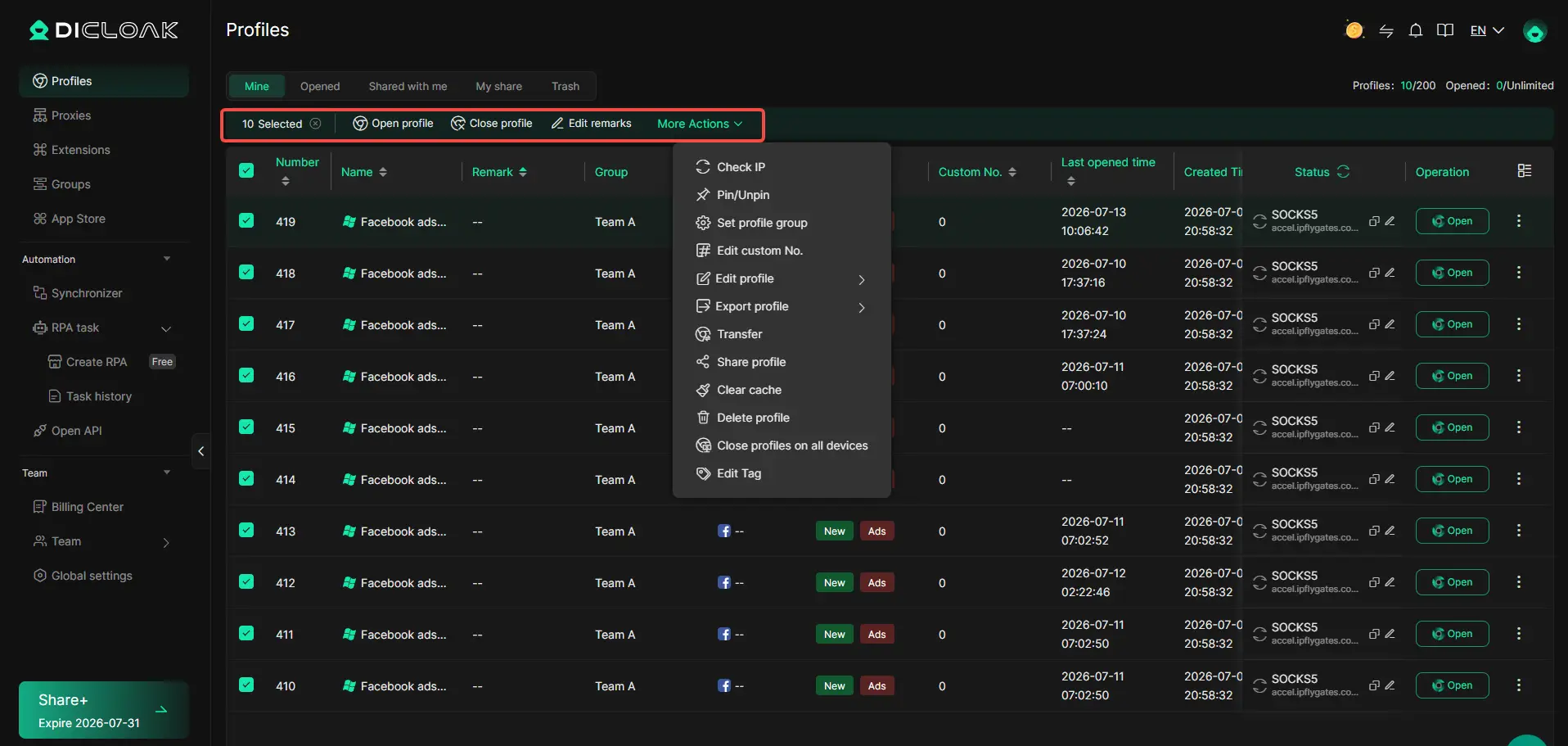
DICloak gives teams a more structured way to handle multiple affiliate advertiser accounts. Each authorized account can be placed in its own browser Profile, with separate cookies, login sessions, browser storage, settings, and optional proxy configuration. Profiles can then be grouped by client, brand, network, or region and assigned to the team members who actually need them.
Quick answer: DICloak helps advertisers and agencies manage multiple affiliate accounts by keeping each account in a separate browser Profile, organizing Profiles into groups, controlling team access, and maintaining clear session boundaries between different advertiser workspaces.
Separate Multiple Affiliate Accounts Into Individual Profiles
The foundation of multiple account management is separation.
For example, an agency may manage five clients across Awin, impact.com, CJ Affiliate, and other networks. Instead of keeping all of those advertiser logins inside one browser, the agency can create one DICloak Profile for each account.
A setup might look like this:
| Account |
DICloak Profile |
| Brand A - Awin |
Brand A - Awin |
| Brand A - impact.com |
Brand A - impact |
| Brand B - CJ Affiliate |
Brand B - CJ |
| Client C - U.S. program |
Client C - US |
| Client C - Europe program |
Client C - EU |
Each Profile keeps its own cookies, session data, Local Storage, IndexedDB, bookmarks, extensions, and browser settings. This makes it easier to keep one advertiser account from becoming mixed with another.
For teams managing many affiliate accounts, DICloak Profile Groups can also organize them by brand, client, region, team, or affiliate network. That becomes increasingly useful as an agency grows from five advertiser accounts to twenty or fifty.
A simple naming rule such as Brand - Network - Region - Purpose can make a large Profile list much easier to understand.
For example:
NovaShop - Awin - US - Main NovaShop - impact - Global Client42 - CJ - UK
This is the core value of DICloak in this scenario: turning multiple affiliate accounts into clearly separated and organized browser workspaces.
Keep Multiple Account Sessions and Browser Data Organized
Managing multiple affiliate accounts is not only about storing different usernames and passwords. Each account builds up its own browser profile over time.
That can include authentication cookies, saved sessions, bookmarks to reporting pages, Local Storage, IndexedDB, and extension data. When several accounts are opened from one normal browser, those environments can become harder to manage.
DICloak keeps this data connected to the individual Profile. Its Data Sync features can also help authorized team members return to the same working environment across devices instead of rebuilding the setup each time.
This makes routine affiliate work easier when several accounts need attention every day. A manager can open one Profile to review publishers for Brand A, switch to another Profile to check commissions for Client B, and then open a third workspace for a regional campaign without repeatedly signing in and out.
The goal is not to create duplicate advertiser identities. It is to make multiple legitimate advertiser accounts easier to manage side by side.
For companies with their own approved network setup, users can also configure their own proxies in DICloak on a per-Profile basis. This can help keep network settings organized alongside each advertiser workspace.
Manage Multiple Accounts Across Teams and Clients
Multiple account management becomes more complicated once more people are involved.
An affiliate director may need access to every advertiser account. A regional manager may only need the European accounts. A finance employee may only need selected reporting workspaces. An agency contractor may need one client account for a short campaign.
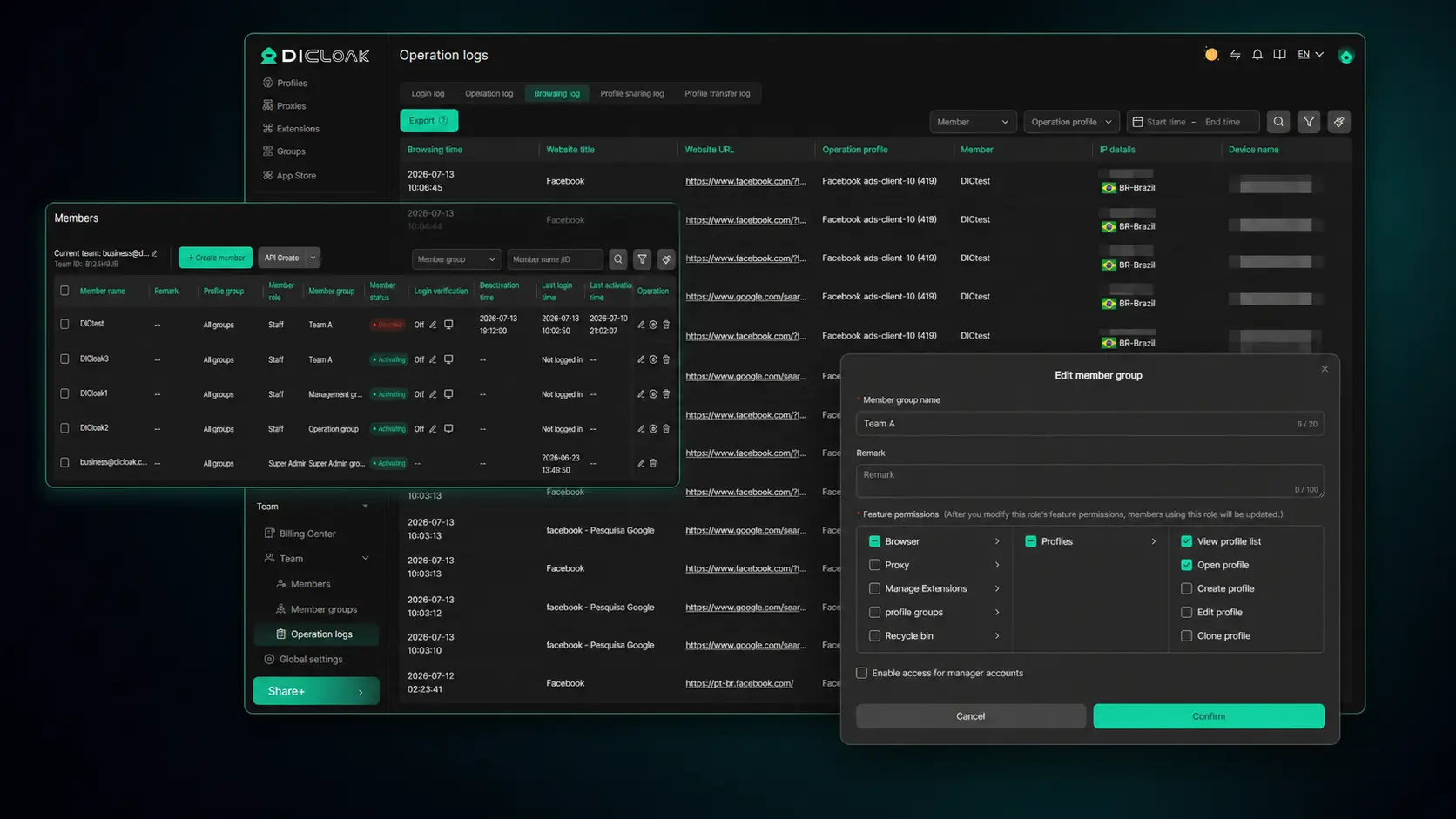
DICloak allows administrators to combine multiple account management with team access control.
Profiles can be shared with selected members, while Member Groups can help organize permissions around roles or teams. This means the company does not need to give every employee access to every advertiser account.
For example:
| Team member |
Account access |
| Affiliate Director |
All advertiser Profiles |
| U.S. Manager |
U.S. affiliate accounts |
| EU Manager |
European affiliate accounts |
| Finance |
Reporting Profiles |
| Agency contractor |
Assigned client Profiles only |
This also makes onboarding and offboarding easier. When a new employee joins, the administrator can give them access to the relevant Profiles. When a contractor leaves, access to those Profiles can be revoked without reorganizing every other account.
DICloak's security settings can also restrict members from viewing saved website passwords or changing sensitive browser settings. So the team can manage multiple advertiser accounts without turning every login credential into a shared company password.
FAQs About Affiliate Networks for Advertisers
What is an affiliate network for advertisers?
An affiliate network is a platform that connects an advertiser with publishers or affiliates that can promote its products or services. The network usually provides partner discovery, tracking, reporting, commission management, transaction validation, and publisher payment infrastructure.
Which affiliate network is best for a small ecommerce advertiser?
Awin is one of the more accessible major options because it publishes an entry plan for advertisers and provides access to a large partner directory. FlexOffers and AvantLink may also be worth evaluating depending on the category and publisher types you need.
Which affiliate network is best for B2B SaaS advertisers?
PartnerStack is purpose-built for B2B SaaS and supports affiliates, referrals, resellers, and co-sell partners. impact.com is another option when the company wants to manage several partnership types in one platform.
How much does an affiliate network cost an advertiser?
Costs vary by network. Advertisers may pay a monthly platform fee, a tracking or network fee, affiliate commissions, setup or service fees, and sometimes paid-placement costs. Awin publicly lists an entry plan at $49 per month plus a 3.5% transaction tracking fee as of September 2026, while many enterprise platforms use custom pricing.
Is an affiliate network the same as affiliate software?
No. Affiliate software mainly provides tracking and program-management tools. An affiliate network normally adds access to an existing publisher marketplace and often handles partner payments and other operational tasks.
 Web Proxy Tools
 Free Tools
 Cookie Plugin
 UA Generator
 MAC Address Generator
 IP Generator
 IP Address List
 2FA Code Generator
 World Clock
 Anonymous Check
 WebRTC Leak Test
 UUID Generator
 Free Web Proxy Site
 Proxy Checker
 FB Ad Checker
 AI Web Scraping
 Free SMM Tools
 Twitter Shadowban Checker
 Instagram Name Checker
 UTM Generator
 Username Generator
 AI Hashtag Generator
 LinkedIn Headline Generator
 Social Media Image Resizer