As AI tools become part of everyday work, small to medium-sized teams often run into extra admin work and higher costs when managing separate ChatGPT Plus subscriptions. As companies try to bring generative AI into their regular operations, many start asking the same question: is there a way to share ChatGPT subscription access more efficiently? Centralized access can help teams keep shared knowledge, reuse strong prompts, and avoid the hassle of managing many separate payments. But moving from individual accounts to a shared setup also brings risks, especially when platform security systems are designed to detect usage patterns that do not look personal.
The Mechanics of Account Association and Detection Heuristics
OpenAI and similar high-tier SaaS platforms implement sophisticated "Account Association" heuristics to prevent unauthorized credential sharing. From a cybersecurity perspective, these platforms do not just look for a correct password; they analyze a multi-dimensional array of telemetry to determine if the user profile remains consistent.
The primary detection mechanism relies on identifying discrepancies in "Digital DNA." When multiple users access a single account, the platform logs inconsistent IP addresses, conflicting browser cookies, and varying hardware identifiers. If these data points exhibit high browser entropy—such as a login from a New York-based Mac followed immediately by a login from a London-based Windows machine—the system triggers security checkpoints. These events often lead to "shadow-banning," API rate-limiting, or permanent account suspension due to suspected account takeover or ToS violations.

Is there a way to share chatgpt subscription without triggering security flags?
To resolve the challenge of sharing access safely, technical leads must shift their focus from credential management to "Environment Isolation." Traditional sharing methods fail because they ignore the persistent tracking of the device's unique signature. The core of a successful risk-mitigation strategy involves ensuring that every team member appears as the exact same entity to the platform's backend.
Simply distributing a password is insufficient when platforms track hardware-level identifiers. Managing the browser profile is significantly more critical than managing the login credentials. Effective sharing requires the implementation of a "Virtual Browser Profile" that maintains a consistent hardware fingerprint, geographic location, and session state. By isolating the environment, teams can deceive detection heuristics into perceiving multiple distinct users as a single, consistent operator.
Technical Components of Browser Fingerprinting and Identification Vectors
Maintaining a stable environment requires a deep dive into the specific vectors platforms use to build a device profile. Sophisticated systems look far beyond basic IP addresses.
Websites use Canvas and WebGL API calls to read how a browser renders complex graphics. Because this rendering is influenced by the specific GPU, system drivers, and even the OS's font-smoothing algorithms, it creates a unique hardware ID. Advanced tools like DICloak provide "Canvas noise" or consistent hardware hashes to mask these identifiers. Furthermore, vectors such as AudioContext (how your system processes sound) and specific Font Enumeration are tracked to identify unique machines. Masking these ensure the platform sees a uniform device profile regardless of the actual hardware used by team members.
Cookie Management and Session Persistence
Session tokens and authentication states are stored within the browser's Local Storage and Session Storage. When multiple users share an account using standard browsers, conflicting cookie jars and mismatched session data from different IPs lead to "logout loops" or immediate flagging for suspicious activity. Professional isolation requires that the cookie jar be "frozen" and transferred exactly between users, ensuring the session remains persistent and does not collide with other active sessions.
For distributed teams, proxy management is often a key part of keeping account environments more consistent. When accounts are accessed across different locations, many users choose to assign a dedicated proxy to each account and keep related browser settings, such as timezone, WebRTC, and geolocation, aligned with that setup. This can make the account environment look more stable and easier to manage over time.
Infrastructure Options for Secure Multi-User Access
Teams generally evaluate two technical pathways for sharing access, each with distinct trade-offs in resource allocation and security.
The Limitations of Standard Browser Profiles
While Chrome and Firefox offer profile management, they are fundamentally insufficient for bypassing "Account Association." These profiles do not prevent OS-level leaks and do not provide hardware fingerprint masking (Canvas, WebGL, etc.). They are organizational tools, not security tools, and offer no protection against the sophisticated detection heuristics used by modern AI platforms.
Lightweight Isolation for Multi-Account Management
When multiple accounts need to be managed at the same time, the challenge is often keeping each account environment separate without making daily operations too heavy or complicated. A lighter setup can be easier to maintain, especially when more profiles need to run on one device.
This is where antidetect browser profiles can be useful. Instead of putting every account into the same browser session, users can create separate profiles with their own cookies, local storage, and fingerprint-related settings. This gives them a way to keep account environments more clearly separated while still managing them inside one browser-based system. For users handling larger account setups, this can feel more flexible and easier to scale than heavier account management methods.
Comparison: Standard Sharing Methods vs. DICloak Isolation
| Criteria |
Standard Password Sharing |
DICloak Managed Profiles |
| Risk of Ban |
High (Frequent heuristic flags) |
Low (Profile isolation) |
| Fingerprint Consistency |
None (High Browser Entropy) |
High (Virtual fingerprints) |
| Team Collaboration |
Manual/Chaotic |
Synchronized (Session Transfer) |
| Setup Complexity |
Low |
Moderate (Proxy integration required) |
Pro-Tip: Never mix residential and datacenter proxies when accessing a shared subscription. Platforms perform ASN checks; a sudden switch from a residential ISP to a known datacenter server range is a high-confidence trigger for immediate security review and potential account locking.
Is there a way to share a ChatGPT subscription using DICloak?
Some users use DICloak to create one dedicated browser profile for a shared ChatGPT account, then let team members access that same profile instead of logging in through different browsers and devices. In this setup, the profile keeps the same browser profile, login session, and account state more consistent across users. Shared browser profiles, stable proxy settings, synced login status, and team-based access controls can make account sharing easier to manage than passing the password around repeatedly.
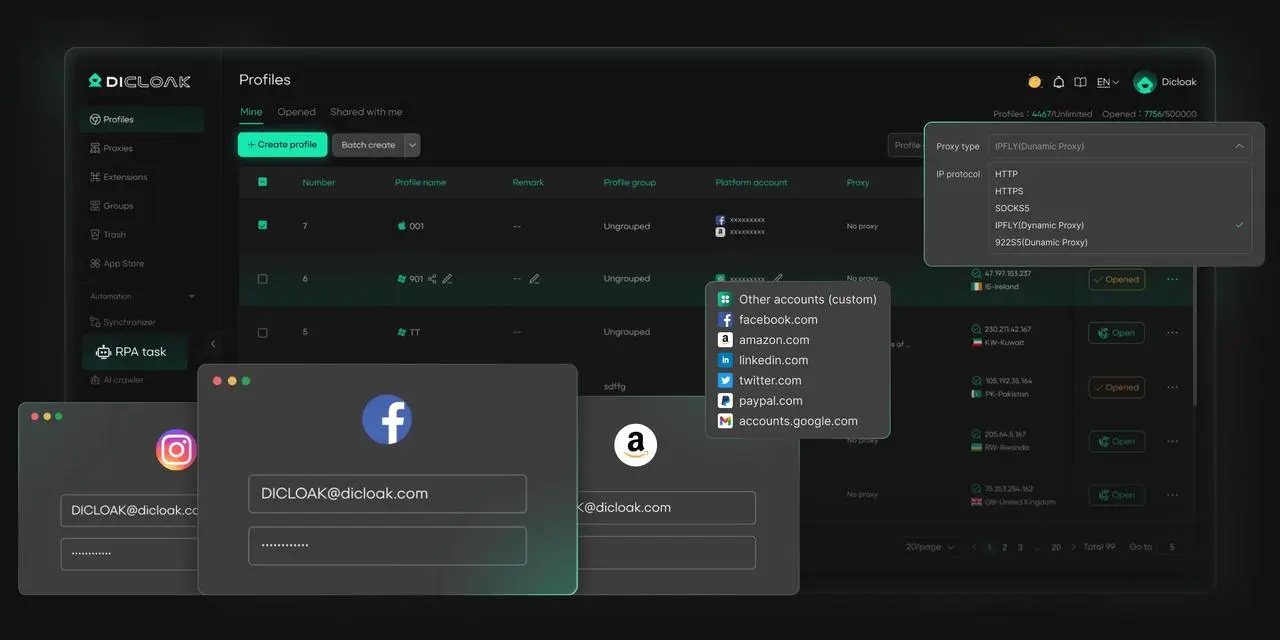
- Shared browser profile: One user can set up the ChatGPT account inside a dedicated browser profile, and other approved team members can open that same profile later. This keeps account access inside one more consistent browser profile.
- Stable access setup: A stable proxy setup can help keep account access conditions more consistent over time when the same shared profile is used by a team.
- Synced login state: After the main user logs in, other team members may be able to access the same logged-in profile through DICloak's synced session approach, which reduces the need to enter the password again and again.
- Team-based access control: Instead of handing out the raw account password to everyone, users can manage access through profile sharing and team permissions inside DICloak.
Better Practices for Lowering Account Suspension Risk
Reducing account risk is often less about one single tool and more about keeping the overall account environment stable. When login conditions, browser settings, and access patterns change too often, account review issues can become more likely.
- Role-based access and profile transfer: Teams can reduce confusion by assigning browser profiles based on tasks or roles instead of sharing one account setup across everyone. This helps keep each profile's browsing conditions more consistent and makes access easier to manage over time.
- Stable proxy configuration: Many users also try to keep proxy settings stable for the same account environment, rather than changing locations or connection settings too often. A more consistent setup can make routine account access easier to organize and reduce avoidable environment changes.
Common Questions About Sharing a ChatGPT Subscription
Is it legal to share accounts?
This is usually a terms-of-service issue. In practice, the bigger concern is whether account sharing goes against the platform's access rules and creates a higher risk of suspension, restricted access, or data exposure. For individuals, sharing one subscription across multiple people can be risky over time. For teams, they must weigh the cost-savings against the risk of losing access to their data and accounts.
Will using a proxy management tool prevent all bans?
No. Proxy management and environment isolation may help reduce some account risks, but they are not guarantees. Platforms change their detection methods over time, so these tools are best seen as ways to lower risk and keep account environments more consistent, not to prevent every ban.
Can I use the same account on mobile and desktop?
The source indicates that simultaneous use of an account on a mobile device and a desktop is a high-risk activity. Mobile devices present entirely different fingerprint vectors (IMEI, GPS, mobile carrier data) that cannot be easily synced with a desktop browser profile, making simultaneous usage a primary trigger for account flagging.
What is the most common reason shared accounts get banned?
The most frequent cause is "Account Association" triggered by simultaneous logins from distinct geographic locations or sudden changes in hardware metadata, such as switching between different operating systems or browser engines on the same session.
 Web Proxy Tools
 Free Tools
 Cookie Plugin
 UA Generator
 MAC Address Generator
 IP Generator
 IP Address List
 2FA Code Generator
 World Clock
 Anonymous Check
 WebRTC Leak Test
 UUID Generator
 Free Web Proxy Site
 Proxy Checker
 FB Ad Checker
 AI Web Scraping
 Free SMM Tools
 Twitter Shadowban Checker
 Instagram Name Checker
 UTM Generator
 Username Generator
 AI Hashtag Generator
 LinkedIn Headline Generator
 Social Media Image Resizer