Why many users are searching for the best AdsPower alternatives right now
AdsPower has been a powerful tool for years, serving as a reliable utility for account management. However, the business landscape in 2026 is shifting. Companies are no longer satisfied with static feature sets or legacy pricing models. They need infrastructure that scales efficiently with their revenue. The search for a replacement is driven by the need for better operational continuity and smarter budget allocation. When you manage thousands of accounts, even small inefficiencies in your browser infrastructure can compound into significant financial losses.
What makes a modern browser a good AdsPower alternative?
To replace a core business tool, a competitor must offer significant advantages in three specific areas: cost, automation, and team security.
Cost Efficiency at Scale
Legacy pricing models often penalize growth. As teams expand, the monthly bill for extra team seats and profiles can skyrocket unexpectedly. Many users are now investigating "cheaper alternatives to AdsPower" to improve their bottom line. They want predictable costs, not variable pricing that punishes success. This is why the search for the "best free adspower alternative" often leads to tools offering generous base tiers for testing before commitment.
Advanced Automation Support
Basic macros are no longer sufficient for enterprise workflows. Sophisticated teams require robust "selenium automation browser alternatives" that handle complex tasks without breaking. While AdsPower has its own tools, developers often seek open environments that integrate seamlessly with external code.
Team Security and Role Management
Sharing access should not mean sharing risks. Modern alternatives must prioritize role-based access control. This is essential for agencies running the "safe browser for crypto airdrops" or managing high-value client assets. You need to know exactly which team member accessed which profile and when, without sharing the actual account credentials.

What you should check before switching to an AdsPower alternative
Migrating your browser infrastructure is a strategic decision, not just a software update. When you move away from a tool like AdsPower, you are transplanting the foundation of your digital revenue. A poor choice here can trigger chain reactions of account bans that take months to recover from. Before you migrate your data, you must verify that the new platform can handle your current volume without flagging security systems.
How we evaluated these tools based on real user needs
To identify the best replacements, we moved beyond simple feature checklists. We tested these browsers under the stress of daily agency operations. We focused on the friction points that usually appear only after you have paid for a subscription, such as API latency during peak hours and the accuracy of browser fingerprinting on updated platforms.
Stability and account safety across different websites
Your first check must be the consistency of the digital fingerprint. A browser might pass a simple checker website today but fail on a sophisticated platform like Facebook or Amazon tomorrow. We looked for consistent uptime and the ability to maintain a session without crashing. High-quality alternatives use distinct browser cores that update alongside Chrome or Firefox. If a tool lags behind the official browser version by several months, it creates a discrepancy that security algorithms can easily detect.
Pricing per profile and hidden team member costs
Many users search for cheaper alternatives to AdsPower only to find that the base price is misleading. Some platforms charge a low fee for profiles but require expensive add-ons for every additional team member seat. You must calculate the total cost of operation. Does the plan include free seats? Does it charge for data transfer or API access? For example, tools like DICloak include generous team features in their structure, whereas others might charge $15 to $20 per extra user, drastically increasing your monthly invoice as you scale.
Automation tools and how easy they are to set up
If your workflow relies on speed, manual clicking is not an option. We evaluated how well these tools handle automation. For developers, we tested for robust selenium automation browser alternatives that offer local API support. A stable API allows you to run scripts without opening the visual interface, saving system resources. For non-coders, we looked for no-code automation antidetect features, such as RPA (Robotic Process Automation) recorders. These allow you to record a sequence of mouse clicks and replay them across hundreds of profiles, a feature critical for farming and repetitive account management.
Speed of customer support and community trust
When your operation halts due to a technical error, you cannot wait 24 hours for an email response. We assessed the responsiveness of support teams and the activity level of their user communities. A responsive support team indicates active development and a lower likelihood of the software becoming obsolete. We also checked for community feedback regarding recent ban waves, as the user base is often the first to notice when a browser's stealth capabilities have been compromised.
The 9 best AdsPower alternatives for managing multiple accounts in 2026
Switching software is a calculated risk. When you move your operations from AdsPower, you are not just changing interfaces; you are migrating your business infrastructure. We selected these nine platforms because they balance technical reliability with practical business features. Whether you need a cheaper alternative to AdsPower or a more robust enterprise solution, these tools offer the stability required for scaling operations.
DICloak: For small teams and RPA automation
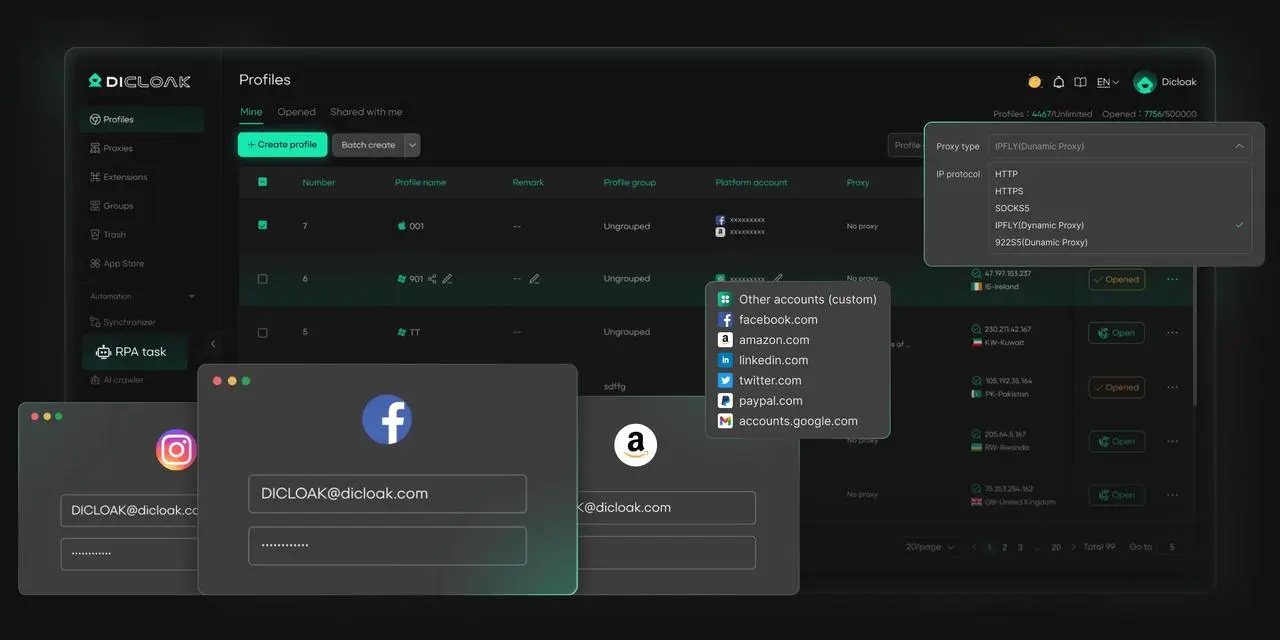
DICloak has quickly positioned itself as a high-value option for teams focused on efficiency. Unlike many competitors that gate essential automation behind high-tier subscriptions, DICloak democratizes access to these tools. It is particularly effective for businesses that rely on no-code automation antidetect features, allowing users to automate repetitive tasks like account warming or data entry without hiring a developer. The platform supports bulk profile creation and cloud data synchronization, keeping your team has consistent access to accounts regardless of location.
Why it works: Free plan for 5 profiles and built-in automation
For startups and solo operators, DICloak offers one of the most generous entry points in the market. The free plan includes 5 daily browser profiles. This allows you to validate your workflow and manage a small fleet of accounts at zero cost before committing to a paid subscription.
The trade-off: Advanced integrations require a paid Share+ plan
While the base features are robust, larger enterprises needing deep API integration for custom tools will need to upgrade. Open API access is reserved for the Share+ plan ($138/mo), which is designed for heavy-duty scaling rather than casual use.
Multilogin: For agencies and professional scrapers
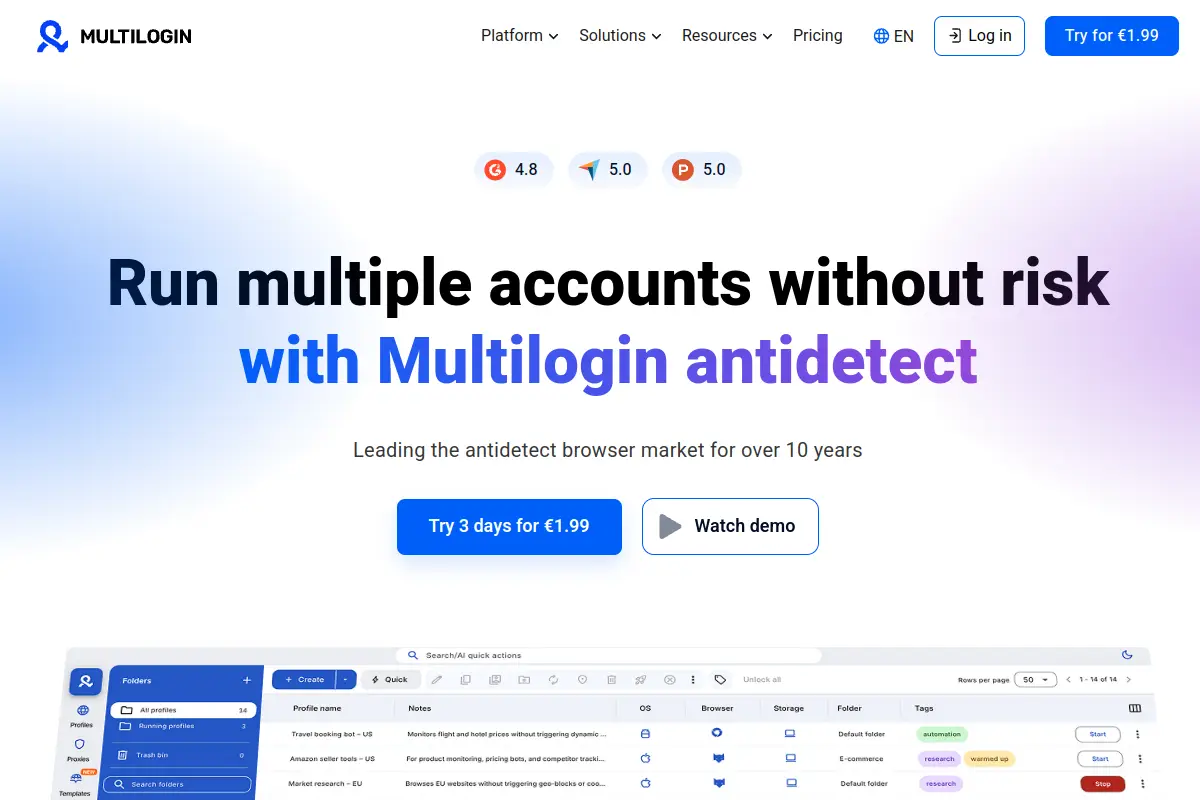
Multilogin remains a standard for security. It operates two distinct browser engines, Mimic and Stealthfox, which remove the "noise" that often leads to account bans on strict platforms. It is built for teams that cannot afford downtime or security leaks. The platform supports native automation with Playwright and Puppeteer, making it a choice for developers building complex scraping operations.
Why it works: High-end browser engines and included proxy traffic
Multilogin invests heavily in keeping its browser cores updated to match regular Chrome and Firefox releases. This reduces the discrepancy between your virtual profile and a real user’s device. Additionally, some plans now include premium residential proxy traffic, simplifying the vendor stack for agencies.
The trade-off: Higher starting price compared to most competitors
With plans starting around €99 for substantial usage (the cheaper €9 plan is very limited), it requires a larger upfront investmen, making it less suitable for hobbyists.
GoLogin: For ease of use and mobile management
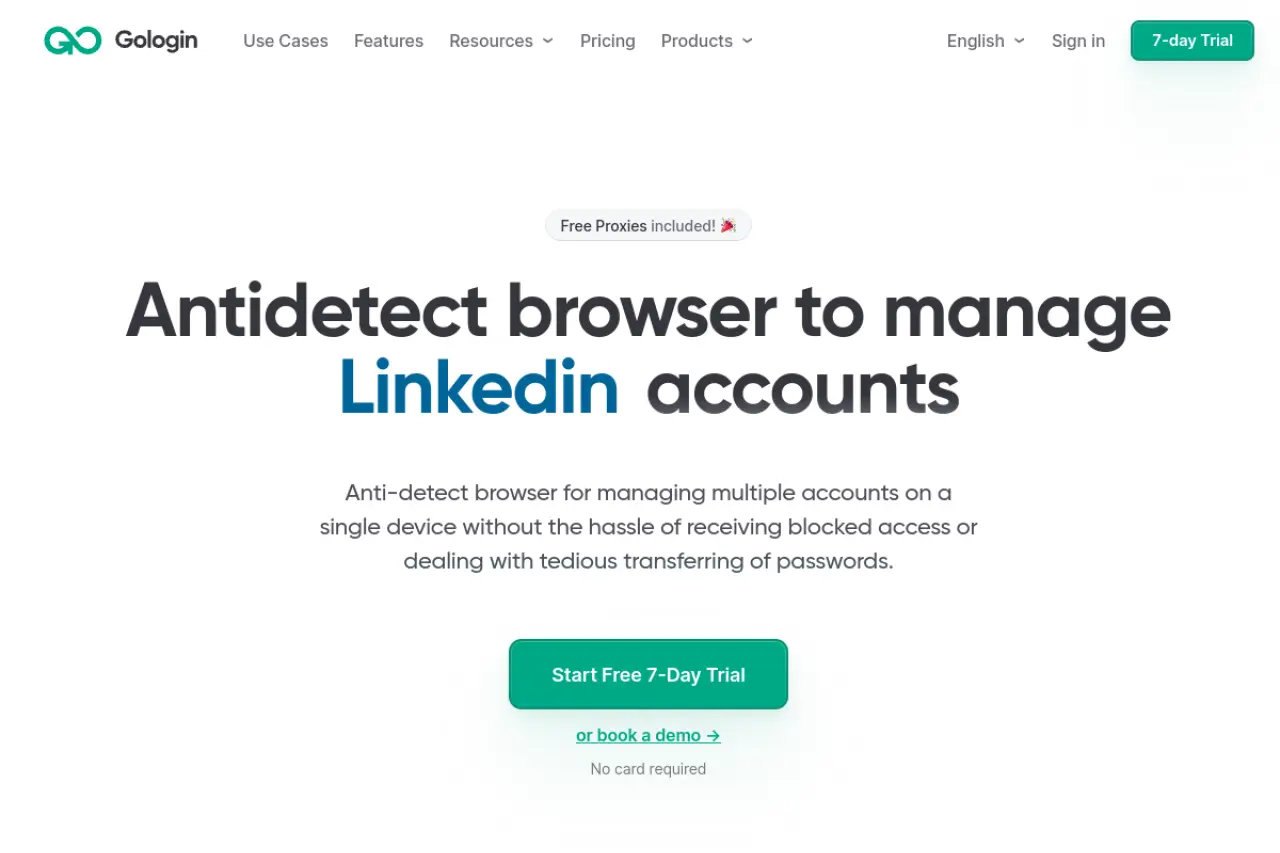
GoLogin offers a flexible approach to multi-accounting by focusing on accessibility. Its standout feature is the cloud-based launching capability, which allows you to run profiles directly in the cloud without draining local resources. This is ideal for teams managing accounts remotely or on lower-spec hardware. It also provides a database of over 50 configurable fingerprint parameters for those who need to tweak specific settings manually.
Why it works: Cloud-based launching and a dedicated Android app
For managers on the move, GoLogin’s Android app is a significant advantage. It allows you to create and manage profiles from a smartphone, a feature rarely found in desktop-centric competitors. This makes it excellent for emergency checks or travel.
The trade-off: Basic automation might not be enough for complex workflows
While it supports basic API interactions, heavy users often find the automation capabilities less granular than those of DICloak. It is better suited for manual management than high-volume automated farming.
Dolphin{anty}: For affiliate marketers and ad agencies
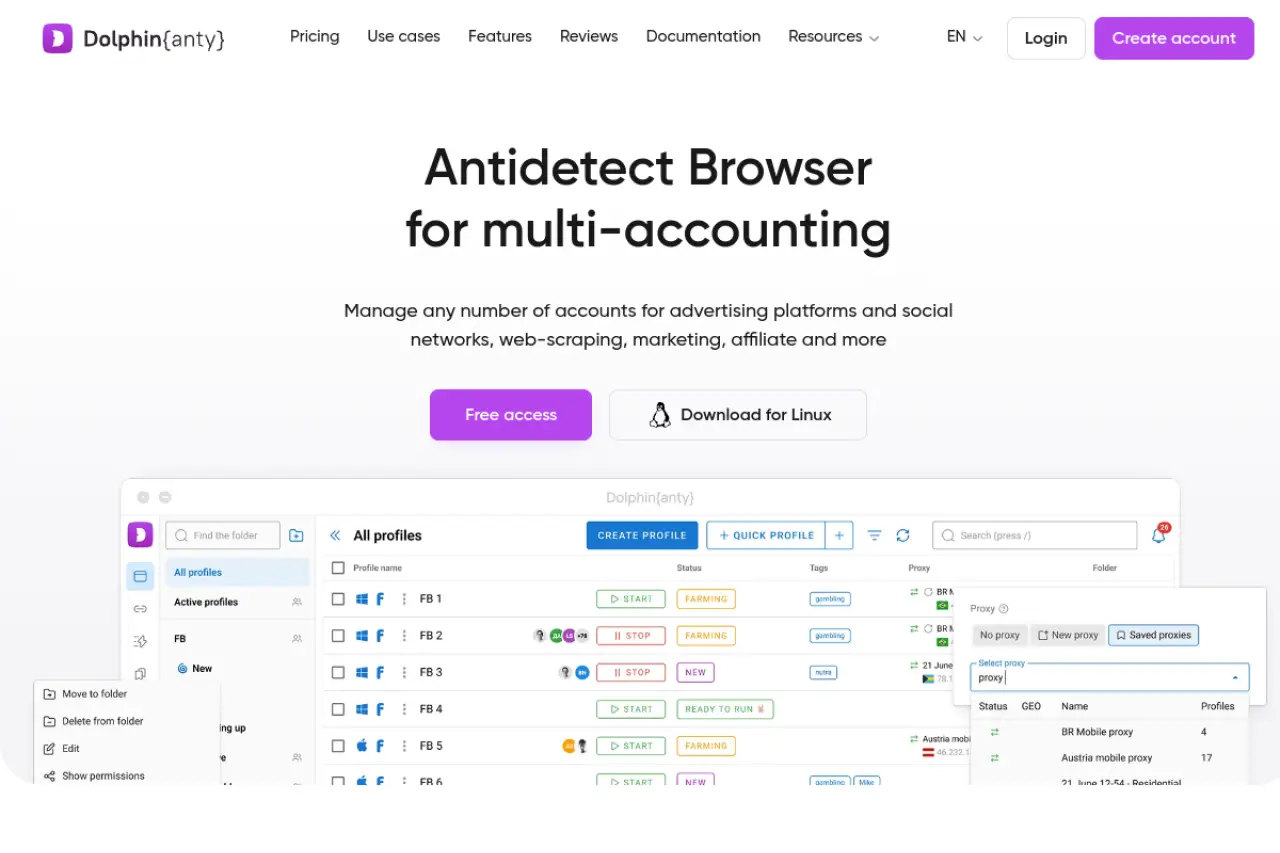
Dolphin{anty} was built with the affiliate marketing workflow in mind. The interface is designed to handle hundreds of ad accounts with ease, offering statuses, tags, and notes that help large teams stay organized. It integrates a "cookie robot" that visits websites automatically to build a browsing history, making new accounts look trustworthy to security algorithms before you even launch your first ad.
Why it works: Scenario builders and automatic cookie warming tools
The built-in scenario builder allows you to script routine actions without coding knowledge. This is critical for agencies that need to warm up dozens of Facebook or Google accounts simultaneously to increase their trust score.
The trade-off: Free plan is limited compared to professional tiers
The free plan offers 10 profiles, which is decent, but team management features are locked behind the Base plan ($89/mo). Growing teams will hit a paywall sooner than expected if they need role-based access control.
Incogniton: For solo entrepreneurs and automation beginners
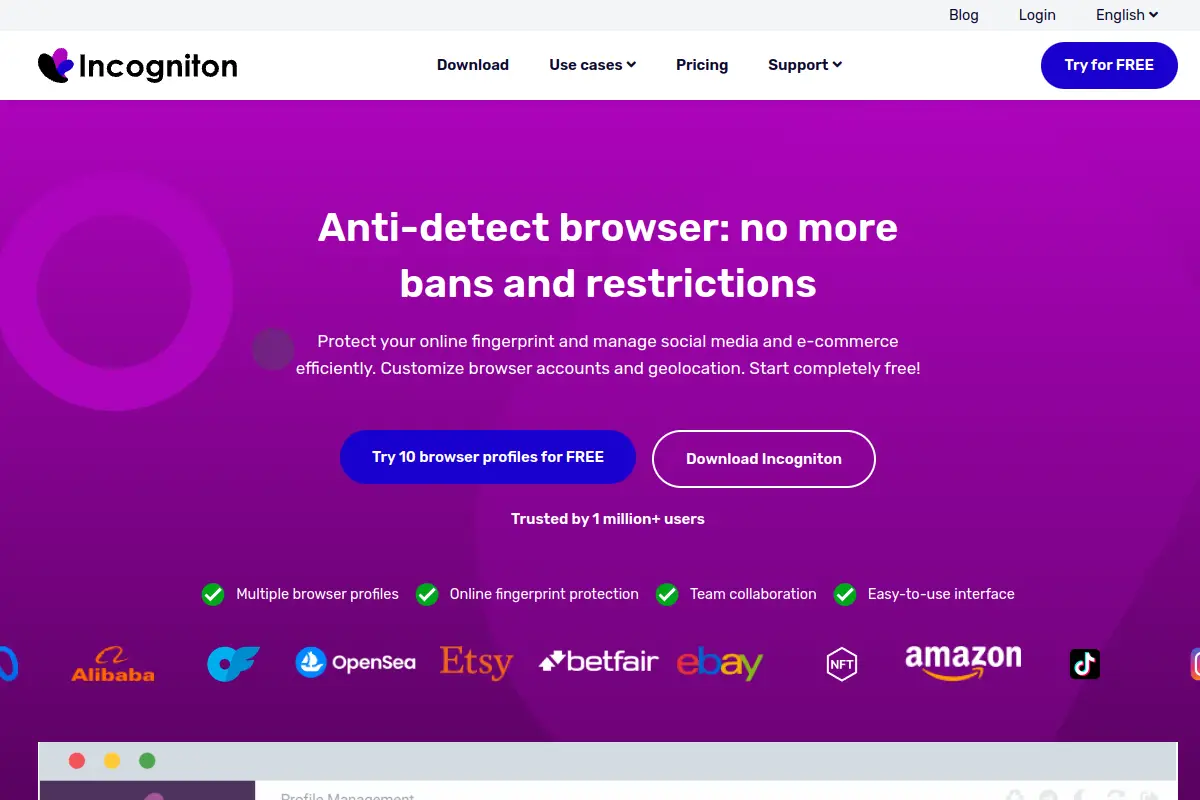
Incogniton is often cited as a strong selenium automation browser alternative due to its developer-friendly focus. However, its user interface is also accessible enough for beginners. It emphasizes human simulation, with features like "Paste as Human Typing" that prevent anti-fraud systems from detecting robotic inputs during form fills. It supports both local and cloud storage for profiles, giving you control over data security.
Why it works: Human-like typing simulation and local data storage options
The typing simulation is a subtle but effective feature for avoiding bans on sensitive platforms. Furthermore, the option to store data locally ensures that your profiles load faster and your data remains on your hardware.
The trade-off: Team features are locked behind higher-priced plans
While excellent for solo users, collaborative features are only available on the Professional plan and above. Small teams looking for shared folders on a budget might find other tools more accommodating.
Octo Browser: For fast profile creation and multi-accounting
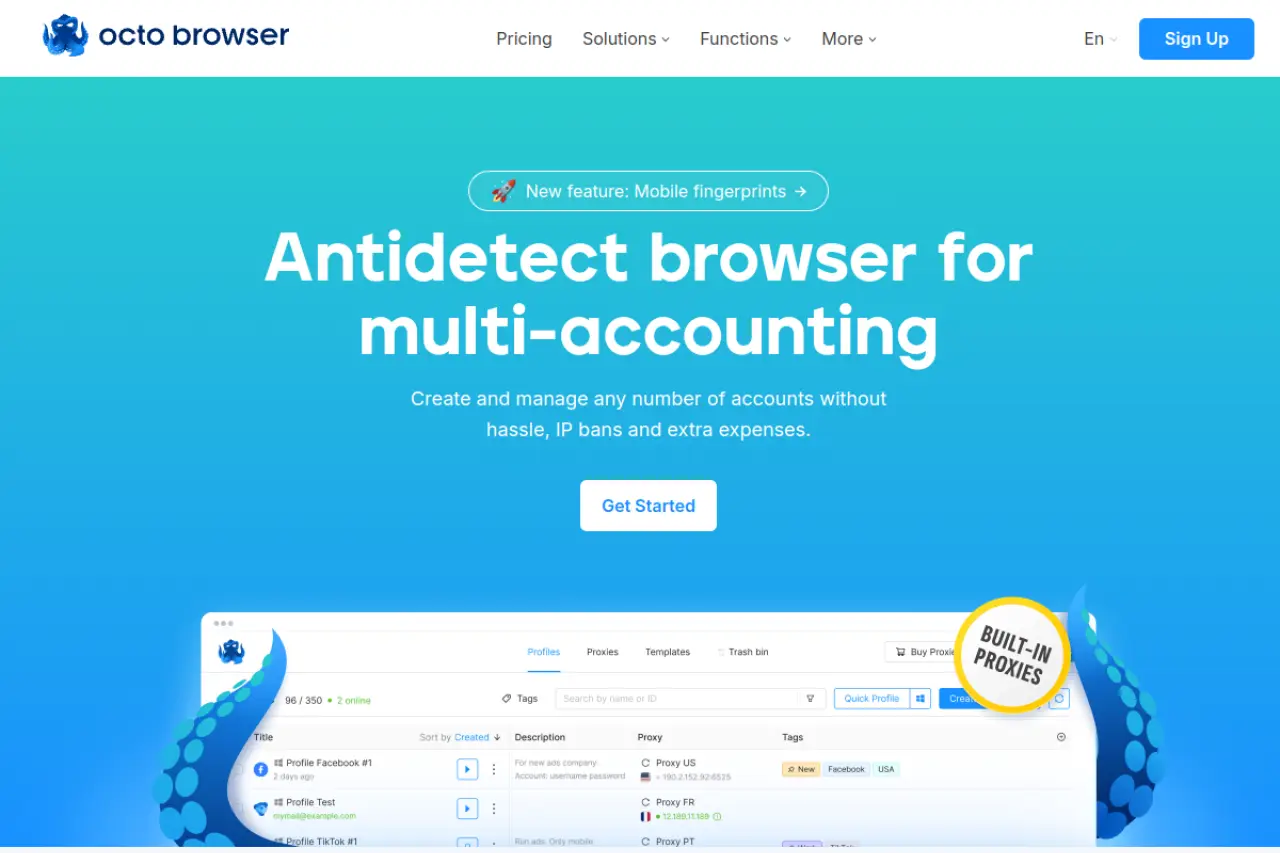
Octo Browser is designed for speed. The interface is minimalist and fast, allowing users to create valid browser profiles in seconds using real device fingerprints. It targets arbitrage teams and agencies that treat accounts as high-turnover assets. The browser passes complex checkers by using a database of genuine device fingerprints rather than generating synthetic noise.
Why it works: Intuitive interface and high-quality device fingerprints
The learning curve is practically non-existent. You can spin up a profile and start browsing immediately. The quality of the fingerprints is high, often passing strict checks on crypto.
The trade-off: Automation features only start on the Base plan
API access for automation is not available on the Starter plan. If you intend to run scripts or integrate with third-party tools, you must commit to the Base plan (€79/mo) or higher.
MoreLogin: For e-commerce and social media management
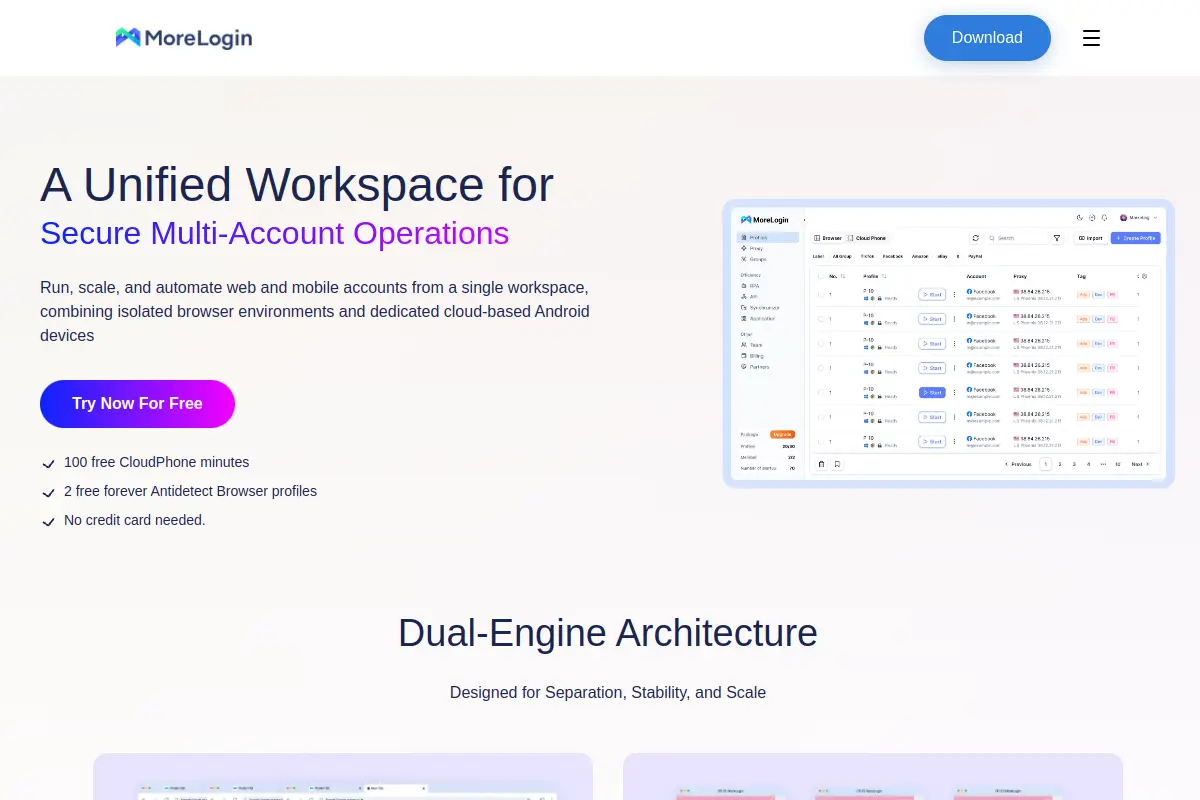
MoreLogin focuses on the technical accuracy of the browser canvas. It uses "real canvas fingerprint" technology to collect canvas data from real users around the world, rather than masking it artificially. This approach aims to reduce the red flags raised by traditional canvas blocking methods. It is particularly popular among e-commerce sellers managing multiple storefronts.
Why it works: High pass rates with real canvas fingerprint tech
By mimicking real-world data distributions, MoreLogin achieves high success rates on platforms that aggressively analyze hardware rendering. It also includes a synchronizer for controlling multiple windows at once.
The trade-off: Free tier is limited to only 2 profiles
The free offering is very restrictive, providing only 2 profiles. This makes it difficult to thoroughly test the platform for a larger operation without paying for a Pro plan upfront.
Hidemium: For mobile device simulation
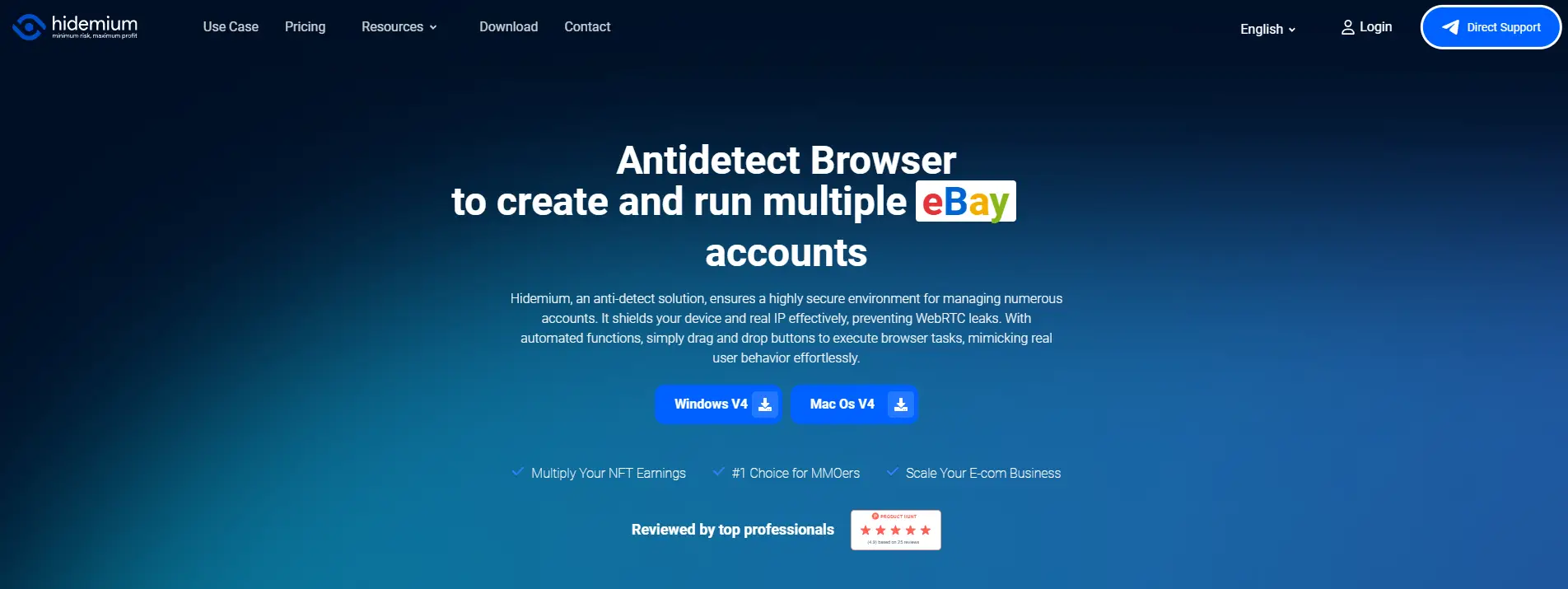
Hidemium carves out a niche by specializing in mobile device simulation. As platforms like TikTok and Instagram become mobile-first, desktop fingerprints often look suspicious. Hidemium addresses this with robust mobile emulation and a built-in AI agent designed to handle automated tasks intelligently.
Why it works: Built-in AI agent for automation and mobile support
The AI agent can navigate complex sites more naturally than standard scripts. If your business relies on mobile app ecosystems, Hidemium provides a more convincing fingerprint than standard desktop emulators.
The trade-off: Pricing structure can get complex for large fleets
The pricing tiers jump significantly between the Premium and Business plans. Scaling from 1,000 to 13,000 profiles requires a massive leap in monthly costs, which may complicate budgeting for mid-sized growth.
Browser.lol: Best lightweight alternative for quick, disposable browsing
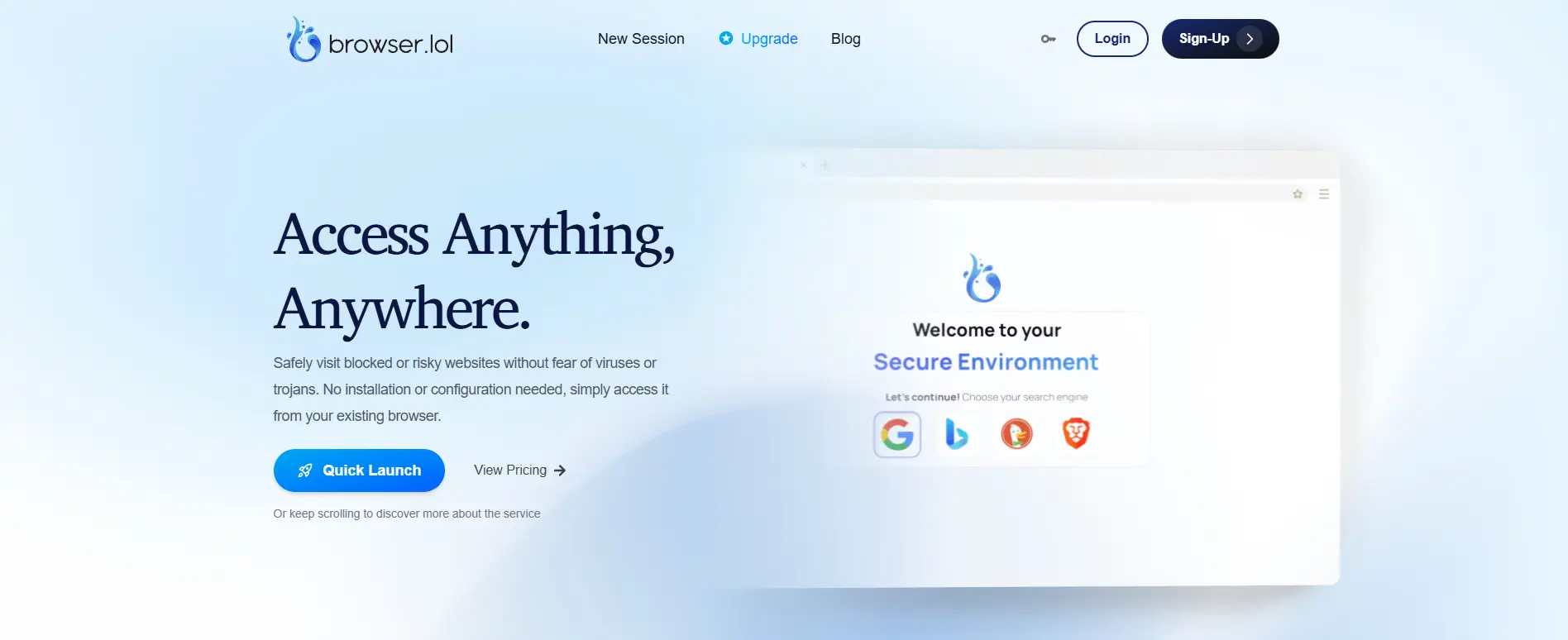
Browser.lol is a unique outlier. It is not a traditional antidetect browser for long-term farming but a cloud-based disposable browser solution. It runs entirely in your existing web browser, streaming a session from a remote server. This offers a high degree of safety for one-off tasks where you do not want any local data residue.
Why it works: No installation needed and works in your current browser
It is the ultimate portable solution. You can access a fresh, sandboxed browser profile from any device without installing software. This is perfect for security checks or quick, isolated tasks.
The trade-off: Not designed for long-term account farming
Sessions are temporary (especially on the free tier). It does not offer the persistent cookie storage or profile management features needed to maintain long-term accounts like Facebook Ads managers.
How the top AdsPower alternatives compare on pricing and key features
Choosing the right browser infrastructure is a business decision, not just a technical one. While features like browser fingerprinting are standard across the board, the real difference lies in the cost of scaling your operation. Many users switch from AdsPower because the costs can become unpredictable as you add more team members or require advanced automation features.
When evaluating a replacement, you must look at the "cost per profile" and whether essential tools—like API access or RPA automation—are included in the base price or charged as extras. For agencies and growing teams, a low starting price often hides steep upgrades later.
A direct comparison of profiles, team seats, and setup costs
We analyzed the entry-level paid tiers and free allowances of the top ten market leaders. This comparison highlights which tools offer the best immediate value for cheaper alternatives to AdsPower and which are built for enterprise scale.
| Product |
Free Plan Limit |
Entry Paid Plan |
Key Advantage |
| DICloak |
5 Profiles |
$8/mo (20 Profiles) |
Free RPA Automation |
| Multilogin |
3-Day Trial (€1.99) |
€9/mo (10 Profiles) |
Premium Privacy Engines |
| GoLogin |
3 Profiles |
$9/mo (10 Profiles) |
Cloud Launching |
| AdsPower |
2 Profiles |
$9/mo (10 Profiles) |
Flexible Pricing |
| Dolphin{anty} |
10 Profiles |
$10/mo (20 Profiles) |
Scenario Builder |
| Incogniton |
10 Profiles |
$19.99/mo (10 Profiles) |
Human Typing Simulation |
| Octo Browser |
No |
€10/mo (3 Profiles) |
Fast Profile Creation |
| MoreLogin |
2 Profiles |
$9/mo (10 Profiles) |
Real Canvas Tech |
| Hidemium |
5 Profiles |
$15/mo (30 Profiles) |
Mobile Simulation |
| Browser.lol |
Ad-Supported |
$9/mo (Unlimited\*) |
Disposable Sessions |
DICloak presents a strong case for value-focused teams. It offers double the profile count (20) for a lower price ($8) compared to AdsPower's entry tier ($9 for 10). Crucially, DICloak includes RPA automation on all plans, whereas many competitors reserve automation for higher-tier subscriptions.
What usually goes wrong when switching to a different AdsPower alternative
Switching your business infrastructure is never as simple as just installing a new app. Most teams focus entirely on the lower monthly price but forget about the operational friction. The biggest risk isn't that the new tool won't open websites; it is that your existing accounts might react negatively to the sudden change in environment. When teams rush to find cheaper alternatives to AdsPower, they often overlook how sensitive platforms like Facebook or Google are to sudden shifts in browser configuration. If you do not plan the migration of your digital identities carefully, you risk triggering security flags that can lock assets you spent months building.
Common pitfalls when moving your browser profiles between tools
The most frequent issue occurs during cookie migration. AdsPower and its competitors often use slightly different formatting for cookie imports. If you export cookies from one tool and simply paste them into another without verifying the format (JSON versus Netscape), the session data may corrupt. This forces the new browser to log you out, killing the trust score of that account immediately.
Another major oversight involves browser fingerprint inconsistency. When you move a high-value account to a new platform like DICloak, the underlying "hardware" signature changes. Even if you copy the User Agent string, parameters like Canvas hashing or WebGL noise will differ between engines. Platforms interpret this as a device change. Doing this simultaneously for fifty accounts signals a coordinated attack to security bots, often leading to a wave of bans.
Finally, automation workflows rarely transfer one-to-one. If your team relies on AdsPower’s RPA robot or local API, you will likely face selenium automation browser alternatives that require different syntax. We often see teams migrate to save budget, only to spend weeks rewriting scripts because the API endpoints for launching profiles are different. Always test your automation on a single profile before migrating the entire fleet.
How different AdsPower alternatives handle scaling up to hundreds of profiles
Moving your operation from twenty profiles to five hundred changes the technical requirements of your business. At this scale, the primary challenge shifts from software features to infrastructure stability. Many entry-level tools perform perfectly fine with a handful of accounts but become sluggish or unresponsive when managing a large database. If your agency plans to scale, you must evaluate how efficiently the browser handles local resources and data synchronization.
Performance limits and RAM usage considerations at scale
Every browser profile you open functions as an independent instance of a web browser, typically Chromium. This requires significant computer power. If you open twenty profiles simultaneously on a standard laptop, the machine will likely freeze. This is a hardware reality, not just a software flaw. However, some tools are optimized better than others. Users specifically searching for a lightweight antidetect browser for low ram situations will find that tools like DICloak are less resource-intensive on the dashboard side than older, heavier legacy platforms.
When you scale, data synchronization becomes the next bottleneck. Cloud-centric architectures found in DICloak help that the profile state is updated instantly across all devices. This prevents the common "session conflict" error where one employee logs out another.
For businesses relying on automation, the Application Programming Interface (API) is the lifeline. Running 500 accounts manually is impossible. You need an antidetect browser with the best API capabilities to manage this load programmatically. DICloak offers robust API documentation that allows you to launch, stop, and manage profiles via code, which is essential for Selenium or Puppeteer workflows.
Common questions people ask when choosing the best AdsPower alternatives
Transitioning your business infrastructure from one platform to another always carries risk. Beyond just pricing and features, you need to know if the new tool can handle your specific workflow without triggering security flags. We have compiled the most frequent inquiries from agency owners and developers to help you make a data-driven decision.
What is the best free alternative to AdsPower in 2026?
If you are strictly looking for a zero-cost entry point to test features, several options exist. DICloak provides five free profiles, which allows you to test how to manage multiple accounts.
However, you should be wary of any offer claiming to be a free antidetect browser unlimited profiles solution. Maintaining secure browser fingerprints requires constant engineering updates to match Chrome and Firefox releases. Developers cannot sustain that level of security without revenue. True enterprise security always comes with a premium, so treat free plans as testing grounds rather than permanent infrastructure.
Which AdsPower alternative has the best success rate for Facebook Ads?
Facebook has one of the most sophisticated detection systems in the world. It analyzes not just your IP address but also the consistency of your hardware fingerprint, such as your Canvas and WebGL readouts. For this specific use case, DICloak generally offers the highest stability. They isolate each profile effectively, ensuring that a suspension on one account does not cascade to your other assets.
When looking for the best adspower alternative for facebook ads, you must prioritize the quality of the "noise" injection. DICloak uses advanced techniques to keep your digital fingerprint looks unique yet natural to Facebook's algorithms. This reduces the frequency of checkpoints and identity verifications that often plague lower-quality tools.
Can I transfer my browser profiles from AdsPower to DICloak?
You cannot simply copy the browser profile file from one software to another because each platform uses a different architecture for its browser engine. However, you can transfer your digital assets. The standard procedure involves exporting your cookies and account credentials from AdsPower and then importing them into DICloak.
Most professional tools support a bulk import feature via Excel or CSV files. This process preserves your active sessions, meaning you will not be logged out of your accounts during the migration. We recommend moving a small batch of accounts first to ensure your cookies remain valid before migrating your entire fleet.
Is DICloak worth the extra cost compared to an AdsPower alternative?
While some users assume premium tools are more expensive, the math often favors DICloak when you scale. The key differentiator is the team management structure. Many alternatives charge you for every additional team member you add to the system. If you run an agency with ten media buyers, those per-seat costs add up quickly.
DICloak offers a Share+ plan that includes unlimited team members. For a growing business, this flat-rate approach reduces the penalty for expansion. You get access to enterprise-grade automation and security without your monthly bill increasing every time you hire a new employee. For agencies, this consolidation of costs usually results in a lower total cost of ownership compared to sticking with legacy pricing models.
 Web Proxy Tools
 Free Tools
 Cookie Plugin
 UA Generator
 MAC Address Generator
 IP Generator
 IP Address List
 2FA Code Generator
 World Clock
 Anonymous Check
 WebRTC Leak Test
 UUID Generator
 Free Web Proxy Site
 Proxy Checker
 FB Ad Checker
 AI Web Scraping
 Free SMM Tools
 Twitter Shadowban Checker
 Instagram Name Checker
 UTM Generator
 Username Generator
 AI Hashtag Generator
 LinkedIn Headline Generator
 Social Media Image Resizer