In the network infrastructure landscape of 2026, the concept of the "perimeter" has evolved significantly. As a Senior Cybersecurity Researcher, I have watched the industry move from simple Layer 3 (Network Layer) defenses to sophisticated, AI-driven behavioral analysis. While IP spoofing remains a foundational technique for stress testing and specific attack vectors, its efficacy in a world of deep-packet inspection and advanced identity verification has dwindled. For modern professionals, understanding the mechanics of a spoofer is essential, but recognizing its limitations compared to comprehensive identity management is critical for operational success.
How Does an IP Spoofer Actually Work at the Packet Level?
IP spoofing is a technique that exploits the way the Internet Protocol (IP) handles packet headers. Every packet traveling across the web contains a header with metadata, including the source and destination IP addresses. A spoofer manually overwrites the "Source Address" field to hide the sender’s true identity.
The Anatomy of a Spoofed Packet
The life cycle of a spoofed packet follows a three-stage progression:
- Packet Creation: Using raw socket programming or specialized utilities, a user crafts a packet and modifies the IP header. They can inject any arbitrary IP address—such as a trusted internal address or a non-existent one—into the source field.
- Sending: The packet is transmitted into the wild. Most intermediate routers and switches perform destination-based forwarding, meaning they look only at where the packet is going, not whether the source address is legitimate.
- The Destination's Response: The target server receives the packet and, seeing a valid (though forged) source IP, attempts to process it. If a response is required, the server sends it back to the forged address.
Why the Return Path Matters
In 2026, the "blind" nature of spoofing is its greatest drawback. Because the destination server sends responses to the forged IP address, the original sender never receives them. From a technical standpoint, this makes a TCP Three-Way Handshake (SYN, SYN-ACK, ACK) impossible to complete. The sender sends the SYN, the server sends the SYN-ACK to the spoofed address, and the sender is left in the dark, unable to send the final ACK. This renders spoofing "stateless" and ineffective for interactive tasks like web browsing or account logins.

Why Are Professionals Using IP Spoofing in 2026?
Despite the "one-way" limitation, spoofing is a staple in the toolkit of network architects and security researchers for specific, high-stakes scenarios.
Strengthening Network Defenses through Stress Testing
We use tools like hping to simulate massive traffic loads from disparate, forged sources. This allows us to stress-test firewalls, evaluate the performance of load balancers, and ensure that DDoS mitigation systems can distinguish between legitimate traffic and spoofed floods before a real-world incident occurs.
The Dark Side: DoS Attacks and System Overload
Malicious actors utilize spoofing to execute Denial-of-Service (DoS) attacks. By flooding a target with millions of spoofed packets, they exhaust the target’s CPU and memory resources. Since the source IPs are forged, the target cannot easily block the attack by simply blacklisting a single IP address.
In environments with weak Access Control Lists (ACLs), attackers may spoof the IP of a trusted internal device to bypass perimeter security. Furthermore, in session hijacking, an attacker might attempt to take over an active user session by spoofing the victim's IP address, hoping to inject commands into an established stream.
What Are the Most Common IP Spoofing Tools Currently Available?
The 2026 toolkit for packet manipulation remains dominated by a few powerful, low-level utilities.
Command-Line and Scripting Utilities
- hping: A command-line oriented TCP/IP packet assembler and analyzer. It is the industry standard for testing firewalls and performing network discovery.
- Scapy: A powerful Python-based interactive packet manipulation program. It can forge or decode packets of a wide number of protocols, making it the preferred choice for researchers writing custom security scripts.
Specialized Injection and Exploitation Frameworks
- Nemesis: A command-line network packet crafting and injection utility that supports a variety of protocols (ARP, Ethernet, IP, ICMP, etc.).
- Yersinia: A framework for analyzing and exploiting weaknesses in different network protocols, often used for Layer 2 and Layer 3 attacks.
- Ettercap: A comprehensive suite for man-in-the-middle (MITM) attacks, which uses spoofing (specifically ARP spoofing) to intercept and filter traffic on a local area network.
Is IP Spoofing the Same as Using a VPN or Proxy?
There is a fundamental technical divide between these technologies, primarily concerning the OSI model.
Deep Packet Alteration vs. Connection Relaying
IP spoofing operates at Layer 3 (Network Layer) by performing deep packet alteration on the header itself. Conversely, VPNs and proxies operate at Layer 7 (Application Layer) or as an intermediary connection. A proxy doesn't "forge" your header; it establishes a legitimate, new connection to the destination on your behalf, relaying the data back to you.
The Visibility Gap
Because proxies and VPNs maintain a two-way state, they support the TCP handshake, allowing you to browse, log in, and interact with websites. Spoofing is a "one-way" broadcast; it provides no visibility into the server's response, making it useless for managing an online identity or browsing an e-commerce platform.
What Are the Primary Risks of Relying on IP Spoofing?
Using raw IP spoofing in 2026 is a high-risk strategy that often leads to immediate detection.
Traceability and Incident Response Complications
While spoofing hides your IP from the destination server, it does not make you invisible to your Internet Service Provider (ISP). Modern forensic tools can often trace spoofed packets back to their true ingress point, leading to severe legal and technical repercussions for the user.
The Risk of Being Blacklisted by Modern Security Protocols
Infrastructure in 2026 is far more aggressive. If your packets do not match the expected topological origin (e.g., sending a packet from a residential IP range while physically located in a data center), automated security protocols will permanently blacklist your entire subnet.
Can Modern Websites Detect and Block Spoofing Attempts?
The short answer is yes. Organizations have moved beyond simple IP checks to integrated traffic analysis.
Ingress and Egress Filtering Strategies
Network administrators use Best Current Practice 38 (BCP38) to implement ingress and egress filtering. Routers are configured to drop any packet that enters an interface if its source IP address does not logically belong to the network connected to that interface.
Beyond the IP: Identifying Unusual Patterns
In 2026, AI-driven traffic analysis monitors for spikes and invalid IP ranges. Most importantly, systems look for "Sybil detection" markers—identifying when a single entity is attempting to manifest as multiple fake identities through inconsistent traffic signatures or invalid TCP states.
Why an IP Spoofer Isn't Enough for Multi-Account Management
For professionals in fields like traffic arbitrage or airdrop farming, raw IP spoofing is fundamentally insufficient.
The Problem with Isolated IP Changes
Modern platforms like Facebook, Google, and Amazon use more than just an IP to identify you. They utilize browser fingerprinting to collect data on your screen resolution, installed fonts, and hardware IDs. An IP spoofer might change your "address," but it doesn't change your "DNA."
Why Account Bans Happen Despite IP Masking
Account bans occur because of a lack of identity isolation. This is where Sybil detection—the identification of multiple fake accounts controlled by one user—comes into play. If you change your IP but your browser fingerprint remains the same across ten accounts, the platform will link them all and initiate a "chain ban." IP is only about 10% of the modern digital identity.
A Professional Workflow: Moving Beyond Basic Spoofing
To operate at scale—managing 1,000+ accounts on a single device—professionals have moved toward antidetect browsers like DICloak. This represents a shift from raw packet manipulation to comprehensive environment isolation.
Integrating Custom Fingerprints with Proxy Management
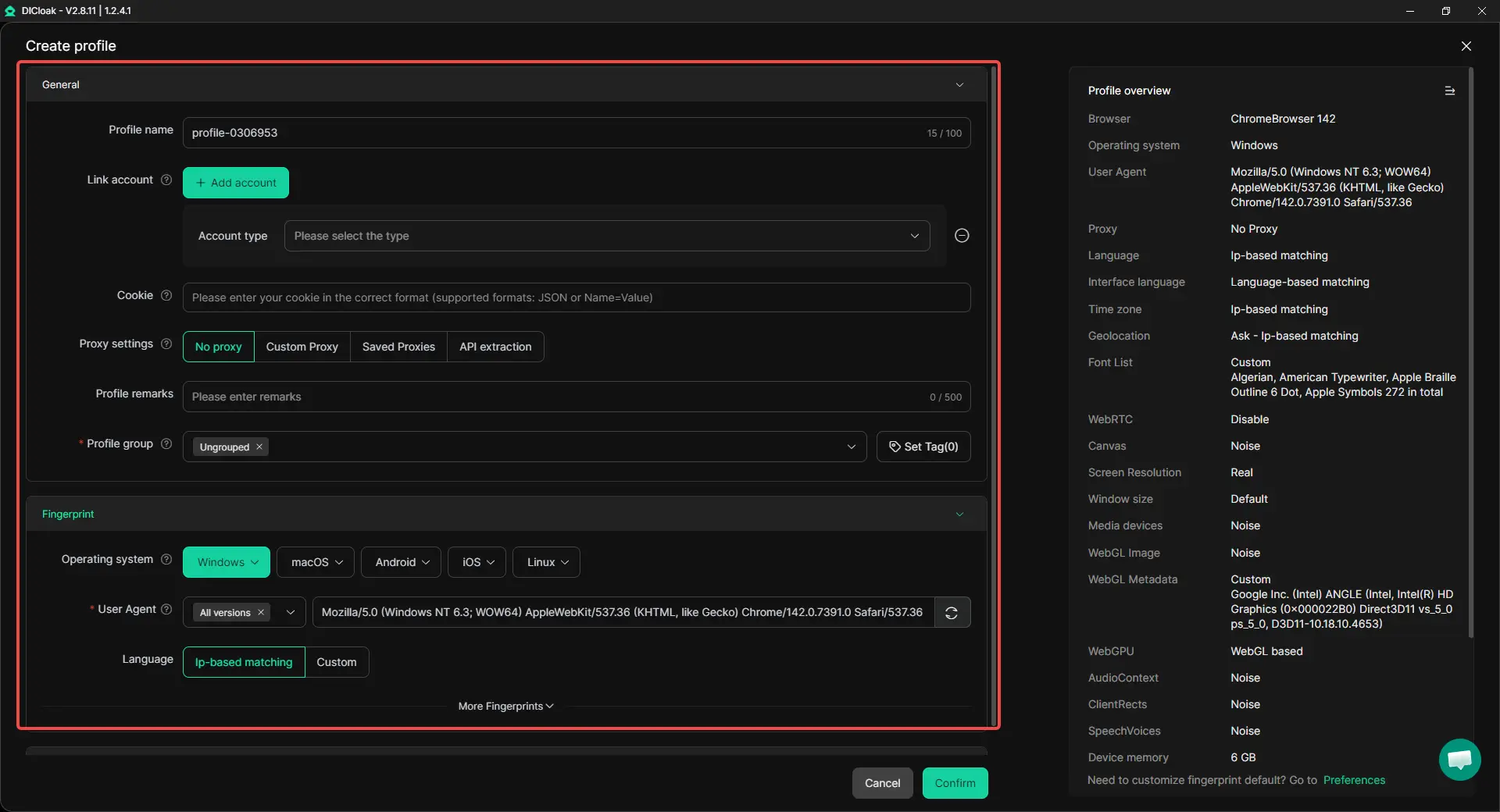
Unlike a spoofer, users can create fully isolated browser profiles with DICloak for different accounts. They can assign a dedicated HTTP, HTTPS, or SOCKS5 proxy to each profile, customize fingerprints, and simulate operating systems such as Windows, Mac, iOS, Android, and Linux. This gives users a more complete and independent browser profile for each account, while a basic IP spoofer usually only changes part of the network information.
Scaling Operations with Automation and RPA
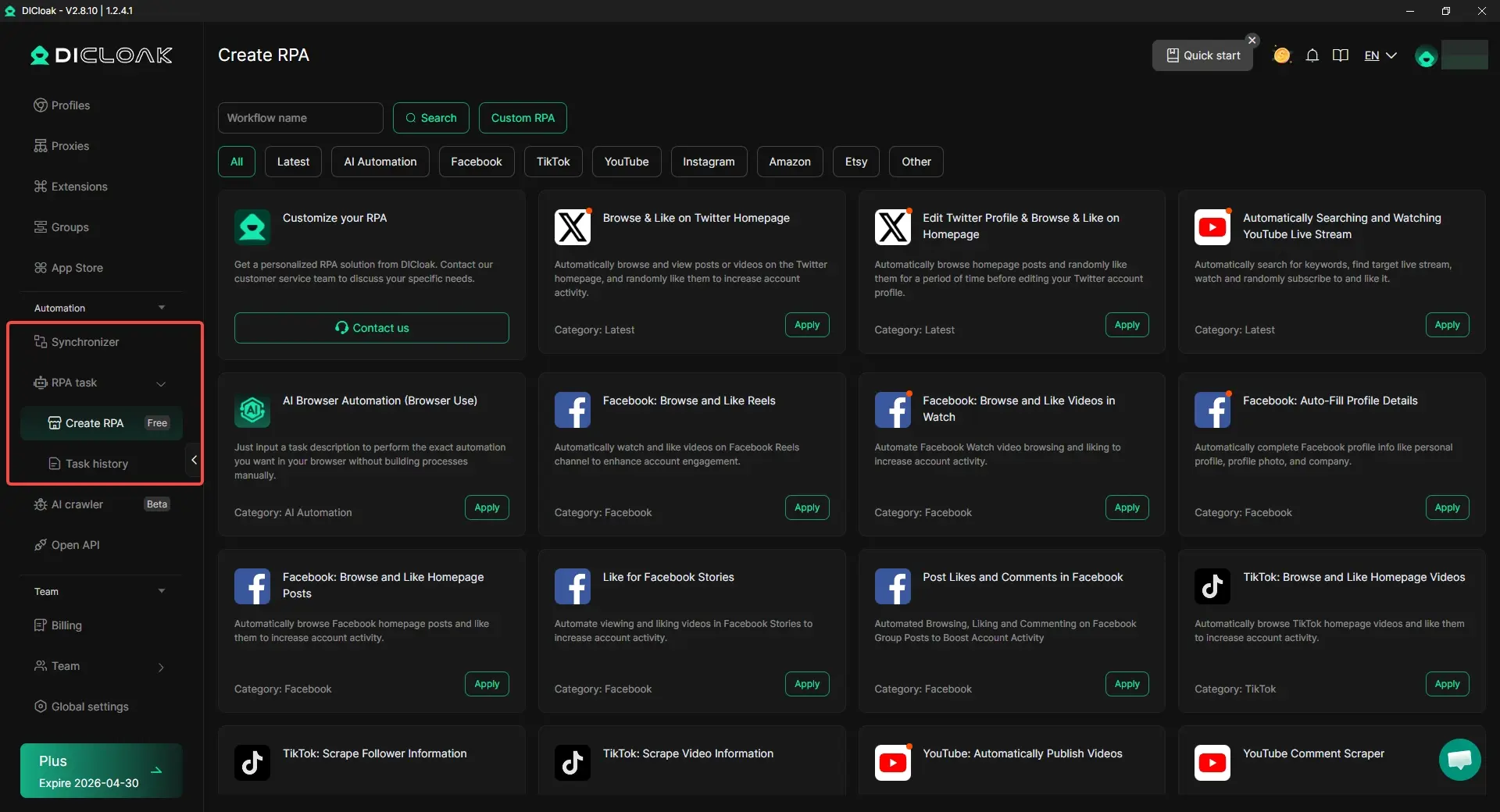
Professional setups utilize Robotic Process Automation (RPA) to automate the "grind" of account management. A key feature is the Synchronizer, which allows a user to perform an action in one "master" window and have it mirrored across hundreds of others simultaneously. This is the viable way to scale tasks like airdrop farming or bulk e-commerce management.
Team Collaboration and Data Isolation
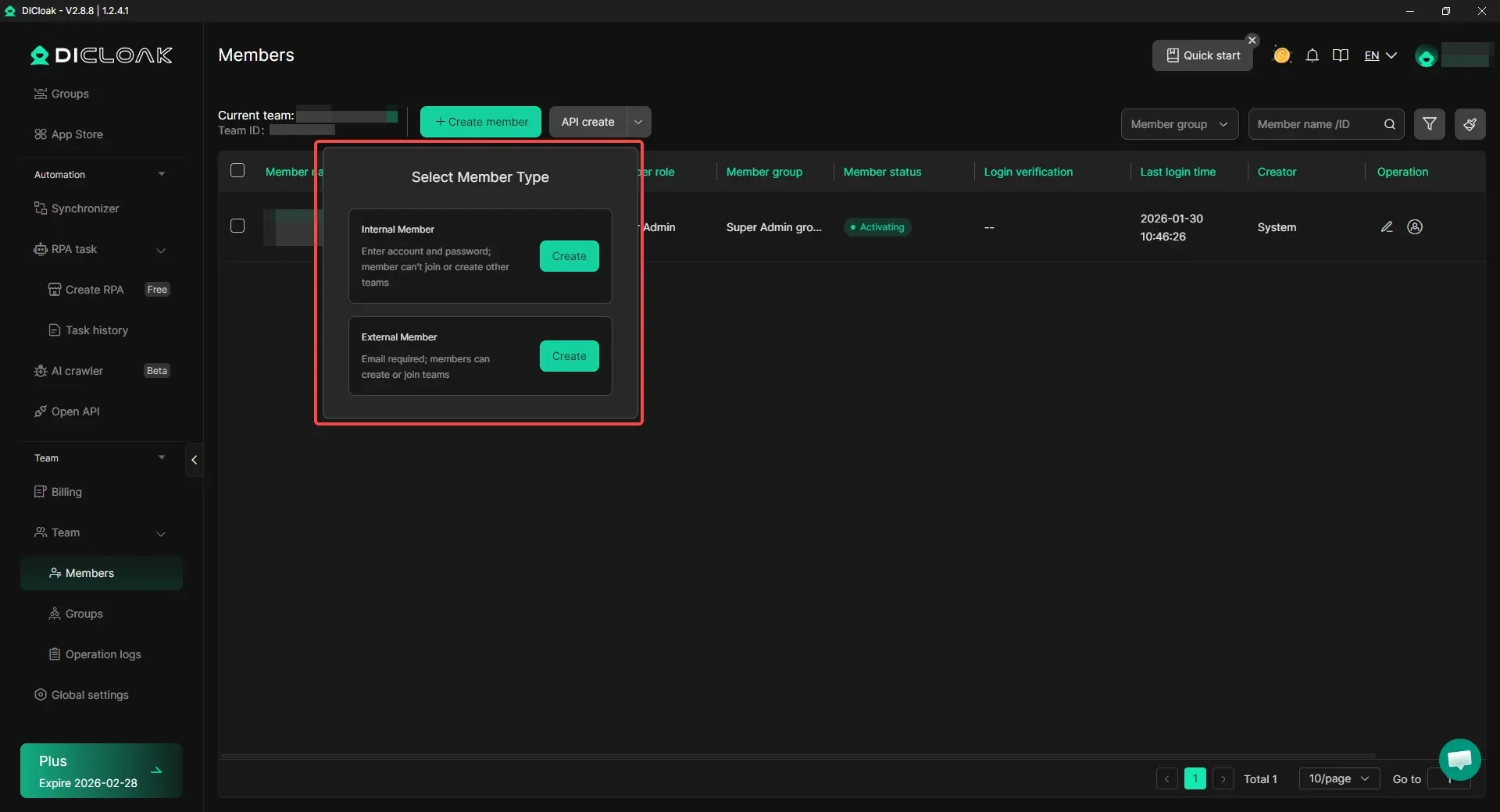
Modern workflows require team-based efficiency. Through DICloak, teams can set different access permissions, review operation logs, and keep account data isolated. This allows team members to work together on large numbers of accounts more safely, with a lower risk of account overlap, identity crossover, or security checks.
Final Summary of the 2026 Landscape
As we navigate 2026, the era of raw IP spoofing as a viable tool for identity masking is over. While it remains a critical concept for understanding network vulnerabilities and testing infrastructure resilience, it is no longer sufficient for the complexities of modern web platforms. For professionals requiring safety, stability, and scale—particularly in traffic arbitrage and e-commerce—the standard has shifted. The future lies in comprehensive antidetect solutions that provide total profile isolation, combining proxy management with deep browser fingerprint customization to ensure that every digital identity remains truly unique.
Common Questions About IP Spoofing (FAQ)
What is a concrete example of an IP spoofing attack?
The most common example is a Denial-of-Service (DoS) attack, where an attacker floods a server with packets featuring forged source addresses. The server exhausts its resources trying to process these fake requests, eventually crashing.
Can I use IP spoofing to browse the web anonymously?
No. Because spoofing is "one-way" and stateless, you cannot complete a TCP handshake. You would never receive the website's data back. For anonymity and two-way interaction, an antidetect browser with a high-quality proxy is required.
Is IP spoofing illegal?
The legality of IP spoofing depends on how it is used and the laws in a specific region. In some cases, security professionals may use it in authorized network testing or research. However, using it to bypass security controls, mislead systems, or support harmful online activity may violate platform rules, service terms, or local laws.
How do I prevent my own network from being used in a spoofing attack?
Adopt industry-standard "Defense in Depth." Implement ingress and egress filtering, use Network Segmentation to isolate critical assets, and enforce Multi-factor Authentication (MFA) to verify device identities.
What is the most effective tool for packet crafting?
Scapy and hping remain the gold standards. Scapy offers the most flexibility for Python-based automation, while hping is better for rapid command-line testing.
 Web Proxy Tools
 Free Tools
 Cookie Plugin
 UA Generator
 MAC Address Generator
 IP Generator
 IP Address List
 2FA Code Generator
 World Clock
 Anonymous Check
 WebRTC Leak Test
 UUID Generator
 Free Web Proxy Site
 Proxy Checker
 FB Ad Checker
 AI Web Scraping
 Free SMM Tools
 Twitter Shadowban Checker
 Instagram Name Checker
 UTM Generator
 Username Generator
 AI Hashtag Generator
 LinkedIn Headline Generator
 Social Media Image Resizer