Crypto fraud losses reached $5.6 billion in 2023, according to the FBI Internet Crime Report, and fake token claim pages keep targeting people who rush wallet actions. That is the core risk around the spark token airdrop: users often focus on “where to claim” before they verify whether they are even eligible.
Spark distribution rules come from Flare’s official channels, not social threads or direct messages. You can cross-check claim and distribution logic in Flare’s docs and network updates on the Flare website. If a page asks for your seed phrase, asks for blind signature approvals, or pushes urgency without matching official links, treat it as a scam attempt.
You are here for a practical outcome: confirm eligibility with the right wallet and snapshot context, claim SPK through trusted paths, and avoid the common mistakes that lock users out or expose funds. By the end, you should be able to verify a claim flow in minutes and reject risky links fast. Start with eligibility checks before connecting any wallet.
How can you verify a Spark token airdrop is real and still active?
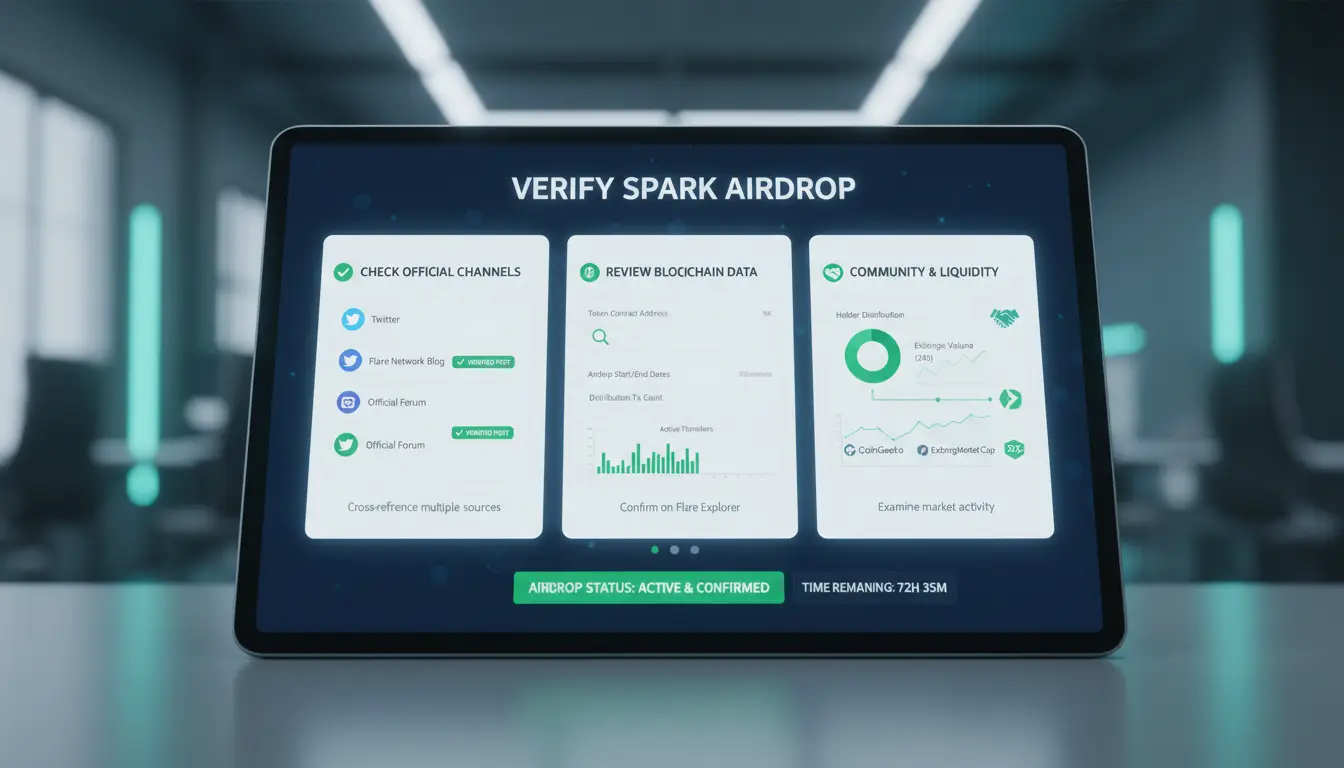
Use this quick process before you connect any wallet to a spark token airdrop page.
Check the official source before clicking any claim link
Open only links published on Flare’s official site or in Flare documentation. Do not trust links from replies, direct messages, or copied posts.
Then verify domain spelling character by character. Scam pages often swap one letter, add a dash, or use a different top-level domain. Check for HTTPS and confirm the exact claim URL appears in official Flare channels, such as the Flare Networks account.
For contract addresses, copy the address from official docs and compare the full string on your claim page. If one character differs, stop.
Look for status signals that an airdrop is active, ended, or delayed
Match three items in official updates: snapshot date, claim window, and unlock schedule. If a page asks you to claim but does not show those dates, treat it as untrusted.
Check dashboard banners for pause notices, maintenance windows, or distribution delays. An active campaign usually shows live claim status and clear timing notes.
Red flags that usually indicate a fake SPK airdrop page
Hard stop signals:
- Countdown pressure like “claim in 5 minutes or lose funds”
- Any request for seed phrase or private key
- Wallet approval asks for broad token spend rights unrelated to claiming
- Social profile name looks right, handle is slightly different
Copycat accounts trick new users by reposting real graphics with fake links. For any spark token airdrop, trust the source path, not the post design.
Who is eligible for the Spark token airdrop?
For the spark token airdrop, eligibility usually comes down to wallet state at snapshot time, required on-chain actions, and task completion recorded by official systems. Use only Flare docs and updates on the Flare website to verify rules for your campaign.
Typical eligibility factors: snapshots, wallet activity, and campaign tasks
- On-chain actions that may count toward eligibility A wallet may need to hold a required asset at snapshot time, delegate, bridge, or complete a campaign action on the correct chain. The exact action list can change by campaign.
- Why timing and wallet history can matter If tokens move before or after the snapshot window, that wallet can fail checks. Wallet history can also be reviewed for fake task patterns, rapid fund loops, or repeated claim behavior that looks automated.
Exchange users vs self-custody wallets: who gets included?
- How supported exchanges handle claims Some exchanges process distributions for eligible users and credit balances directly.
- When manual claiming is required for non-custodial wallets Self-custody users often need to connect to an official claim page and sign with the wallet that met eligibility.
| Holder type |
Included when |
Claim path |
Common miss |
| Supported exchange account |
Exchange joins the campaign and tracks eligible balances |
Auto credit by exchange |
Using an exchange that did not support that round |
| Self-custody wallet |
Wallet meets snapshot and task rules |
Manual claim via official portal |
Connecting a different wallet than the eligible one |
Common disqualification reasons and how to prevent them
- Missed snapshots, incomplete tasks, and wrong network usage Missing the snapshot block, skipping one required task, or doing actions on the wrong chain can void eligibility.
- Duplicate or suspicious activity patterns that trigger review Reused patterns across wallets can lead to review holds. Keep actions clean, one wallet per intended claim flow, and confirm network details in XRPL docs or Flare documentation before signing.
When can you claim SPK, and how is your Spark token airdrop amount calculated?
Understand snapshot dates, claim windows, and vesting schedules
Your claim timing depends on three dates: snapshot date, claim window open date, and claim deadline. Check them only on Flare docs and the Flare site, since social posts often mix old and new rounds.
| Distribution style |
What you receive |
What to check |
| One-time claim |
Full amount in one claim |
Exact deadline and supported wallet path |
| Phased distribution |
Part at claim, rest over time |
Vesting cadence, unlock rules, and claiming steps per phase |
If you miss the deadline, you usually lose that claim round. Some campaigns do not reopen claims. Treat the deadline as hard unless official docs say otherwise.
How allocation models usually work in SPK-style campaigns
A spark token airdrop amount is usually based on one model: fixed per eligible wallet, tiered by onchain activity, or a points score converted to tokens.
Community calculators can be wrong when they miss disqualifiers, cap rules, or wallet-level limits. Use official allocation notes, then estimate with your own wallet history. If your wallet changed after snapshot, that change often does not affect eligibility for that round.
Fees and network costs to plan before claiming
Plan for network fees before you claim. Gas can spike during claim hours, and failed transactions still cost gas on networks like Ethereum when the airdrop path uses it.
Keep a small extra balance for retries and confirmations. If the claim flow bridges assets or signs multiple transactions, budget for each step. For any spark token airdrop, run a small test transaction if the route allows it.
How do you claim the Spark token airdrop step by step without mistakes?
Use this flow for the spark token airdrop only through official links. Do not trust links from replies, ads, or direct messages.
Pre-claim setup checklist
- Confirm eligibility in Flare Docs and current notices on the Flare website.
- Open the same wallet address used for the snapshot or approved claim path. If the address is different, stop and verify before signing anything.
- Switch to the correct network in your wallet before you connect.
- Keep a small gas balance on that network. Claims fail if gas is empty, even when you are eligible.
- Back up recovery data offline. Never paste a seed phrase into any claim page.
- Check token contract details against official docs, then save the verified contract in your wallet watchlist to avoid fake token lookalikes.
Claim execution walkthrough
- Open the claim page only from official Flare links.
- Connect wallet, then verify three items before signing: connected address, network, and contract address.
- Read the wallet prompt line by line. If permission asks for unlimited token spend and the claim does not require it, reject and re-check.
- Approve only required actions, then submit the claim transaction.
- Copy the transaction hash right away.
- Track status on the network explorer linked by official Flare resources. Wait for on-chain confirmation before you refresh or retry.
- If one check does not match, cancel the transaction and restart from the official source page.
Post-claim verification and recovery steps
- Use the transaction hash to confirm success on explorer: status should be “Success,” with your wallet as recipient.
- If wallet UI does not show tokens, add the token contract manually from official docs and refresh balances.
- If transaction is pending, wait for network processing. Do not spam new claims.
- If transaction failed, open details and check failure reason: low gas, wrong network, or rejected signature are common.
- If tokens still look missing after confirmed success, verify you are viewing the exact claim address used in the spark token airdrop path.
Where do people get scammed during a Spark token airdrop, and how can you avoid it?
During a spark token airdrop, loss usually comes from fake claim links, bad signature requests, and rushed wallet actions. Use official links only: Flare docs and the Flare website.
Most common scam paths in SPK airdrop campaigns
| Check point |
Legit flow |
Scam flow |
| Claim URL |
Linked from official Flare channels |
Sent by DM, ads, or lookalike domains |
| Wallet prompt |
Clear network + contract details |
Blind signature or vague “Approve” |
| Recovery phrase request |
Never asked |
Asked on fake “verification” page |
- Fake claim dashboards, phishing messages, and impersonation Copycat pages often change one letter in the domain. Attackers also mimic support staff in Telegram or X and push urgency.
- Malicious smart contracts hidden behind cloned interfaces A cloned UI can still send approval to a hostile contract. Never enter your seed phrase on any claim page.
Wallet security controls that prevent major losses
- Use a separate claim wallet instead of your primary treasury wallet Keep claim activity isolated. If a claim wallet gets exposed, your main funds stay separate.
- Revoke risky approvals after claiming After claiming, review and revoke token approvals with tools like Revoke.cash. Also follow wallet hardening steps from MetaMask security guidance.
Behavior patterns that get accounts or wallets flagged
- Aggressive repetitive actions from identical environments Rapid repeated claims from the same setup can trigger anti-abuse checks.
- Why rushed multi-account setups can trigger reviews If you run multi-wallet claims, keep clean records, stable claim timing, and clear ownership logic. For spark token airdrop claims, speed is less useful than traceable, low-risk execution.
How can teams handle multiple wallets for a Spark token airdrop with lower detection risk?
Why shared devices and mixed login environments create risk
Teams often fail here: one browser, reused cookies, and changing IPs across wallets. That creates overlap between accounts that should look unrelated. A reviewer can flag this as coordinated behavior, even if your claim is valid. For a spark token airdrop, account separation is safer than speed.
| Workflow |
Typical signals |
Risk outcome |
| Shared browser + shared device |
Same fingerprint, mixed sessions, login crossover |
Manual review or claim rejection |
| Isolated profiles + fixed proxy per wallet |
Stable fingerprint per wallet, clean session boundaries |
Lower chance of cross-account linkage |
Use official claim paths only from Flare documentation and network notices on Flare.
Using DICloak to isolate wallet operations by profile
You can use DICloak to create one browser profile per wallet, then bind one proxy to each profile. Keep seed handling outside browser storage where possible, and never import multiple wallet secrets into one profile. This setup keeps cookies, local storage, and wallet sessions separated, so one operator mistake does not spread across all accounts.
How DICloak team features reduce operational mistakes
You can use team permissions so only approved members can open, edit, or transfer specific profiles. Keep profile sharing rules strict, and review operation logs before each claim window. For repeated steps, run batch actions or RPA automation to keep each claim flow consistent and reduce manual cross-login errors.
What should you do after receiving SPK tokens?
After a spark token airdrop, your next move should follow a plan, not a price spike on listing day.
Hold, stake, bridge, or sell: a practical decision framework
Match each choice to your lockup limits, liquidity needs, and downside tolerance. Do not go all-in on day one. Early trading can swing fast, and emotional moves are hard to undo.
| Option |
Use it when |
Main risk |
| Hold |
You want long-term exposure |
Drawdowns |
| Stake |
You want yield and can lock funds |
Lock period + slashing rules |
| Bridge |
You need another chain’s apps/liquidity |
Bridge smart contract risk |
| Sell |
You need cash or want lower exposure |
Missing later upside |
If you handle multiple wallets, mistakes often happen during repetitive claim and transfer steps. You can use tools like DICloak to map each wallet to an isolated browser profile with a unique fingerprint and dedicated proxy, which cuts wallet linkage signals.
You can use DICloak team permissions, profile sharing controls, and operation logs to prevent cross-access errors. For repeated steps, batch actions or RPA flows keep the process consistent and reduce manual slips.
How token utility and ecosystem plans affect long-term value
Check utility before chasing candles: governance rights, incentive design, and real DeFi use. Track updates in Flare docs and network releases on Flare. Monitor on-chain activity and protocol traction with DefiLlama.
Recordkeeping basics for taxes and compliance
Store claim timestamp, wallet address, transaction hash, and transfer history from day one. For price references, use a public tracker like CoinGecko. Tax treatment of a spark token airdrop can differ by country, so keep clean records before filing.
What if you missed the Spark token airdrop?
If you missed a claim window, don’t rush into random links. For any spark token airdrop, missed deadlines are usually final unless Flare posts a new round through official channels.
How to confirm whether your wallet was actually ineligible
Re-check the exact rules and snapshot date in Flare Docs and updates on the Flare website. Match those rules to your wallet history, not screenshots from social media.
Then verify your own on-chain records in Flare Explorer: wallet address, transaction time, and qualifying action. If your action happened after the snapshot, eligibility will not apply. Trust chain data over chat claims.
Ways to prepare for future Spark ecosystem distributions
Track only official announcements from Flare and set alerts for claim windows. Keep one clean wallet for airdrops, with small test funds for gas. Store claim deadlines in your calendar and set two reminders before cutoff.
How to avoid chasing low-quality airdrop rumors
Use a quick checklist before spending fees: official domain, matching docs, verified contract address, and no seed phrase request. Skip “urgent” claim pages that cannot be confirmed on Flare channels. Focus on recurring ecosystem tasks and governance updates, not hype spikes.
Frequently Asked Questions
Is the spark token airdrop legal in every country?
No. The spark token airdrop can be legal in one place and restricted in another. Rules change based on local crypto laws, whether the token is treated as a security, and sanctions or KYC rules. Some exchanges also block residents from certain countries. Check your local regulator and tax authority before you claim.
Can I join the spark token airdrop from an exchange account instead of a self-custody wallet?
You can use an exchange account only when that exchange officially supports the spark token airdrop. In supported cases, the exchange usually takes the snapshot and credits tokens automatically. If support is missing, you may get nothing, because manual claiming often needs wallet signatures and on-chain actions that exchange users cannot perform.
How much gas should I keep ready for a spark token airdrop claim?
For a spark token airdrop claim, keep more gas than the current estimate. A practical buffer is two to three times the shown fee, plus extra native coins for retries. For example, if a claim looks cheap now, congestion can spike before confirmation and make the same transaction fail.
Will I lose my spark token airdrop if I claim late?
Late claims follow the campaign’s exact rules. Some teams add a grace window after the main deadline, while others close the claim contract at a fixed block time. Once closed, unclaimed spark token airdrop allocations are often burned or moved to a treasury. Read the official claim page and contract dates early.
Do I need to report spark token airdrop rewards for taxes?
In many regions, yes. Tax agencies often treat airdropped tokens as income when you gain control of them, using market value at claim time. Later, selling or swapping can create capital gains or losses. Record your claim date, wallet address, transaction hash, and local-currency value, then share that log with a tax professional.
The Spark token airdrop can be a valuable opportunity, but the biggest takeaway is that careful preparation matters more than hype. By confirming eligibility early, using only official claim channels, and tracking distribution timelines, you can reduce risk and increase what you receive.
Try DICloak For Free
 Web Proxy Tools
 Free Tools
 Cookie Plugin
 UA Generator
 MAC Address Generator
 IP Generator
 IP Address List
 2FA Code Generator
 World Clock
 Anonymous Check
 WebRTC Leak Test
 UUID Generator
 Free Web Proxy Site
 Proxy Checker
 FB Ad Checker
 AI Web Scraping
 Free SMM Tools
 Twitter Shadowban Checker
 Instagram Name Checker
 UTM Generator
 Username Generator
 AI Hashtag Generator
 LinkedIn Headline Generator
 Social Media Image Resizer