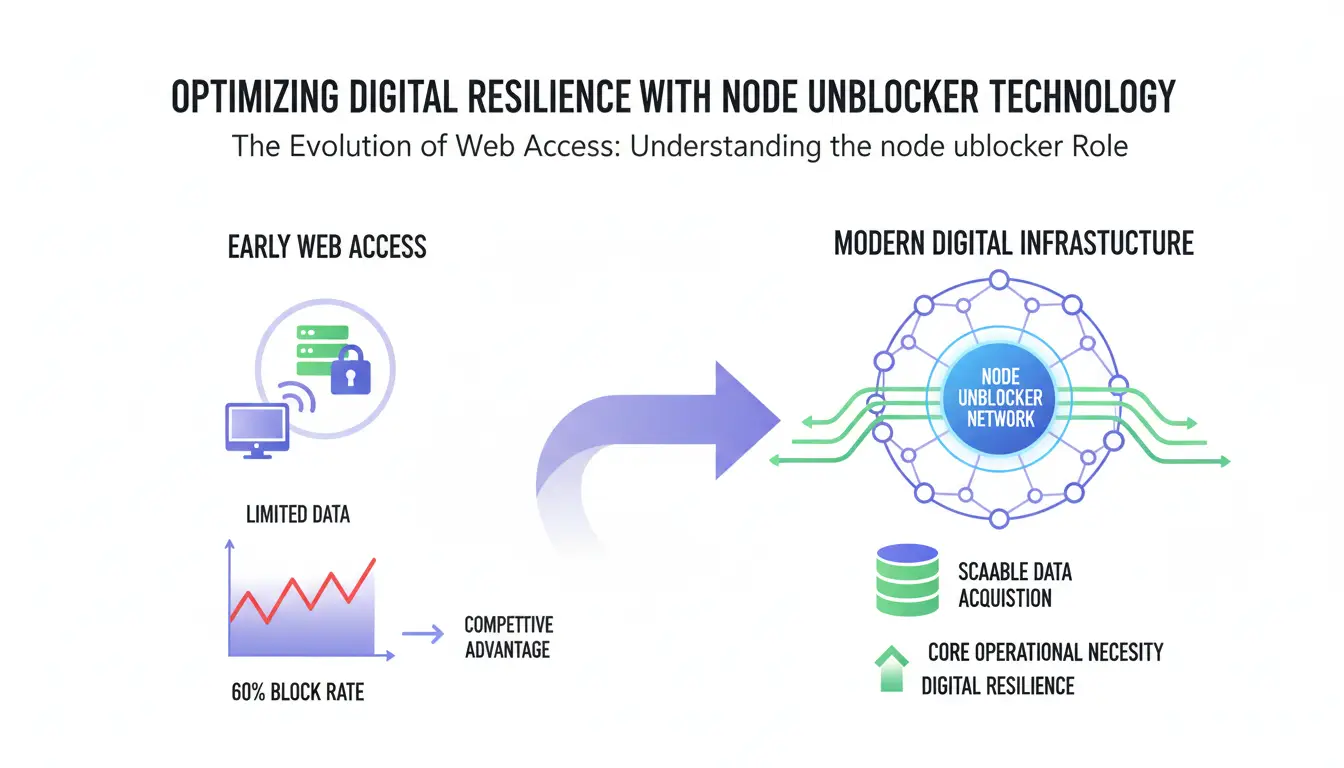
The Evolution of Web Access: Understanding the node unblocker Role
Web data acquisition has transitioned from a competitive advantage to a core operational necessity. However, the environment has become increasingly hostile; recent data indicates that approximately 60% of web scraping projects now face significant access restrictions. These failures are not merely technical hurdles—businesses lose an estimated $5 billion annually due to access failures and the resulting data gaps.
The "node unblocker" has emerged as a specialized response to these challenges. Defined as a middleware-based proxy solution, it operates as an application-level interception layer within a Node.js stack. Unlike traditional network-wide shifts, which often lack the granularity required for modern security bypass, node unblocker focuses on network isolation and IP protection. By intercepting traffic at the application layer, organizations can achieve a higher degree of flexibility and stealth, reducing the footprint that typically triggers automated defensive systems.
The Architectural Core of node unblocker Middleware
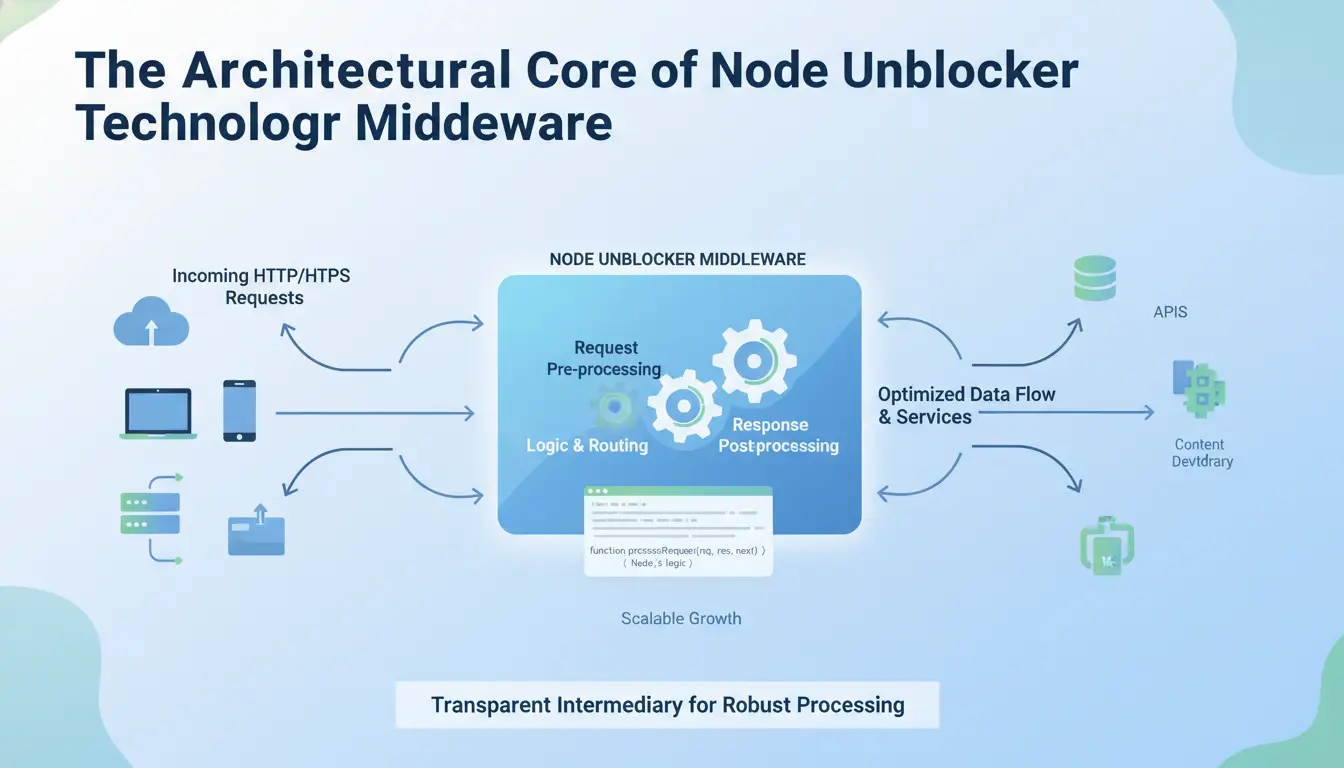
The technical efficacy of node unblocker logic is rooted in its ability to function as a transparent intermediary. By leveraging the Node.js ecosystem, it creates a robust request processing pipeline that manages the complexities of HTTP/HTTPS communication with high efficiency.
The Request Processing Pipeline
The middleware intercepts and modifies outgoing requests to strip away identifying markers. A senior-level implementation utilizes connection pooling and request queuing to manage resource allocation effectively. Because Node.js utilizes an event-driven, non-blocking I/O model, the system can maintain high concurrency without the overhead of traditional multi-threaded architectures. This is critical for preventing "Event Loop Lag," a common performance bottleneck where synchronous operations block the execution thread, leading to increased latency and potential service timeouts.
Memory Management and Streaming Handlers
Handling large data responses requires sophisticated memory management. Senior engineers implement streaming handlers to process data in chunks, preventing the system from attempting to load massive payloads into the heap at once. This approach, combined with transparent SSL/TLS handling, ensures that the middleware processes secure content delivery without triggering certificate-related security warnings on target servers.
Why Modern Platforms Detect and Block Standard Access
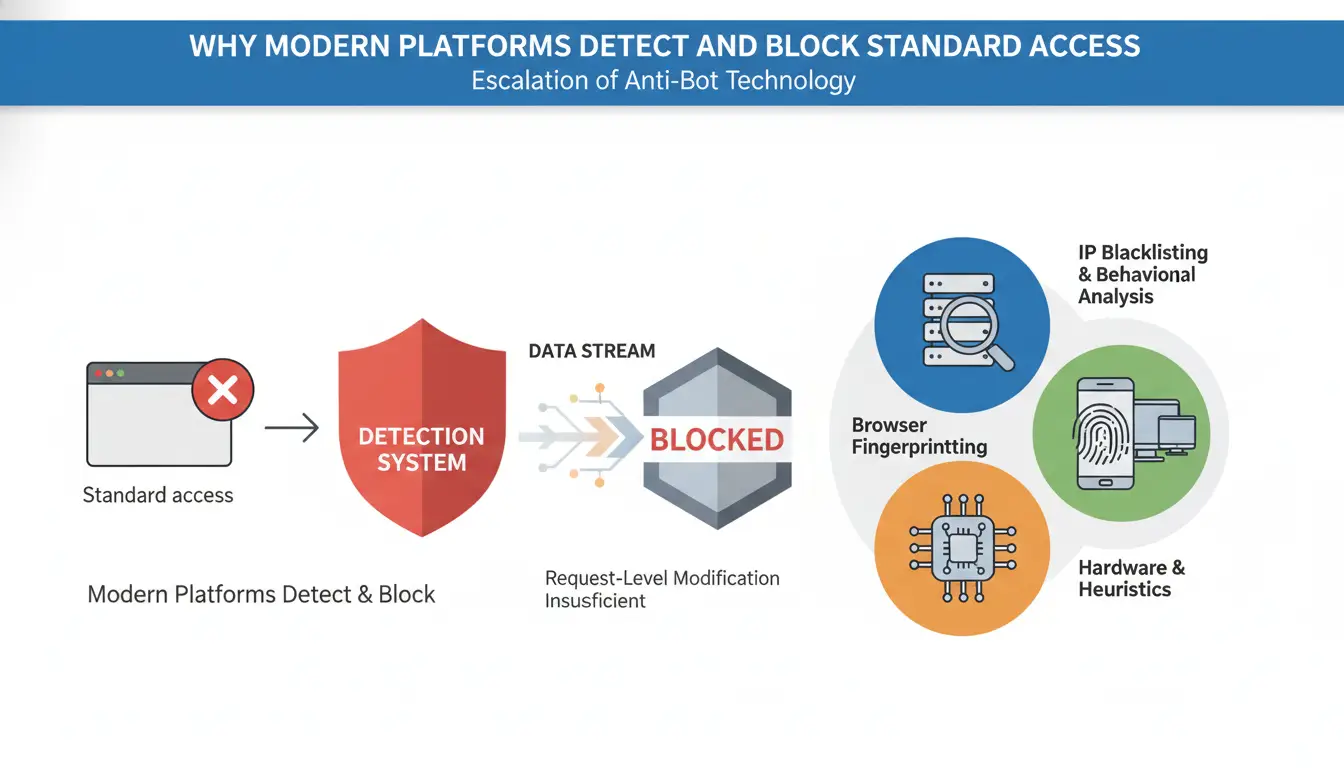
The escalation of anti-bot technology has shifted detection from simple IP blacklisting to sophisticated behavioral and hardware analysis.
Standard middleware solutions operate at the request level, modifying headers like User-Agent or Referer. However, modern platforms employ client-side JavaScript execution to gather data points such as Canvas hashes, device IDs, and screen resolutions. This "fingerprinting" occurs within the browser profile, meaning a middleware proxy alone cannot mask these signals. If a platform detects consistent hardware identifiers across different IP addresses, the traffic is flagged as "unnatural" and blocked.
Beyond fingerprints, systems evaluate the signal of the IP itself. There is a stark contrast in reputation between datacenter IPs and residential IPs. Datacenter signals are often pre-flagged as bot-originated. High-resilience workflows require strict network isolation to ensure that traffic patterns do not exhibit the "bursty" characteristics typical of automated scripts.
Pro-Tip: Avoid mixing residential and datacenter proxy types in a single workflow. Inconsistent network signals across a single session are a high-confidence indicator for bot detection algorithms and will lead to immediate IP flagging.
Scaling Operations with node unblocker and Proxy Management
Transitioning from local scripts to enterprise-scale operations requires an 85% success rate to remain economically viable. Achieving this requires a transition from simple unblocking to comprehensive proxy management and rotation.
Consider an operational scenario where a team manages 50 separate e-commerce accounts. Without advanced isolation, these accounts are susceptible to "association." Platforms identify linked accounts not just by IP, but through JA3 signatures (TLS fingerprints) and consistent header ordering. If one account is banned, a "domino effect" occurs where all accounts sharing that specific TLS signature or fingerprint are purged simultaneously. Successful scaling requires rotating these signals as aggressively as the IPs themselves.
How node unblocker Logic Enhances Digital Growth Workflows
Integrating unblocker logic into social media marketing or affiliate models provides a layer of security that traditional tools lack.
Automating Multi-Account Security
The strategic implementation of this logic focuses on isolating browser profiles. By ensuring that every account session has a unique, persistent hardware profile, teams can simulate legitimate user behavior. DICloak is the industry-standard implementation tool for this logic, providing the necessary environment isolation to reduce the risk of cross-contamination between profiles.
Strategic IP Rotation and Rate Limiting
Automation must be tempered with intelligent retry mechanisms and rate limiting. By implementing logic that mimics human pacing and utilizes diverse IP pools, organizations prevent resource exhaustion and avoid the algorithmic "red flags" triggered by high-frequency, repetitive requests.
Strategic Comparison: Standard Access vs. DICloak
| Feature |
Standard Proxy/Unblocker Methods |
DICloak Implementation |
| Fingerprint Masking |
Basic header modification; high detection risk from JS-level checks. |
Automated isolation of Canvas fingerprints, WebGL, and hardware IDs. |
| Multi-Account Isolation |
Limited; vulnerable to JA3 and TLS fingerprint association. |
Full, hardware-level environment isolation for every profile. |
| Automation API |
Requires manual integration of various npm packages. |
Unified API designed for enterprise-scale account orchestration. |
Evaluating the Pros and Cons of node unblocker Solutions
While node unblocker is highly versatile, an objective analysis reveals specific operational limits that senior analysts must account for.
Pros
- Lightweight and Customizablility: High degree of customization via the npm ecosystem for bespoke header handling.
- Asynchronous Efficiency: The Node.js event loop handles thousands of concurrent I/O-bound connections effectively.
- Modern Protocol Support: 2024 updates include native support for WebSockets and improved HTTPS handling.
Cons
- AI Detection Vulnerability: Middleware alone cannot defeat AI-powered client-side verification or behavioral analysis.
- Event Loop Sensitivity: Improperly managed CPU-intensive tasks (like complex content transformation) cause "Event Loop Lag," stalling all concurrent requests.
- Computational Limits: For high-intensity workloads involving physics or AI, Node.js can be less efficient than lower-level languages.
Technical Advisory
When complex data transformations or heavy computations are required, senior engineers often offload these workloads to worker threads or migrate specific services to Go or .NET to maintain infrastructure responsiveness.
Best Practices for Risk Mitigation and Compliance
To maintain long-term digital resilience, the following industry practices are mandatory:
- Intelligent Caching: Implement caching of static resources to reduce the load on both the proxy and the target server, improving performance and reducing the detection footprint.
- Worker Thread Utilization: Move any non-I/O tasks to worker threads to ensure the main Node.js event loop remains dedicated to handling incoming connections.
- Request Filtering: Deploy strict filters to prevent the proxy from being used for unauthorized or abusive activities.
- Robust Logging: Maintain detailed logs to monitor for patterns of blocking (e.g., a sudden spike in 403 errors), allowing for real-time rotation strategy adjustments.
Pro-Tip: Digital resilience does not grant immunity from legal frameworks. Ensure all automation complies with platform Terms of Service and data privacy regulations to avoid permanent legal and operational repercussions.
Frequently Asked Questions about node unblocker Implementation
How does a node unblocker differ from a standard proxy?
A standard proxy is a routing tool. A node unblocker is a middleware layer that actively inspects and modifies the request/response lifecycle at the application level, allowing for header manipulation and content transformation that simple proxies cannot perform.
Can node unblocker handle WebSocket connections?
Yes. Recent 2024 benchmarks confirm that current implementations fully support WebSocket connections, which is essential for modern real-time data streams and interactive web applications.
Why do some sites still detect my scraper?
Most detection occurs at the client-side via JavaScript. Since node unblocker operates at the request level, it cannot hide the browser’s "fingerprint" (like Canvas hashes). If the site executes a script to check your hardware ID, a middleware proxy will not be enough to prevent detection.
What is the most reliable way to manage 100+ profiles?
At enterprise scale, simple middleware is insufficient. You must transition to specialized environment isolation tools like DICloak. These tools ensure that each of the 100+ profiles has a unique TLS fingerprint and hardware profile, preventing the "association" that leads to mass account bans.
Conclusion: The Future of Network Isolation Technology
As we progress into 2025 and 2026, the primary challenge for digital growth will be the rise of AI-powered behavioral detection and dynamic browser verification. Success in this landscape requires a multi-layered approach. While the flexible middleware logic of a node unblocker is excellent for I/O-bound request management, it must be paired with robust environment isolation tools like DICloak to address client-side fingerprinting. For organizations seeking scalable growth, the synergy between request-level flexibility and environment-level isolation is the only viable path toward true digital resilience.
 Web Proxy Tools
 Free Tools
 Cookie Plugin
 UA Generator
 MAC Address Generator
 IP Generator
 IP Address List
 2FA Code Generator
 World Clock
 Anonymous Check
 WebRTC Leak Test
 UUID Generator
 Free Web Proxy Site
 Proxy Checker
 FB Ad Checker
 AI Web Scraping
 Free SMM Tools
 Twitter Shadowban Checker
 Instagram Name Checker
 UTM Generator
 Username Generator
 AI Hashtag Generator
 LinkedIn Headline Generator
 Social Media Image Resizer