Does ProxySite keep logs? For its public web proxy, the published answer is yes, within a defined window. ProxySite's privacy policy says it uses automated monitoring for URLs accessed through the public service and keeps those logs for 14 days before automatic deletion.
That sentence is more useful than a broad promise about anonymous browsing. It tells us what is recorded, why the record exists, and how long the stated retention period lasts. It also sets a limit on what users should assume: the public proxy is not presented as a zero-record service.
This guide reads the current policy in plain English. It separates ProxySite's statements from technical inference and gives a task-by-task way to decide when a public web proxy is an acceptable tool.

The short answer: ProxySite 14-day logs exist
The ProxySite privacy policy says the public web proxy uses an automated system to monitor URLs for abuse. It states that logs are retained for 14 days and then automatically deleted.
Three details matter:
- The statement applies to the public web proxy.
- The stated purpose is URL abuse monitoring.
- The published retention period is 14 days.
So the answer to "does ProxySite keep logs" is not "no." A more accurate answer is: the service says it keeps public-proxy URL monitoring logs for 14 days.
The policy also says ProxySite does not sell personal information and does not look at or capture data passing through its networks. Those are the provider's claims. They do not cancel the separate 14-day statement, and they should not be rewritten as a blanket no-log promise.
What the ProxySite privacy policy separates
The policy covers more than one product surface. Mixing those surfaces creates most of the confusion around ProxySite logging policy.
| Policy area |
What the page says |
What a careful reader should infer |
| Public web proxy |
Automated URL abuse monitoring; logs kept for 14 days |
Public proxy use leaves a temporary provider-side record under the stated process |
| Premium or private services |
The policy describes no traffic logs for those services |
This claim should not be copied onto the free public proxy |
| ProxySite website logs |
Log files can include IP address, browser, ISP, timestamps, referral or exit pages, and clicks |
Visiting the website can create ordinary site-level records apart from proxied-page activity |
| Cookies and advertising |
The policy discusses cookies and third-party advertising technology |
Browser storage and ad-related tracking deserve a separate review |
Public proxy URL monitoring is a narrow but real record
The wording names URLs and abuse monitoring. It does not publish a full field-by-field schema for the retained log, and it does not explain every internal access control around that data. A reader should not invent either a larger collection system or a smaller one.
The defensible statement is narrow: URL activity used by the public proxy is subject to an automated monitoring log with a 14-day retention period.
That window may be acceptable for reading a public page that contains no personal data. It is a different decision for a confidential document, a work account, a payment session, or a page whose URL itself exposes private information.
Website analytics are not the same as proxy traffic
The same privacy page describes standard website log information, including IP address, browser type, internet provider, time data, referral and exit pages, and click counts. It also discusses cookies and advertising partners.
These records belong to the website and advertising context described in the policy. They should not be silently merged with the public proxy's URL log. They still matter because a user reaches the public proxy through the website, but the categories answer different questions.
One question is "what may be recorded when I visit ProxySite.com?" Another is "what does the public proxy retain about requested URLs?" The policy has language relevant to both.
What IP masking does and does not cover
The ProxySite homepage presents the service as an intermediary: a user submits a destination, ProxySite retrieves it, and the destination sees the proxy connection rather than a direct request from the user's public IP. The page also advertises SSL connections and lists US and EU proxy endpoints.
That model can hide the user's direct IP address from the destination page. It does not make the proxy disappear from the path.
The distinction can be stated without drama:
- The destination site normally sees the proxy endpoint for requests sent through the service.
- ProxySite receives the user's request because it must act on that request.
- The provider's own policy, not the word "anonymous," defines its stated logging practice.
- Cookies, account logins, page scripts, and other identifiers can still identify a returning session or signed-in user.
- A web proxy covers pages loaded through its interface; it does not automatically reroute every connection made by the device.
SSL is also easy to overread. An encrypted browser connection helps protect data while it travels between the browser and the service endpoint. It does not turn a public intermediary into a party that the user no longer needs to trust.
For a simple public article, that trade may be reasonable. For a password, private message, customer record, or payment detail, the cost of choosing the wrong intermediary is much higher.
Is ProxySite anonymous in the way you need?
"Anonymous" can refer to several separate properties. A useful check asks which property the task actually needs.
| Need |
What a public web proxy may provide |
What remains outside that promise |
| Hide a direct IP from a destination page |
The request can arrive from a proxy endpoint |
The proxy provider still handles the request |
| Open a public page through another endpoint |
Browser-based routing with no local installation |
Availability, speed, and page compatibility are not guaranteed |
| Remove every identifying signal |
No such promise appears in the cited policy |
Cookies, logins, browser data, and site behavior can still identify a session |
| Leave no provider-side record |
The public policy does not promise this |
It states a 14-day URL monitoring log |
| Protect every app on a device |
A web proxy acts on pages opened through its interface |
Other apps and direct browser tabs use their own network paths |
This is why the question "is ProxySite anonymous" needs a scope. It may mask a direct IP from a destination during a proxied page request. That is not the same as eliminating provider logs, account identity, browser identifiers, or device-wide traffic exposure.
A task-by-task risk guide
The ProxySite terms of service provide the service as-is and do not guarantee uptime, speed, locations, or quality. The terms also restrict abuse, allow limits or suspension, and require lawful use.
Those terms support a practical split between low-risk access and sensitive work.
Reasonable low-risk cases
- Reading a public page that does not require a login
- Checking whether a public site loads through a listed US or EU endpoint
- Viewing non-confidential reference material on a network where the access is permitted
- Testing a public page with no personal data entered
Cases that deserve a different route
- Banking, payment, health, tax, or identity records
- Work email, customer dashboards, admin panels, or private cloud files
- Entering passwords, recovery codes, card data, or private messages
- Downloading executable files from a source that has not been verified
- Any task where the requested URL itself exposes confidential information
- Any use that conflicts with local law, network policy, or the destination site's terms
This list is not a claim that a bad event will occur. It is a decision rule: a free public intermediary with a stated log window is a poor place to add high-impact credentials or private business data.
If a proxied page asks for a login, stop and reassess. Open the service directly through a trusted connection, verify the domain and certificate, and use the security path approved for that account.
A separate browser-profile workflow for teams using DICloak
Logging by a public web proxy and separation of browser sessions are different problems. Changing a browser profile does not erase ProxySite logs. Using ProxySite does not create durable separation between a team's account sessions.
Some teams need a separate operational setup for assigned accounts. DICloak's browser profile documentation describes distinct profiles with their own browser settings and stored session data. Its proxy configuration guide describes how an operator can attach and test a user-provided proxy for a profile.
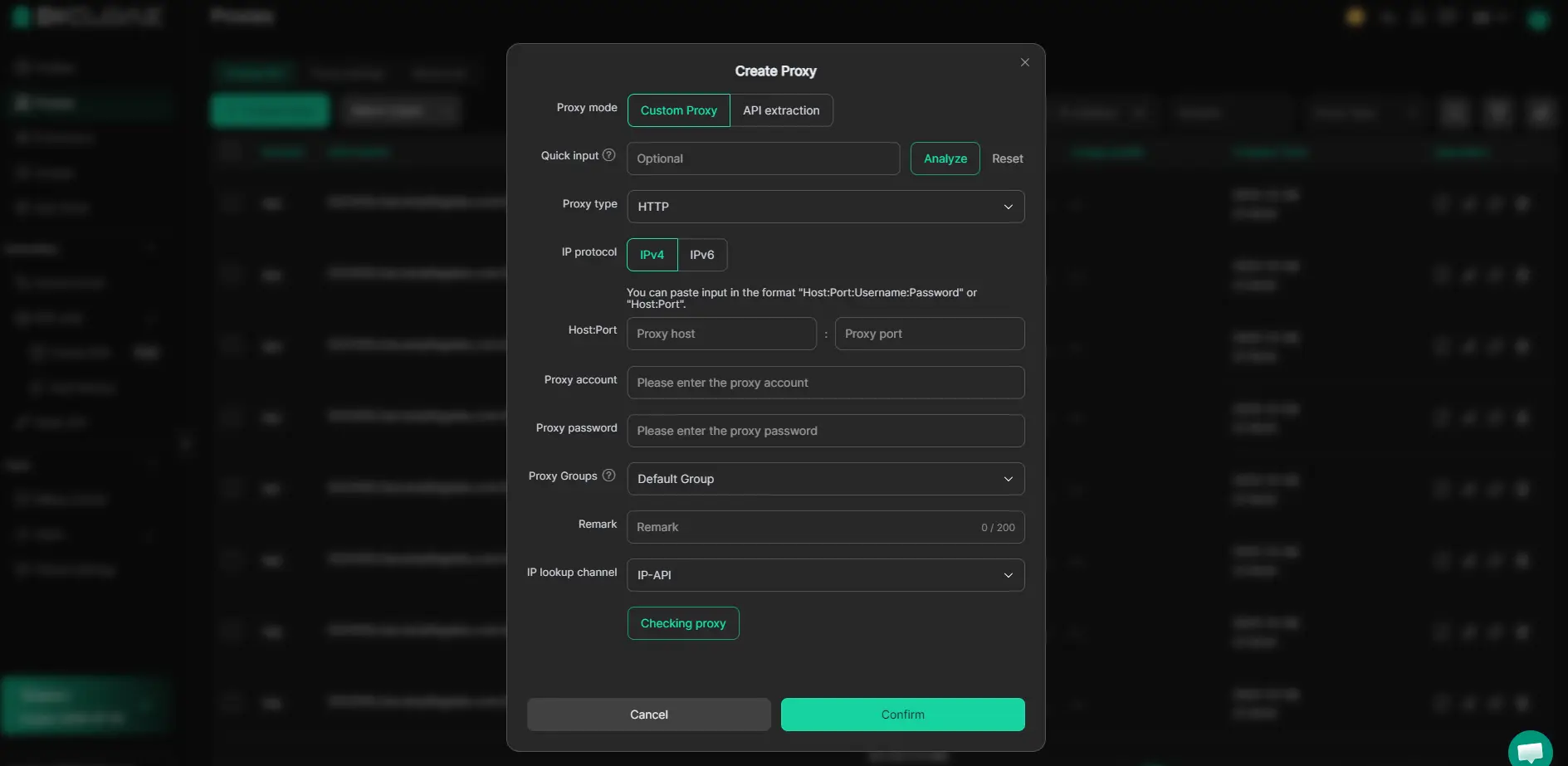
Teams can review the current product boundary on the DICloak website before deciding whether that separate profile workflow fits their work.
The boundary matters:
- DICloak is not ProxySite and cannot change ProxySite's privacy policy.
- Proxy resources come from the operator or another provider, outside DICloak.
- A profile workflow addresses browser-session organization and configured profile settings.
- Trust in the selected proxy provider remains a separate decision.
For a team, this means evaluating two layers independently. Choose a network intermediary whose policy fits the data being handled. Then decide whether separate browser profiles, access controls, and assigned sessions are needed for the work.
A practical reading of the policy
ProxySite is easy to use because the product reduces setup to a destination field and a server choice. Convenience is the main strength of that design. The privacy decision still belongs to the user.
A sound reading of the public documents looks like this:
- ProxySite says its public proxy keeps URL abuse-monitoring logs for 14 days.
- It separately says premium or private services do not keep traffic logs.
- It describes website log files and advertising cookies in another part of the policy.
- It claims SSL support and IP masking, but those features do not amount to a zero-record guarantee.
- Its terms reserve service limits and provide no promise of uninterrupted quality.
Use the public proxy for tasks whose sensitivity matches those facts. If the job involves an account, confidential data, or a lasting business session, choose a path designed and approved for that job.
Frequently Asked Questions
Does ProxySite keep logs of public proxy use?
Yes, according to its current privacy policy. The page says automated URL abuse-monitoring logs for the public web proxy are retained for 14 days and then automatically deleted.
Does ProxySite hide my IP address from the destination website?
For a page successfully loaded through the proxy, the destination normally receives the request from the proxy endpoint rather than from the user's direct public IP. ProxySite remains the intermediary handling that request.
Does the 14-day period mean every trace is deleted everywhere?
The published statement describes automatic deletion of the specified logs after 14 days. It does not provide a technical audit, backup map, or field-level deletion report. Treat the statement as the provider's policy claim within its stated scope.
Is ProxySite suitable for banking or confidential work?
A public proxy with a stated monitoring log is not a sensible route for high-sensitivity sessions. Use a direct, trusted connection and the security process approved by the account or organization.
Does closing the ProxySite tab delete server logs?
No such behavior is promised. Closing a tab removes the active page from the local browser view; it does not override the provider's server-side retention process.
Is DICloak a replacement for ProxySite?
No. Teams use DICloak for browser-profile workflows and can configure proxies obtained elsewhere. That workflow is not the ProxySite public web proxy and cannot alter another provider's logs.
The clearest answer remains the narrow one: ProxySite's public web proxy has a stated 14-day URL monitoring log. Decide from that fact, the sensitivity of the task, and the trust required by the data involved.
 Web Proxy Tools
 Free Tools
 Cookie Plugin
 UA Generator
 MAC Address Generator
 IP Generator
 IP Address List
 2FA Code Generator
 World Clock
 Anonymous Check
 WebRTC Leak Test
 UUID Generator
 Free Web Proxy Site
 Proxy Checker
 FB Ad Checker
 AI Web Scraping
 Free SMM Tools
 Twitter Shadowban Checker
 Instagram Name Checker
 UTM Generator
 Username Generator
 AI Hashtag Generator
 LinkedIn Headline Generator
 Social Media Image Resizer