Beyond Simple IP Masking: The 2026 Reality of Using an Antidetect Browser for eBay Sellers
In 2026, hiding your IP address is only the first step. It is no longer a complete solution. eBay’s security systems have evolved. They now look at your entire digital identity, not just where you connect from. If you run a business with multiple storefronts, relying on old tricks like proxies is dangerous. You need a dedicated Antidetect Browser for eBay Sellers to survive. This tool creates a secure wall around each account. It stops eBay from linking your stores together and protects your revenue.
The Evolution of eBay’s Fraud Detection in 2026
Years ago, eBay simply checked for duplicate addresses or matching credit cards. Today, the algorithm is much more aggressive. We can see a massive shift toward "fingerprinting." This technology scans your computer's hardware details. It checks your screen resolution, installed fonts, and even how your graphics card draws images via the Canvas API.
If you use the same computer for five different accounts, eBay sees the same hardware fingerprint five times. It does not matter if you change your IP address. The hardware ID remains the same. This triggers an immediate link. When the system detects this match, it suspends all associated accounts to prevent fraud.
Modern detection also tracks behavioral metrics. They monitor mouse movements and typing speeds to see if a human is really behind the screen. You need advanced browser fingerprinting protection to look like a unique user on a unique device for every single login. Tools like DICloak specialize in spoofing these hardware signals so each profile appears as a completely different physical machine.
Why Incognito Mode and Clearing Cookies Leads to Immediate Suspensions
Many new sellers think "Incognito Mode" is safe. This is a fatal mistake. Incognito mode tells eBay you have no history. A real, trusted buyer has cookies. They have a browsing history. When you log in from a blank slate every time, you look suspicious. You look like a bot or a fraudster trying to hide.
eBay expects to see data. When you clear your cookies constantly, you trigger security flags. The system asks, "Why is this user hiding their tracks?" This often leads to a password reset request or the dreaded MC011 restriction.
To succeed, you need a profile that saves data permanently. A high-quality Antidetect Browser for eBay Sellers keeps your cookies intact between sessions. It lets you build a reputation over time. We call this "seasoning" or warming up. Using a cookie warm up bot helps generate this history automatically before you even list your first item. This makes your account look established and trustworthy, rather than empty and risky.
The High Stakes of Multi-Accounting: Protecting Your Business Continuity
Managing one store is difficult. Managing ten requires military precision. The biggest risk in this business model is the "Domino Effect." If eBay bans one account, they immediately look for links to ban your other stores. This can destroy your cash flow overnight.
Since the full rollout of eBay managed payments multi account systems, financial tracking is tighter than ever. You cannot share bank accounts, and you definitely cannot share digital footprints. To stay safe, you must use static residential proxies for eBay. These proxies look like real home internet connections and do not change. Rotating IPs are risky because they might switch to a blacklisted address in the middle of a transaction.
Professional sellers use infrastructure tools to isolate these elements. DICloak, for example, ensures that each store gets its own proxy, its own fingerprint, and its own cookies. This separation ensures that if one store goes down, the others stay alive. It is the only way to protect your business continuity in 2026.
Why Stealth Accounts Fail Without a Dedicated Antidetect Browser for eBay Sellers
Protecting your IP address is only the first step. In 2026, eBay’s security goes much deeper than just your internet connection. It scans your actual hardware. If you buy a high-quality stealth account but log in using a standard Chrome or Firefox browser, you will likely be banned within days.
This happens because standard browsers leak your device's physical identity. eBay sees the "container" you are using, not just the connection. To succeed, you must hide the machine itself. You need an Antidetect Browser for eBay Sellers to ensure that every storefront appears to run on a completely different computer. Without this layer of protection, your accounts are easily linked and suspended.
Canvas and WebGL Fingerprinting: How eBay Identifies Your Hardware
eBay does not just read text cookies; it asks your computer to perform complex tasks in the background. The most common method is Canvas Fingerprinting. The website commands your graphics card (GPU) to draw a hidden image.
Because every graphics card processes lighting and textures slightly differently, this image acts like a unique serial number for your device. If you run ten different eBay accounts on one laptop, they all produce the exact same image hash. eBay detects this match immediately. This is the leading cause of failure for sellers trying to separate their stores.
You cannot turn this off in a regular browser without breaking the website. The only solution is avoiding eBay account linking by using a specialized tool. Advanced software like DICloak uses "noise injection." It alters the drawing data slightly for every profile. To eBay, it looks like ten distinct users on ten different machines, even though you are managing them all from one dashboard.
The MC011 Flag: Behavioral Analysis and the Scrutiny of New Accounts
The MC011 restriction is the most feared flag for dropshippers and resellers. It freezes your funds and demands proof of identity. While often triggered by shipping issues, it is frequently caused by suspicious login behavior.
eBay monitors your "trust score." A normal user has a browser history, saved cookies, and a consistent cache. If you try to manage multiple accounts by using "Incognito Mode" or clearing your cookies constantly, you look like a bot. You are effectively erasing your reputation every time you log out.
An Antidetect Browser for eBay Sellers solves this by creating a permanent, isolated environment for each account. It saves your cookies and cache securely. When you open a profile in DICloak, you resume exactly where you left off. This consistent history signals to eBay’s algorithm that you are a stable, returning user, significantly lowering the risk of an MC011 audit.
Device Proximity and Font Enumeration: The Hidden Leaks
Sophisticated tracking also looks at the small details of your system configuration. One powerful tracking method is Font Enumeration. Your browser can list every font installed on your operating system. A graphic designer will have a different list of fonts than a gamer. This unique list creates a highly specific fingerprint.
Another major leak is the mismatch between your connection and your device settings. If you use a Residential Proxy located in New York, but your computer’s system time is set to London, eBay flags the discrepancy instantly.
Professional tools handle these technical settings automatically. DICloak helps your profile's timezone, language, and geolocation strictly match your proxy IP. It also standardizes your font list to look like a generic Windows or macOS user. By aligning these "soft" data points, you blend in with the crowd and avoid the red flags that catch amateur sellers.
The Science of Profile Isolation in an Antidetect Browser for eBay Sellers
Fixing fonts and timezones manually is impossible at scale. You cannot change your computer's graphic card ten times a day. This is why professional merchants rely on software to handle the heavy lifting. An Antidetect Browser for eBay Sellers does not just hide your identity. It builds a completely new one.
This software creates a virtual environment called a "profile." Each profile acts like a separate computer. It has its own cookies, local storage, and digital fingerprint. When you use a tool like DICloak, eBay sees distinct devices logging in from different locations, even though you are sitting at one desk. This isolation is the only way to safely run multiple stores without triggering an immediate link.
Creating Unique Digital DNA: Spoofing vs. Noise Injection
In the past, privacy tools tried to stop tracking by blocking requests. They would tell a website, "I will not show you my screen resolution." For an eBay seller, this is dangerous. A real buyer does not hide their screen size. If you block these checks, eBay’s fraud filters flag you immediately as "suspicious" or a bot.
Modern browser fingerprinting protection works differently. It uses a technique called "Noise Injection." instead of blocking data, the browser alters it slightly.
When eBay asks for your Canvas fingerprint (how your computer draws an image), the browser intercepts the request. It adds a tiny, invisible layer of random noise to the image code. The image looks the same to the human eye, but the data code is unique.
- Old Method (Blocking): eBay sees "Access Denied." Result: Account Flagged.
- New Method (Noise): eBay sees "Device A," then "Device B." Result: Valid User.
This allows you to pass as a legitimate user with a unique WebGL fingerprint for every account you own.
Static Residential Proxies for eBay: Maintaining Network Reputation
A perfect browser profile is useless if you connect from a data center IP address. eBay knows that real people do not shop from Amazon AWS or DigitalOcean servers. Using those cheap IPs is the fastest way to get banned.
You must use static residential proxies for eBay operations. These are IP addresses assigned by real Internet Service Providers (like Verizon or AT&T) to real homes. To eBay, your traffic looks exactly like a normal customer browsing from their living room.
The "Static" part is critical. Normal home users do not change their IP address every five minutes. If your IP rotates constantly while you are listing items, it triggers a security alert. Top-tier browsers allow you to bind one specific static residential IP to one specific profile. This ensures that every time you open "Store #1," you connect from the exact same digital location, building a trusted history over time.
Mobile Fingerprint Emulation: Why eBay Trusts Handheld Devices More
A growing trend in 2026 is mimicking mobile devices. Fraud detection algorithms are often more lenient towards traffic coming from smartphones. It is much harder to run automated scraping bots on a phone than on a server, so eBay inherently trusts these signals more.
Advanced antidetect browsers can emulate a mobile environment entirely. They change the "User Agent" string to tell eBay you are using an iPhone 16 or a Samsung Galaxy. More importantly, they adjust the screen resolution and touch events.
When you click your mouse, the browser translates that action into a "touch" event. It mimics the swipe and tap behavior of a finger on a screen. By mixing mobile profiles into your Multi-Accounting strategy, you diversify your digital footprint and lower the risk of a blanket ban across all your stores.
Comparing the Top 6 Tools for an Antidetect Browser for eBay Sellers
We have established that mobile fingerprints and static proxies are vital. Now, you need the right software to manage them. Choosing the best Antidetect Browser for eBay Sellers is not about finding the cheapest option. It is about finding a tool that protects your revenue.
If your browser software leaks your real IP address or crashes during a listing, you lose money. You need a platform that handles browser fingerprinting protection reliably while allowing your team to work together. Many professional sellers start with an antidetect browser free trial to test stability before moving their entire business.
Here is a comparison of the top tools available in 2026.
| Tool Name |
Best For |
Free Trial / Plan |
Starting Price |
| DICloak |
Secure Scaling & Team Ops |
5 Profiles (Free Forever) |
$8/mo |
| Incogniton |
User-Friendly Interface |
10 Profiles (2 Months) |
$19.99/mo |
| Browser.lol |
Instant Disposable Sessions |
Ad-supported Free Tier |
$9/mo |
| Octo Browser |
Technical E-Commerce |
No Free Plan |
€10/mo |
| MoreLogin |
Cloud Phone Emulation |
2 Profiles (Free Forever) |
$9/mo |
| Hidemium |
Mobile/PC Hybrid |
5 Profiles (Free Forever) |
$15/mo |
DICloak: The Secure Standard for Multi-Account Isolation
DICloak is the premier choice for serious eBay businesses. It focuses on the most critical aspect of multi-accounting: security and team safety. While other tools focus on colorful interfaces, DICloak focuses on the backend code that prevents leaks. It allows you to manage over 1,000 accounts reducing the risk of the profiles "bleeding" data into each other.
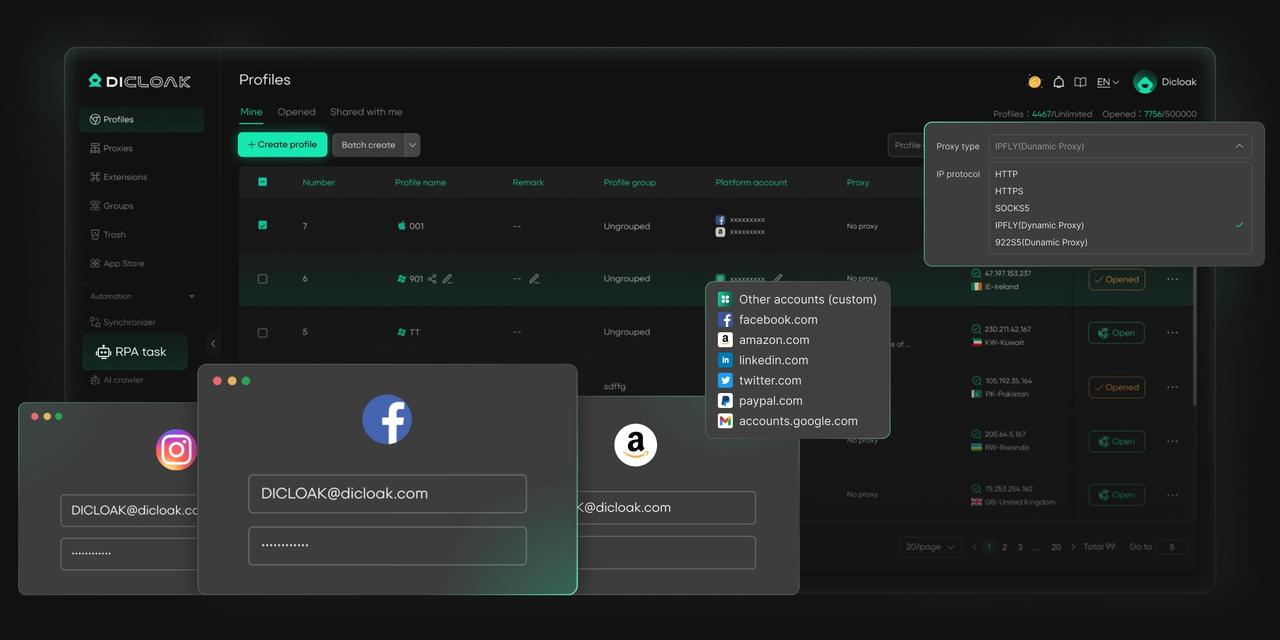
The standout feature for eBay sellers is the RPA Automation. You can set up workflows to automatically browse eBay, scroll through listings, and click random items to "warm up" your cookies before you ever log in to sell. This mimics human behavior perfectly. Additionally, the Team Collaboration features let you share access with Virtual Assistants without revealing your passwords or real IP address.
Key Features:
- Deep Fingerprint Control: Customizes Canvas, WebGL, and AudioContext to look like real unique devices.
- Team Permissions: Granular control over who can access which store.
Price: A generous Free Plan (5 profiles), with a Base Plan at $8/month (20 profiles).
Verdict: The secure and scalable Antidetect Browser for eBay Sellers currently on the market.
Incogniton: Streamlined Interface for Stealth Operations
Incogniton has built a strong reputation among newer sellers because it is easy to learn. The interface is clean and does not overwhelm you with technical settings immediately. It focuses on helping you launch profiles quickly.
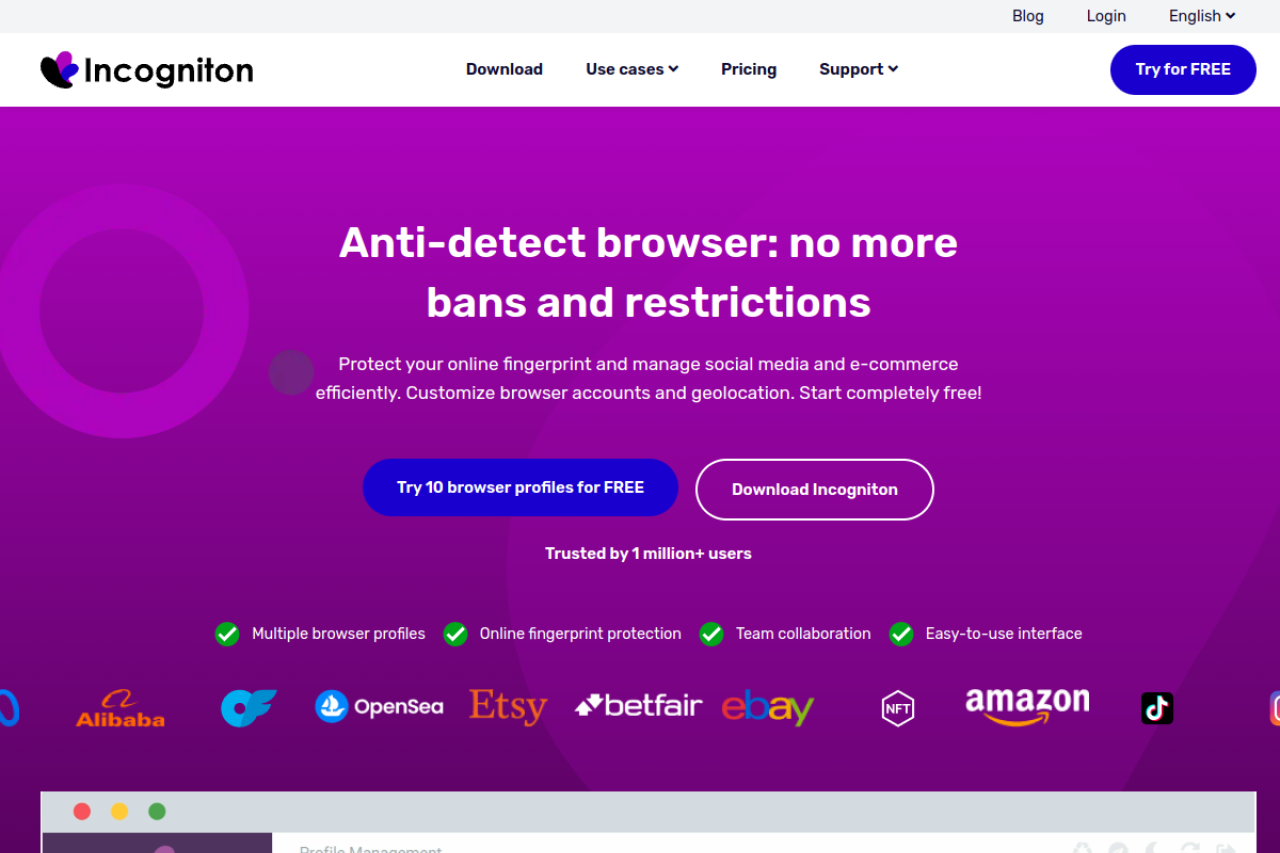
For an eBay seller, the Data Synchronization feature is helpful. It ensures that your cookies and tabs save correctly across devices. If you work from a laptop and a desktop, your session follows you. It also supports Selenium for users who want to write their own custom scripts.
Key Features: easy import and export of JSON cookies.
Price: Starter Plus at $19.99/month.
Pros: Very easy to use for beginners.
Cons: Can become expensive as you scale to hundreds of profiles compared to DICloak.
Verdict: A solid entry-level tool with a user-friendly design.
Browser.lol: Immediate Virtual Access via Disposable Sessions
Browser.lol takes a different approach. Instead of installing heavy software on your computer, it runs the browser in the cloud. You access it through your own web browser. This acts like a remote desktop for browsing.
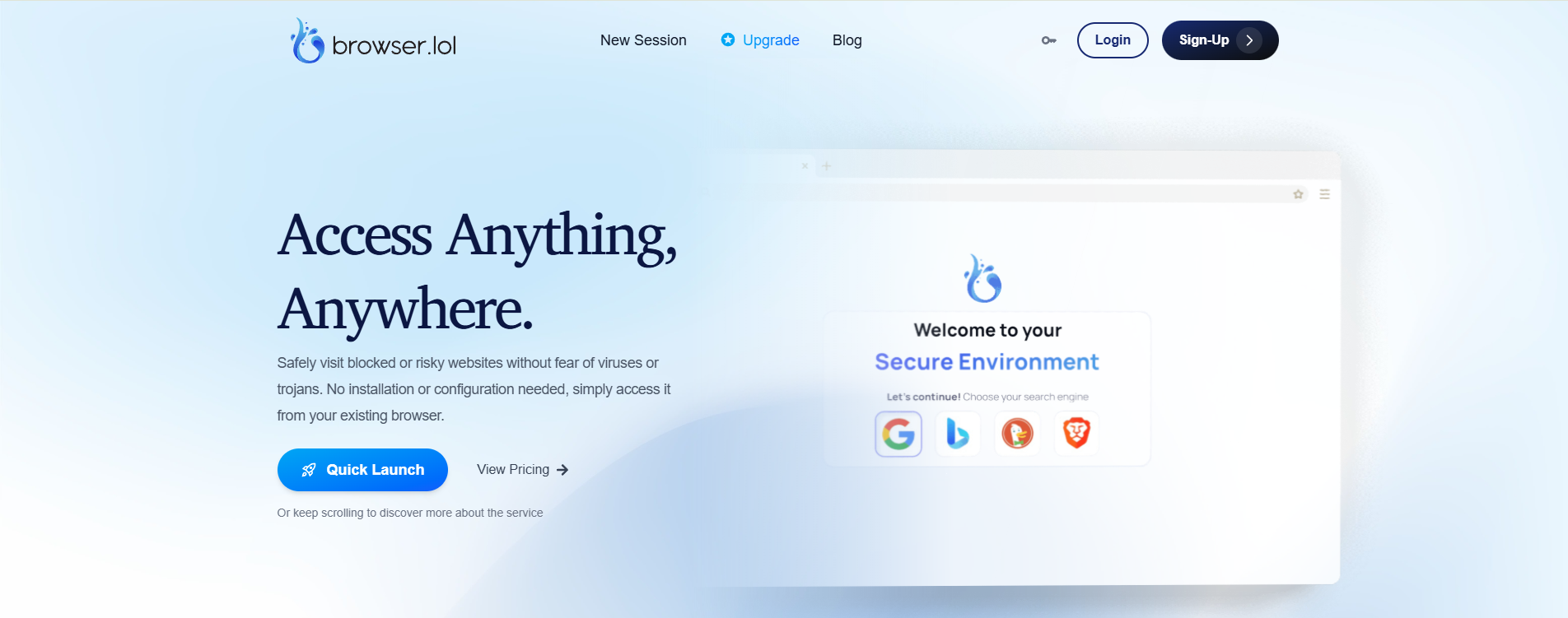
This is useful for quick checks. If you need to check if your eBay listing is visible from a different region, you can spin up a Browser.lol session instantly. However, for long-term store management, relying purely on disposable cloud sessions can be risky if the "persistence" (saving your data) fails.
Key Features: Run it from Chrome or Edge.
Price: $9/month for Premium.
Pros: Zero hardware footprint; good for quick tasks.
Cons: Less control over deep fingerprint settings than installed apps.
Verdict: Excellent as a supporting tool for quick verification tasks.
Octo Browser: Technical Precision for E-Commerce Models
Octo Browser is designed for power users who understand the technical details of browser fingerprinting. It is widely used in affiliate marketing and fits eBay sellers who need granular control over every parameter.
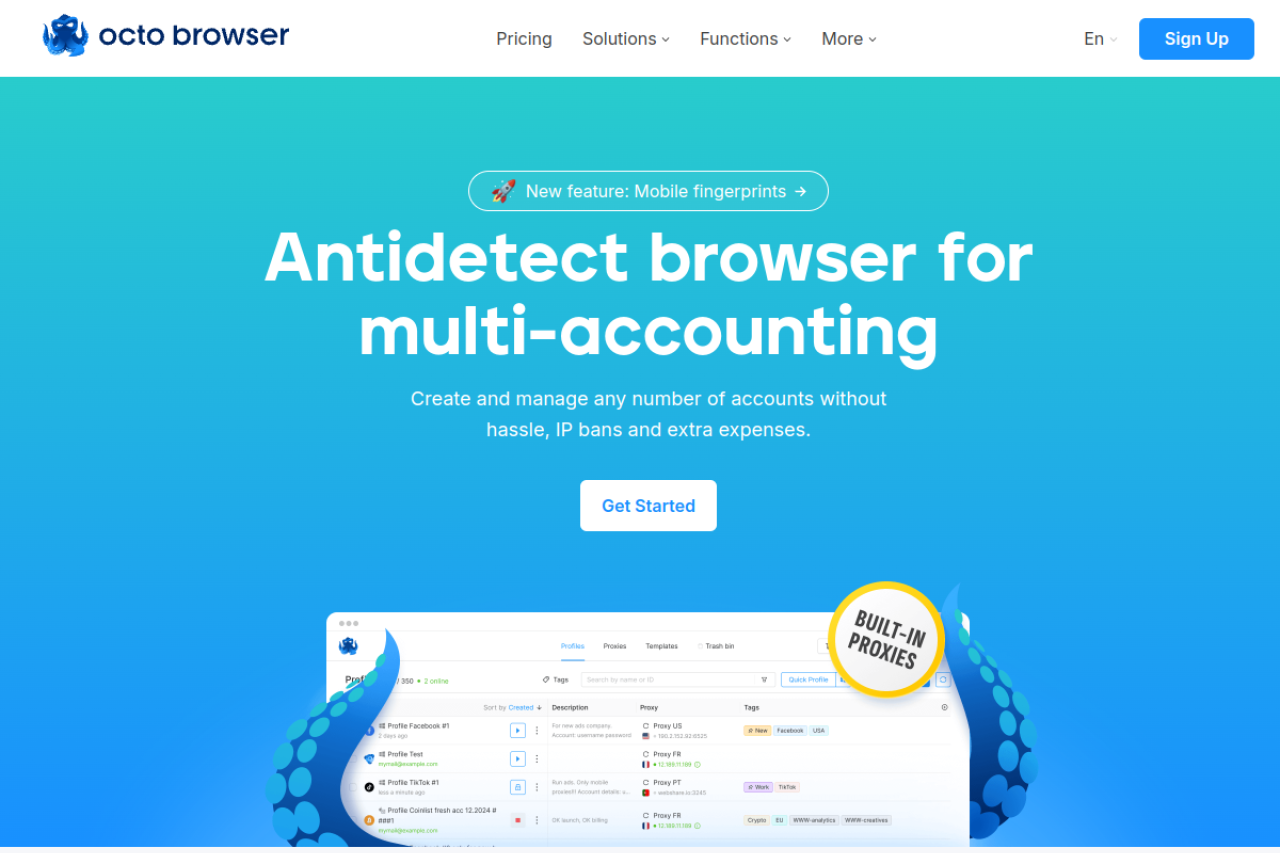
Octo uses a custom browser core based on Chromium. The downside to new businesses is the cost. There is no free plan, which raises the barrier to entry.
Key Features: Real Device Fingerprints with Using a database of real system configs.
Price: Starts at €10/month (Lite).
Pros: High-quality spoofing technology.
Cons: Pricing is in Euros and higher than competitors; no free tier.
Verdict: A premium, robust tool for sellers with a budget.
MoreLogin: Cloud-Based Phone Emulation and Syncing
MoreLogin addresses the "Mobile Trust" factor directly. It offers a specialized feature specifically for mimicking mobile environments. As we discussed, eBay trusts mobile traffic more than desktop traffic.
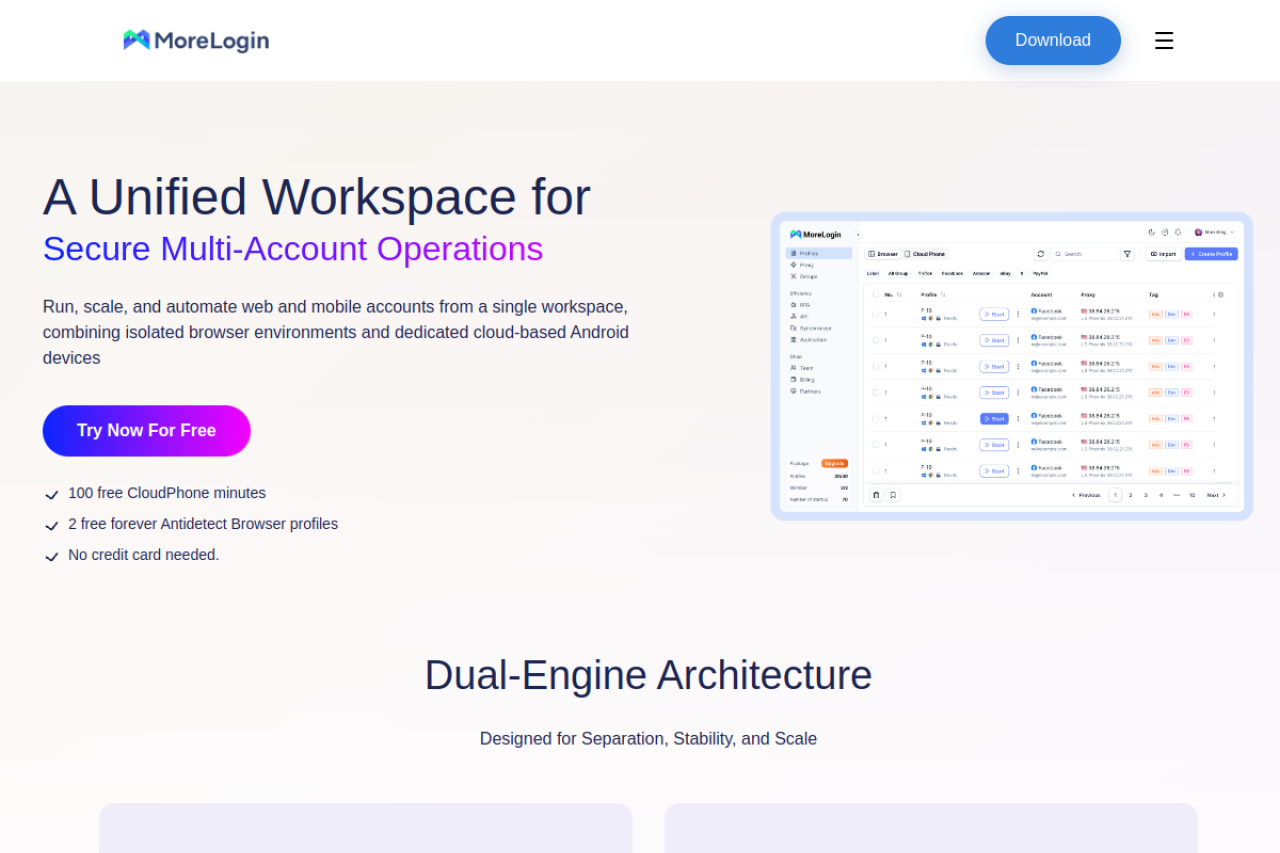
The tool allows you to create profiles that appear as Android or iOS devices. This is not just changing the User Agent string; it simulates the screen size and touch inputs. This can be a game-changer for avoiding the MC011 flag on new accounts.
Key Features: Run virtual phones in the browser.
Price: Pro plan starts at $9/month.
Pros: Excellent for mobile-first stealth strategies.
Cons: The interface can be complex for users used to standard browsers.
Verdict: The best choice if your strategy relies heavily on mobile app emulation.
Hidemium: Combining Mobile/Desktop Profiles for Trust
Hidemium is a versatile tool that attempts to bridge the gap between automation and manual management. It supports both mobile and computer profiles, allowing you to diversify your account farm.
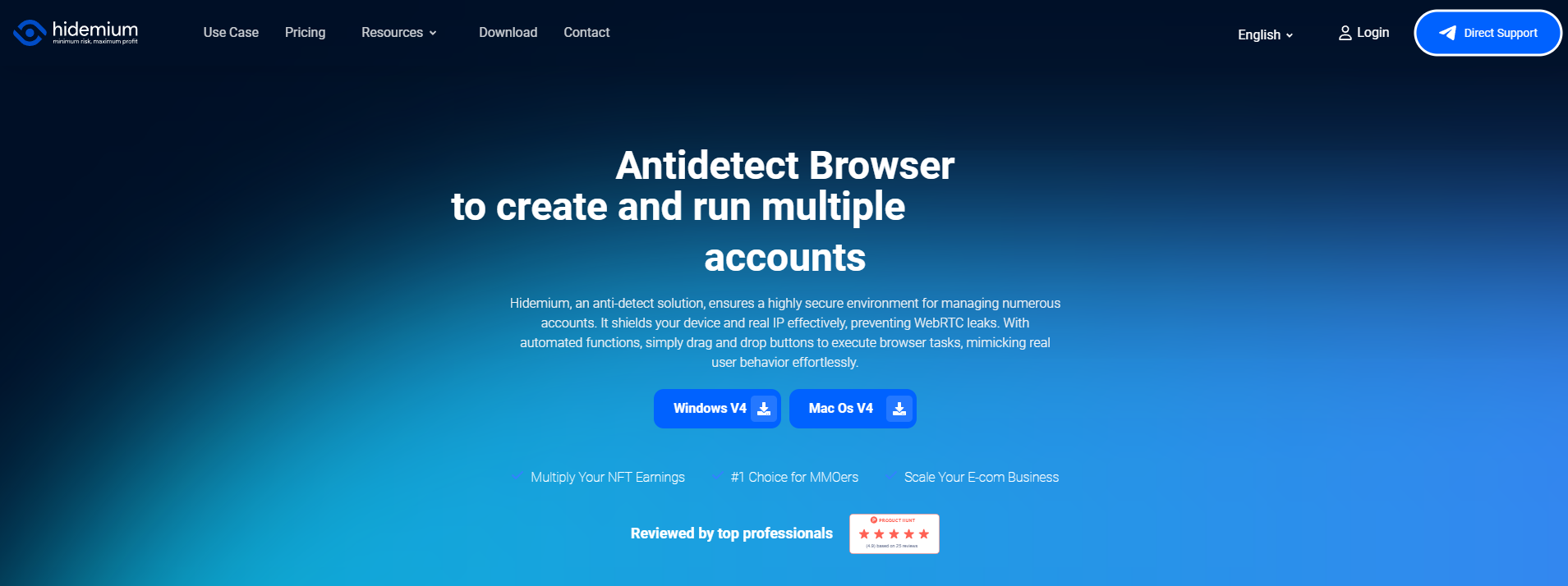
One of its strong points is the built-in "Auto-search/Boost views" function. This helps in generating traffic to your eBay listings from your own accounts, which can improve search ranking (Cassini algorithm). However, using this requires extreme caution to avoid linking accounts.
Key Features: Supports PC and Mobile fingerprints.
Price: Basic plan starts at $15/month.
Pros: Good automation features for traffic generation.
Cons: Higher learning curve for automation tools.
Verdict: A strong contender for advanced users who want to automate traffic.
Using Your Antidetect Browser for eBay Sellers
Owning the software is only the first step. To build a resilient business, you must follow a strict operational roadmap. Even the best Antidetect Browser for eBay Sellers cannot save you if your behavior triggers a manual review. In this section, we move from choosing tools to executing a proven strategy. We will outline the Standard Operating Procedures (SOPs) that successful enterprise teams use to scale without bans.
The Step-by-Step eBay Stealth Account Guide 2026
Creating a stealth account requires precision. If you make one mistake, eBay links the new account to your banned history. Follow this workflow to ensure total isolation.
- Clean Your Digital Identity: Before opening your browser, obtain fresh identity data. You need a new name, address, and phone number that has never been used on eBay.
- Configure the Profile: Open your antidetect browser (we recommend DICloak for its secure defaults). Create a new profile. Set the operating system to match your computer or use a mobile configuration.
- Assign Network Security: Bind a high-quality static residential proxy to the profile. Do not use data center IPs. They are too risky for 2026 standards.
- Sync Location Data: Ensure your profile's timezone and geolocation match your proxy's IP address. A mismatch here is an immediate red flag.
- The "24-Hour" Rule: Do not create an eBay account immediately. Browse popular websites like Amazon, CNN, and Walmart first. This builds a natural browser history that fraud filters expect to see.
Why Professional Sellers Buy Aged eBay Accounts to Skip the Warm-Up
Time is the biggest cost in multi-accounting. A brand-new account has strict selling limits and is watched closely by eBay's algorithms. To bypass this, many enterprise sellers buy aged eBay accounts.
These accounts were created years ago and have a history of "normal" activity. They often come with higher selling limits right away. When you import an aged account into your antidetect browser, you must also import its cookies.
Cookies act like a digital memory. They tell eBay, "This is a returning user, not a stranger." By importing these cookies, you transfer the account's trust score to your new device fingerprint. This strategy helps in avoiding eBay account linking because the transition looks seamless to eBay's servers.
Developing a Cookie Warming Schedule with an Automated Robot
If you create a fresh account, you cannot list items on day one. You must "warm up" the profile to prove you are human. Doing this manually for 50 accounts is impossible.
You should use a cookie warm up bot or the RPA (Robotic Process Automation) features found in tools like DICloak.
The 14-Day Warm-Up Schedule:
- Days 1-3: Visit generic news sites and tech blogs. Scroll and click random links.
- Days 4-7: Search for items on eBay but do not log in. Visit competitor listings. Add items to your cart and then abandon them.
- Days 8-10: Create an account. verify your email. Continue browsing without listing.
- Days 11-14: Make a small purchase ($1-$2). Leave positive feedback.
- Day 15: List your first low-risk item.
Automation handles the repetitive browsing, ensuring every profile has a unique, "noisy" history before you start selling.
Managing eBay Managed Payments Across 50+ Isolated Profiles
The most common way sellers get banned in 2026 is through financial linking. This is known as the eBay managed payments multi account challenge. If two different stealth accounts receive payouts to the same bank account, eBay will ban both immediately.
Financial Isolation Rules:
- One Store, One Bank: Every stealth profile must have its own unique bank account number.
- Digital Banking: Use services like Wise, Payoneer, or Monzo that allow you to generate multiple virtual account numbers.
- Consistency: Always access the banking dashboard through the same isolated browser profile you use for the eBay store. Never log into Bank A from Store B's profile.
By strictly separating your financials and using a secure tool like DICloak to manage the sessions, you prevent the "money trail" that leads to account suspensions.
Frequently Asked Questions about Antidetect Browser for eBay Sellers
Is using an antidetect browser for eBay sellers legal in 2026?
Yes, using an antidetect browser is legal. You have the right to protect your digital privacy and control your browser fingerprint. However, you must differentiate between legality and company policy. While the software is legal, using it to violate eBay's Terms of Service (like evading a permanent ban) is against their rules. Professional sellers use tools like DICloak primarily for account isolation and data security.
Can I use an antidetect browser free trial for my first stealth account?
Yes, you can start with a trial. A high-quality antidetect browser free trial allows you to test the fingerprinting technology before committing money. DICloak offers a generous free plan that includes 5 profiles. This is perfect for setting up your first few stealth accounts securely. Avoid completely free, unknown browsers, as they often sell your data or leak your IP address.
How do I prevent eBay from linking my static residential proxies?
To avoid linking, you must adhere to a strict "One IP, One Profile" rule. Assign a high-quality static residential proxy to a single browser profile and never change it. Do not rotate IPs while logged in. By keeping the IP address consistent, you mimic a real home user. DICloak simplifies this by binding the proxy directly to the profile configuration so it never leaks.
Can I share a profile with a VA without a new login alert?
Yes, this is a major benefit of using enterprise tools. You can grant a Virtual Assistant access to a specific browser profile via the cloud. When they open the profile, eBay sees the established device fingerprint and proxy, not the VA's personal computer. This prevents the "New Device Login" security flag and keeps your account safe during team operations.
How long should I wait before listing items on a new stealth account?
You should wait at least 10 to 14 days. This is a standard rule in any eBay stealth account guide 2026. If you list items on Day 1, you trigger fraud filters. Spend the first two weeks browsing, searching for products, and visiting competitor stores to build a history of trust. This "warm-up" period is essential for long-term account survival.
 Web Proxy Tools
 Free Tools
 Cookie Plugin
 UA Generator
 MAC Address Generator
 IP Generator
 IP Address List
 2FA Code Generator
 World Clock
 Anonymous Check
 WebRTC Leak Test
 UUID Generator
 Free Web Proxy Site
 Proxy Checker
 FB Ad Checker
 AI Web Scraping
 Free SMM Tools
 Twitter Shadowban Checker
 Instagram Name Checker
 UTM Generator
 Username Generator
 AI Hashtag Generator
 LinkedIn Headline Generator
 Social Media Image Resizer