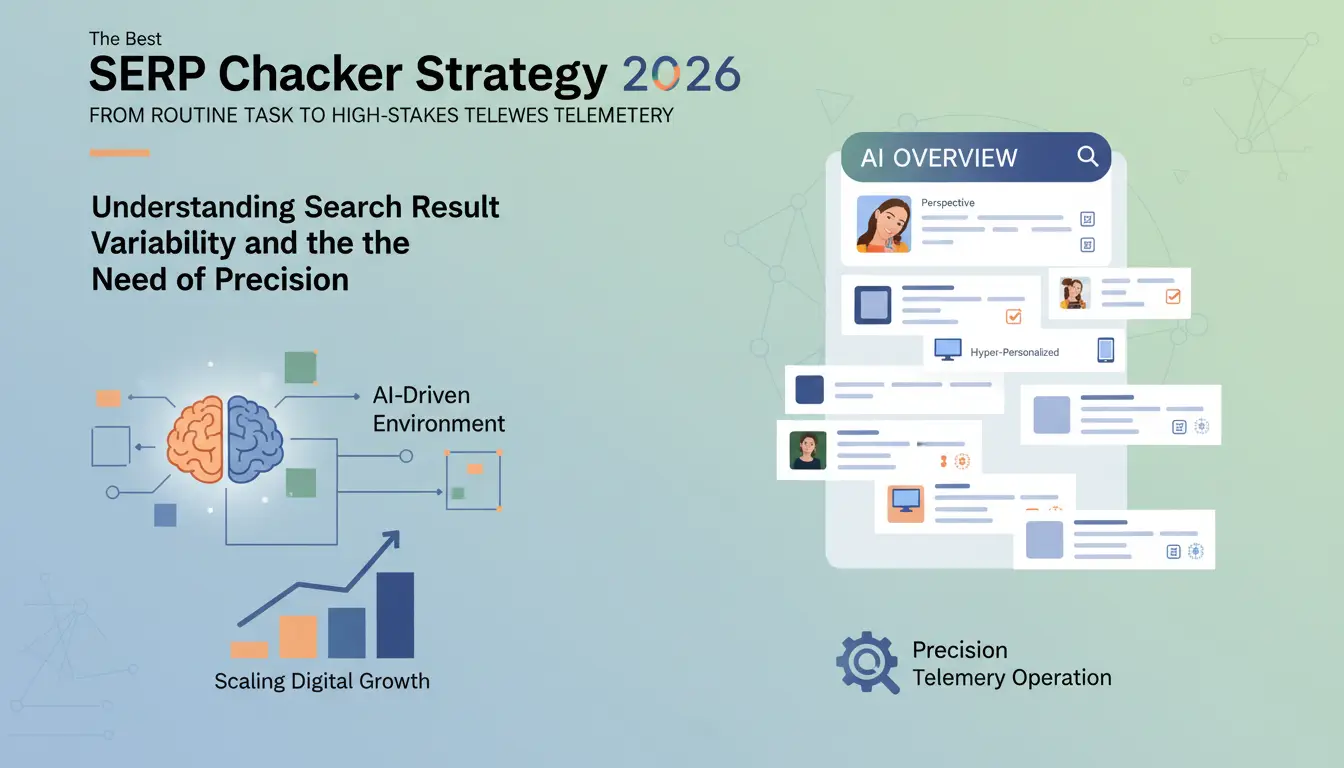
Understanding Search Result Variability and the Need for Precision
In 2026, rank tracking has transitioned from a routine SEO task to a high-stakes telemetry operation. The search engine result page (SERP) is no longer a static list of ten blue links; it is a hyper-personalized, AI-driven environment. With the full integration of AI Overviews (SGE) and "Perspective" tabs, the data digital growth teams must collect is increasingly volatile.
Standard tracking tools frequently suffer from adversarial data corruption where search engines serve distorted results or entirely different layouts based on the perceived trust of the querying agent. Achieving high-volume precision requires an architectural shift toward specialized infrastructure capable of simulating high-trust user environments to capture gated AI features and localized results without triggering detection.
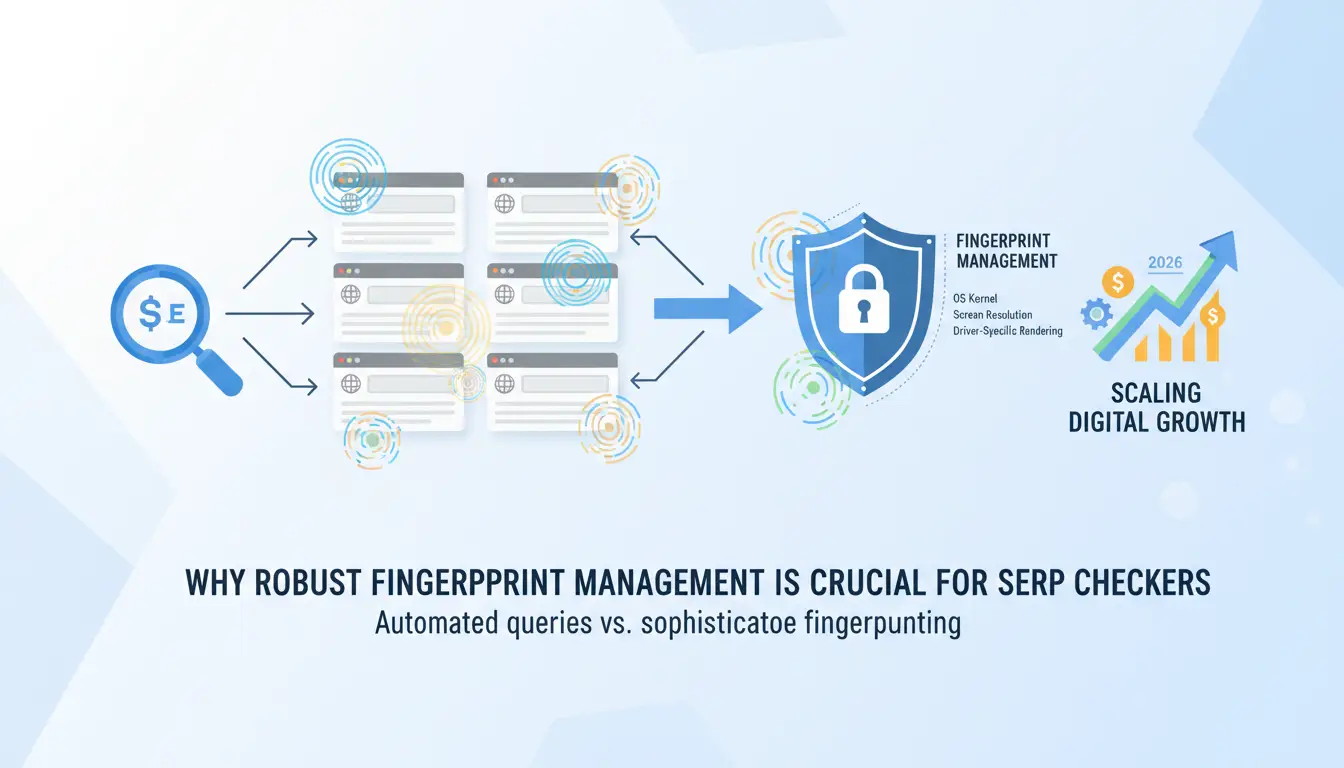
Why Using the Best SERP Checker Requires Robust Fingerprint Management
Automated search queries are the primary target of sophisticated browser fingerprinting algorithms. A fingerprint is an aggregate of hardware and software telemetry, including OS kernel versions, screen resolution, and driver-specific rendering, that creates a nearly unique digital signature. Search engines use these signatures to identify and throttle automated traffic that deviates from standard human behavior.
Failure to manage these signatures triggers a "Kill Switch" response. This is not merely a temporary block; it is a systemic risk to an organization's IP reputation. Once a signature is flagged as "non-human," search engines may implement rate-limiting across all associated network segments, leading to permanent telemetry pollution and the inability to view authentic ranking data.
Pro-Tip: Utilizing default browser configurations for high-frequency scraping creates high-entropy signatures that are easily detectable. To maintain a low-risk profile, analysts must employ browser profiles that offer kernel-level masking and a statistically probable distribution of fingerprint attributes.
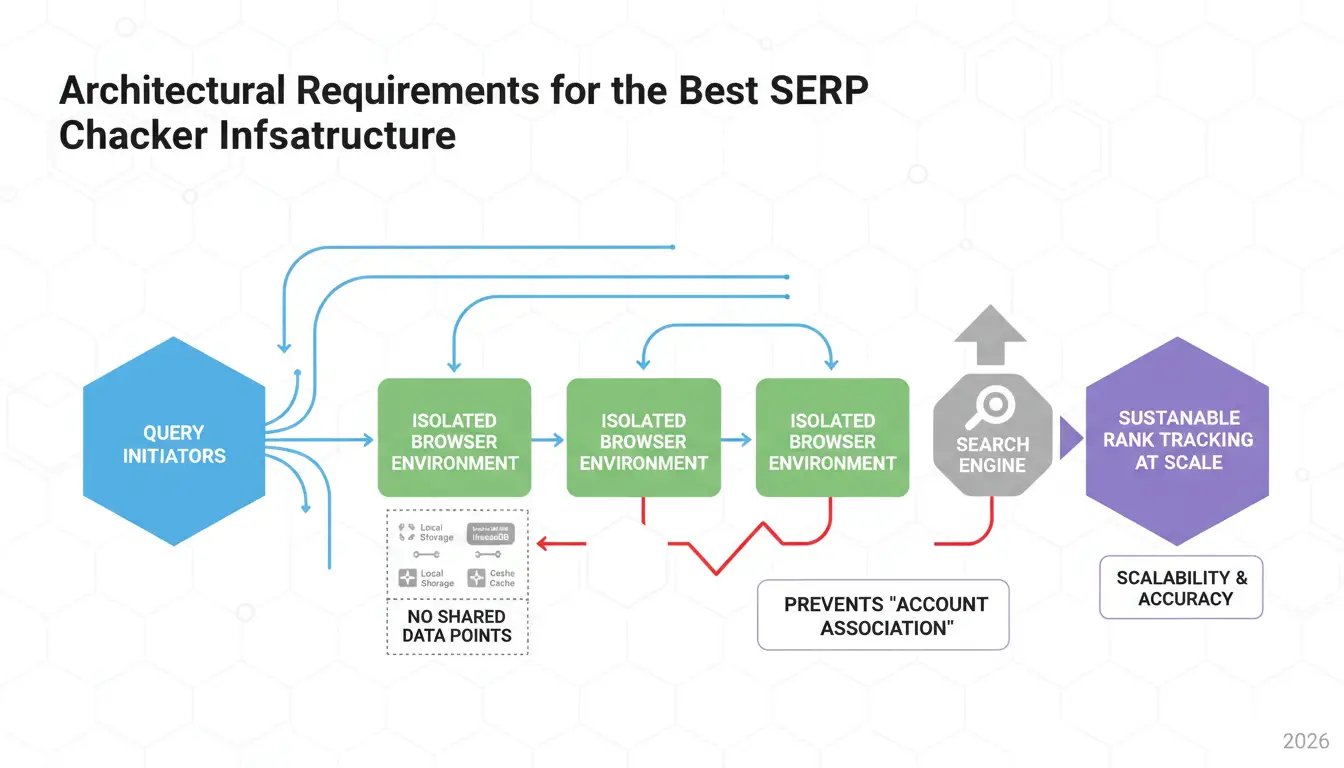
Architectural Requirements for the Best SERP Checker Infrastructure
Sustainable rank tracking at scale requires effective isolation of browser profiles to prevent "Account Association." This phenomenon occurs when a search engine links multiple queries to a single origin through shared data points such as local storage, indexedDB, or browser cache.
When isolation is breached, search engines detect synchronized behavior across supposedly distinct users. This triggers security checkpoints, most commonly CAPTCHAs or immediate IP-level blocks. To scale in 2026, the infrastructure must help ensure that every search profile exists in a sandboxed container, preventing any data leakage that could allow a platform to map the tracking network's topology.
Navigating Detection Mechanisms: Canvas and WebGL Fingerprinting
As we move into 2026, detection mechanisms have evolved toward entropy-based analysis. It is no longer enough to change an IP; the hardware signals must be consistent with the reported environment.
Canvas fingerprinting forces the browser to render a hidden image. Because different GPU and driver combinations render pixels with infinitesimal variations, the resulting hash is a reliable device identifier. In 2026, search engines evaluate the statistical probability of these hashes. If a tracker presents a hash that is unique but does not match the expected rendering of its reported User-Agent, it is instantly flagged as an automated instance.
Beyond graphics, modern anti-automation systems use AudioContext fingerprinting—measuring how a device processes sound waves—and font enumeration to further refine a device's identity. Hardware concurrency, which reports the number of CPU cores, must also align perfectly. A common red flag for search engines is a "mismatched signal," such as a profile claiming to be a mobile device while reporting the hardware concurrency and AudioContext signature of a server-grade Linux environment.
Scaling Rank Tracking with the Best SERP Checker Techniques
Scaling to thousands of keywords across global regions requires a sophisticated orchestration of network and session variables.
Implementing Proxy Management for Localized Results
For maximum SERP accuracy, integrating with suitable user-configured proxies is often recommended. Unlike datacenter IPs, which are often categorized as server-farm traffic, integrating with certain proxy types can provide the stability of a fixed IP with the characteristics of a consumer-grade ISP. This is essential for accessing localized features like Map Packs and AI-driven "Near Me" recommendations that are often hidden from datacenter-originated queries.
Isolating Browsing Profiles to Reduce the Risk of Cross-Account Association
Utilizing digital containers allows for the simultaneous execution of multiple search instances. By ensuring each profile maintains its own unique digital signature and localized network exit point, analysts can help prevent the cross-pollination of tracking data. This can help ensure that the search engine treats each query as an independent, isolated user session.
Operational Scenarios: Managing 100+ Geolocation-Specific SERP Profiles
Senior analysts must approach high-volume monitoring as a managed infrastructure project rather than a series of manual checks.
Workflow for Large-Scale Affiliate Site Monitoring
To monitor a global affiliate footprint, analysts utilize API-driven profile orchestration. This involves programmatically generating profiles for specific markets. Each profile is assigned a unique, persistent fingerprint that matches the target demographic's hardware norms, helping ensure that the AI Overviews and local rankings captured are what a real user in those regions would see.
Avoiding Checkpoints during High-Frequency Rank Checks
To help reduce detection risk, analysts implement "jitter" and human-mimicry latency. By varying the intervals between queries and simulating natural scrolling or interaction with the SERP, the tracking activity can avoid the rhythmic signatures of a bot. Combining these behavioral patterns with hardened browser profiles helps ensure the longevity of the tracking infrastructure.
Optimizing Your Workflow Using a Robust SERP Checker Integration in DICloak
DICloak provides a specialized environment for implementing advanced isolation strategies. By offering an alternative to conventional browser instances, SEO professionals can manage numerous profiles while supporting control over their digital signatures.
Comparing Conventional Browsing vs. DICloak Protected Environments
| Feature |
Conventional Browser Instances |
DICloak Profiles |
| Fingerprint Management |
Shared/Default signatures across all instances. |
Unique, isolated profiles with configurable fingerprint masking. |
| Data Isolation |
High risk of cookie/cache leakage between sessions. |
Supports effective isolation of cookies, cache, and local storage. |
| Network Fingerprint Decoupling |
High vulnerability to IP-based rate limiting. |
Supports custom proxy configuration for each browser profile. |
| Hardware Signal Accuracy |
Static or mismatched hardware specifications. |
Supports masking of Canvas, WebGL, AudioContext, and Fonts. |
Objective Analysis: Implementation of DICloak in SEO Workflows
Integrating an anti-detect solution like DICloak into a digital growth stack involves specific strategic considerations.
Pros:
- Architectural Scalability: Supports the management of numerous concurrent search profiles while helping reduce the risk of account association.
- Advanced Risk Mitigation: Can help reduce the incidence of CAPTCHAs and blocks through browser fingerprint configuration.
- Localized Accuracy: Supports the capture of region-locked search features and AI-driven results.
Cons:
- Configuration Complexity: May require a technical understanding of browser telemetry to optimize profiles for desired authenticity.
- Infrastructure Investment: User-configured proxies and profile management software represent a necessary but recurring operational cost.
Frequently Asked Questions About Rank Tracking and Account Safety
Why do my search results differ between my local browser and my tracker?
Discrepancies are usually caused by local cookie telemetry and IP-based localization. Your local browser carries a legacy of search history that biases results. A DICloak profile, using an isolated container and a specific localized IP, views the SERP through the lens of a new, regional user, providing a more objective data point for rank tracking.
Can I run multiple search profiles on the same machine?
Yes, provided you use an environment that supports profile isolation. DICloak creates distinct digital containers that decouple the browser's identity from the underlying hardware. This supports high-frequency, simultaneous checks without search engines linking the instances to a single machine.
How do I reduce the risk of my accounts being flagged during SERP checks?
The most effective mitigation strategy is the synchronization of hardware signals. By ensuring that your reported User-Agent, Canvas hash, AudioContext, and hardware concurrency are statistically probable and consistent, you minimize the risk of being identified by entropy-based detection systems. Pairing this with user-configured proxy management can help ensure your queries appear as legitimate human traffic.
 Web Proxy Tools
 Free Tools
 Cookie Plugin
 UA Generator
 MAC Address Generator
 IP Generator
 IP Address List
 2FA Code Generator
 World Clock
 Anonymous Check
 WebRTC Leak Test
 UUID Generator
 Free Web Proxy Site
 Proxy Checker
 FB Ad Checker
 AI Web Scraping
 Free SMM Tools
 Twitter Shadowban Checker
 Instagram Name Checker
 UTM Generator
 Username Generator
 AI Hashtag Generator
 LinkedIn Headline Generator
 Social Media Image Resizer