Understanding the financial yield of a single view is critical for building a sustainable growth infrastructure. From a technical standpoint, there is no monolithic "pay-per-view" rate. Instead, creators operate within a highly volatile range dictated by advertiser demand, audience demographics, and platform-level algorithmic mediation.
On average, data from the current ecosystem indicates a revenue range of $0.002 to $0.025 per view. For creators, this equates to approximately $2.00 to $25.00 for every 1,000 views that are successfully monetized. It is vital to distinguish between a "raw view" and a "Monetized Playback." Raw view counts are often decoupled from revenue due to the prevalence of ad-blocking software, high skip rates, and playback on unsupported devices. Consequently, professional revenue forecasting must account for these technical "leaks" in the conversion funnel.
The Internal Mechanics of the YouTube Payment System
The flow of capital within the platform follows a structured revenue-sharing protocol. YouTube functions as a marketplace where brands bid on the attention of specific user segments. Once an ad is successfully served and satisfies the platform's engagement criteria, the resulting revenue is partitioned according to a 55/45 split.
Under this model, the creator is allocated 55% of the gross ad revenue, while YouTube retains 45% to cover global server infrastructure, content delivery networks (CDNs), and platform maintenance. This extraction happens at the source, meaning the figures visible in a creator’s financial dashboard generally reflect the net amount after the platform’s cut has been processed.

Understanding the Metric Gap: CPM vs. RPM in Creator Analytics
For the digital growth expert, high-level metrics must be decoded to understand the actual efficiency of a channel’s traffic.
Decoding Cost Per Mille (CPM)
CPM represents the "Cost Per Mille" (thousand) impressions from the advertiser's perspective. It is the gross amount a brand pays to reach 1,000 viewers. This figure is a reflection of market competition; higher advertiser demand for a specific audience drives the CPM upward.
Analyzing Revenue Per Mille (RPM)
RPM is the definitive metric for creator-side health. Unlike CPM, RPM calculates the net earnings per 1,000 views after YouTube's 45% share is removed. Crucially, RPM incorporates "zero-revenue views"—those where ads were skipped or blocked—providing a realistic view of the channel’s total monetization efficiency.
Operational Scenario: Analysis of Revenue Disparity
Consider two channels, both generating 1 million views. Channel A, focused on broad-market entertainment, might yield an RPM of $2.00 ($2,000 total). Channel B, operating in the enterprise SaaS or high-end finance niche, commands an RPM of $25.00 ($25,000 total). This 1,150% difference occurs because high advertiser competition in the enterprise sector drives a CPM spike that remains substantial even after platform extraction, whereas general entertainment traffic is often viewed as "low-intent" by high-budget advertisers.
Key Factors Affecting How Much Do YouTubers Get Paid Per View
Revenue volatility is rarely accidental; it is driven by several quantifiable technical and demographic variables.
Geographic Influence and Tier-1 Traffic
The geographic origin of a viewer’s IP address significantly dictates the value of the view. Advertisers prioritize "Tier-1" markets—specifically the United States, Canada, Australia, and Western Europe—due to the higher purchasing power of these populations. A view originating from a Tier-1 infrastructure will consistently command higher CPMs than views from regions with emerging or smaller advertising economies.
Niche Profitability and Content Topic
Content categorization determines which ad auctions the video participates in. High-intent niches such as Finance, Tech, and Education attract brands with massive customer acquisition cost (CAC) budgets, leading to higher payouts. To maintain the professional standard these niches require, many creators utilize an AI ppt maker to design high-quality visual aids for their tutorials. Vlogging or lifestyle content, being more general, often participates in lower-value auctions.
Device Context and Playback Environment
Technical telemetry shows that device type impacts ad duration and frequency. Viewers accessing content via desktop computers are often served longer, non-skippable ad formats compared to mobile users. This hardware-based variance can lead to a measurable increase in the revenue-per-view for channels with a predominantly desktop-based audience.
Pro-Tip: Revenue infrastructure is highly seasonal. Creators should anticipate "Golden Quarter" spikes (Q4), where ad budgets surge for Black Friday and end-of-year retail cycles, often doubling the average annual CPM.
Tactical Content Optimization to Improve Revenue Efficiency
Yield optimization requires a strategic approach to video architecture and metadata.
Strategic Video Duration and Mid-Roll Placement
The 8-minute threshold is a critical technical pivot point. Videos exceeding this duration allow for the insertion of mid-roll ads. By increasing the density of ad impressions within a single view session, creators can significantly improve the RPM of a single asset without needing to increase the raw view count.
Search Engine Optimization for High-Intent Traffic
Precise metadata—titles, descriptions, and tags—serves as a signal to the ad-serving algorithm. By optimizing for keywords associated with high-value commercial intent, creators ensure their content is indexed for high-paying ad auctions, effectively matching their content with the most lucrative advertisers.
Diversifying Revenue Beyond the AdSense Model
A robust digital growth strategy minimizes "single-point-of-failure" risk by diversifying income streams:
- Channel Memberships: Recurring monthly revenue for exclusive access and badges.
- Super Chat & Super Stickers: A mechanism allowing viewers to pay for message prominence during live streams, providing immediate liquidity.
- Merchandise Integration: Leveraging the built-in "merch shelf" to sell physical or digital assets directly below the player.
- Sponsorships: Direct brand-to-creator contracts that bypass platform ad auctions.
- Affiliate Marketing: Performance-based commissions via trackable links in the description.
- Crowdfunding: Utilizing external support platforms to ensure creative independence.
Managing Growth Infrastructure with DICloak
Scaling a multi-channel portfolio introduces significant operational risks. Platforms utilize sophisticated detection vectors to link and monitor account activity.
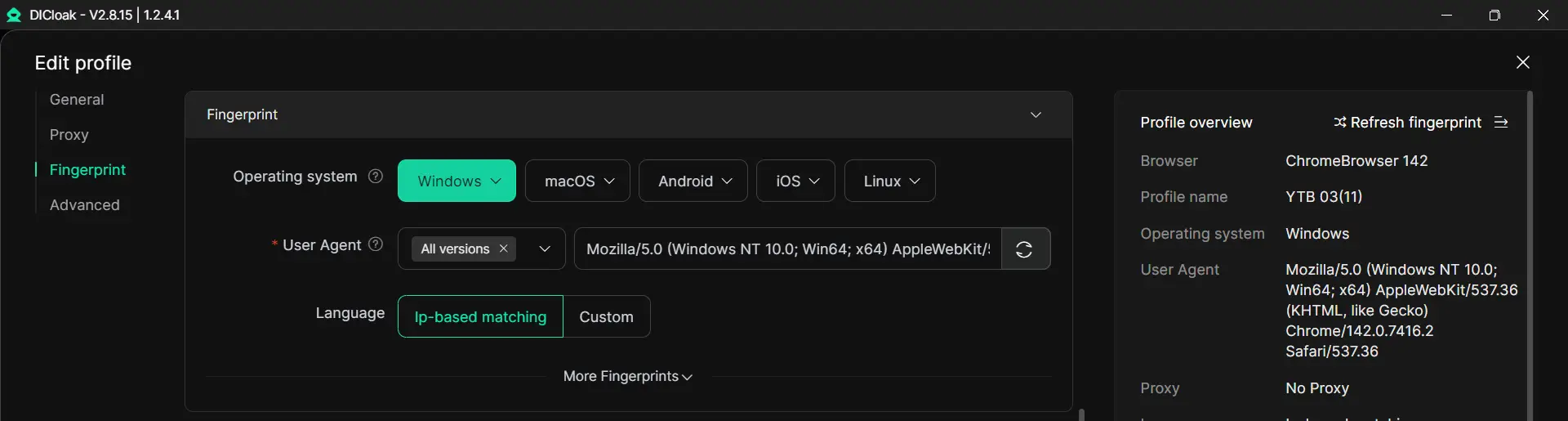
YouTube’s security stack utilizes Canvas hashing, WebGL metadata, font enumeration, and Media Device IDs to create a unique digital fingerprint for every user. For creators managing multiple channels, a security flag on one account can lead to "collateral suspension"—a catastrophic event where the platform links and terminates an entire portfolio due to "Risk of Association." DICloak mitigates this by creating strictly isolated browser profiles. Each profile presents a unique, spoofed fingerprint, ensuring the platform perceives each account as an entirely independent entity.
Workflow Scaling via Profile Management
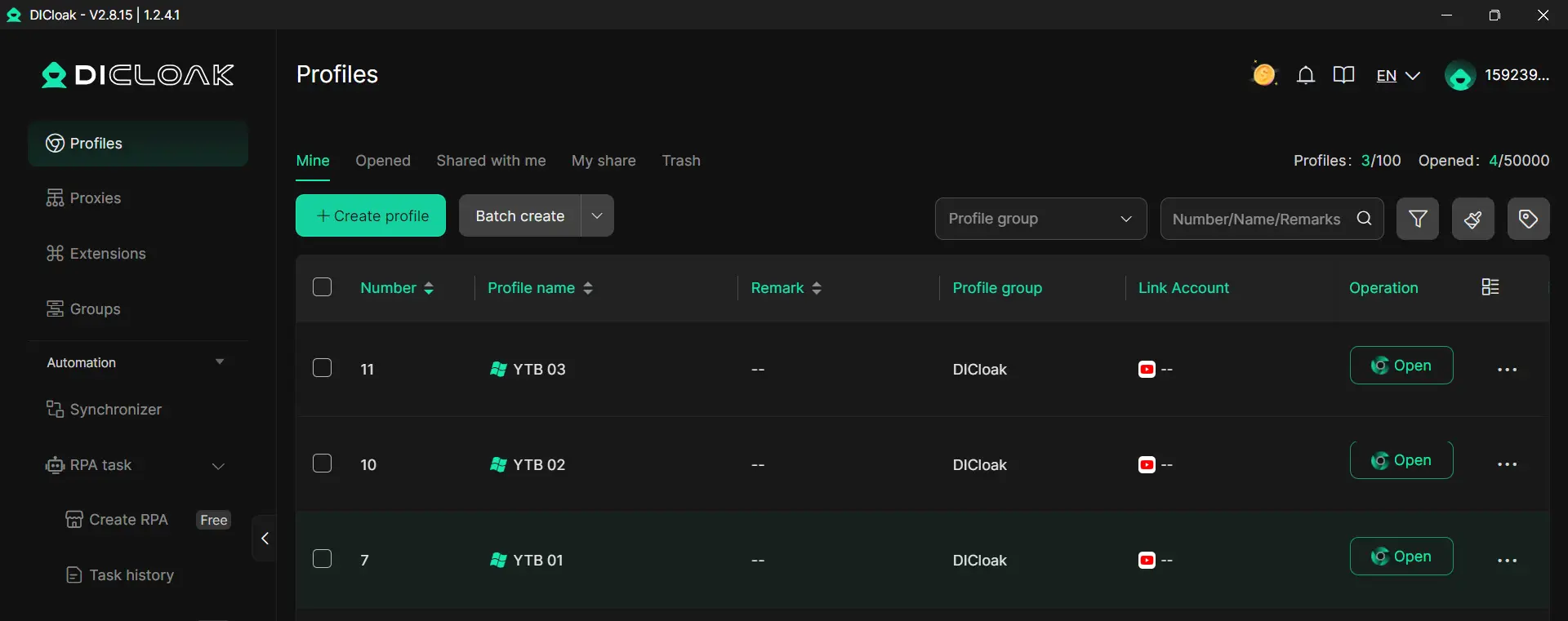
Managing 50 or more channels manually is not only inefficient but dangerous. Logging into multiple accounts from a single standard browser profile triggers security checkpoints and IP-correlation flags. DICloak provides the infrastructure to manage these assets within separate profiles, keeping cookies, cache, and local storage partitioned.
Comparing Management Frameworks for Content Creators
| Feature |
Standard Browser Management |
DICloak Infrastructure |
| Identity Isolation |
Minimal; accounts easily linked via fingerprints |
High; unique fingerprints (WebGL/Canvas) per profile |
| Risk of Association |
High; one suspension can trigger a portfolio-wide ban |
Low; technical isolation prevents account linking |
| Network Isolation |
Manual; prone to IP leaks |
Integrated granular IP control per profile |
| Workflow Scalability |
Low; high risk of security checkpoints |
Efficient; simultaneous management of 50+ channels |
Professional Analysis: The Pros and Cons of Infrastructure Tools
Adopting professional-grade management tools like DICloak is a strategic decision that requires balancing security against overhead.
Pros:
- Enhanced Security: Prevents "linked account" flags through advanced fingerprint spoofing.
- Portfolio Protection: Isolates experimental or high-risk niches from primary assets.
- Team Collaboration: Facilitates organized workflows for managing large-scale channel portfolios.
Cons:
- Technical Learning Curve: Requires an understanding of digital fingerprinting and profile configuration.
- Operational Cost: Involves recurring subscription overhead for professional features.
- Network Requirements: Full isolation requires the integration of high-quality proxies to maintain unique IP addresses.
Conclusion
There is no fixed answer to how much YouTubers get paid per view. Earnings can change based on niche, audience location, video format, and how well a channel is monetized. In most cases, creators earn more when they focus on high-value traffic, strong content structure, and multiple income streams instead of relying only on views.
Frequently Asked Questions Regarding How Much Do YouTubers Get Paid Per View
How much does 1 million views pay?
A video with 1 million views typically yields between $2,000 and $5,000. However, in high-paying niches with Tier-1 traffic, this figure can exceed $20,000.
How much for 100k, 70k, or 500k views?
- 100,000 views: Generally $200 to $2,500.
- 70,000 views: Typically $140 to $1,750.
- 500,000 views: Usually $1,000 to $3,000.
These ranges are influenced heavily by the niche's RPM and the seasonality of the ad market.
Does YouTube pay for Shorts?
Yes. YouTube operates a Shorts revenue-sharing program. Ad revenue from the Shorts feed is pooled and distributed to eligible creators based on their proportion of total views and music licensing costs.
Who is the highest-paid YouTuber?
MrBeast (Jimmy Donaldson) is currently the highest-earning creator globally, achieving massive revenue through a combination of ultra-high ad volume, integrated sponsorships, and independent business ventures.
How much do YouTubers get paid per view in different niches?
Some niches earn much more than others. Finance, business, software, and marketing content often bring in higher ad rates because advertisers in those fields are willing to pay more. Entertainment, memes, or general viral content may get more views but lower value per view.
 Web Proxy Tools
 Free Tools
 Cookie Plugin
 UA Generator
 MAC Address Generator
 IP Generator
 IP Address List
 2FA Code Generator
 World Clock
 Anonymous Check
 WebRTC Leak Test
 UUID Generator
 Free Web Proxy Site
 Proxy Checker
 FB Ad Checker
 AI Web Scraping
 Free SMM Tools
 Twitter Shadowban Checker
 Instagram Name Checker
 UTM Generator
 Username Generator
 AI Hashtag Generator
 LinkedIn Headline Generator
 Social Media Image Resizer