Why are so many users looking for a MuLogin alternative right now?
The antidetect browser landscape has shifted. A few years ago, securing isolated profiles was enough to run campaigns. Today, your business infrastructure requires more. Agencies and e-commerce brands are outgrowing legacy tools because scaling demands efficient automation and flexible pricing. If you manage multiple Facebook accounts without a ban, you already know that manual setups no longer work. Users are actively migrating to fix three major operational bottlenecks in their 2026 workflows.
The high cost of maintaining large account sets
Scaling your operations should decrease your cost per account, not inflate it. As your business grows from fifty to five hundred profiles, the financial burden of legacy pricing models becomes a serious risk. Many teams realize that sticking with their current setup drains their budget. Finding the cheapest MuLogin alternative is rarely about cutting corners. It is about restructuring your expenses. Modern alternatives offer tiered pricing that aligns with actual usage rather than punishing growth. When you scale a crypto airdrop farming browser or an e-commerce network, you need a predictable overhead. High fixed costs limit your ability to expand operations quickly and test new markets.
Interface clutter and the learning curve for new teams
Complex interfaces slow down team expansion. When you hire new media buyers or virtual assistants, they need to start working immediately. If your software requires weeks of training, you lose money. Legacy antidetect tools often feature cluttered dashboards that confuse non-technical staff. Modern browser automation for teams focuses on clean, role-based access. You need to assign profiles to employees without exposing sensitive proxy configurations or account credentials. An intuitive interface reduces human error, which is the leading cause of compromised stealth setups. A secure profile handover multi-login system ensures your team scales smoothly without triggering security flags across your ad networks.
The need for better automation and mobile device options
Manual account management is dead. Relying on human operators to warm up profiles or execute repetitive tasks guarantees failure at scale. Modern workflows require built-in Robotic Process Automation (RPA) and seamless local REST API antidetect browser integrations. Teams are leaving legacy platforms because they need no-code builders that automate interactions instantly. Furthermore, desktop-only spoofing is no longer sufficient. Platforms like TikTok and mobile-first ad networks look for mobile device fingerprints. You need robust iOS and Android emulation. If your current tool cannot provide convincing WebGL fingerprint evasion 2026 standards alongside mobile hardware profiles, your accounts will face inevitable bans. Upgrading your infrastructure ensures your digital assets remain protected.
Quick Verdict: The best alternatives to MuLogin by scenario
Upgrading your business infrastructure means choosing a tool that fits your exact operational goals. A setup built for heavy data scraping might overwhelm a small social media agency. To help you protect your digital assets and scale safely in 2026, we categorized the top competitors by their primary strengths.
DICloak is our top recommendation for growing teams. It delivers a perfect balance of isolated browser profiles, seamless cloud sharing, and built-in automation. Review the comparison below to see which platform matches your specific workflow.
Choosing the right business infrastructure requires looking past marketing claims and top-level comparisons. We evaluate these platforms based on real-world risk mitigation and ROI. A cheap tool that leaks your data costs significantly more in banned accounts than a premium platform. To find the best antidetect browser 2026 has to offer, we tested each competitor under strict agency conditions. We focused heavily on identity isolation, secure team access, and robust automation capabilities.
Consistency in keeping your digital identities separated
Reliable isolation is your primary defense against account bans. If a platform fails to mask your actual hardware, ad networks will block your entire portfolio. We look for tools that generate truly independent digital identities from the hardware level up. This means strictly analyzing how well a browser handles WebGL fingerprint evasion 2026 standards. We also deeply test canvas fingerprint spoofing accuracy.
We test for core vulnerabilities daily. A tool must bypass WebRTC leaks without disabling the protocol, as disabling it entirely looks highly suspicious to anti-fraud systems. It must also provide accurate timezone and geolocation spoofing browser capabilities to perfectly match your proxy IP. We instantly reject legacy browsers that simply block tracking scripts. Modern platforms must use intelligent noise technology to blend seamlessly into normal user traffic.
Consistency over time is the ultimate test. A secure enterprise browser isolation tool must keep your profile fingerprints perfectly stable across multiple remote sessions. If your e-commerce stealth accounts suddenly display a changed hardware signature, platforms like Amazon will lock them immediately. We prioritize solutions that maintain strict cache and cookie isolation. You cannot afford sudden fingerprint changes when managing high-stakes client campaigns.
Ease of sharing profiles with team members without flags
Business scaling relies on safe delegation. You need an agency level account management tool that lets staff work without exposing underlying credentials. We evaluate how each browser handles a secure profile handover multi-login process under high-pressure conditions.
When a manager creates a profile in your main office, a remote contractor should be able to open it without triggering a security checkpoint. We test the reliability of cloud-based profile sync 2026 features across different continents. The best tools transfer cookies, active sessions, and proxy settings seamlessly. They ensure the target website sees the exact same returning user, regardless of the physical computer launching the profile.
We also look closely at role-based access antidetect capabilities. You must be able to restrict specific permissions for every user. Team members should launch profiles without ever seeing the master passwords or modifying the proxy configurations. A proper browser profile sharing cloud setup prevents critical human error. Simple mistakes are the fastest way to lose high-value assets. If a multi-seat antidetect browser makes collaboration clunky or risky, it fails our enterprise evaluation. You need team collaboration stealth browser tools that protect your business by default.
Integration with proxy providers and automation tools
Manual work destroys your operational ROI. To scale social media agency multi-login operations efficiently, you need built-in automation workflows. We score these platforms strictly on their ability to connect with third-party software and proxy networks. Automation is the only way to manage large-scale campaigns profitably in 2026.
First, we test residential proxy browser integration. The antidetect tool must auto-detect IP locations and adjust the profile's timezone, language, and DNS settings instantly. If you have to configure these manually for hundreds of accounts, you are wasting valuable labor hours.
Next, we evaluate the underlying automation infrastructure. We look for a reliable local REST API antidetect browser setup. Developers need comprehensive documentation to seamlessly connect tools like Puppeteer and Selenium. For advanced scraping or ad farming, we heavily favor platforms that offer robust Playwright headless browser detection bypass capabilities.
Finally, we assess no-code automation options for non-technical team members. Built-in RPA workflows and an AI-assisted profile generation API allow your marketing team to warm up accounts without writing custom code. A modern tool must streamline your daily bulk profile creation REST API tasks. If it cannot handle automated interactions reliably, it cannot support a growing enterprise team.
The top 7 MuLogin alternatives ranked for performance and price
After evaluating the market for API integrations and team collaboration, we ranked the top options for 2026. Replacing MuLogin requires a tool that balances secure identity isolation with predictable costs. You need a platform that scales without draining your operational budget.
Securing your digital assets requires true identity isolation, not just basic cookie clearing.
Below is our comparison of the top seven antidetect browsers based on performance, team features, and pricing.
| Browser |
Best For |
Starting Price |
Key Feature |
| DICloak |
Affiliate marketing teams |
$0 (Free plan) |
AI automation & secure sharing |
| HideMyAcc |
Social media growth |
$10/month |
Visual drag-and-drop editor |
| ixBrowser |
Tight budgets |
$0 (Free core) |
Unlimited free profiles |
| Kameleo |
Mobile device emulation |
€59/month |
Intelligent canvas spoofing |
| Ghost Browser |
Tech productivity |
$0 (Free tier) |
Tab-based isolation |
| Nstbrowser |
Enterprise scraping |
$29.90/month |
AI captcha solving |
| SessionBox |
Lightweight setups |
$12.99/month |
Color-coded tab sessions |
DICloak: The best all-around alternative for affiliate marketing teams
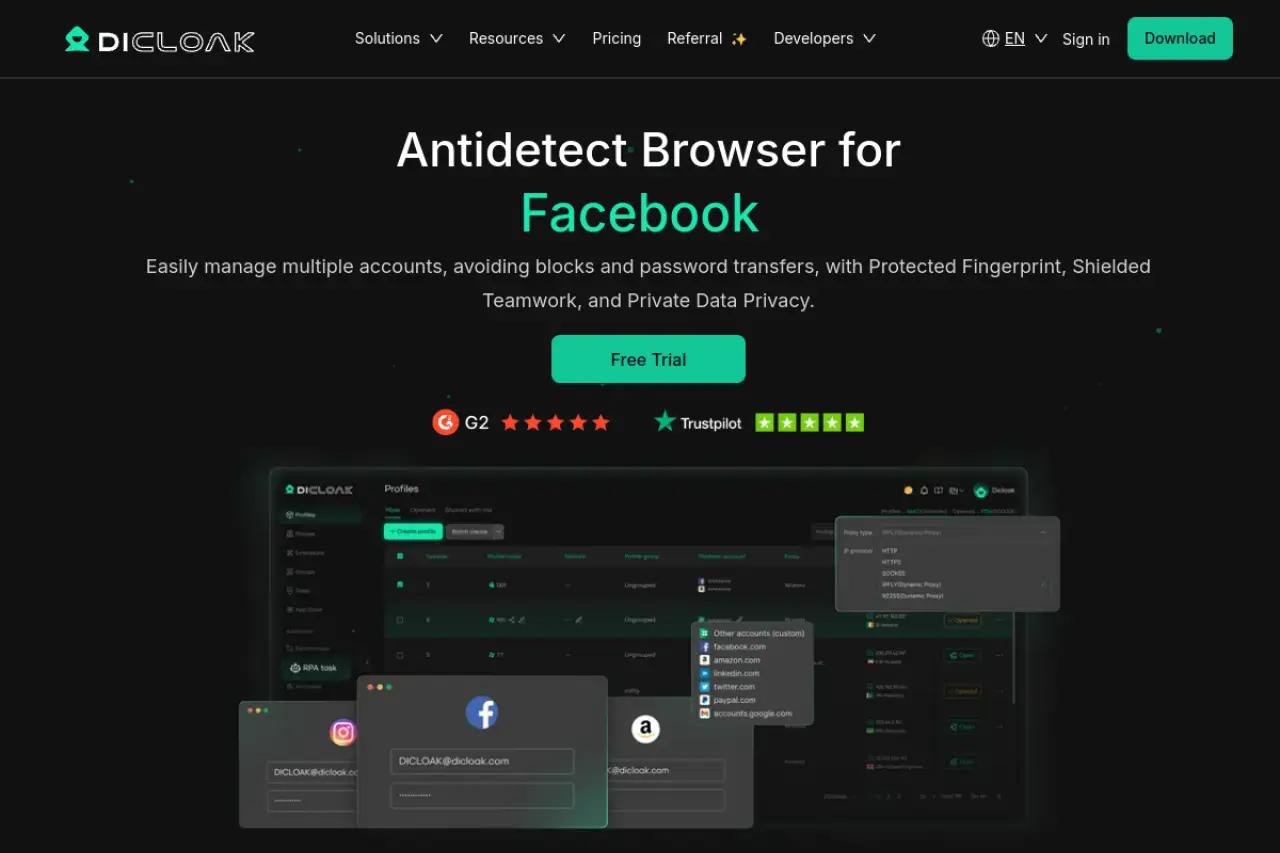
DICloak stands out as the premier replacement for business owners scaling digital assets. When managing multiple affiliate or e-commerce accounts, you need absolute profile isolation. DICloak generates independent Canvas, WebGL, and WebGPU fingerprints. This ensures platforms cannot link your activities. What makes DICloak the top choice is its built-in RPA automation. Your team can build no-code workflows with AI assistance, saving hours on manual account warm-ups. It also excels in team collaboration. The cloud synchronization feature lets you share profiles securely across global teams without exposing proxy credentials.
Best for: Teams needing built-in AI automation and secure profile sharing
Key strengths: Isolated browser identities with no-code RPA workflows
Key limitations: Higher tier pricing is required for full team manager support
Pricing: Starts with a free plan for 5 profiles; Plus plan from $28.80/month
HideMyAcc: Best for social media and e-commerce growth
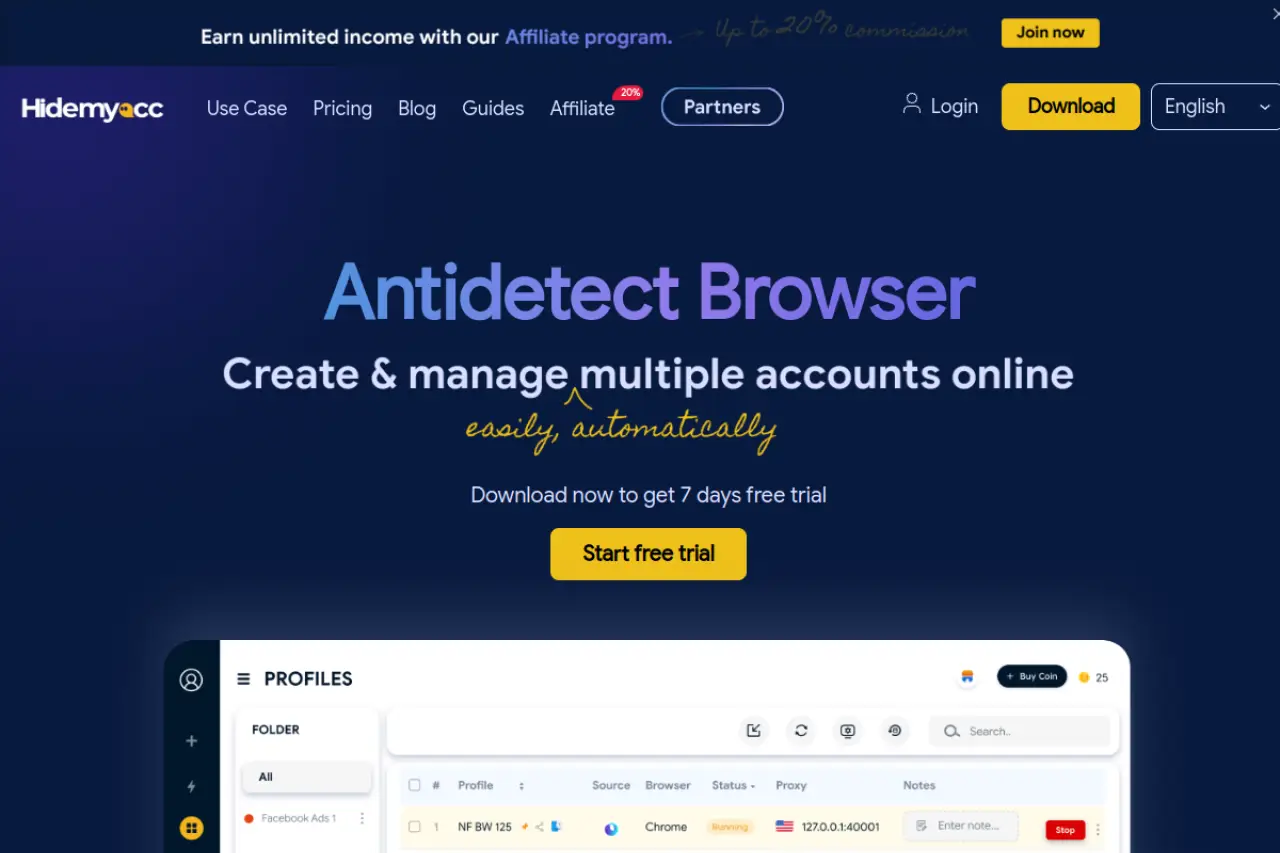
If your agency focuses heavily on social media and e-commerce growth, HideMyAcc offers a robust environment. It provides advanced fingerprint spoofing to keep your Facebook and Amazon environments isolated. A major advantage for digital marketers is the visual drag-and-drop editor. This allows non-technical staff to build complex automation scripts easily. HideMyAcc also includes over 700 pre-installed extensions tailored for social media tasks. However, business owners should watch the cost. While the entry point is low, scaling to hundreds of profiles requires expensive higher-tier plans.
Best for: Digital marketers running Facebook, Amazon, or TikTok accounts
Key strengths: Over 700 pre-installed tools and visual drag-and-drop automation
Key limitations: Pricing scales quickly as you add more profiles
Pricing: Entry-level Mini plan starts at $10/month for 5 profiles
ixBrowser: The best free MuLogin alternative for small setups
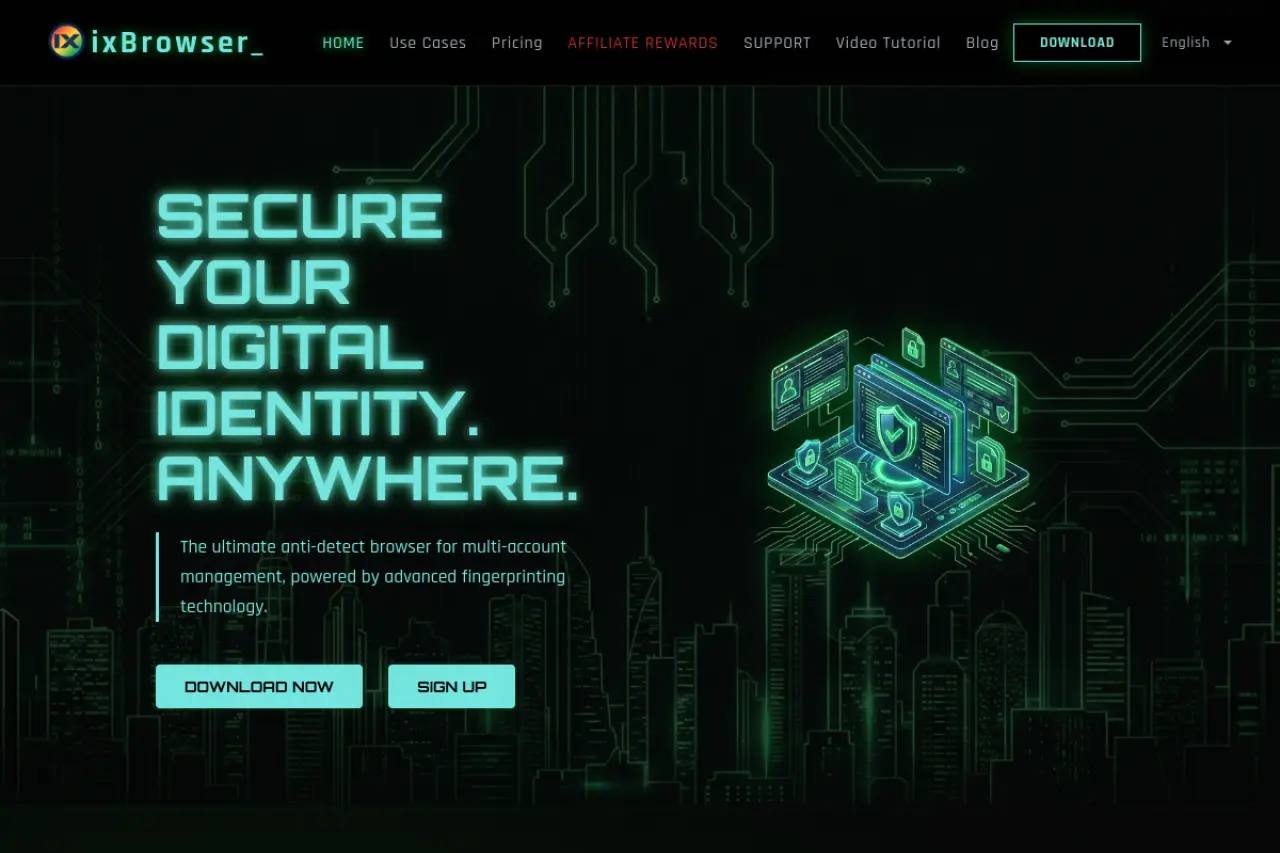
Maintaining a large inventory of long-term accounts can drain your operational budget quickly. ixBrowser solves this by offering permanently free core functionality. You get unlimited browser profiles and advanced digital fingerprint masking at no baseline cost. It even includes a teamwork ecosystem that allows unlimited team members for free. This makes it an ideal choice for traffic arbitrage teams operating on tight margins. The trade-off is velocity. The free tier strictly limits you to creating only 10 new profiles per day. If you need rapid bulk profile creation, you will need to upgrade.
Best for: Users managing long-term accounts on a tight budget
Key strengths: Permanently free core features with unlimited profile storage
Key limitations: Daily limits on creating new profiles in the free version
Pricing: Core features are free; professional access starts at $3.99/month
Kameleo: Best for those who need advanced mobile device options
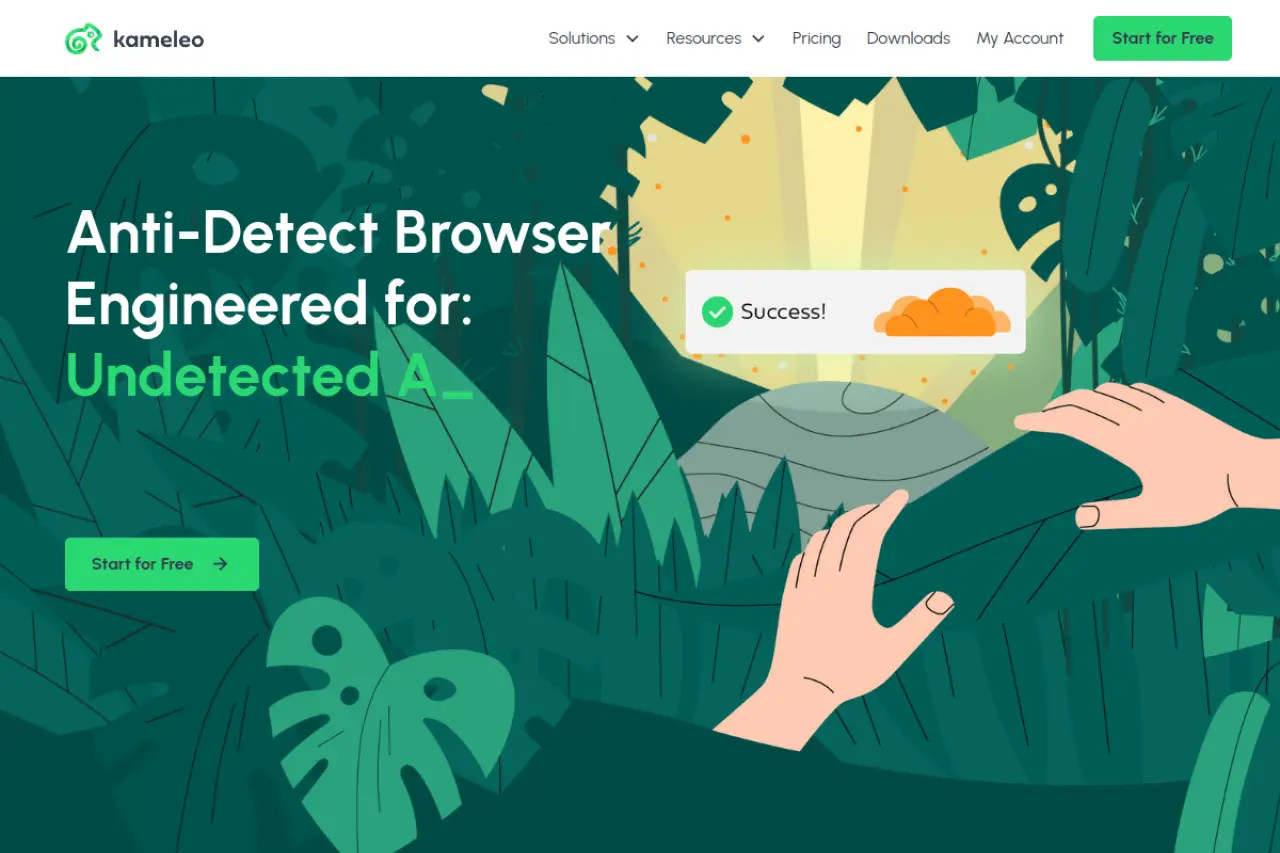
Certain workflows, like strict ad verification or app scraping, require exact mobile environments. Kameleo provides robust mobile browser emulation for both Android and iOS. Instead of simply blocking tracking scripts, Kameleo uses intelligent canvas spoofing. It adds subtle noise to your fingerprints, creating highly authentic digital identities. You can create unlimited local profiles on all paid plans. It also offers excellent integration for developers using Playwright, Puppeteer, or Selenium. The downside is the steep cost and the lack of a native cloud-only sync option for remote teams.
Best for: Ad verification and users requiring Android or iOS environments
Key strengths: Intelligent noise tech and unlimited local profile creation
Key limitations: High starting price and lacks a cloud-only sync option
Pricing: Premium plans start at €59/month for unlimited local profiles
Ghost Browser: Best for daily productivity and customer support
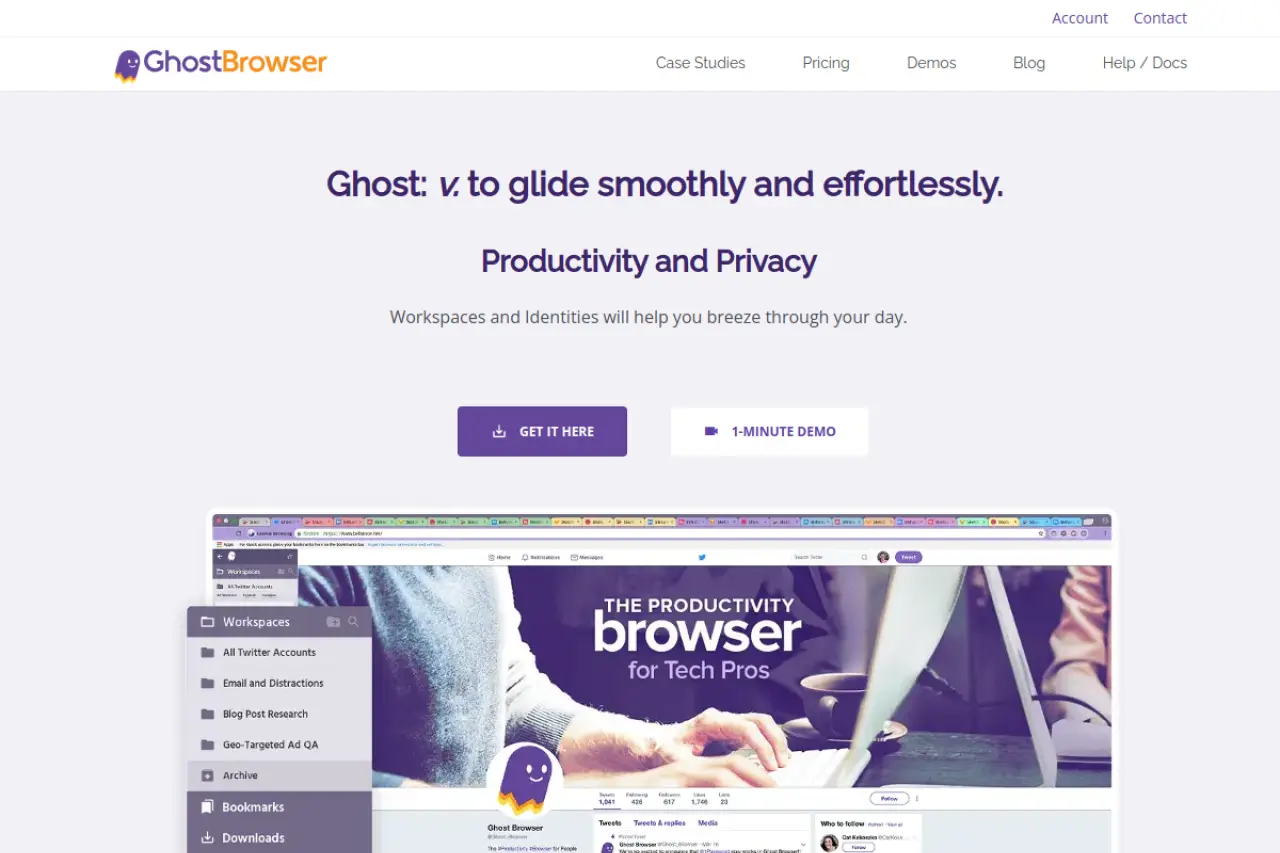
Ghost Browser takes a different architectural approach. Instead of launching heavy, separate browser windows, it optimizes productivity within a single interface. Ghost Browser uses distinct Identities and Workspaces to isolate tabs and cookie jars. Tech professionals and customer support teams can manage multiple client accounts seamlessly. The Ghost Proxy Control feature lets you assign a different proxy IP to each individual tab. While excellent for daily productivity, it lacks the deep, hardware-level fingerprint spoofing needed for high-risk stealth accounts or heavy automated farming.
Best for: Tech professionals managing multiple tabs in one window
Key strengths: Tab-based identity isolation and seamless Chrome extension support
Key limitations: Not designed for heavy automation or stealth accounts
Pricing: Free version available; Pro features start at $46/month
Nstbrowser: Top choice for heavy data collection and scraping
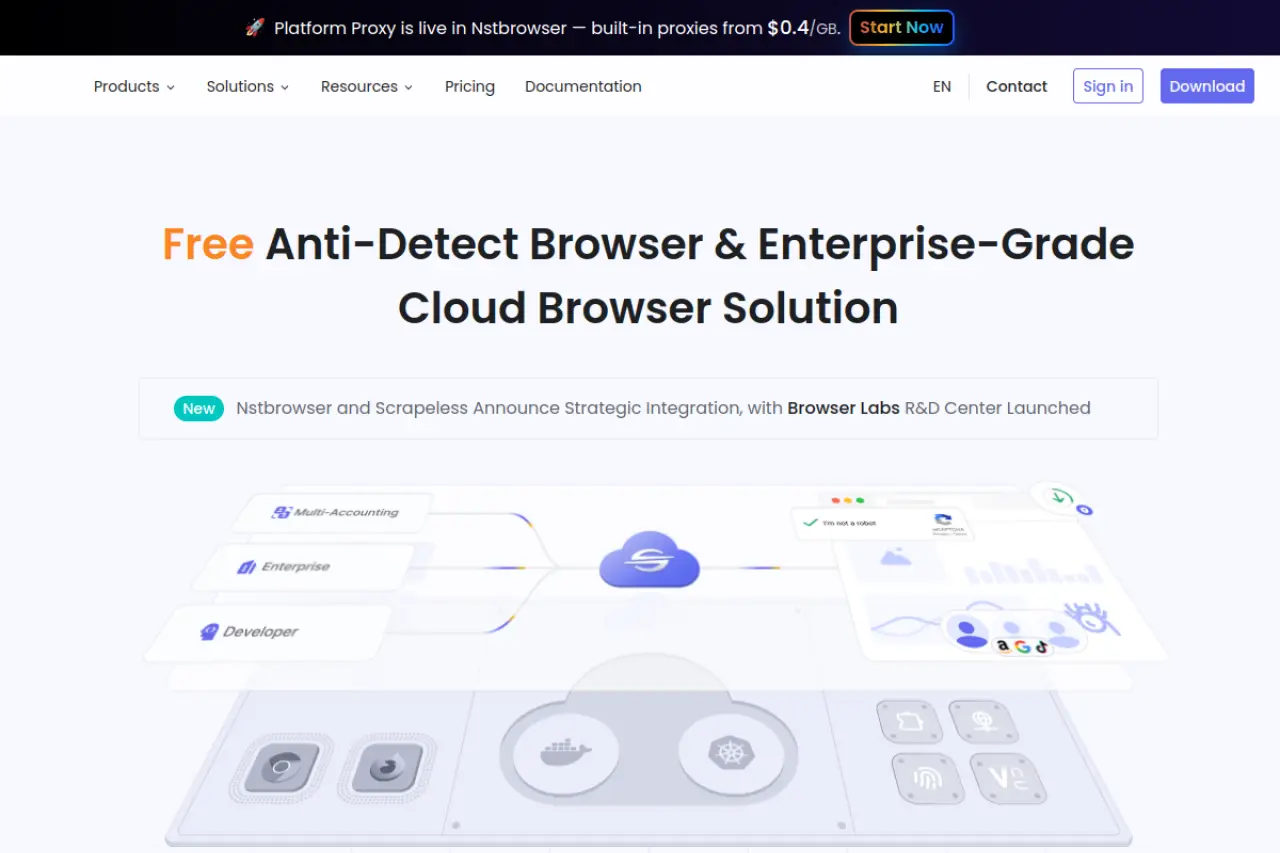
Enterprise-scale data extraction requires heavy infrastructure. Nstbrowser delivers fully managed cloud cluster services designed specifically for web scraping and bulk account management. It features advanced fingerprint randomization alongside AI-powered capabilities for intelligent proxy rotation and captcha bypass. If your developers use Node.js or Python, the comprehensive API v2 makes integration smooth. This tool is built for high-concurrency tasks rather than simple social media management. The developer-focused interface means non-technical marketing teams might face a steep learning curve during setup.
Best for: Enterprise-scale web scraping and bulk account management
Key strengths: Fully managed cloud cluster services and AI captcha solving
Key limitations: Interface is geared toward developers and data scientists
Pricing: Pay-as-you-go model or professional plans from $29.90/month
SessionBox: Best for managing sessions directly in your browser
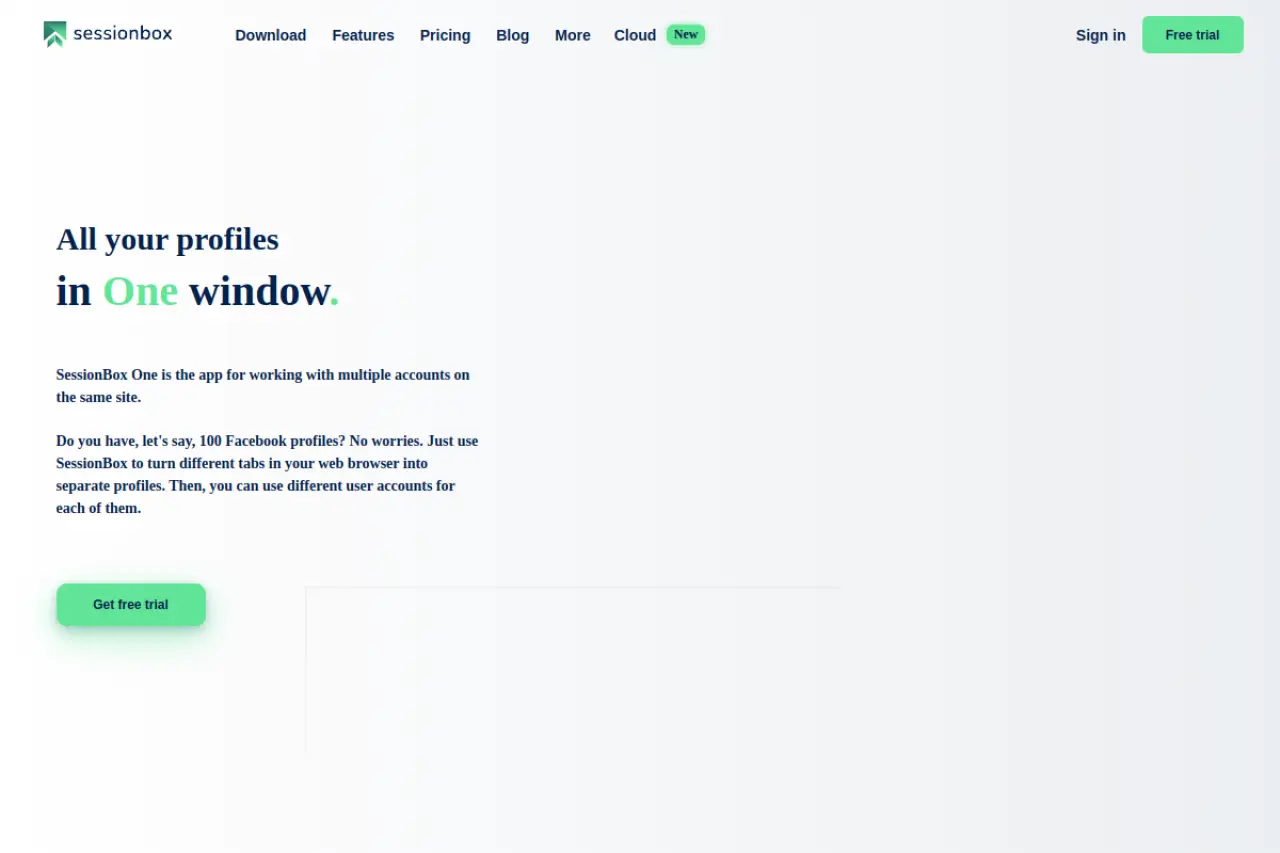
Agencies looking for a lightweight, rapid-deployment tool often prefer SessionBox. It allows you to manage multiple browsing sessions within a single standard browser window. It isolates cache, cookies, and fingerprint data per color-coded tab. This setup prevents accidental cross-contamination when switching between client ad accounts. SessionBox automatically assigns proxies with matching locations and timezones. While it offers excellent cloud synchronization, tab-based isolation can sometimes be less stable against aggressive tracking compared to fully standalone antidetect browsers.
Best for: Agencies needing a lightweight tool for multiple logins
Key strengths: Color-coded session isolation and cloud synchronization
Key limitations: Individual tab isolation can be less stable than standalone browsers
Pricing: Hobby plans start at $12.99/month
How these MuLogin competitors compare on cost and team features
Transitioning from individual tool capabilities to your overall business infrastructure requires a hard look at the bottom line. When evaluating how these platforms handle team scaling, your choice directly impacts your operational risk and ROI.
Scaling your operations should not mean multiplying your software costs exponentially.
For the best balance of price and performance, DICloak stands out. It provides secure profile sharing, cloud synchronization, and built-in automation workflows starting at a highly competitive rate. This makes it the most scalable option for growing teams.
Setup expectations when moving to a MuLogin alternative
After securing the right platform for your budget and team size, you face the actual migration. Changing your core business infrastructure carries operational risk. A sloppy transition can trigger immediate security flags and paralyze your revenue streams. Planning the move carefully prevents downtime. You must set realistic timelines for your team to adapt to the new interface and workflow.
How long does it take to migrate your browser profiles?
Expect the migration to take anywhere from a few hours to a full week. The timeline depends entirely on the size of your operation. Moving a small batch of accounts is fast. You export your cookies from MuLogin and import them into your new platform. However, scaling this across hundreds of accounts requires a phased approach.
Logic dictates that you should never move everything at once. Migrate a small test batch first. If you manage multiple Facebook accounts without ban, you know that sudden changes in browser profiles can trigger verification locks. Modern platforms streamline the transition by allowing bulk cookie imports, but you must still let the new profiles settle to build trust with the platform.
Allocate at least one full day for your team to learn the new platform. A smooth handover means training your staff on the new automation workflows and profile sharing mechanics. Rushing the process increases the chance of human error. Human error remains the leading cause of account suspensions during a software switch.
What to check in your proxy settings before going live
Your proxy configuration is the most critical element of the migration. A perfectly spoofed browser fingerprint is useless if your IP address leaks or changes drastically. Before launching any live accounts, verify that your new tool correctly handles your existing proxy lists.
First, confirm protocol compatibility. Check if the alternative supports HTTP, HTTPS, and SOCKS5 exactly as your current setup demands. Next, audit the automated location matching. If you are operating an Amazon stealth account browser setup, the new software must automatically sync the browser timezone and geolocation with the proxy IP.
Always run a secure connection test before logging in. Open a blank profile and check your IP score on a third-party verification site. Ensure there are no WebRTC leaks or DNS mismatches. Validating these settings takes only a few minutes per profile, but it protects your entire business operation.
Which tool should you choose for your specific workflow?
After validating your secure proxy connections, the final step is matching a software platform to your daily operations. Choosing the right tool depends entirely on your business goals. A setup that works for a single developer will fail a large marketing agency. You must align your software choice with your growth targets, team size, and budget to mitigate operational risk. Below is a breakdown of the best antidetect browser options based on distinct business needs.
If you are scaling to 100+ accounts for crypto or affiliate deals
Managing massive account networks requires strict isolation and heavy automation. When you operate a crypto airdrop farming browser setup or handle large-scale affiliate marketing campaigns, human execution becomes a bottleneck. You cannot manually log into hundreds of accounts every day without making costly mistakes.
For high-volume operations, DICloak is the premier choice. It offers built-in RPA automation with no-code workflows. This allows you to program repetitive tasks, like account warm-ups, across hundreds of profiles simultaneously. The software generates independent Canvas and WebGL fingerprints for every session. This ensures your affiliate marketing anti-detect tools never leak your core identity.
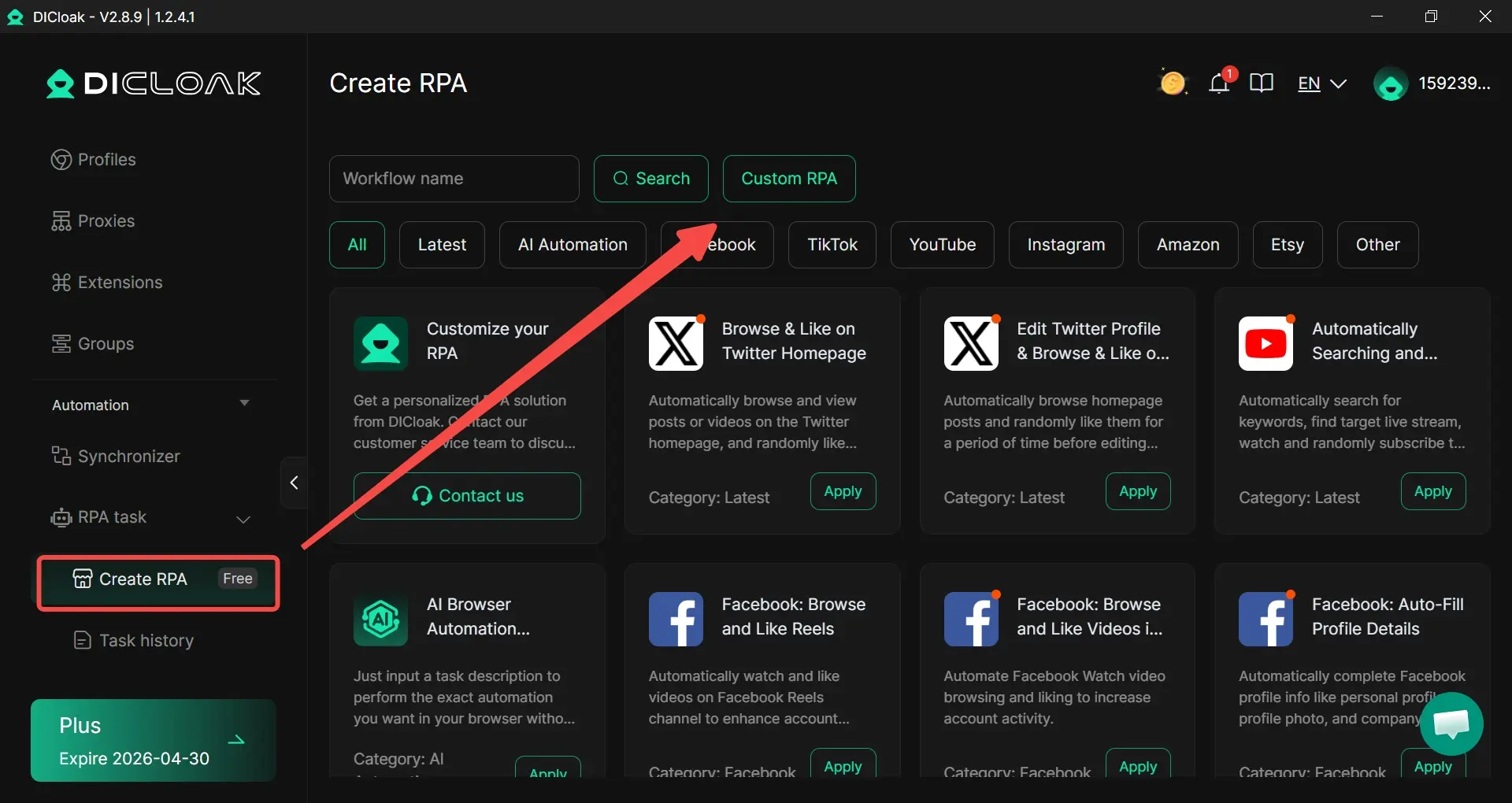
While other browsers provide a visual drag-and-drop editor for complex web automation. However, its pricing scales steeply as you cross the 300-profile mark. DICloak provides better financial predictability for enterprise teams deploying massive account clusters.
FAQs about Best Mulogin Alternatives
What is the best free alternative to MuLogin in 2026?
For users needing a permanently free core, ixBrowser is the most logical choice. It provides unlimited profile storage at no cost, limiting only the daily creation rate. This makes it an excellent starting point for businesses managing long-term, stable accounts without requiring advanced team collaboration features.
Is it easy to transfer my accounts and cookies from MuLogin to another tool?
Yes, modern platforms prioritize smooth migrations to minimize operational downtime. Most top competitors allow you to export your active cookies and proxy lists directly via CSV or API. For instance, tools like DICloak let you bulk-import these assets, instantly restoring your active sessions without triggering security alerts.
Which MuLogin competitor is safest for Facebook and Google Ads management?
DICloak is the most secure option for high-risk ad platforms. It generates independent digital fingerprints for Canvas and WebGL at the hardware level, preventing tracking leaks. Combined with its secure cloud synchronization, your team can manage sensitive agency accounts without facing unexpected verification locks.
Are there cheaper options than MuLogin for small marketing teams?
Yes, there are several highly capable, budget-friendly options available today. DICloak offers free plan plan for 5 profiles. If you need a lightweight setup, it also provides basic session isolation directly in your standard browser starting around $8 per month.
Which alternative offers the best API for developers switching from MuLogin?
For developers requiring programmatic control, DICloak and Nstbrowser provide the most robust infrastructure. DICloak offers both Local and Cloud Browser APIs, integrating perfectly with existing automation workflows. Nstbrowser also delivers a comprehensive API designed specifically for enterprise-scale web scraping and data collection.
 Web Proxy Tools
 Free Tools
 Cookie Plugin
 UA Generator
 MAC Address Generator
 IP Generator
 IP Address List
 2FA Code Generator
 World Clock
 Anonymous Check
 WebRTC Leak Test
 UUID Generator
 Free Web Proxy Site
 Proxy Checker
 FB Ad Checker
 AI Web Scraping
 Free SMM Tools
 Twitter Shadowban Checker
 Instagram Name Checker
 UTM Generator
 Username Generator
 AI Hashtag Generator
 LinkedIn Headline Generator
 Social Media Image Resizer