A Facebook ad set can hold a steady 2.5 ROAS at $80 per day, then slip under break-even within 48 hours after a fast budget jump. That pattern is common because delivery runs through a live Meta ad auction, where cost and reach shift as competition changes. Teams often scale too early, reset learning, and lose stability right when they expect growth. Meta also notes that heavy edits can push ads back into the learning phase, which can raise CPA before performance settles.
This guide gives you a practical Facebook Ads scaling strategy: how to decide when an ad set is ready, how much to raise budget without shocking delivery, when to duplicate instead of edit, and what guardrails to set for stop-loss, ROAS, and CPA. You will also see how team setup affects scaling speed, especially when multiple buyers share accounts in Meta Ads Manager and use controlled access tools like DICloak to keep account operations consistent. Start with the readiness checks that decide whether scaling should happen now or wait.
How Do You Know You’re Actually Ready to Scale Facebook Ads?
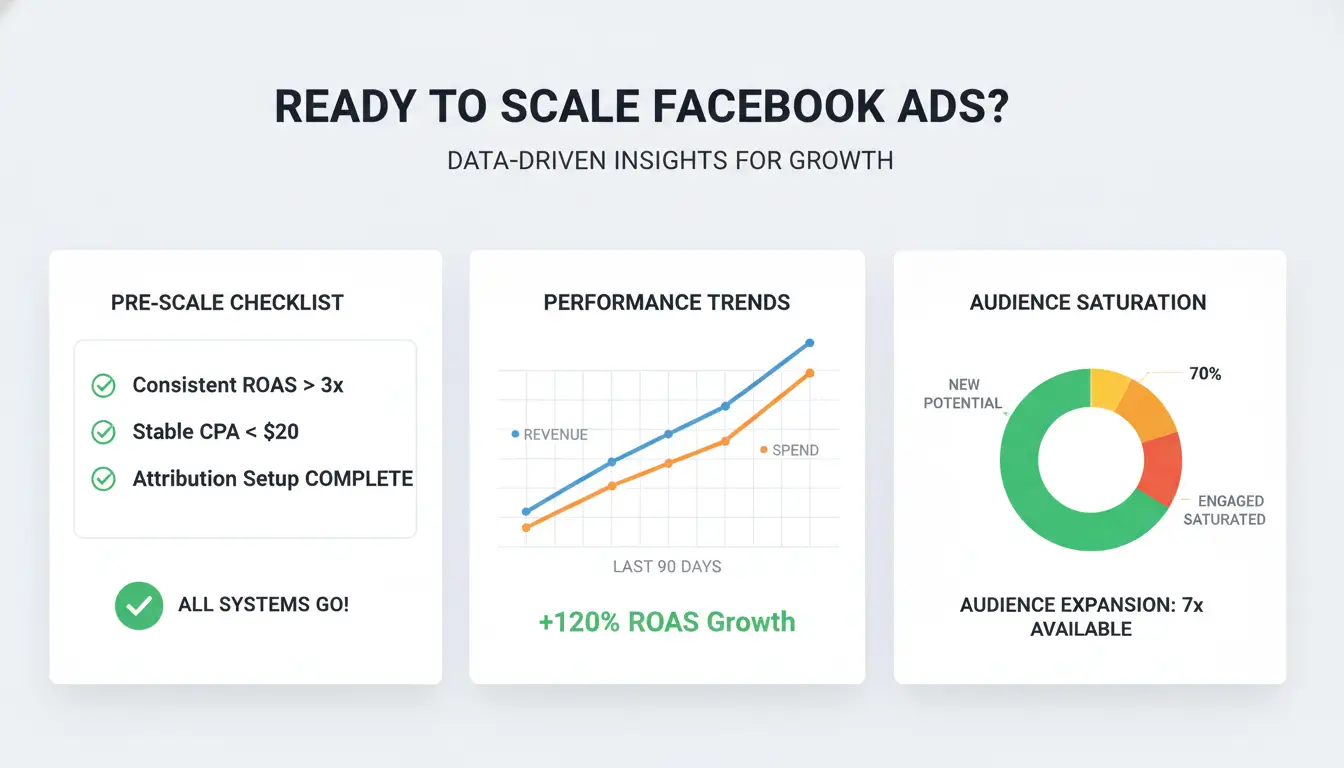
If your decision comes from one good day, wait. A solid facebook ads scaling strategy starts with proof that performance is steady, tracking is clean, and unit economics still work after spend goes up.
Set minimum stability windows before any budget increase
Use a 5–7 day window, not a 24-hour spike. Check the same ad set across that full period. You want CPA, CTR, and conversion rate moving in a tight band, not jumping up and down.
A practical rule: only scale ad sets that hit your target CPA for at least 5 days, with no single day far above break-even. Also keep edits low, since heavy changes can reset delivery into the learning phase. Scale only from repeatable results, not short-term wins.
Validate tracking and attribution before scaling decisions
Before raising budget, compare Meta Ads Manager conversions with your checkout or CRM revenue logs. If ad platform numbers and backend sales do not match, fix tracking first.
Watch attribution lag. Some purchases show up hours later or the next day. If you judge too early, you may kill a working ad set or scale a weak one.
Use go/no-go thresholds for spend expansion
Write hard thresholds before you scale: break-even ROAS floor, target CPA ceiling, and daily cash flow limit. If one threshold fails for 2 straight days after a budget raise, stop expansion.
If your team has more than one buyer, keep access and actions consistent. You can use DICloak to control who changes what, so scaling decisions stay clean and auditable.
What Numbers Matter Most in a Facebook Ads Scaling Strategy?
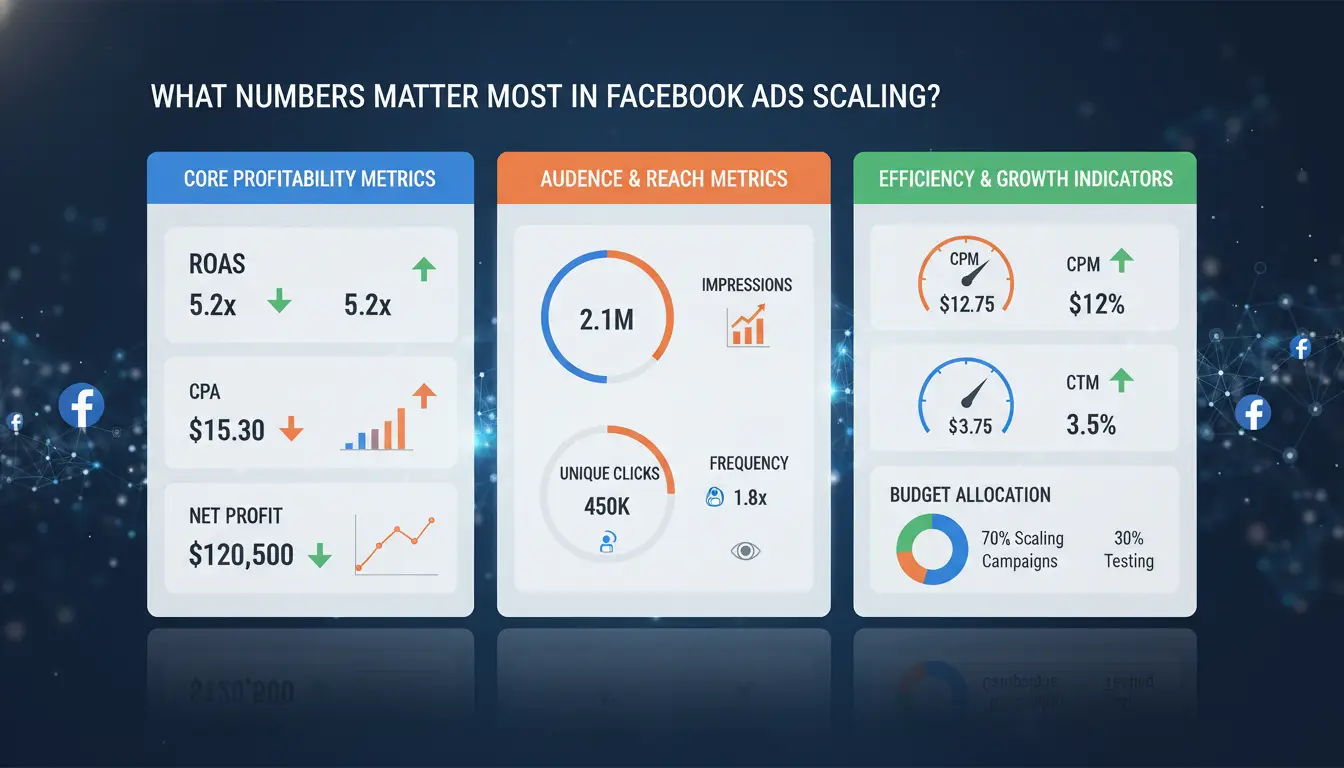
A solid facebook ads scaling strategy tracks profit, not just ad account wins. In Meta Ads Manager, ROAS can look healthy while net profit drops after shipping, fees, and returns. Guard your contribution margin per order before you raise spend.
Track blended metrics, not platform metrics alone
Use this comparison each week:
| Metric |
What it shows |
Why it can mislead during scale |
| In-platform ROAS |
Revenue tied to tracked ad conversions |
Misses untracked sales paths and some post-click behavior |
| MER (total revenue / total ad spend) |
Store-level payback from all paid media |
Can hide weak ad set quality if brand demand is high |
| Contribution margin |
Cash left after variable costs |
Best check for profit safety at higher budget |
If your offer has repeat orders, add 30-day and 60-day reorder rate. Check this in your ecommerce backend, then compare with Meta attribution windows. Rising spend is safer when reorder behavior stays stable.
Model acceptable performance decay during scale
Expect some ROAS compression as you push into broader audiences. Set a pre-approved decay band before scaling. Example: allow ROAS to drop 10% to 15% if contribution margin still clears your floor. Set CAC bands by offer type. A subscription offer can accept higher CAC if payback is quick. A one-time low-margin product needs tighter CAC control.
Build a simple scaling scorecard for weekly decisions
Use three checks: delivery health, efficiency, and profit safety.
| Check |
Green |
Yellow |
Red |
| Delivery health |
Stable CPM, no reset events |
Mild volatility |
Frequent learning resets |
| Efficiency |
CAC within target band |
Slightly above band |
Outside band 2+ days |
| Profit safety |
Margin above floor |
Near floor |
Below floor |
Green: raise budget. Yellow: hold and watch. Red: cut or duplicate into a cleaner test path.
Vertical vs Horizontal Scaling: Which Should You Use First?
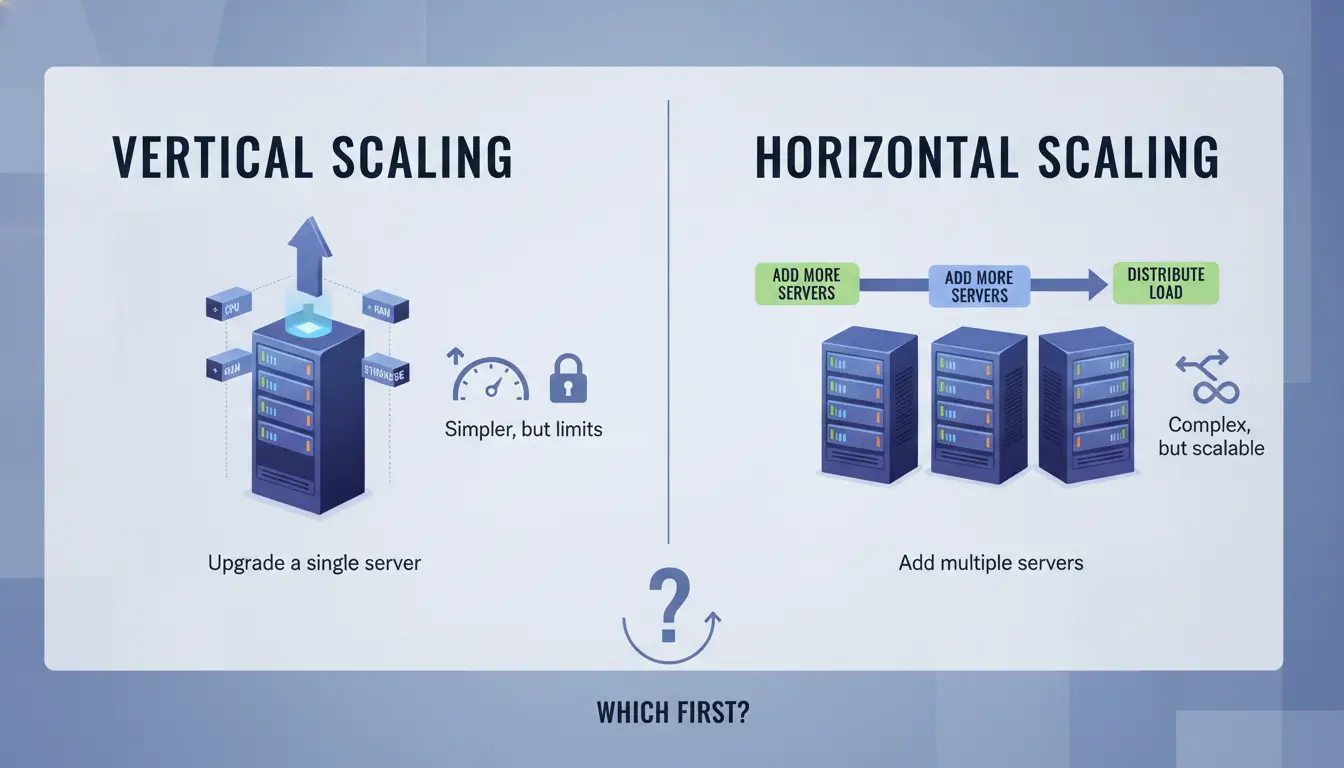
Use this part of your facebook ads scaling strategy to match scale type to what your account can support right now. If your account has thin conversion data, scaling budget faster usually hurts CPA before delivery stabilizes.
When vertical scaling is the better first move
Scale vertically when one ad set already hits your CPA or ROAS target for at least 3 days, with stable spend and no sharp conversion drop. Raise budget in small steps (about 10%–20% each change), then wait 24–48 hours before the next edit. This lowers the chance of sending delivery back into the learning phase.
Use this path when audience size is still healthy and creative is still converting. If frequency climbs and CTR drops, stop budget increases and refresh creatives before the next push.
When horizontal scaling beats budget increases
Go horizontal when budget edits stop improving results, or when one audience starts to saturate. Duplicate your winning setup into new audiences, placements, or geos inside Meta Ads Manager. Keep one variable changed per duplicate so you can read results clearly.
Good expansion lanes: broad targeting, lookalike tiers, and nearby geos with similar CPM behavior. Keep your original winner running as a control.
Decision matrix: pick based on account maturity
| Account state |
Better move now |
Main trigger |
Main risk |
| Low-data account |
Horizontal testing on creative + audience |
Few conversions, unstable CPA |
False winners from noise |
| Mid-data account |
Vertical on proven ad sets |
Stable CPA/ROAS for several days |
Learning reset from large edits |
| Mature account |
Combine both in separate lanes |
Strong creative bank + dense data |
Overlap and budget cannibalization |
If your team scales in parallel, you can use DICloak to keep account actions consistent across buyers and reduce avoidable setup mistakes.
How Should You Increase Budget Without Triggering Performance Drops?
Use a staged plan, not big edits. A practical facebook ads scaling strategy is to raise budget only after stable results over 3 days, then check CPA and ROAS before each next step. Keep one clear log in Meta Ads Manager, and if multiple buyers touch the same campaigns, you can use DICloak for fixed profile access and cleaner change control.
Use staged budget ladders instead of random jumps
Raise budget by 10% to 20% every 24 to 48 hours. Hold at each step until KPIs stay inside your target range. If CPA rises above your stop-loss line for two checks in a row, pause the next increase. Do not change budget, audience, and creative in the same window. That is what often causes unstable delivery and unclear diagnosis.
Choose ABO or CBO based on control needs
Use ABO when you need tight ad-set control or you are scaling a fragile winner. Use CBO after you confirm repeatable conversion patterns across ad sets.
| Setup |
When to use |
Main risk while scaling |
Practical rule |
| ABO |
Testing phase, unstable winners |
Under-spend on strong sets |
Raise only winning sets |
| CBO |
Post-validation scaling |
Budget shifts too fast |
Add spend in small steps |
Protect learning phase stability while scaling
Meta states heavy edits can reset delivery into the learning phase. Batch major changes once per cycle. Keep all other variables fixed for at least one check window. This keeps your facebook ads scaling strategy readable: you know what changed, when it changed, and why KPI moved.
Why Creative Testing Is the Real Growth Lever in Meta Ads Scaling
Budget can buy more impressions, but it cannot fix weak ads. In a real facebook ads scaling strategy, creative output controls how far you can scale before CPA rises. Meta delivery also gets unstable after heavy edits that reset or disturb the learning phase. If you scale spend faster than you replace tired creatives, performance usually drops.
Build a creative testing pipeline before aggressive scale
Run a steady test flow every week: new hooks, new angles, new formats, and new offer framing. Keep testing in separate campaigns from scaling campaigns inside Meta Ads Manager. That split protects your winners. Testing ad sets can absorb volatility, while scaling ad sets keep stable delivery and cleaner readouts on CPA and ROAS.
Set creative replacement rules to avoid fatigue
Set hard rules before spend rises. Watch frequency, CTR trend, and CPM trend together, not alone. Example rule set: if frequency keeps rising for 3 days, CTR drops, and CPM climbs, queue a replacement creative even if ROAS still looks acceptable. Rotate concepts early. Waiting until results collapse usually costs more than replacing one ad too soon.
Use message-market match by audience temperature
Use different messages by funnel stage:
| Audience |
Creative focus |
Goal |
| TOF |
Pattern interrupts, broad pain points |
Stop scroll, earn click |
| MOF |
Proof, product mechanism, objection handling |
Build trust, qualify intent |
| BOF |
Offer clarity, urgency, risk reversal |
Drive conversion |
This is where facebook ads scaling strategy gets real: scale winners by audience temperature, then feed each stage with fresh creatives on schedule.
How Can Teams Scale Facebook Ads Safely Across Multiple Accounts?
A solid facebook ads scaling strategy breaks when team actions are inconsistent. The ad logic may be right, but account behavior still triggers review delays, edit conflicts, or unstable delivery in Meta Ads Manager.
Identify team-level risks that hurt scaling performance
When two buyers log into the same ad account from mixed devices and IP locations, Meta can read that as unusual activity. That risk grows during budget increases, where timing and edit order already matter. The bigger failure point is silent changes. One person duplicates ad sets while another edits targeting, and no one can trace who changed what. If your team cannot trace actions, you cannot debug performance drops.
Use DICloak to isolate environments and standardize operations
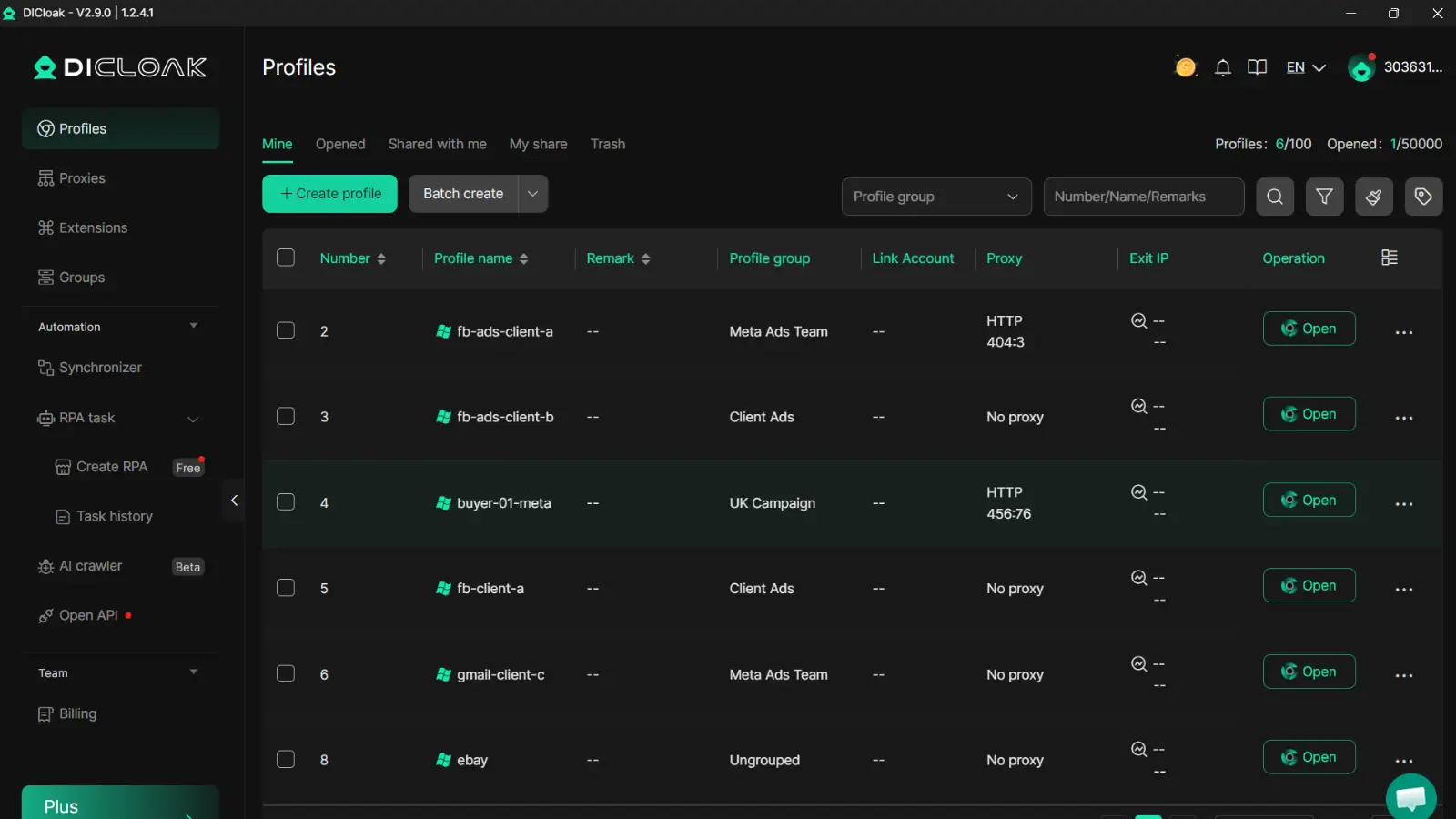
You can use DICloak to give each buyer an isolated browser profile with a separate fingerprint and a dedicated proxy bound to that profile. This keeps account sessions stable while people work across client accounts. You can also set role-based access, share profiles safely, and check operation logs. That helps prevent accidental edits and speeds up root-cause checks after CPA spikes or rejected ads.
Reduce manual errors with repeatable execution
Manual setup causes drift. One buyer names campaigns one way, another skips a placement check, and reporting breaks. Use batch actions for repeated setup steps so every account follows the same pattern. For repeated tasks, use DICloak RPA flows to run the same sequence each time, like opening the right profile, checking key campaign fields, and logging completion. This keeps your facebook ads scaling strategy consistent while the team scales volume.
What Usually Breaks During Scaling, and How Do You Fix It Fast?
Fast scale fails when one weak link gets hidden by spend. A solid facebook ads scaling strategy checks breakdowns in order, then rolls back fast when signals turn.
Diagnose ROAS drops by stage: traffic, conversion, or margin
Split the drop: CPM, CTR, landing page CVR, then unit margin. If CPM jumps but CTR holds, auction pressure is the issue. If CTR drops, creative fatigue is likely. If clicks hold but CVR falls, check page speed and checkout errors. Meta warns heavy edits can reset delivery into the learning phase, so track edits before blaming audiences.
Fix audience overlap and signal dilution
Audit overlap and exclusions inside Meta Ads Manager. Merge tiny ad sets that chase the same users. Tools like DICloak let you map each ad account to an isolated browser profile with its own fingerprint and proxy, lowering cross-account linkage risk when buyers switch accounts.
Apply rollback rules before losses compound
Set hard stop-loss rules: pause losers, cut budget in fixed steps, retest before scaling again. You can use DICloak permissions, profile sharing, and operation logs to control who edits what, then run batch actions and RPA so rollback steps stay consistent across operators.
What Does a Repeatable 30-Day Facebook Ads Scaling Plan Look Like?
Use this cadence if you want a facebook ads scaling strategy your team can repeat every month. Keep edits controlled, track results daily in Meta Ads Manager, and avoid resetting delivery by changing too much at once, since heavy edits can re-enter the learning phase. Scale only ad sets that hold target CPA or ROAS for 3 straight days after the last edit.
Week 1: audit baseline, fix tracking, and lock thresholds
Pull the last 14 days by ad set, ad, and placement. Mark winners, break-even units, and clear losers. Set hard rules before spend goes up:
- Stop-loss: pause if spend hits 1.5x target CPA with no purchase.
- Scale gate: raise budget only after stable CPA/ROAS for 3 days.
- Cooldown: wait 24 hours after each budget edit before the next one.
Create two testing lanes: budget tests on proven ads, and creative tests on small capped budgets.
Week 2-3: run budget and creative scale experiments
Run controlled vertical scaling: increase ad set budget by 10% to 20% every 24 to 48 hours if metrics stay inside limits. Run horizontal scaling in parallel: duplicate top ad sets into new audiences or placements instead of heavy edits on one ad set.
Promote winners only after they pass your gate twice. Kill weak tests fast and reallocate budget the same day. If multiple buyers work in one account, you can use DICloak with role-based access and action logs to keep changes consistent across shifts.
Week 4: consolidate winners into a stable scaling system
Move validated ad sets into a scale campaign with clear naming, fixed rules, and one owner per shift. Write a short playbook: budget step size, fail conditions, creative refresh timing, and rollback steps. End the cycle by logging 3 next hypotheses so your next facebook ads scaling strategy starts with tested ideas, not guesses.
Frequently Asked Questions
How long should results stay stable before scaling Facebook ads?
In a facebook ads scaling strategy, wait for a clear stability window before increasing spend. Use at least 5–7 days of steady results, not one good day. Look for enough conversion volume, such as several purchases per week, plus stable CPA or ROAS. If costs swing hard day to day, hold budget and keep testing.
Can a facebook ads scaling strategy work with small daily budgets?
Yes. A facebook ads scaling strategy can work on small budgets when you scale slowly. Raise budget in small steps, like 10–20% at a time, instead of big jumps. Put most effort into creative testing, because better ads improve results fastest. Keep strict stop rules, and pause ad sets that miss your profit target.
Should I scale prospecting and retargeting campaigns at the same time in a facebook ads scaling strategy?
Usually no. In a facebook ads scaling strategy, change one lever at a time so you can read results clearly. If you scale prospecting and retargeting together, you cannot tell which change caused a CPA spike or ROAS drop. Scale prospecting first, then retargeting, or reverse the order based on your current bottleneck.
How many creatives do I need each month to support scaling?
Set a monthly creative output target tied to spend and fatigue speed. As spend rises, ads burn out faster, so you need more fresh concepts. Plan enough new creatives each month to replace weak ads before performance drops. Keep winning hooks, but refresh angles, visuals, and opening lines to protect efficiency during scale.
Is broad targeting always better for Meta ads scaling strategy?
No. Broad targeting is strong when your creative sends clear buyer signals and your pixel has steady conversion data. But niche offers often need tighter controls, such as interest or lookalike layers, to keep quality traffic high. Test broad against controlled audiences side by side, and scale the option with more stable CPA and ROAS.
A strong Facebook ads scaling strategy comes down to increasing budget and reach in controlled steps while protecting performance through constant creative testing, audience refinement, and clear KPI tracking. The brands that scale sustainably are the ones that treat scaling as a repeatable system, not a one-time push, so growth stays profitable as spend rises. Try DICloak For Free
 Web Proxy Tools
 Free Tools
 Cookie Plugin
 UA Generator
 MAC Address Generator
 IP Generator
 IP Address List
 2FA Code Generator
 World Clock
 Anonymous Check
 WebRTC Leak Test
 UUID Generator
 Free Web Proxy Site
 Proxy Checker
 FB Ad Checker
 AI Web Scraping
 Free SMM Tools
 Twitter Shadowban Checker
 Instagram Name Checker
 UTM Generator
 Username Generator
 AI Hashtag Generator
 LinkedIn Headline Generator
 Social Media Image Resizer