OnlyFans has aggressively scaled its bot detection in 2026, transitioning from simple IP blacklisting to sophisticated behavioral analysis and hardware-level fingerprinting. For engineers tasked with maintaining data pipeline uptime, the challenge isn't just about finding a scraper—it’s about architecting a stealth environment that prevents the immediate termination of authenticated accounts. Reliable market intelligence now depends on the ability to bypass these protections while maintaining a low cost-per-successful-request.
What data can you actually extract with an OnlyFans scraper in 2026?
Building a robust research model requires defining the technical scope of extraction. We are no longer just pulling raw HTML; we are monitoring XHR requests and DOM mutations to capture data in real-time.
Analyzing public profile metadata and creator bios
Scrapers target the top-level JSON responses that populate creator profiles. This allows for the mass extraction of usernames, verified status, and bios. By analyzing these datasets at scale, engineers can map out keyword density and branding pivots across the platform's most successful niches.
Tracking subscription pricing and promotional trends
Automated scripts monitor the price-point keys within the platform's API responses. This data allows for the historical tracking of subscription costs, "bundle" discounts, and limited-time promotions. For an agency, this provides a clear view of how competitors adjust pricing in response to seasonal demand or platform-wide shifts.
Measuring engagement through likes and public post counts
While subscriber lists are shielded, public engagement metrics remain visible. Scrapers aggregate total likes and post counts to calculate average engagement rates. These metrics serve as the primary proxy for estimating a creator's growth trajectory and audience retention without requiring access to private feeds.
Is scraping OnlyFans legal or will it get your account banned?
From a technical and legal standpoint, the distinction between "what can be done" and "what should be done" is sharp.
The distinction between public data and paywalled content
According to established precedents and platform documentation, scraping publicly available data—such as bios and public pricing—is generally legal. However, paywalled content is a different matter. Attempting to automate the extraction of private media is a direct violation of the Terms of Service (ToS) and introduces significant legal liability regarding intellectual property. Most professional-grade operations restrict their scope to public metadata to ensure long-term project viability.
Understanding account-level risks during authenticated scraping
Authenticated scraping is a high-stakes operation. OnlyFans monitors the telemetry of logged-in sessions with extreme scrutiny. If your scraper’s request headers, mouse movements, or navigation paths deviate from a human baseline, the account used for the session will be permanently terminated. We never recommend using high-value or personal accounts for scraping; instead, use burner accounts managed within isolated browser profiles to mitigate the impact of a potential ban.
Which OnlyFans scraping tools are most effective right now?
The 2026 landscape is dominated by tools that prioritize stealth and support for modern browser profiles.
ScrapeMaster 2026 for bulk analytics
ScrapeMaster remains the industry standard for high-volume operations. It utilizes advanced headless browser configurations that are specifically hardened against detection. It is designed to handle thousands of concurrent requests while maintaining deep integration with residential proxy rotators.
OnlyFans Insights Pro for competitor tracking
This tool focuses on the agency side of the market, offering sophisticated visual analytics. It is particularly effective at monitoring price fluctuations and subscriber growth patterns, converting raw data into actionable reports for influencer management.
OF Data Miner for lightweight extraction
For targeted, low-volume research, OF Data Miner offers a streamlined UI. It is built for one-click exports of profile metadata and public statistics. Its primary advantage is its minimal footprint, making it less likely to trigger behavioral alerts for simple queries.
StealthScraper AI for bypassing advanced detection
StealthScraper AI uses machine learning to generate "humanized" interaction patterns. It simulates irregular scrolling, randomized mouse hovering, and varying dwell times. It is the tool of choice when scraping profiles that have implemented the most aggressive anti-bot scripts.
AutoScrapeBot for multi-profile automation
AutoScrapeBot excels at scheduled monitoring. It allows engineers to set custom scraping rules for a specific list of creators, automating the collection of data updates at set intervals and pushing that data directly to cloud storage solutions for further analysis.
Why does OnlyFans block most automated scraping attempts?
The platform’s security doesn't just look for high request volumes; it looks for technical signatures that prove the user is a machine.
OnlyFans uses JavaScript to query the browser for hardware-level details. If your scraper reveals it is running on a generic Linux server or fails to properly spoof its WebGL and Canvas signatures, the platform identifies a "hardware leak." This reveals that the environment is virtualized, leading to an immediate block even if the IP address is clean.
Rate limiting and the danger of "inhuman" request patterns
Rhythmic request patterns are a dead giveaway. A human user does not click a profile every exactly 2.0 seconds. When requests are made with machine-like precision, the platform’s firewalls trigger a 403 Forbidden error and blacklist the IP range.
How to set up a secure environment for high-volume scraping?
Reliability in 2026 requires a multi-layered defense-in-depth strategy.
Integrating residential proxies for IP diversity
Data center proxies are a waste of resources; they are flagged by platform firewalls instantly. Rotating residential proxies are mandatory. Crucially, your scraper must match the proxy’s IP geolocation with the browser’s internal GPS and timezone settings. A mismatch between a New York IP and a London system clock is an immediate red flag.
Implementing human-like request delays and jitter
To stay under the radar, you must implement "jitter"—the randomization of delays between requests. Aim for request intervals that mirror a high-intent human user, typically 10–15 seconds per page load, with occasional randomized "bursts" of activity followed by longer idle periods.
Regularly updating scraper configurations
OnlyFans frequently updates its DOM structure to break CSS selectors. Maintaining a successful data pipeline requires monitoring for "null" returns and regularly updating your scraper's configuration to adapt to changes in site architecture and security scripts.
How to use advanced browser isolation for more controlled scraping setups
For larger-scale scraping tasks, relying on a single browser profile can make sessions harder to separate and manage over time. With DICloak, users can build a more controlled setup by keeping different tasks in independent profiles and maintaining greater consistency across sessions.
Separate profiles with more control over setup
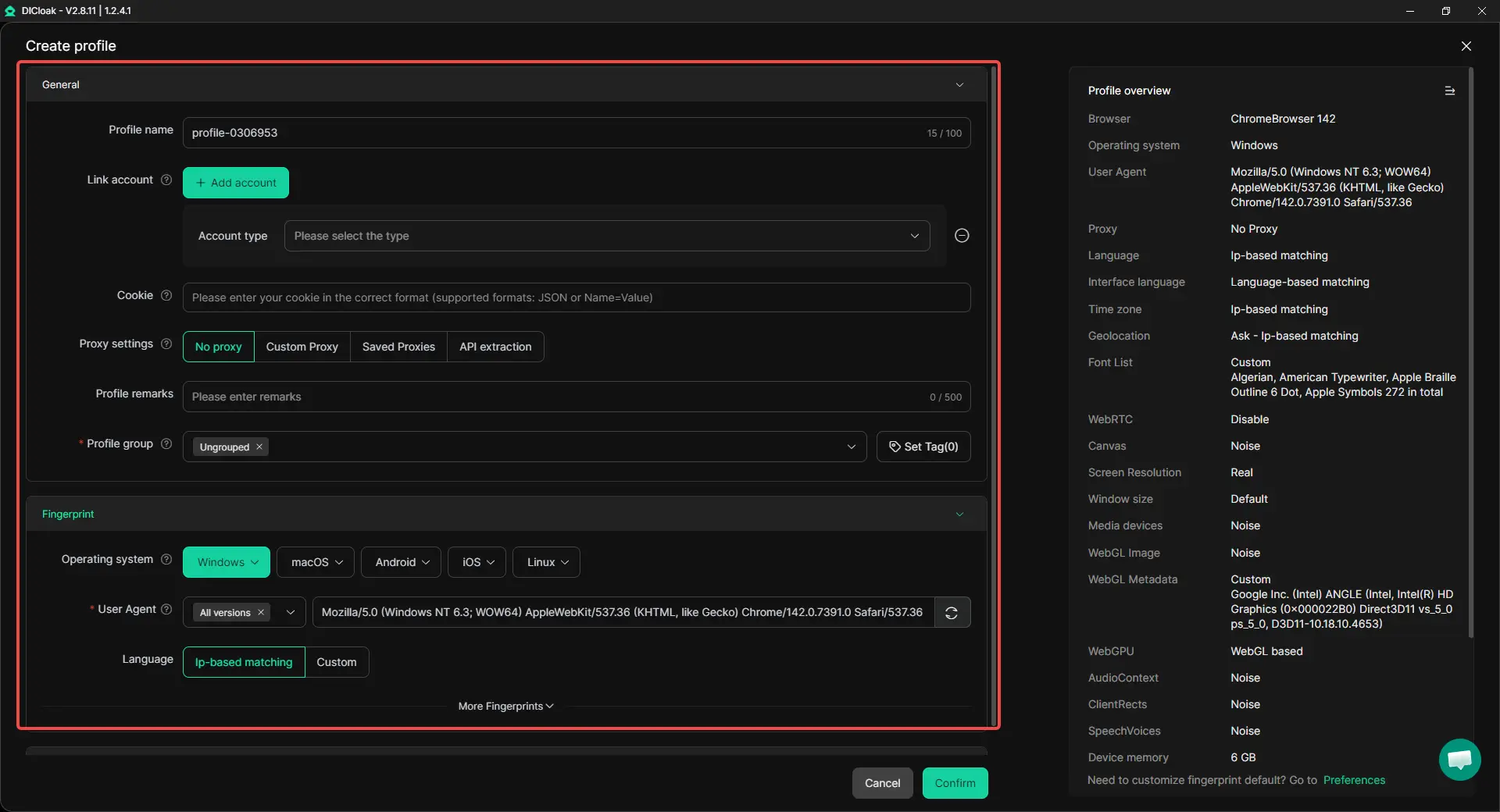
With DICloak, users can create separate browser profiles for different tasks, each with its own cookies, local storage, and session data. Users can also adjust fingerprint and profile settings based on different needs, making it easier to keep account environments organized and avoid unnecessary overlap.
Managing fingerprint consistency more carefully
With DICloak, users can adjust settings such as browser-related fingerprint parameters to keep profile environments more consistent over time. This can be useful in cases where session stability matters and frequent environment changes may create more friction.
Supporting larger-scale operations
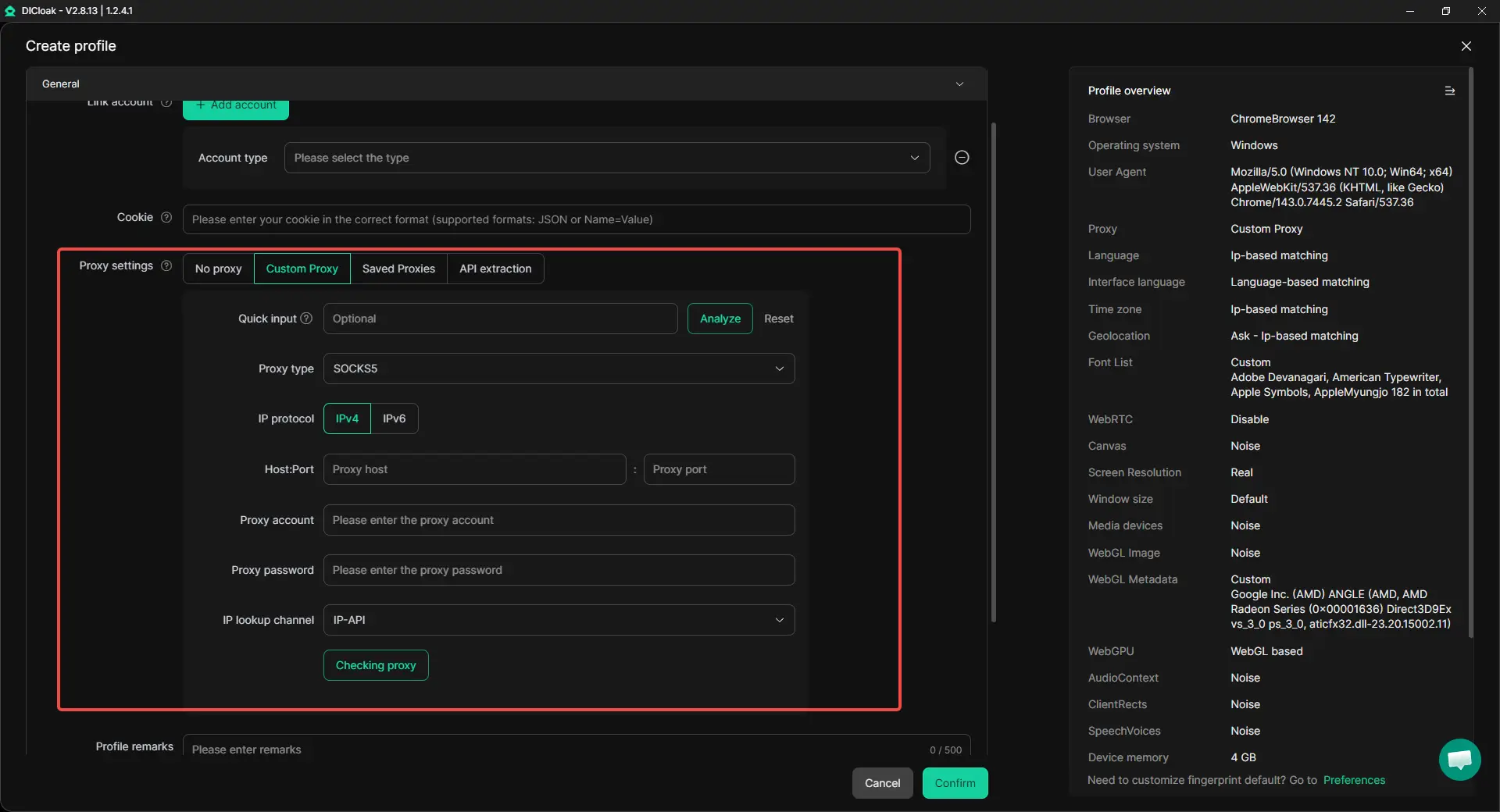
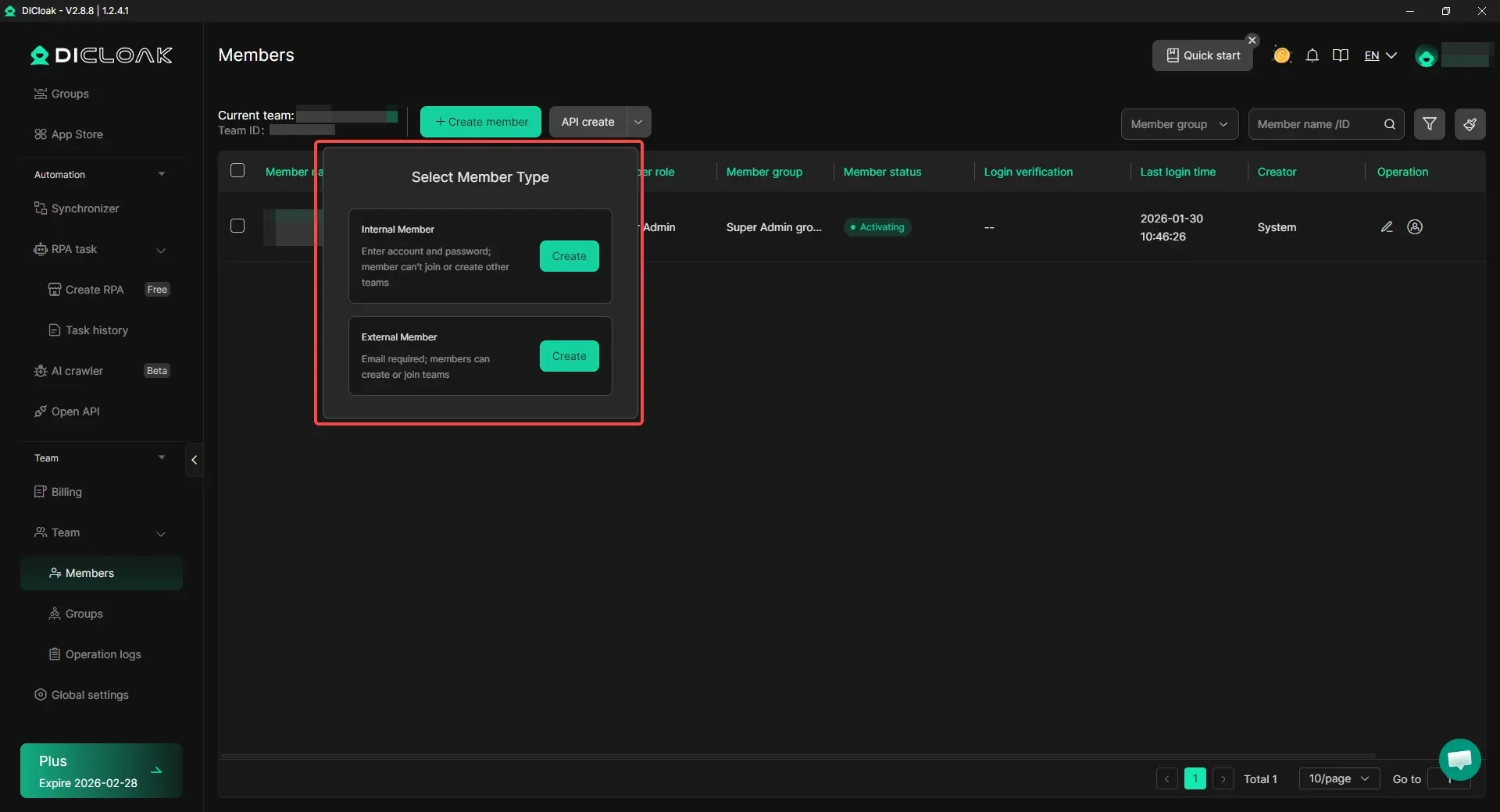
With DICloak, users can organize and manage multiple browser profiles more efficiently through batch tools, team features, and API-based operations. This makes it easier to keep environments separated at scale while making day-to-day management more structured.
What are the most common mistakes when running an OnlyFans scraper?
Operational failures are usually the result of neglecting the technical details of the browser profile.
Using data center proxies instead of residential IPs
Using data center IPs is the fastest way to get your account flagged. These ranges are known and pre-blocked by most high-security platform firewalls.
Failing to clear cookies and session data between profiles
Data leakage occurs when session artifacts are carried over between different scraping tasks. If the platform detects a cookie trail connecting multiple accounts, it will trigger a mass ban across your entire infrastructure.
Ignoring behavioral cues and GPS matching
In 2026, the "browser profile" includes the internal GPS. If you are using a proxy for a specific region but your browser reports a different location via its geolocation API, the platform’s security scripts will flag the inconsistency immediately.
Frequently Asked Questions (FAQ)
Is a proxy enough to keep my scraping undetected?
No. A proxy only masks your IP. Without fingerprint protection and hardware spoofing, the platform will still detect the environment as automated.
Can I scrape OnlyFans without an account?
Only public-facing metadata is accessible without authentication. Any data behind a paywall or "follow" button requires an authenticated session, which increases the risk profile.
What is the best scraper for a non-technical user?
OF Data Miner is the most accessible. Its simple UI and one-click export functions allow users to gather metadata without writing custom code.
How many requests per minute are considered safe?
Avoid fixed rates. As a rule of thumb, maintain a 10–15 second interval between major actions and use randomized jitter to ensure no two requests look identical.
Does OnlyFans detect headless browsers?
Yes, standard headless browsers like Puppeteer or Selenium leave "headless signals" in the JavaScript environment. You must use a hardened antidetect browser to strip these signals.
Final Considerations for 2026
Achieving consistent data extraction on OnlyFans in 2026 is an engineering challenge that requires more than just a script. Success is found at the intersection of high-quality scraping tools, a robust pool of residential proxies, and an antidetect environment like DICloak to manage browser identity. By focusing on mimicking human behavior and emulating real mobile environments, you can maintain data integrity and protect your accounts from the platform’s increasingly sophisticated security layers. Maintaining this technical standard is the effective way to keep the long-term viability of your data collection pipeline.
 Web Proxy Tools
 Free Tools
 Cookie Plugin
 UA Generator
 MAC Address Generator
 IP Generator
 IP Address List
 2FA Code Generator
 World Clock
 Anonymous Check
 WebRTC Leak Test
 UUID Generator
 Free Web Proxy Site
 Proxy Checker
 FB Ad Checker
 AI Web Scraping
 Free SMM Tools
 Twitter Shadowban Checker
 Instagram Name Checker
 UTM Generator
 Username Generator
 AI Hashtag Generator
 LinkedIn Headline Generator
 Social Media Image Resizer