Why Use Free Alternatives to Ahrefs?
Ahrefs combines keyword research, backlink analysis, site audits, rank tracking, and competitor research in one platform. But not every user needs all of these features, especially when managing only one or two websites.
For many small businesses, bloggers, and freelancers, free alternatives to Ahrefs can cover the most common SEO tasks. Google Search Console shows real Google search performance for your own site. Bing Webmaster Tools provides keyword and backlink data. Ahrefs also offers free access for verified websites, including limited Site Explorer and Site Audit features.
Instead of looking for one complete free Ahrefs replacement, it often makes more sense to combine several free SEO tools. This lets you start with the data you actually need and upgrade only when deeper competitor research, larger exports, or more advanced tracking becomes necessary.
Why Ahrefs May Be Too Expensive for Small Teams
Ahrefs can be valuable for agencies and SEO teams that analyze many websites every day. For smaller teams, however, the cost may be harder to justify.
Ahrefs currently offers a Starter plan for $29 per month, while the Lite plan costs $129 per month and provides higher limits and more features.
A small business may only need to know which pages receive clicks, which keywords bring visitors, and whether the website has technical SEO problems. Google Search Console and free audit tools can already answer many of these questions.
Ahrefs Free also gives verified website owners access to useful data, including up to 1,000 visible backlinks and keywords in Site Explorer and 5,000 Site Audit crawl credits per project each month.
For small teams, a practical approach is to use Ahrefs Free together with other free tools first, then move to a paid plan when the extra data and time savings become necessary.
When Free Alternatives to Ahrefs Are Enough
Free tools are usually enough when you manage a small number of websites and mainly focus on your own SEO performance.
A simple setup can include:
- Google Search Console for Google search queries, impressions, clicks, and page performance
- Bing Webmaster Tools for additional keyword ideas and basic backlink data
- Ahrefs Free for verified-site backlinks and technical audits
This combination can handle many everyday SEO tasks, including finding pages that are losing traffic, researching basic keyword ideas, checking backlinks, and identifying technical issues.
Free tools become less suitable when you need deep competitor research, large backlink databases, historical data, bulk exports, or rank tracking across many websites.
If you manage one small website and mainly want to improve your own organic traffic, free alternatives to Ahrefs may already cover most of your needs. The goal is not to avoid paid SEO tools forever, but to pay for them only when their extra features solve a real problem.
Best Free Alternatives to Ahrefs in 2026
Ahrefs is one of the most useful SEO platforms for keyword research, backlinks, competitor analysis, and site audits. But not every business needs a full paid SEO suite. A blogger may only need keyword ideas, while a small agency may want to check backlinks or review a client website once a month.
That is why many people search for free alternatives to Ahrefs in 2026. The important point is that there is no single free tool that replaces every Ahrefs feature. In most cases, the better option is to combine a few free SEO tools and use each one for the task it handles best.

Google Search Console
Google Search Console is one of the most useful free SEO tools for anyone who owns or manages a website. It shows how your pages perform in Google Search, including clicks, impressions, CTR, average position, and the search queries that lead users to your site.
This makes it very useful for finding content that already has SEO potential. For example, you may find that a blog post receives 8,000 impressions a month but only 120 clicks. If the page ranks around positions 6 to 10 for several useful keywords, you may not need to write a new article. Updating the title, improving the introduction, or adding missing sections may be a better use of your time.
Search Console also provides indexing information and a Links report. It can help you see which pages receive links and which sites link to your domain. However, it is mainly designed for websites you control, so it is not a full competitor research tool.
For this reason, Google Search Console is one of the best free Ahrefs alternatives for your own website data, but it works best when combined with another tool for competitor and keyword research.
Semrush is often compared with Ahrefs because both platforms cover many of the same SEO tasks. These include keyword research, competitor analysis, backlinks, site audits, and rank tracking. Semrush also offers limited free access, which can be enough for smaller research tasks.
The free version works best when you already know what you want to check. For example, if you are planning a new article about email marketing software, you may only need to compare a few keywords. You can use Semrush to check estimated search volume, keyword difficulty, intent, and the pages that already rank.
It is also useful for quick competitor research. A domain check can help you see estimated organic traffic, ranking keywords, and backlink signals. This gives you a fast idea of whether a competitor depends heavily on SEO or only ranks for a small number of important terms.
The main problem is the free usage limit. If you manage many sites or search dozens of keywords every day, the free version becomes restrictive quite quickly. Semrush Free is therefore best for focused checks rather than full-time SEO research.
Ubersuggest
Ubersuggest is another popular choice for people looking for a simple Ahrefs alternative. It combines keyword ideas, competitor research, backlink data, site audits, and rank tracking in an interface that is easier for beginners to understand.
Its keyword research features are especially useful when you are still exploring a topic. Suppose you want to create content around "project management software." A broad keyword like this may be difficult to rank for, but Ubersuggest can help you discover more specific ideas such as "project management software for small teams" or "free project management tools for freelancers."
These longer keywords often have clearer search intent. They may also be more realistic targets for newer websites. Instead of choosing a keyword only because it has high search volume, you can compare relevance, competition, and the type of pages already ranking.
The free version has strict usage limits, so it is not ideal for large keyword projects. However, for a blogger, freelancer, or small business that only performs a few searches at a time, it can still be a useful part of a free SEO tool stack.
Moz Link Explorer
Moz Link Explorer is a useful option when your main goal is backlink research. It can show inbound links, linking domains, top pages, and Moz metrics such as Domain Authority.
This is useful when reviewing backlink opportunities. Imagine that a website offers you a guest post or partnership. The site looks professional, but that does not always mean the backlink is valuable. You can check the domain in Moz to see whether it has a real link profile and whether other trusted websites link to it.
However, Domain Authority should never be the only metric you use. DA is a metric created by Moz, not a Google ranking factor. A site with a high DA can still have very little real search traffic or weak content.
A better approach is to combine Moz data with traffic checks, content quality, topical relevance, and backlink patterns. This makes Moz Link Explorer useful as a supporting tool rather than a complete replacement for Ahrefs.
Similarweb
Similarweb is different from most tools on this list because it focuses on the wider traffic picture. It can help you estimate how much traffic a competitor receives and where that traffic may come from, including organic search, direct visits, referrals, paid channels, and other sources.
This can be useful when SEO is only one part of your competitor research. For example, two SaaS companies may both rank for similar keywords, but one may depend mainly on Google while the other gets a large share of traffic from referrals or direct visits.
That difference matters. If a competitor is growing because of partnerships or strong brand traffic, copying its SEO content alone may not produce the same result. Similarweb can help you understand this wider context.
Its competitor traffic data should still be treated as an estimate. You are not viewing the competitor's private analytics account. For this reason, Similarweb is better for comparing trends and traffic sources than for treating each traffic number as exact.
Screaming Frog
Screaming Frog is one of the strongest free alternatives to Ahrefs for technical SEO. Instead of focusing on keywords or backlinks, it crawls your website and looks for technical problems.
The free version can crawl up to 500 URLs, which is enough for many small websites. It can help find broken links, missing titles, duplicate metadata, redirects, canonical issues, and pages with indexing directives.
For example, imagine that a company redesigns its website and changes many page URLs. A Screaming Frog crawl may reveal that old internal links still point to pages that return 404 errors. Fixing those links can improve both user experience and crawling efficiency.
Large sites will quickly reach the free crawl limit, and some advanced features require a paid license. Still, for blogs, local business websites, and smaller SaaS sites, Screaming Frog can handle many basic technical SEO checks without needing Ahrefs.
Best Free Ahrefs Alternatives for Different SEO Tasks
Not every free SEO tool is good at the same thing. This is why choosing the "best Ahrefs alternative" without thinking about the actual task can lead to the wrong choice.
A better approach is to decide what information you need first. Then use the tool that gives you the clearest answer with the least extra work.
Keyword Research
For an existing website, Google Search Console is a strong place to start. It can show the queries your pages already appear for, which makes it useful for finding keywords where you have some visibility but have not reached the top results yet.
Suppose one of your articles ranks around position 9 for "best CRM for freelancers." That is usually more actionable than finding a completely new keyword where your site has no ranking history. You can update the current article, improve the title, add a comparison table, or answer missing questions.
Semrush Free or Ubersuggest can then help you expand the topic. Use them to find related terms, check estimated demand, and understand the competition. This gives you both real site data and wider market data instead of relying on one tool.
Backlink Analysis
For backlinks to your own website, Google Search Console is a useful starting point. It can show linking sites and your most linked pages, helping you understand which content attracts links naturally.
For competitor backlinks, Moz Link Explorer or limited Semrush reports are more useful. For example, if several competitors all receive backlinks from the same industry blog, that may be a site worth researching for your own outreach.
Do not expect backlink totals to match across different tools. Ahrefs, Moz, Semrush, and Google use different crawlers and databases. The more useful question is whether several tools reveal the same important linking domains and patterns.
Competitor Research
Semrush Free and Similarweb work well together for competitor research because they answer different questions.
Semrush can help you understand which keywords a competitor may rank for and which pages attract organic search traffic. Similarweb can give you a wider view of the competitor's estimated traffic channels.
For example, you may find that a competitor ranks for many SEO keywords but still gets a large share of visits from referrals. This may suggest that partnerships, affiliate sites, or other external channels are also important to its growth.
Using both tools gives you a more balanced view than looking only at organic traffic.
Technical SEO
Screaming Frog is the most practical free tool in this list for technical audits. It can scan the structure of a small website and highlight problems that are easy to miss when checking pages manually.
Google Search Console works well alongside it. Screaming Frog may find a broken internal link or a noindex tag, while Search Console can show whether Google is having trouble indexing an important page.
For a smaller website, these two tools can cover many technical SEO needs without paying for a large SEO platform.
How Accurate Are Free Alternatives to Ahrefs?
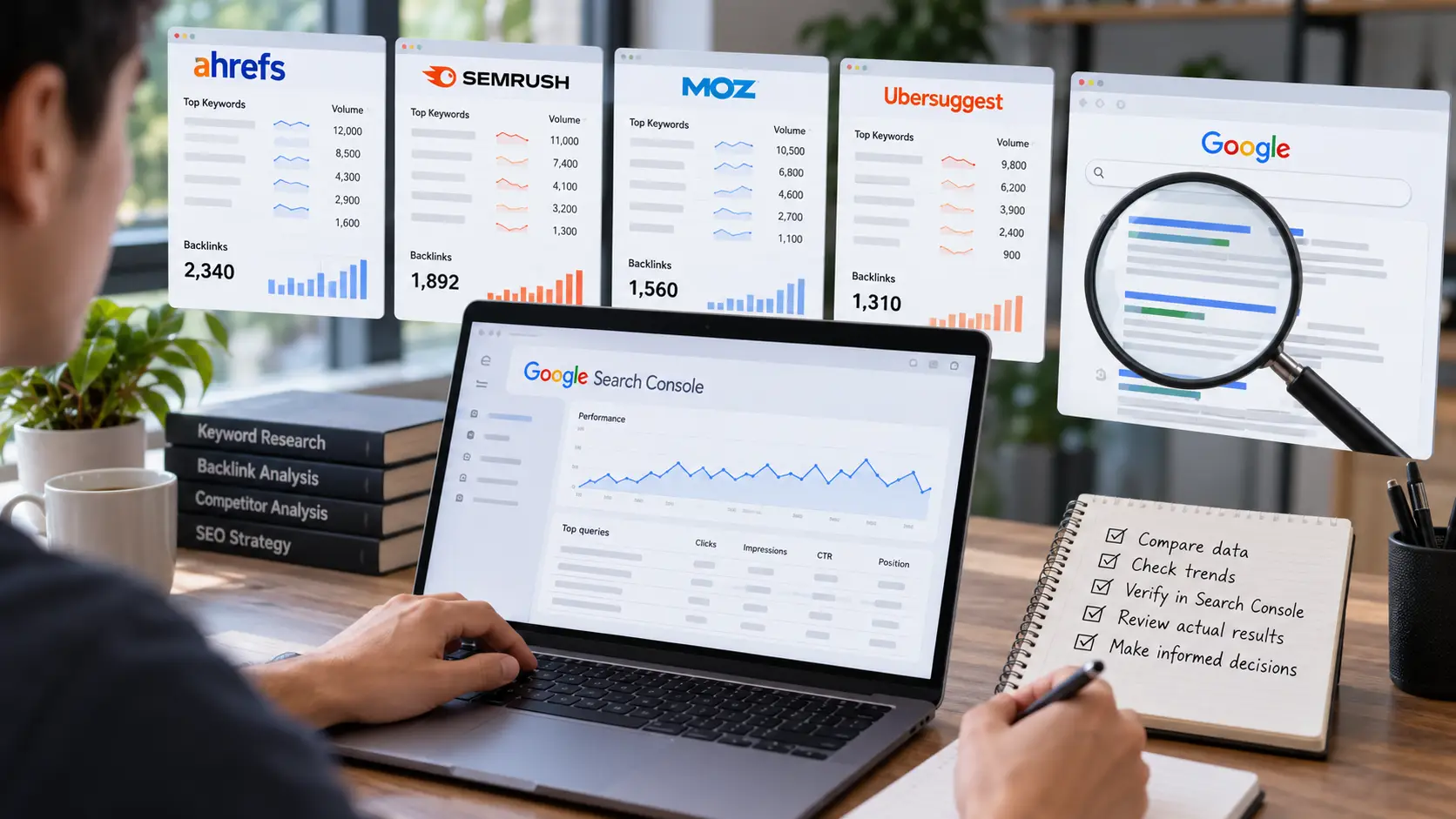
Free SEO tools can provide useful data, but the numbers will often differ from Ahrefs and from each other. This is normal and does not always mean that one tool is wrong.
Each platform collects data in a different way. Some use their own crawlers, while others use search databases, third-party sources, or statistical models. Understanding this difference is more important than trying to find one number that looks perfectly accurate.
Why SEO Data Can Differ Between Tools
Backlinks are a good example. Ahrefs, Moz, and Semrush crawl the web independently, so they may discover the same backlink at different times. One tool may still show a link that was recently removed, while another may already have updated its index.
Keyword data can also differ. Search volume is usually an estimate, and the result may change based on location, time period, keyword grouping, and the tool's own data model.
Competitor traffic data has the same limitation. A tool may estimate that a competitor receives 100,000 monthly visits, while another estimates 130,000. The exact number is less useful than the overall trend and comparison with similar websites.
How to Cross-Check Keyword and Backlink Data
Instead of trusting one SEO tool completely, compare a few important signals. For keyword research, check your Google Search Console data first, then compare estimated volume and difficulty in Semrush or Ubersuggest.
You should also check the actual Google results. If a tool says a keyword looks easy but the first page is filled with strong brands and highly detailed pages, ranking may still be difficult.
For backlinks, compare Moz or Semrush data with Search Console when possible. If the same high-quality domain appears in more than one tool, it is usually a stronger signal than a backlink seen in only one small report.
Cross-checking does take a little more time, but it reduces the risk of making decisions based on one incomplete data source.
How to Combine Free SEO Tools Instead of Ahrefs
Trying to find one completely free version of Ahrefs usually leads to disappointment. Most free tools are limited by daily searches, database size, crawl size, or available reports.
A more practical solution is to create a simple tool stack. Each free tool handles one clear part of the SEO workflow, so you only use it when you actually need that data.
A Simple Free SEO Tool Stack
Start with Google Search Console for your own website. Review it each week to find pages that are gaining impressions, losing clicks, or ranking close to the first few positions.
Use Semrush Free or Ubersuggest when planning new content. You can check a small number of keywords before choosing what to write instead of spending your free searches on random ideas.
Moz Link Explorer can be used when you need to review a competitor or potential backlink source. Screaming Frog can handle monthly technical checks, while Similarweb can support larger competitor or market research.
For example, a small SaaS team might use Search Console every week, Screaming Frog once a month, and Semrush only before creating new content. This is much more efficient than opening every SEO tool every day.
When a Paid SEO Tool Becomes Worth It
Free SEO tools are often enough when you manage a small website or only perform SEO occasionally. Problems start when the amount of research grows.
An agency managing ten clients may need hundreds of keyword checks, regular backlink reports, large exports, and rank tracking across many pages. At that point, free limits do not just reduce data. They also waste working time.
A paid tool becomes worth considering when your team spends too much time switching between tools, waiting for limits to reset, or manually combining reports. The value of Ahrefs or another paid platform is often not just more data. It is having many tasks inside one workflow.
How DICloak Helps Manage SEO Workflows
Using several free Ahrefs alternatives can help reduce software costs, but agencies and teams may face another challenge: managing many client accounts and browser sessions.
DICloak is not an SEO research platform, so it does not provide keyword volume, backlinks, or ranking data. Instead, it can help keep different SEO workspaces separate and easier to manage.
Keep Client SEO Accounts in Separate Browser Profiles
An SEO agency may manage Google accounts, Search Console properties, SEO platforms, CMS accounts, and other tools for several clients. Using all of them in one browser can make it easy to open the wrong account or mix sessions between projects.
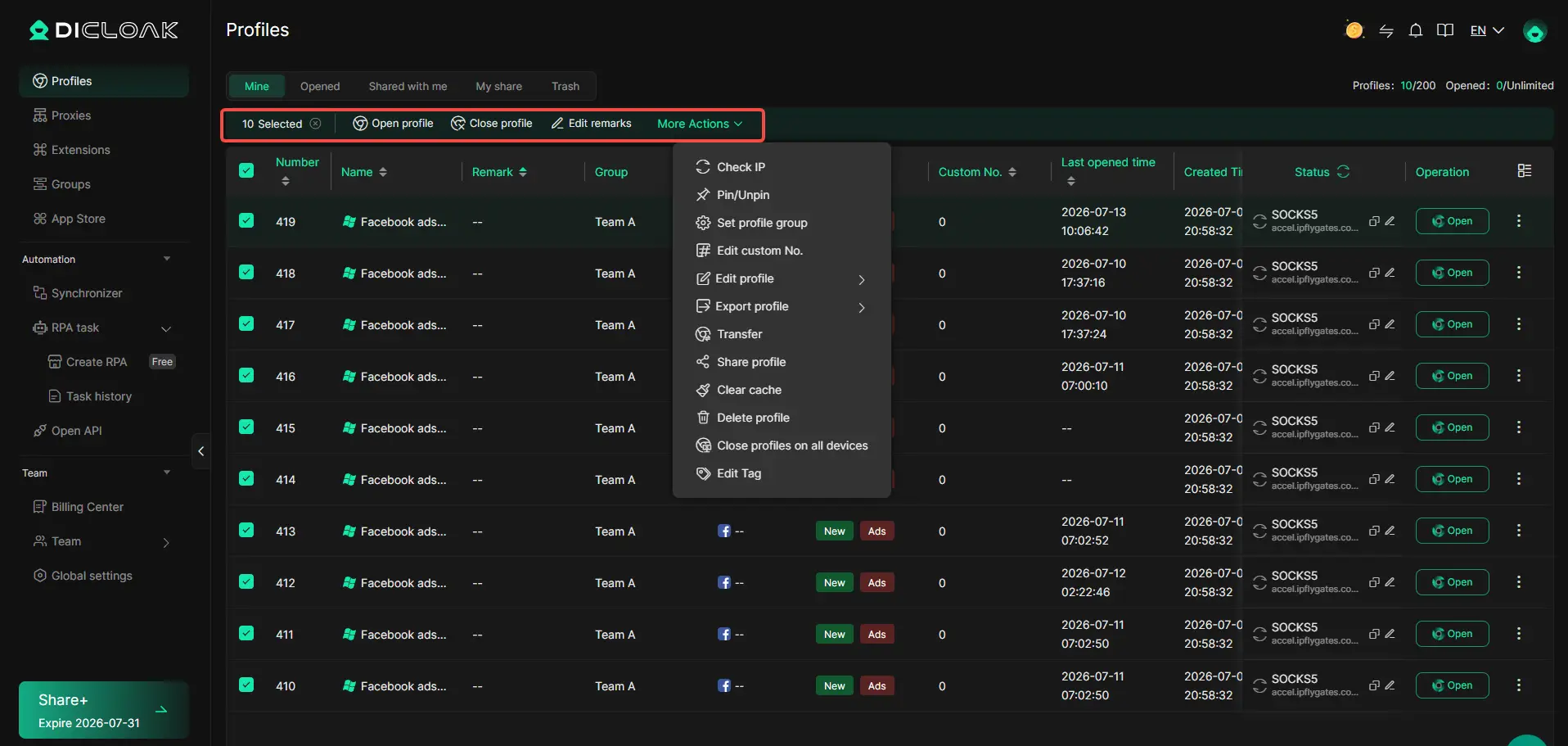
With DICloak, teams can create a separate browser Profile for each client. Each Profile keeps its own cookies, login session, browser settings, and other browser data.
For example, a team might create one Profile called "Client A – SEO" and another called "Client B – SEO." When someone needs to work on Client A, they open that Profile and return to the same browser profile instead of switching between several accounts in one normal browser.
This does not improve SEO rankings directly. Its value is keeping multi-client work cleaner and easier to organize.
Manage Team Access to SEO Tools
SEO projects often involve more than one person. A content writer, SEO specialist, account manager, and team leader may all work with the same client, but they may not need access to every client workspace.
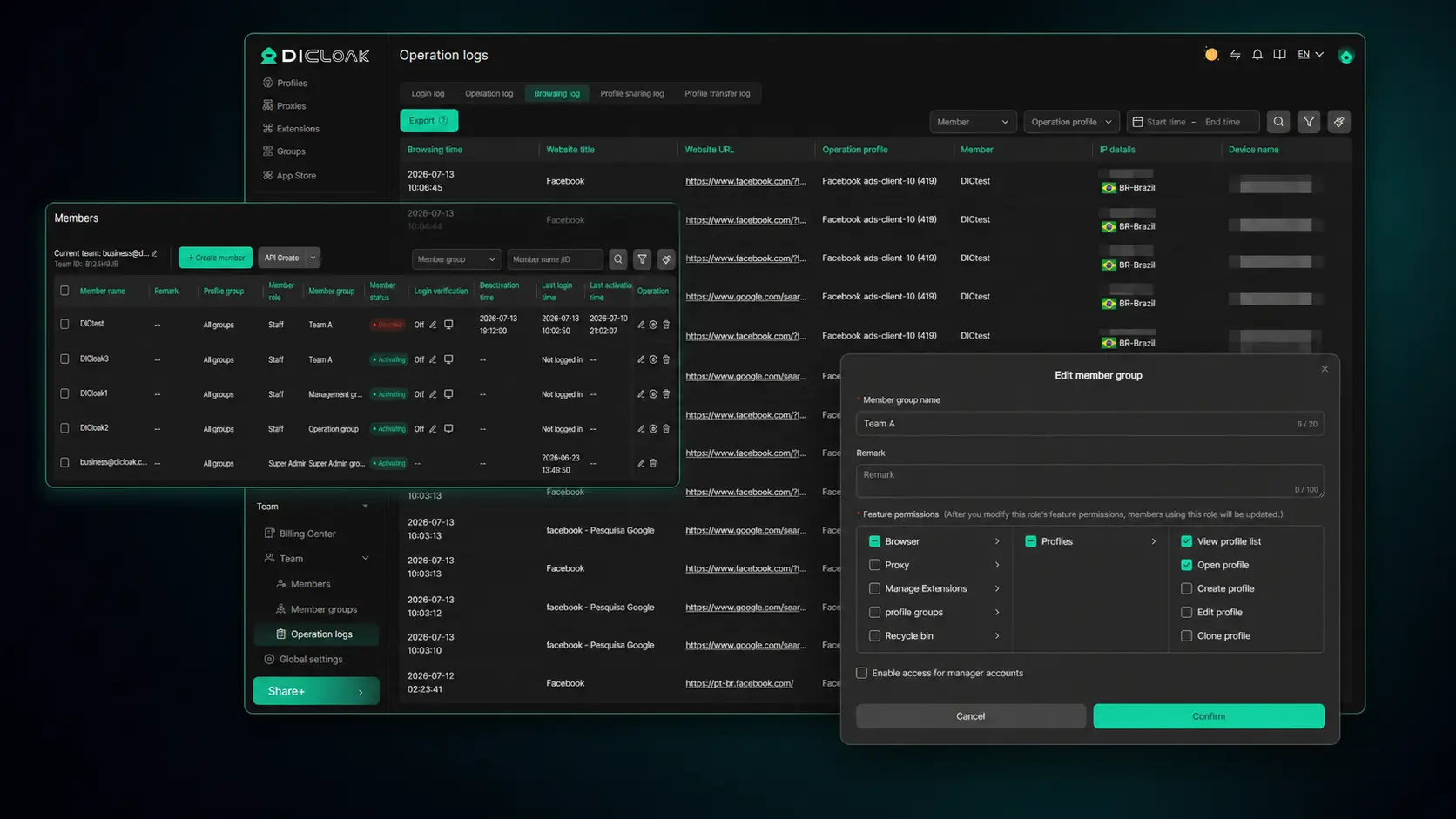
DICloak supports Profile Groups and member permissions. Teams can organize Profiles by client or project and assign access based on who needs to work in each environment.
For example, a writer working only on Client A does not need access to the browser Profiles used for Clients B and C. Teams can also use browser Profile Groups to keep client environments organized as the number of projects grows.
Teams should still follow the account-sharing and seat rules of each SEO service they use. Browser Profile management does not change the terms of Semrush, Similarweb, Google, or other platforms.
Use Different Proxy Settings for Location-Based SEO Work
Location can matter when researching international SEO. A team may want separate browser profiles for the United States, Germany, France, or another target market.
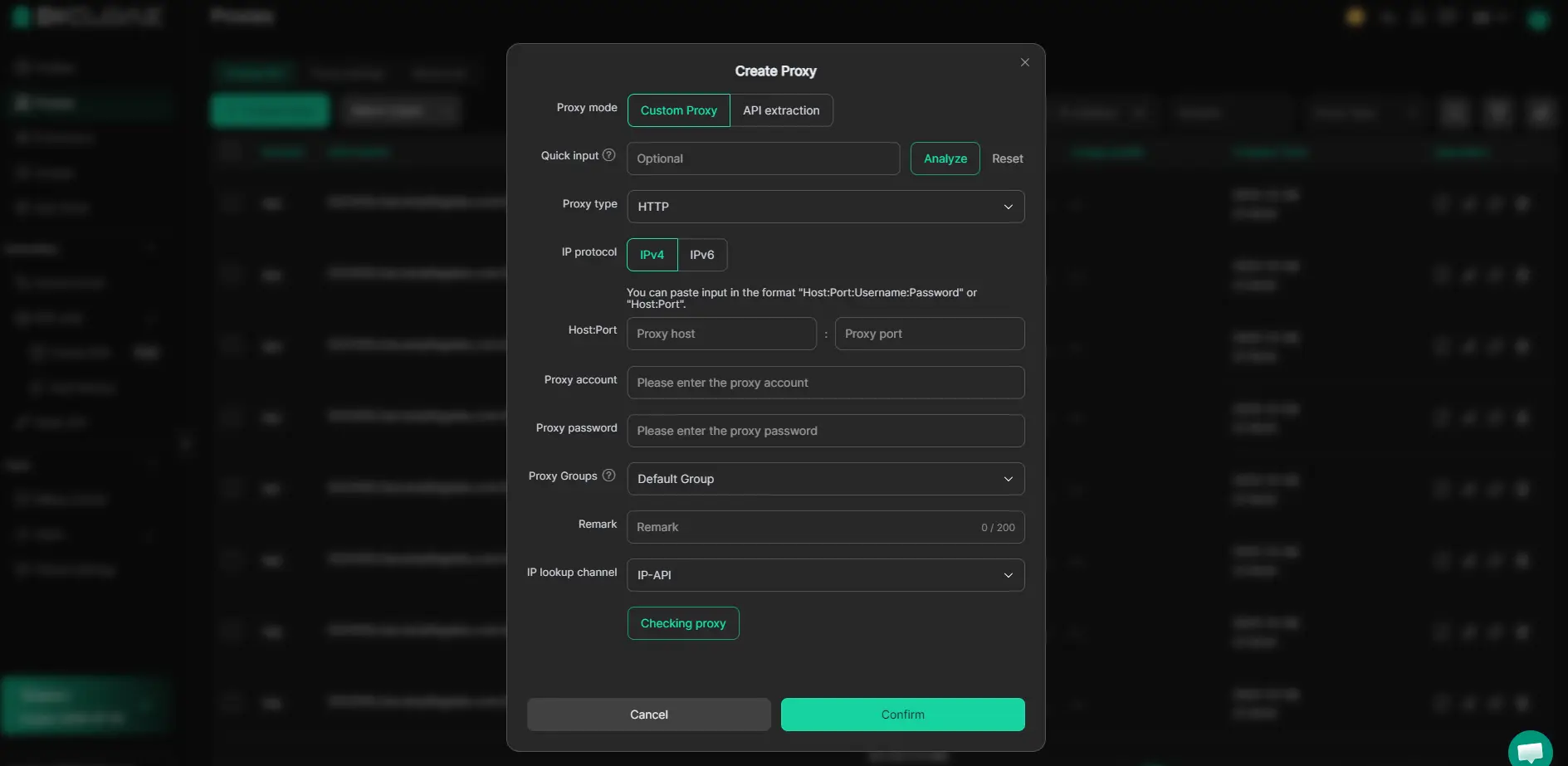
DICloak allows users to configure different proxy settings for each browser Profile. For example, an international SEO team could keep a U.S. research Profile separate from a German research Profile instead of changing the same browser setup again and again.
This can be useful for regional research and routine website checks, but a proxy alone does not guarantee that Google results will exactly match what every local user sees. Search results can also be affected by language, device, account settings, location signals, and personalization.
For accurate rank tracking, a dedicated SEO rank tracker is still the better option. DICloak is more useful for keeping different regional SEO browser profiles organized.
Frequently Asked Questions About Free Alternatives to Ahrefs in 2026
Q1: What are the best free alternatives to Ahrefs in 2026?
Some of the best free alternatives to Ahrefs in 2026 include Google Search Console, Semrush Free, Ubersuggest, Moz Link Explorer, Similarweb, and Screaming Frog. Each tool is better for a different SEO task. Google Search Console is strong for your own search data, Moz is useful for backlinks, and Screaming Frog works well for technical SEO.
Q2: Is there a completely free alternative to Ahrefs?
There is no single completely free tool that offers everything Ahrefs provides. Most free alternatives to Ahrefs have limits on searches, reports, keywords, backlinks, or crawl size. A practical option is to combine several free SEO tools, such as Google Search Console for search performance, Moz for backlink checks, and Screaming Frog for site audits.
Q3: Which free alternative to Ahrefs is best for keyword research?
Google Search Console, Semrush Free, and Ubersuggest are useful free alternatives to Ahrefs for keyword research. Search Console is best for finding keywords your website already appears for, while Semrush and Ubersuggest can help you discover new keyword ideas and compare estimated search demand. Using more than one tool can give you a clearer view of the opportunity.
Q4: Which free alternatives to Ahrefs are best for backlink analysis?
Moz Link Explorer and Semrush Free are useful free alternatives to Ahrefs for backlink analysis, especially when checking competitor websites. Google Search Console is also helpful for backlinks to your own verified site. Keep in mind that backlink counts can differ between tools because each platform uses its own crawler and link database.
Q5: Are free alternatives to Ahrefs accurate enough for SEO?
Yes, free alternatives to Ahrefs can be accurate enough for many basic SEO tasks, but you should not expect every tool to show the same numbers. Keyword volume, traffic, and backlink data are often estimates, while Google Search Console provides real performance data for your own website. For important SEO decisions, compare data from two or more tools and check the actual Google search results.
 Web Proxy Tools
 Free Tools
 Cookie Plugin
 UA Generator
 MAC Address Generator
 IP Generator
 IP Address List
 2FA Code Generator
 World Clock
 Anonymous Check
 WebRTC Leak Test
 UUID Generator
 Free Web Proxy Site
 Proxy Checker
 FB Ad Checker
 AI Web Scraping
 Free SMM Tools
 Twitter Shadowban Checker
 Instagram Name Checker
 UTM Generator
 Username Generator
 AI Hashtag Generator
 LinkedIn Headline Generator
 Social Media Image Resizer