What is ISP Technology in the Modern Digital Ecosystem
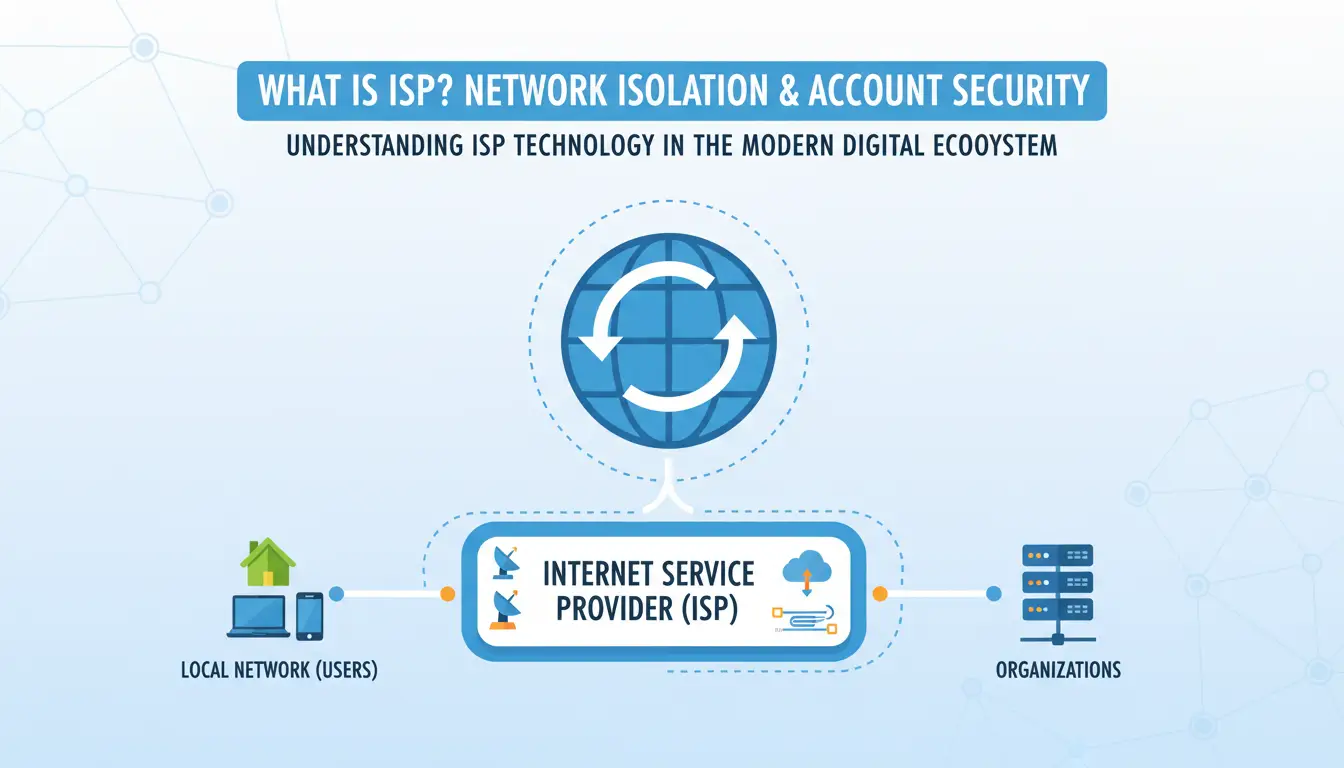
An Internet Service Provider (ISP) is a foundational entity in the global digital infrastructure, acting as the primary gateway for users and organizations to access the internet. Technically, an ISP facilitates the connection between a local network environment and the vast, decentralized network of global servers and routers. Without this intermediary service, the routing of data packets across heterogeneous networks would be impossible for individual actors.
The mechanism of connectivity is built upon a complex physical and logical architecture. ISPs maintain the backbone infrastructure required to provide data transit, translating local requests into routable packets across the global web. A core function of the ISP is the management and assignment of Internet Protocol (IP) addresses. These addresses function as unique network identifiers, allowing for precise device communication. From a cybersecurity perspective, the IP address is a critical data point that determines how external platforms perceive and trust the incoming connection.
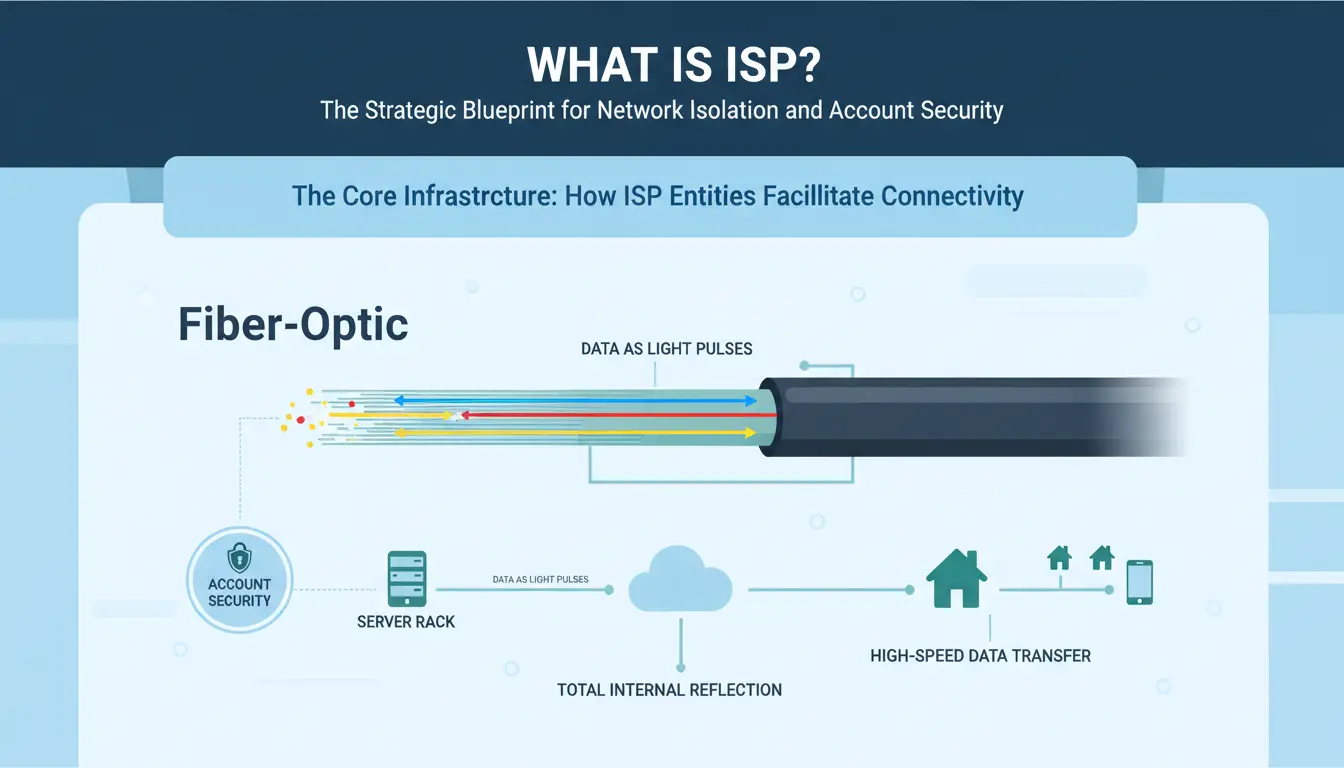
The Core Infrastructure: How ISP Entities Facilitate Connectivity
ISPs utilize several distinct technologies to facilitate data transfer, each with unique physical properties and implications for network performance.
- Fiber-Optic: This infrastructure transmits data as light pulses through glass or plastic strands using the principle of total internal reflection. It is immune to electromagnetic interference (EMI), providing high-bandwidth, low-latency connectivity that is the current standard for high-performance operations.
- DSL (Digital Subscriber Line): Connectivity is delivered over existing copper telephone lines. It utilizes frequency multiplexing to separate voice signals from high-speed data signals, allowing for simultaneous use of the line.
- Cable: This method uses coaxial cables—the same infrastructure used for cable television. It offers significant bandwidth by employing a broad range of frequencies for data transmission.
- Wireless: This utilizes radio frequency (RF) transmission via cellular towers or Wi-Fi protocols to bridge the "last mile" between the provider and the user device.
The Role of Static vs. Dynamic IP Assignment
Network isolation strategies depend heavily on how an ISP manages IP allocation. Dynamic IP addresses are assigned temporarily and change periodically, which can create inconsistencies in session persistence. Conversely, Static IP addresses—common in professional ISP proxy environments—remain fixed. For digital growth experts, a static IP provides a consistent network signature, ensuring that the reputation of a managed account remains stable and is not associated with the "churn" of rotating residential IPs.
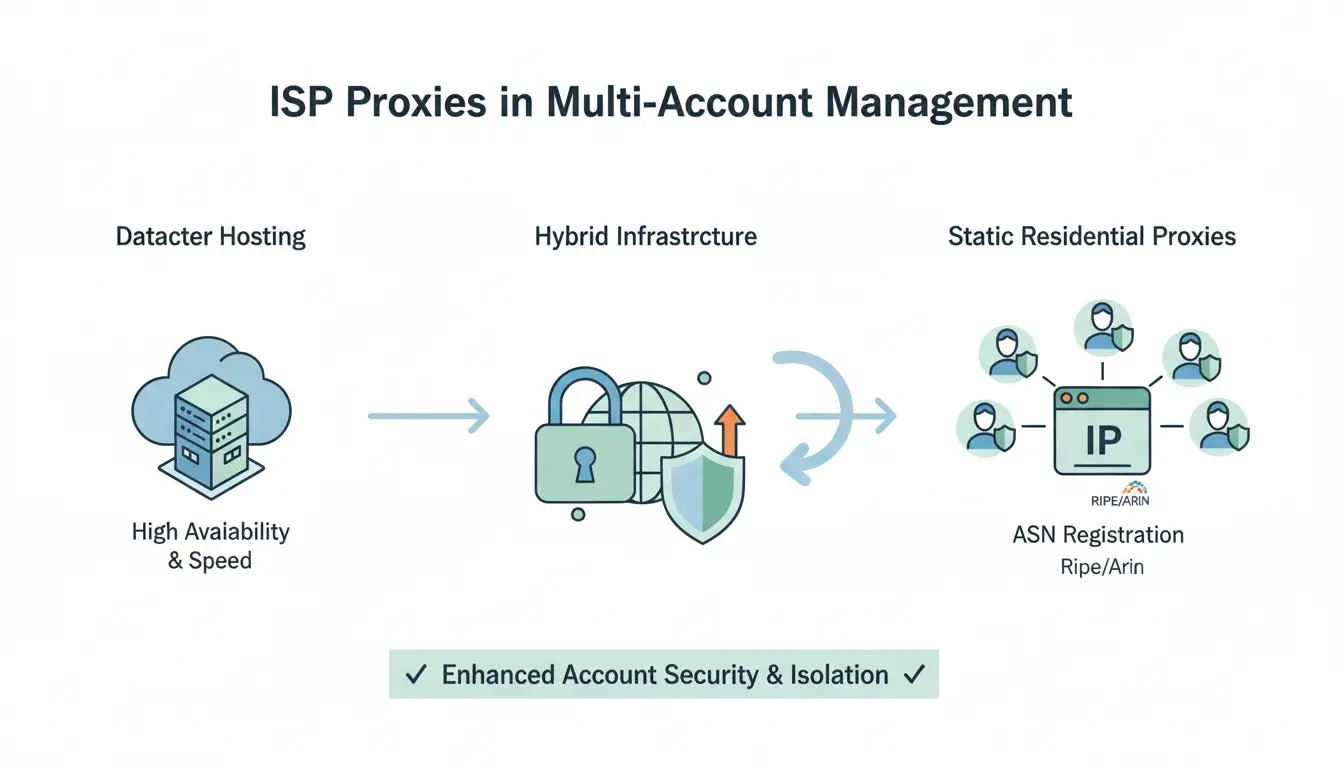
Analyzing the Role of What is ISP Proxies in Multi-Account Management
In the professional landscape of network architecture, ISP proxies are formally known as "Static Residential Proxies." These represent a hybrid infrastructure: the IP addresses are hosted within a datacenter for high availability and speed, but they are registered under the Autonomous System Number (ASN) of a legitimate consumer ISP.
The strategic value of an ISP proxy is rooted in its ASN reputation. Security algorithms on major e-commerce and social media platforms categorize incoming traffic based on the ASN. Datacenter-owned ASNs are often associated with automated scrapers or server-side scripts, leading to higher scrutiny or immediate blocking. ISP proxies carry the ASN of a household provider, signaling to the target platform that the user is a legitimate residential consumer. This high-trust association is vital when managing multiple profiles, as it reduces the probability of triggering fraud detection systems.
Technical Breakdown: Comparing Network Architectures
Choosing the correct network architecture is a requirement for maintaining operational security across different workflows.
Datacenter Infrastructure and Detection Risks
Datacenter proxies utilize IP ranges owned by secondary corporations or cloud hosting providers. While they offer superior speed for data-intensive tasks, their predictable ranges and "Hosting" ASN classification make them highly susceptible to detection. They are generally unsuitable for sensitive account management where the appearance of a human user is required.
Residential Peer-to-Peer Networks
This architecture leverages a pool of over 400 million global IPs sourced from real-peer devices across 195 countries. These networks are often consent-based, utilizing residential infrastructure to provide the highest level of IP diversity. While excellent for bypassing geo-restrictions, the rotating nature of these IPs can be a disadvantage for tasks requiring long-term session persistence on a single identity.
Static ISP Proxy Architecture for High-Speed Reliability
The static ISP architecture provides the stability of a datacenter with the reputation of a residential line. With a pool of over 1.3 million static residential proxies, this architecture is the preferred choice for high-stakes account management. It provides the low latency required for rapid execution while maintaining a residential-grade network signature that resists blacklisting.
How What is ISP Services Impact Digital Fingerprinting and Browser Isolation
Digital fingerprinting is an advanced tracking mechanism that goes beyond simple IP logging. It involves the client-side execution of scripts that query the browser’s rendering engine and hardware APIs. For example, Canvas Fingerprinting forces the browser to draw an invisible image; the resulting pixel data varies based on the GPU and driver version, creating a unique hash or "fingerprint."
When multiple accounts are accessed from a single ISP connection, they become "associated" via shared network metadata and overlapping fingerprints. Even if the IP address is unique, a shared hardware signature can link dozens of accounts to a single operator. True network isolation requires decoupling both the IP address and the browser’s hardware identity.
Pro-Tip: Never mix residential peer-to-peer proxies and datacenter proxies within the same account session. Inconsistent ASN metadata within a short timeframe is a high-confidence signal for automated fraud detection systems and can lead to immediate account suspension.
Operational Scenarios: Risk Mitigation in E-Commerce and Social Media Workflows
Managing a fleet of 50+ social media or affiliate accounts presents a significant technical challenge. Accessing these accounts from a single home or office ISP connection creates a single point of failure. If one account is flagged for a policy violation, the shared network metadata allows the platform to identify and terminate all associated accounts simultaneously.
To mitigate this risk, professional analysts implement tools like DICloak. DICloak functions as a middleware for browser isolation, intercepting and spoofing the API calls that reveal hardware identity. By automating the generation of unique Canvas, WebGL, and hardware metadata for each profile, it ensures that every account has a distinct digital fingerprint. When paired with user-configured ISP proxies, each profile appears to originate from a unique, legitimate service provider. This dual-layer isolation strategy—spoofing the hardware at the browser level and the ASN at the network level—is the industry standard for risk mitigation.
Comparing Standard Connectivity vs. Advanced Isolation with DICloak
| Feature |
Standard ISP Connection |
DICloak + ISP Proxy Management |
| Network Signature |
Single, non-isolated point of failure |
Unique, static ISP IP configuring in per profile |
| Fingerprint Profile |
Identical hardware hashes across accounts |
Spoofed, unique hardware metadata |
| ASN Reputation |
Single Residential/Business ASN |
Frexible Proxies Configuration |
| Scalability |
High risk of "chain-link" bans |
Concurrent isolated sessions |
Pros & Cons of Professional Proxy Management:
- Pros: 100% ethically sourced IP infrastructure, significant reduction in account "linkage" risks, and high-speed datacenter performance.
- Cons: Increased operational expenditure (OPEX) relative to consumer-grade internet; requires disciplined profile configuration.
Strategic Implementation: A Step-by-Step Methodology for Account Protection
Sourcing Ethically-Aligned ISP Infrastructure
The foundation of any secure operation is the use of ethically sourced infrastructure. Professional-grade ISP proxies are derived from consent-based residential peer networks. This ethical sourcing ensures that the IPs are not associated with malicious botnets, which significantly improves the "weathering" capability of an account when subjected to platform security audits.
Configuring Browser Profiles for Maximum Isolation
Profiles must be configured with granular attention to detail. This includes assigning a dedicated ISP proxy to each browser profile and ensuring that the spoofed hardware metadata (Screen resolution, OS version, WebGL signatures) remains consistent for the life of the account.
Monitoring Network Status and IP Health
Effective risk management requires the continuous monitoring of network status. By utilizing user-configured ISP proxies, operators can maintain long-term, stable connections. Periodic checks should be conducted to ensure the IP remains associated with the correct ISP carrier and has not been flagged on public blacklists (DNSBL).
Frequently Asked Questions About What is ISP Connectivity and Network Management
What is the difference between an ISP and a proxy?
An ISP is the primary provider of your physical internet infrastructure and initial IP assignment. A proxy is an intermediary layer that routes your traffic through a different server, replacing your primary ISP’s IP address with a new one—ideally an ISP-sourced static residential IP for high-trust tasks.
Why are ISP proxies considered more reliable for e-commerce?
Reliability in e-commerce is tied to ASN reputation. ISP proxies use IPs registered to consumer providers rather than cloud hosting providers. Platforms treat these as "real" customers, which minimizes the triggering of automated security checkpoints during checkout or login.
How does an ISP affect my digital fingerprint?
The ISP provides the IP address and the ASN. Fraud detection systems use the ASN to distinguish between residential users and server-based traffic. Without isolation, your ISP metadata serves as a persistent anchor that can link multiple browser profiles to a single physical location.
What technologies do ISPs use to provide internet?
ISPs utilize a variety of transmission technologies including Fiber-optic (using light pulses), DSL (utilizing frequency multiplexing over copper), Cable (broadband over coaxial), and Wireless (RF transmission). Each method varies in its bandwidth capacity and susceptibility to interference.
 Web Proxy Tools
 Free Tools
 Cookie Plugin
 UA Generator
 MAC Address Generator
 IP Generator
 IP Address List
 2FA Code Generator
 World Clock
 Anonymous Check
 WebRTC Leak Test
 UUID Generator
 Free Web Proxy Site
 Proxy Checker
 FB Ad Checker
 AI Web Scraping
 Free SMM Tools
 Twitter Shadowban Checker
 Instagram Name Checker
 UTM Generator
 Username Generator
 AI Hashtag Generator
 LinkedIn Headline Generator
 Social Media Image Resizer