Why are mathematical captchas still a major hurdle for scrapers in 2026?
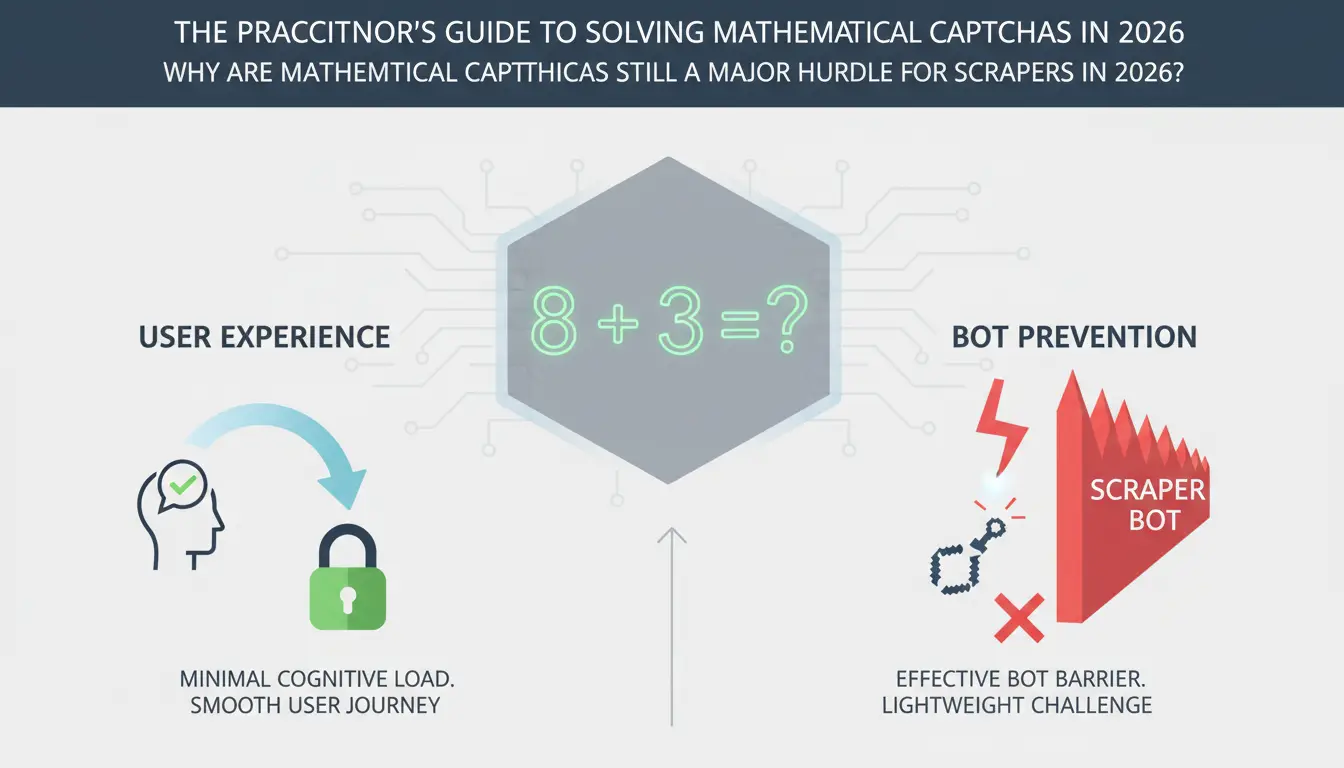
The trade-off between user experience and bot prevention
Simple arithmetic puzzles, such as "8 + 3," are preferred by many platforms because they require minimal cognitive load from humans. This keeps the user journey frictionless. By deploying these lightweight challenges, websites can effectively filter out rudimentary automated traffic while maintaining a high conversion rate for legitimate users who would otherwise bounce if confronted with complex multi-stage verification.
Why basic solvers fail against modern "noisy" math puzzles
Programmatic parsing logic typically fails because modern mathematical puzzles are no longer rendered as plain text. Security implementations now incorporate background interference, non-linear font distortions, and overlapping character fragments. These adversarial elements are specifically tuned to defeat standard optical character recognition by introducing "noise" that a human brain easily ignores but which causes a basic extraction script to return invalid results.
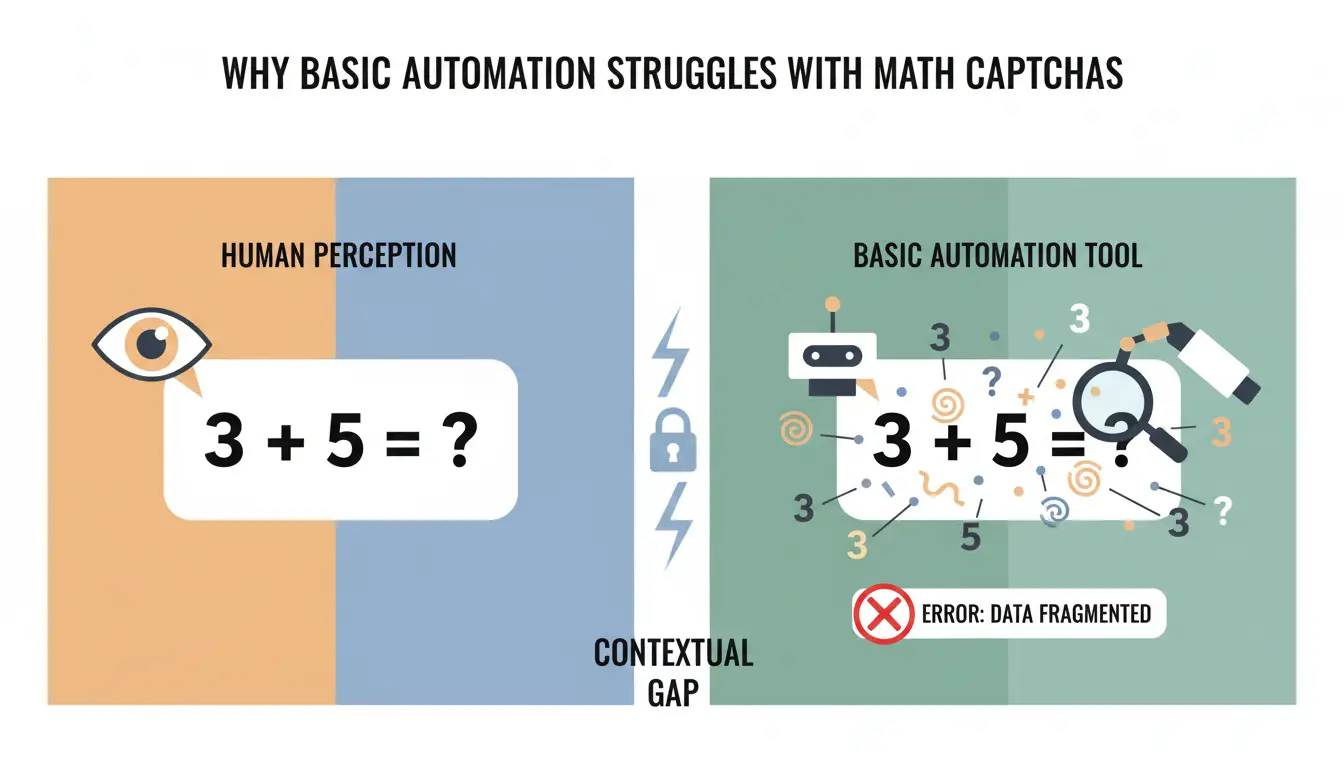
Why do basic automation tools struggle with simple arithmetic puzzles?
The gap between human visual context and programmatic parsing is the fundamental reason simple math puzzles remain an effective deterrent. While a human perceives an equation as a single logical unit, a basic script lacks the contextual depth to distinguish data from decorative artifacts.
The challenge of dynamic text and image rendering
Modern websites increasingly utilize Canvas API or SVG elements to generate math challenges. These methods render the equation as a graphical object rather than text within the DOM. Consequently, simple HTML parsers and standard scrapers see no actual text to extract. Without the ability to render the page fully, the automation tool remains blind to the puzzle's content.
How variable fonts and noise confuse standard OCR
Standard OCR engines are highly sensitive to pixel-level variations. When a site employs textured backgrounds or variable fonts, the engine often misidentifies background artifacts as characters or fails to recognize a heavily distorted digit. This leads to high solve failure rates, which rapidly degrades the reputation of the extraction environment and triggers more aggressive defensive responses from the target server.
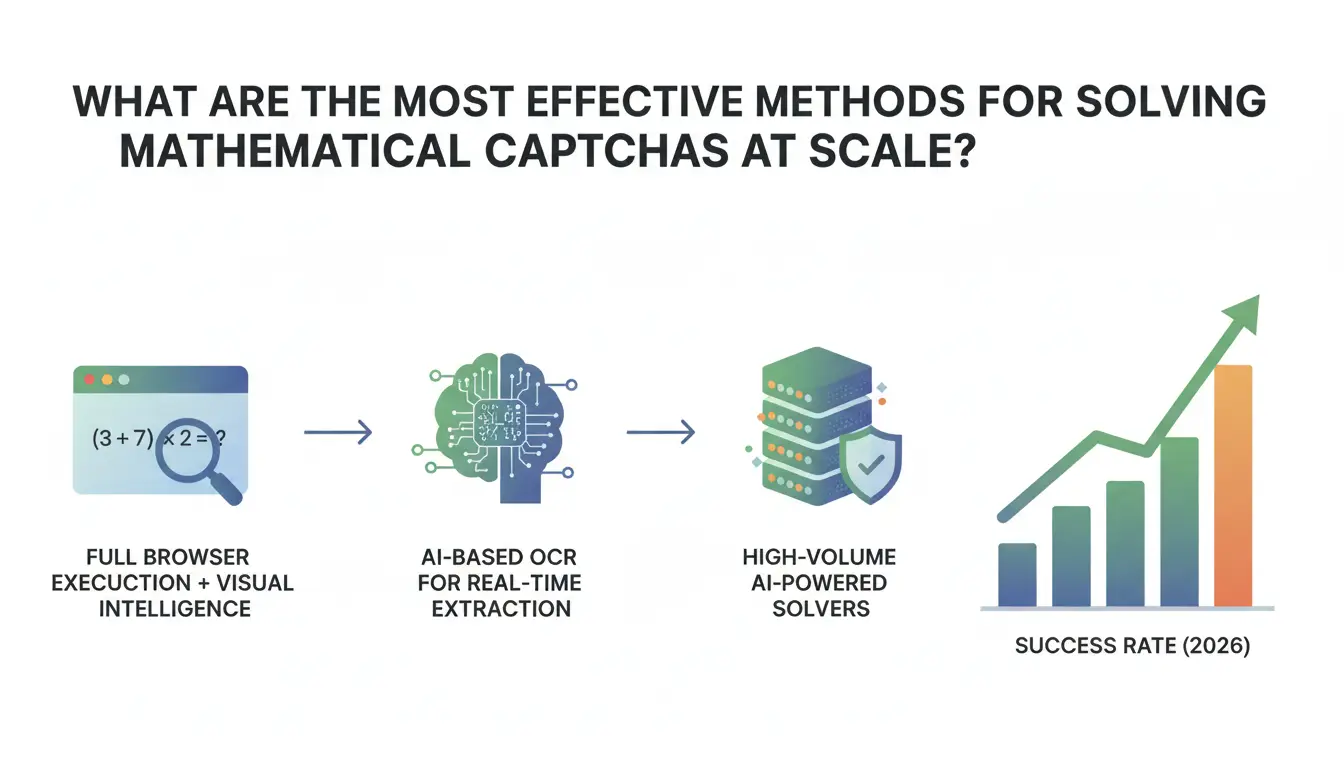
What are the most effective methods for solving mathematical captchas at scale?
Achieving high success rates in 2026 requires moving beyond static extraction toward systems that combine visual intelligence with full browser execution.
Leveraging AI-based OCR for real-time extraction
The industry standard for high-volume extraction involves AI-powered solvers that utilize neural networks. These systems are trained to detect the specific rules of a target site and can parse equations even amidst heavy graphical distortion. By applying AI-based unlocking logic, these solvers can accurately identify the mathematical operator and the integers involved, regardless of the noise density surrounding them.
Using JavaScript rendering to reveal hidden puzzles
Since many mathematical challenges are obfuscated within JavaScript-heavy components, a robust solver must possess built-in JavaScript rendering capabilities. This allows the scraper to execute the site's scripts and fully render the CAPTCHA as it would appear in a standard browser. Without this capability, the extraction tool cannot interact with the Canvas or SVG elements that house the challenge.
How can you avoid triggering redundant captchas during data collection?
Solving a CAPTCHA is a reactive cost; the goal for any senior engineer is to minimize the frequency of these challenges through proactive traffic management and high-quality infrastructure.
The necessity of intelligent IP rotation
Repetitive challenges are often the result of an IP address being flagged for excessive requests. To maintain high throughput, practitioners must utilize an expansive proxy network—ideally one providing access to over 400M monthly IPs across residential and ISP device pools. Rotating through real-peer devices and static residential IPs allows for mimicking authentic traffic patterns, which significantly reduces the probability of a site serving a CAPTCHA.
Managing cookies and sessions to maintain trust
Maintaining a consistent session is critical for establishing a "trusted" status with a target server. Proper management of cookies and session data prevents the "clean slate" behavior that often triggers verification steps. When a site identifies a request as part of an ongoing, valid session, it is far less likely to interrupt the flow with a mathematical puzzle.
What are the risks of using low-quality or "free" mathematical solvers?
The allure of low-cost solvers is often offset by the hidden operational expenses associated with high failure rates and network degradation.
The hidden impact of low success rates on proxy costs
Low-quality solvers contribute to a high volume of "burnt" IPs and failed delivery costs. Even a failed solve consumes bandwidth and negatively impacts the reputation of the proxy being used. For operations scaling toward the 5.5 trillion annual data request mark seen at the enterprise level, a marginal increase in failure rates translates to massive overhead in proxy infrastructure replacement and lost time.
Data integrity and validation issues
A failed or "dirty" solve can lead to more than just a 403 error; it can result in the delivery of incomplete or inaccurate data. Ensuring data integrity requires a solver that validates its own output against the site’s expected response patterns. Relying on "cheap" solvers increases the risk of collecting unreliable data, which can compromise the entire analytical pipeline.
Why is browser fingerprinting the hidden reason behind frequent captchas?
In the current landscape, a CAPTCHA is frequently a response to a detected fingerprint mismatch rather than a primary defense.
How mismatched User-Agents trigger math puzzles
Using a generic or mismatched User-Agent is a primary signal for bot detection. If a request header claims to be a specific browser version but the underlying behavior does not match that profile, the server will immediately challenge the request. Managing specific User-Agents to increase compatibility is an essential step in helping bypass these defensive layers.
The role of Canvas and WebGL fingerprinting
Advanced sites profile the browser’s hardware and software configuration using Canvas and WebGL. To successfully help bypass these checks, an extraction environment must be able to target specific geographic parameters—including country, city, ZIP Code, carrier, and ASN—while mimicking the technical signatures of a real user device.
How do you handle the "multi-layered CAPTCHA" problem?
High-security environments often deploy a "looping" defense mechanism where one successful solve is immediately followed by another challenge.
Detecting and bypassing consecutive challenges
Advanced unlocking logic is designed to detect and solve dual-challenge scenarios. While most sites rely on a single verification step, a robust system identifies when a target is using consecutive CAPTCHAs and automates the resolution of both to help ensure the session remains active.
Implementing automatic retries and logic adjustments
When a solve attempt fails or a site triggers a second challenge, the system must perform automatic retries. These retries should be paired with intelligent adjustments to referral headers, geographic locations, and browser types. This dynamic adjustment helps break the loop by presenting the server with a refreshed, highly authentic-looking profile.
How to build a resilient extraction workflow with advanced antidetect tools?
Developing a professional-grade extraction workflow requires the integration of environment management with automated solving technology to help ensure stealth and reliability.
The use of DICloak allows for the centralized management of these complex technical requirements through a unified interface:
- Isolate browser profiles to prevent cross-session fingerprinting.
- Customize User-Agents and referral headers to mimic authentic organic traffic.
- Handle cookies and session data to help bypass repetitive verification steps.
- Integrate with user-configured proxy networks for automated IP rotation at the profile level.
FAQ
How does an AI-powered solver actually read a math problem?
AI solvers use neural networks to process the visual data within a page. They are designed to identify the rules of popular sites and can parse integers and operators even when they are obscured by Canvas rendering or background noise.
Can a solver handle two CAPTCHAs on the same page?
Yes. While the majority of sites utilize a single challenge, advanced unlocking solutions are engineered to detect and solve dual-challenge scenarios where multiple CAPTCHAs are presented.
Is it possible to bypass math captchas without an external solver?
While possible for very low-volume tasks by using high-quality residential proxies and perfect fingerprinting, high-volume operations almost always benefit from an automated solver to handle the challenges that inevitably arise during large-scale extraction.
Why do I keep getting math captchas even after solving them correctly?
This typically indicates a low trust score. The site may have flagged your browser fingerprint or IP reputation. Solving the puzzle gets you through once, but without proper cookie management and IP rotation, the site may continue to challenge you.
Does JavaScript rendering significantly slow down the scraping process?
Rendering JavaScript does increase resource consumption compared to simple parsing, but it is necessary for sites that use dynamic content. The trade-off is often justified by the much higher success rate and the ability to access data that is otherwise invisible.
What is the difference between a Math CAPTCHA and a standard OCR task?
Standard OCR is designed for clear, static text. A Math CAPTCHA solver must handle adversarial noise, dynamic rendering, and perform mathematical logic simultaneously. Furthermore, high-end solvers use a "pay only for successful delivery" model, helping ensure you don't pay for failed attempts caused by noise.
 Web Proxy Tools
 Free Tools
 Cookie Plugin
 UA Generator
 MAC Address Generator
 IP Generator
 IP Address List
 2FA Code Generator
 World Clock
 Anonymous Check
 WebRTC Leak Test
 UUID Generator
 Free Web Proxy Site
 Proxy Checker
 FB Ad Checker
 AI Web Scraping
 Free SMM Tools
 Twitter Shadowban Checker
 Instagram Name Checker
 UTM Generator
 Username Generator
 AI Hashtag Generator
 LinkedIn Headline Generator
 Social Media Image Resizer