You may have already fallen for ads or videos promising that it is possible to earn money watching videos on YouTube. The idea seems easy: press play, let it run and, at the end of the month, receive a payment just for watching videos. Many people think of this as a simple form of extra income, especially when apps to earn money watching videos appear with positive reviews or screenshots of supposed earnings.
But in practice, the difference between expectation and reality is big. Platforms promise payments in exchange for your time, but they don't always deliver as advertised. There are sites that limit withdrawals, require extra tasks, or even disappear when it's time to pay. Not to mention the risk of wasting time on schemes that only serve to generate traffic for third parties or collect user data.
The point is that, before betting time on ways to make money watching online videos, it is worth understanding how these systems really work. Which platforms really pay? How does withdrawal work? Where are the catches? Anyone who has tried it knows that details such as minimum withdrawal amount, requirement to register in other apps or sudden cuts in the balance make all the difference, and many people only find out about this after hours spent without return.
See below how this market works and what the main risks are before deciding what to bet on.
Is it really possible to make money watching videos on YouTube in 2026?
If the question is whether you can make money just by watching videos on YouTube, the direct answer is: not in a simple or guaranteed way. YouTube does not pay viewers. External platforms promise rewards, but they almost always involve extra tasks, limits, or hidden requirements. Anyone who has tried it knows that the return is usually low and the rules change without warning. Before getting into this, it is worth understanding how this market works and where the difference between promise and reality is.
How platforms that promise to pay per view work
On paper, these platforms work like this:
- You watch videos, accumulate points or credits.
- The balance can be exchanged for cash, gift cards or prizes, but only after reaching high withdrawal limits.
- Most businesses use this model to generate traffic, collect data, or sell advertising to third parties.
This type of site exists because many people are looking for quick ways to earn income online, but the real reward almost never corresponds to the time invested.
Difference Between Watching Videos and Creating Content
Here's the point that most confuses those looking for ways to make money watching online videos: YouTube only pays those who create content, not those who just watch. The official model is the YouTube Partner Program, where creators monetize with ads, sponsorships, and views. For those who only watch, there is no direct remuneration. External platforms promise payments, but they almost always rely on parallel tasks, such as downloading apps, filling out surveys, or inviting friends, which distracts from the focus of just watching.
For example, many apps to make money watching videos require registration with sensitive data, or ask to install extensions. The risk is to waste time on systems that only pay cents, or don't pay at all. Another catch: sites limit withdrawals to high amounts, such as R$50 or R$100, but the earnings per video are so low that reaching this balance can take months. If the site goes offline during this period, all the effort turns into a loss. Therefore, those looking for real income must separate expectation from promise and understand that watching videos, by itself, is not a direct source of money.
This scenario shows that, for those who want to know which methods really pay to watch videos on YouTube, the next step is to analyze which platforms are legitimate and how the collection process works.
What methods actually pay to watch videos on YouTube?
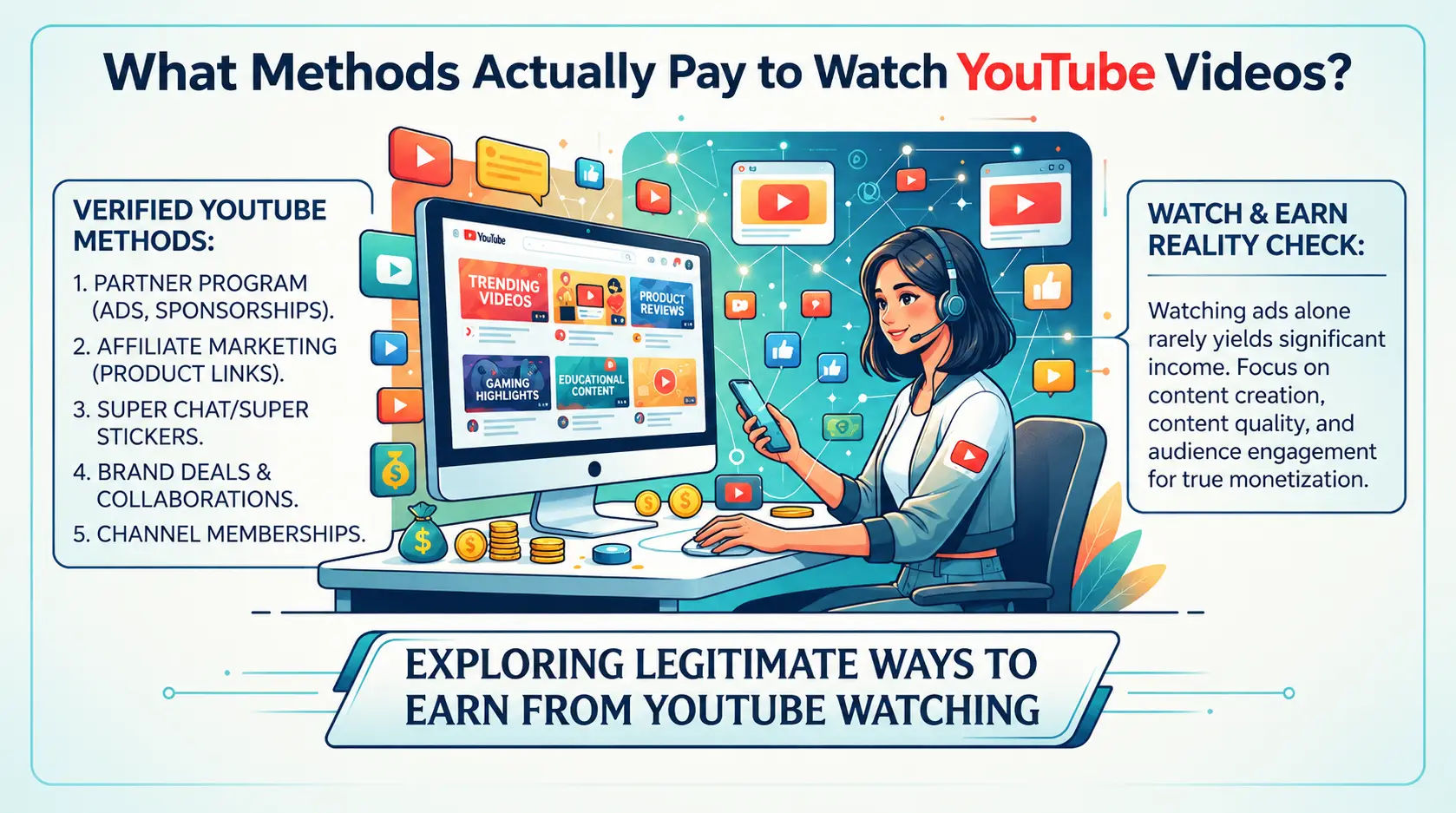
There is only real payment when the platform has a clear withdrawal policy, a history of paying users and does not disappear out of nowhere. In practice, the methods that work usually require registration, profile validation and patience, no easy money just by pressing "play".
Participation in surveys and tests involving YouTube videos
Legitimate opportunities appear on survey sites such as Toluna, LifePoints or Testa Isso, which sometimes ask you to watch videos and give feedback. But the frequency of these invitations is low: you can go days without receiving tasks of this type, because most studies do not involve video.
Rewards apps and sites: how they work and popular examples
The classic model is apps like ClipClaps, Snaptube Rewards and TikBonus, where the user watches videos, earns coins and exchanges them for Pix, PayPal or gift card. But the withdrawal almost always requires accumulating a minimum amount, like R$10 or US$5, which can take weeks. The big risk is when the app disappears or changes the rules close to the withdrawal. National examples, such as Cashin, also work like this, and there is no shortage of reports from those who managed to withdraw, but also from those who had a zero balance without explanation.
| Platform |
Type of reward |
Minimum withdrawal amount |
Does payment usually work? |
| ClipClaps |
PayPal/gift card |
US$10 |
Yes, but reports of delay |
| Cashin |
Pix |
R$10 |
Yes, but balance may expire |
| Toluna |
Gift card |
R$20 |
Yes, but rare research |
Source: user reports on forums and extra income groups.
Referral Programs and Engagement Bonuses
- Referrals are only valid if the referral actually uses the app, and it is not uncommon for the bonus to be canceled later.
- Schemes that promise high gains for "network growth" usually become pyramids.
- When they require investment to release withdrawal, run away without thinking twice.
How much can you earn by watching videos on YouTube? Real expectations
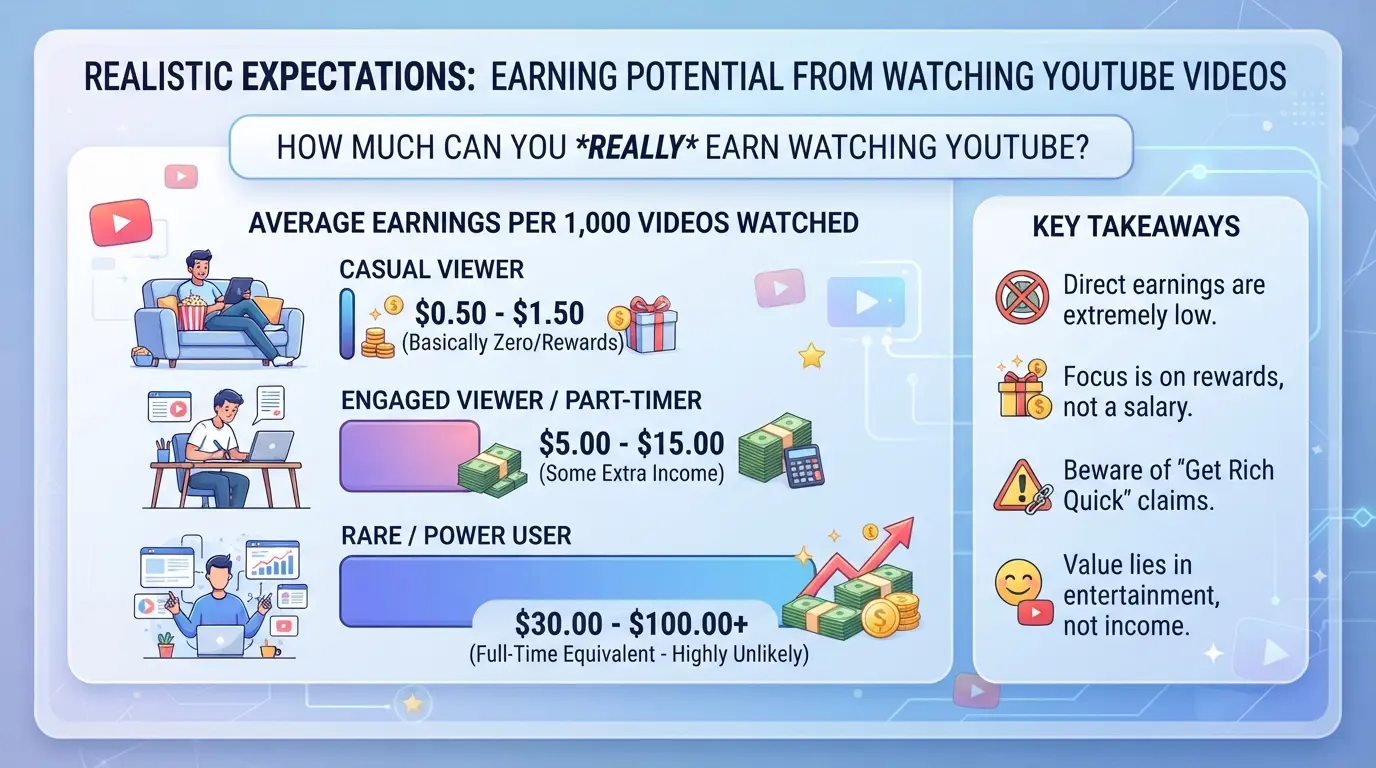
For those thinking of making money watching videos on YouTube, the direct answer is: the values are low, the process is slow and only valid for those looking for extra, not main, income. Few platforms pay in real money, most use points or credits, and the return is usually lower than many people expect.
Average amounts paid per view or task
Most apps and websites pay between R$0.02 and R$0.20 per video watched, depending on the time, the type of task and the country. Some offer points, which only become money after accumulating a lot. That is, to withdraw R$20, you may need to watch hundreds of videos or complete other extra tasks. Those who promise high earnings usually have hidden restrictions.
Withdrawal limits, fees and deadlines for receiving
The real obstacle is in the withdrawal minimums and deadlines. Reliable platforms usually require an accumulation of R$20 to R$50 to release withdrawals, and the balance is not always easy to gather. Many reports show that the user gets close to the minimum, but the balance crashes, falls, or the platform disappears. In several apps, the payment only releases after 30 days or more, with fees that reduce the final amount. When the withdrawal fails, support is usually slow or non-existent, so if you can't withdraw, the time invested becomes a loss.
Comparison: Earnings from watching videos vs. other online tasks
- Paid surveys yield better for time invested, but require a qualified profile.
- Microtasks (e.g., clicking, downloading apps) pay little, but the volume can compensate if the system doesn't limit.
- Creating your own content (videos, posts) has the potential for higher earnings, but it only works for those who get real engagement.
Those looking for ways to make money watching online videos need to understand that the value per task is low and that reaching the minimum withdrawal is the biggest challenge. The next point to keep an eye on is the risks and pitfalls of these systems.
Top Risks and Pitfalls When Trying to Make Money by Watching Videos
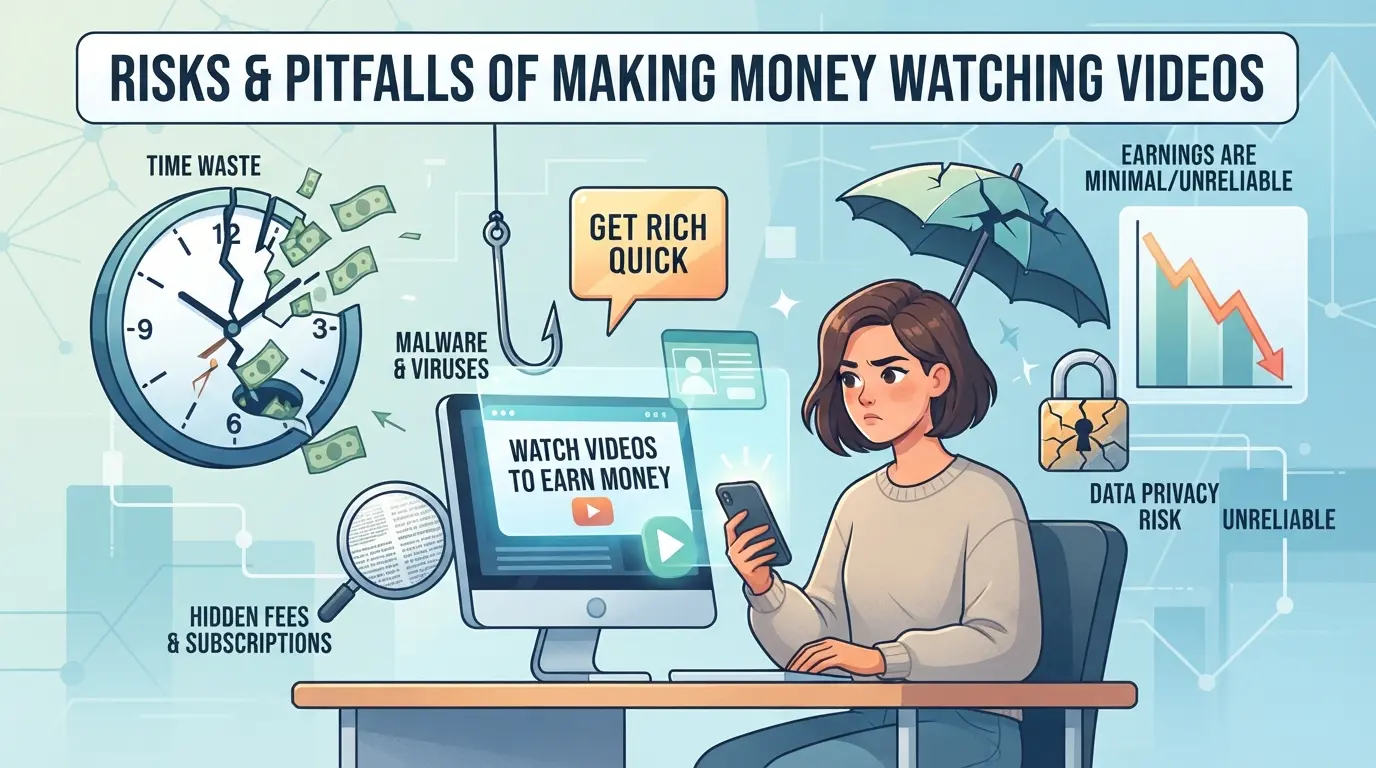
Common scams: exaggerated promises and non-existent payments
Sites that promise quick profits just to watch videos almost always ask for registration, ask to refer friends or demand fees before releasing any amount. The result is a waste of time, money or personal data, with no real return.
Risks to data privacy and security
The biggest risk in these apps is the abusive collection of information. Many demand access to contacts, location, microphone, or even ask for documents under the guise of "verification". The problem is that once authorized, you almost never have control over where this data goes or how it will be used.
- What can go wrong: Your data can be resold, used to open fake accounts, or even to try to scam in your name. It has happened that apps have disappeared after collecting documents from hundreds of people.
- How to act more securely: Avoid apps that ask for more than email and password. Always deny unnecessary permissions and research real reviews before installing any app. If an app requires a selfie, ID, or full access to your phone just to "validate" your account, abandon it right away.
When it's worth giving up: signs of lost time
If the platform never releases withdrawals, changes rules without warning or only has negative reviews in groups and forums, stop before you waste any more time. Those who insist on these apps usually only accumulate virtual balance, without ever seeing the money really fall.
How to Choose Safe Platforms to Make Money by Watching Videos
Before registering on any website or app promising payments to watch videos, what really makes a difference is to check for concrete signs of trust. Only then do you avoid wasting time on platforms that don't pay or put your data at risk.
Essential criteria for evaluating apps and websites
Serious apps have visible traces: real reviews in official stores, presence on forums, and a reputation that can be verified. If the site hides information about payments, or does not offer any support beyond a generic form, it already lights up an alert. Reliable platforms show clear withdrawal rules (minimum, dates, and fees), make visible who is responsible for problems and do not shy away from public criticism, run away from newly released apps without feedback or only with "perfect" testimonials.
Cares with permissions, data and privacy
- Never allow access to your contact list or SMS in unknown apps.
- Use disposable emails to register on sites that do not have a reliable history.
- Avoid authorizing push notifications or unnecessary permissions.
Tips to avoid blocks and access restrictions
Sites that block by suspicious IP or excessive use of accounts are common in this type of market. There is no point in trying to circumvent by automating registration or using false data, blocks come quickly.
- Use proxies only on websites that clearly accept use in the rules.
- Do not create multiple accounts on the same platform if this is not allowed.
- Read the rules of use so as not to fall into restrictions by automations.
If the platform starts asking for more data than necessary or makes it difficult to withdraw without a clear explanation, stop and rethink, wasted time does not come back, and leaked data can become a headache later. This sets the stage for protecting your privacy in managing multiple accounts as well.
How to Manage Multiple Accounts and Protect Your Privacy When Seeking Income Online
Those trying to make money by watching videos on YouTube or similar apps need to avoid mixing personal accounts with income profiles. This reduces the risk of being blocked, limits data exposure, and gives more control if an account is suspended.
Profile Separation: Why Not Mix Personal and Income Accounts
Using the same browser or device for personal and income accounts can cause blocks for simultaneous activity. Ideally, you should keep each profile in a separate environment, without cookies or cross-history.
Setting up proxies for each profile
When operating multiple accounts, set up different proxies for each profile, so each account's IP is isolated. Don't use free proxies: they are often unstable and can expose your data. Prefer well-known vendors with real technical support.
Access control and permissions in teams or family members
- Give access only to what is necessary (don't share everything)
- Change passwords periodically
- Record who has accessed each profile
These precautions reduce the risk of leakage or misuse, especially in shared operations.
How to Use Isolated Profiles, Proxies, and Permissions in DICloak to Manage Online Income Accounts More Securely
Those who need to operate multiple accounts to seek income online, for example, using apps that promise to pay to watch videos, soon realize that mixing profiles or always using the same IP ends up being a problem. Here, separating environments, hiding the main IP, and limiting who accesses each account becomes a matter of survival in the workflow. DICloak enters this scenario as an infrastructure for those who manage several profiles, either alone or in a team.
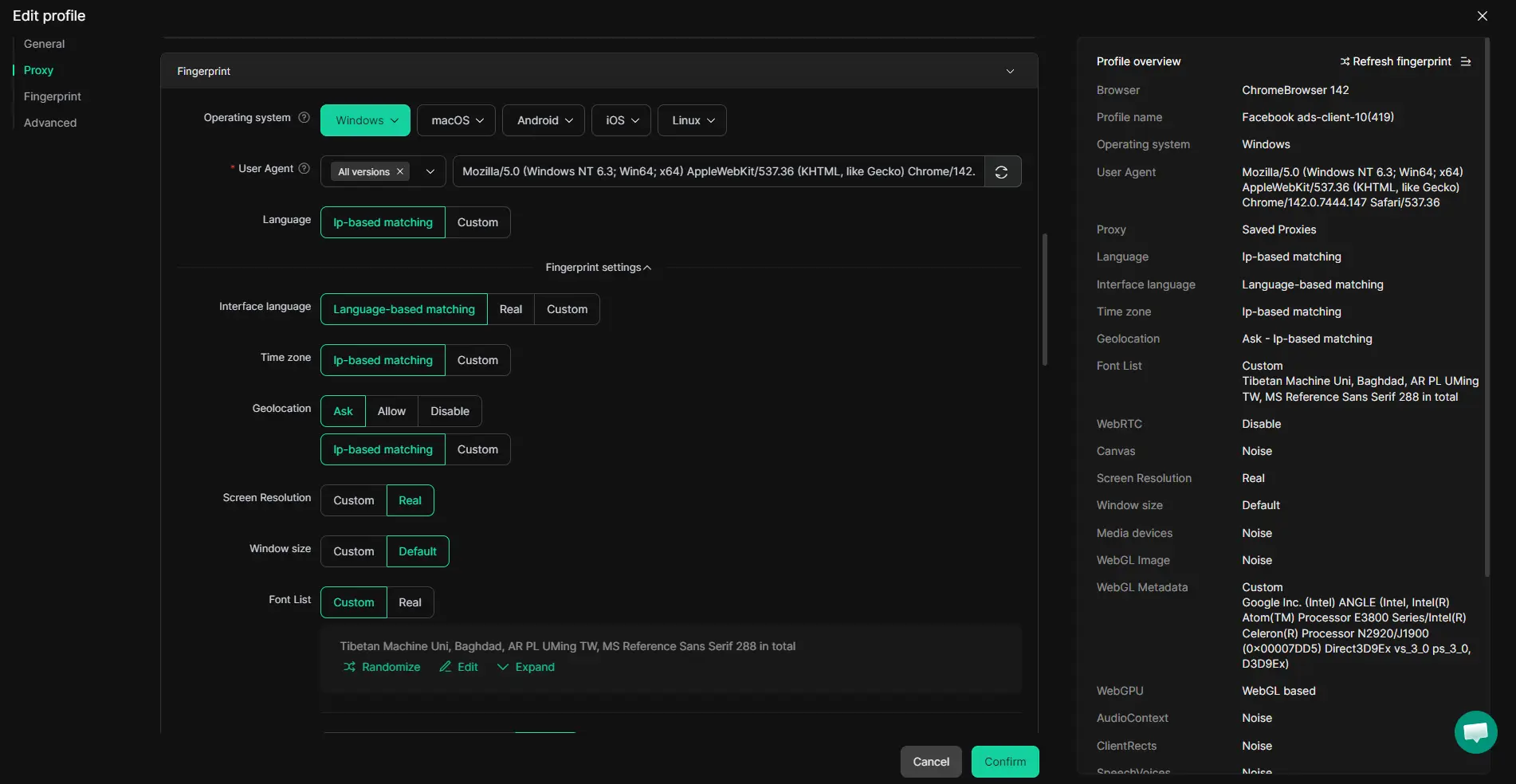
How to Create Isolated Profiles and Configure Fingerprinting in DICloak
Operators using different reward app accounts can create an isolated profile in DICloak for each account, completely separating history, cookies, and browser signals. It is possible to adjust things such as operating system, language, time zone, and screen resolution for each profile, which prevents data from one account from leaking to another. The scope is limited to browsing environments; settings made here do not affect rules or payments on video platforms.
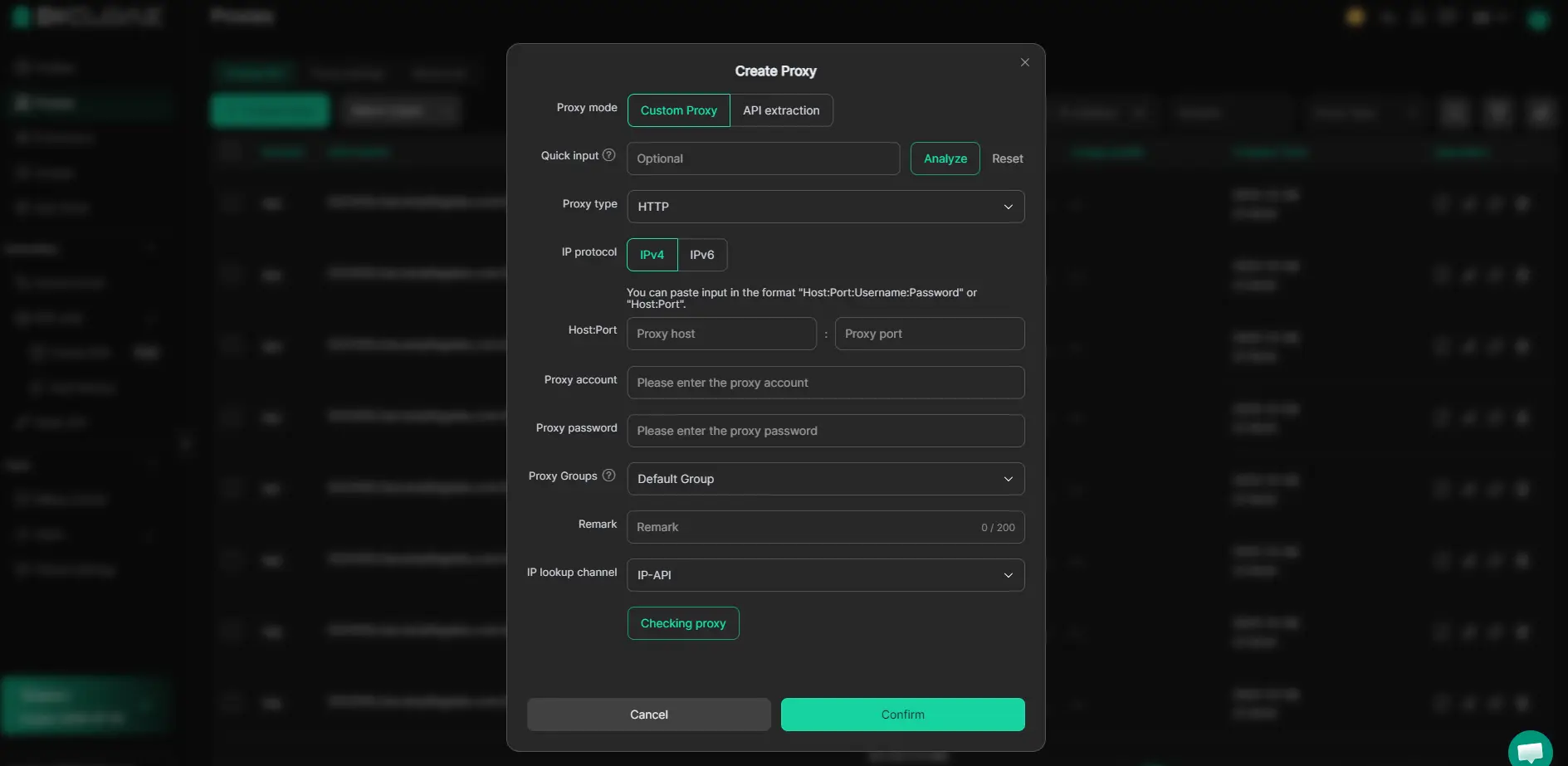
How to set up own proxies in each profile
Using the same IP for all accounts can make platforms that make money watching videos on YouTube detect patterns and limit access. In DICloak, you can configure a different proxy in each profile, the user adds the proxy data and tests the connection directly through the interface. This reduces the risk of cross-tracking, but the choice and quality of the proxy remains the responsibility of those who operate the accounts.
How to set permissions and groups for teams or family members
When access is shared, administrators can create member groups in DICloak and define exactly which profiles each person can open, edit or only view. Thus, only those who need it see what is needed, and the rest is protected, avoiding simple errors that, in the operation of multiple accounts, can cost time or even a blockage.
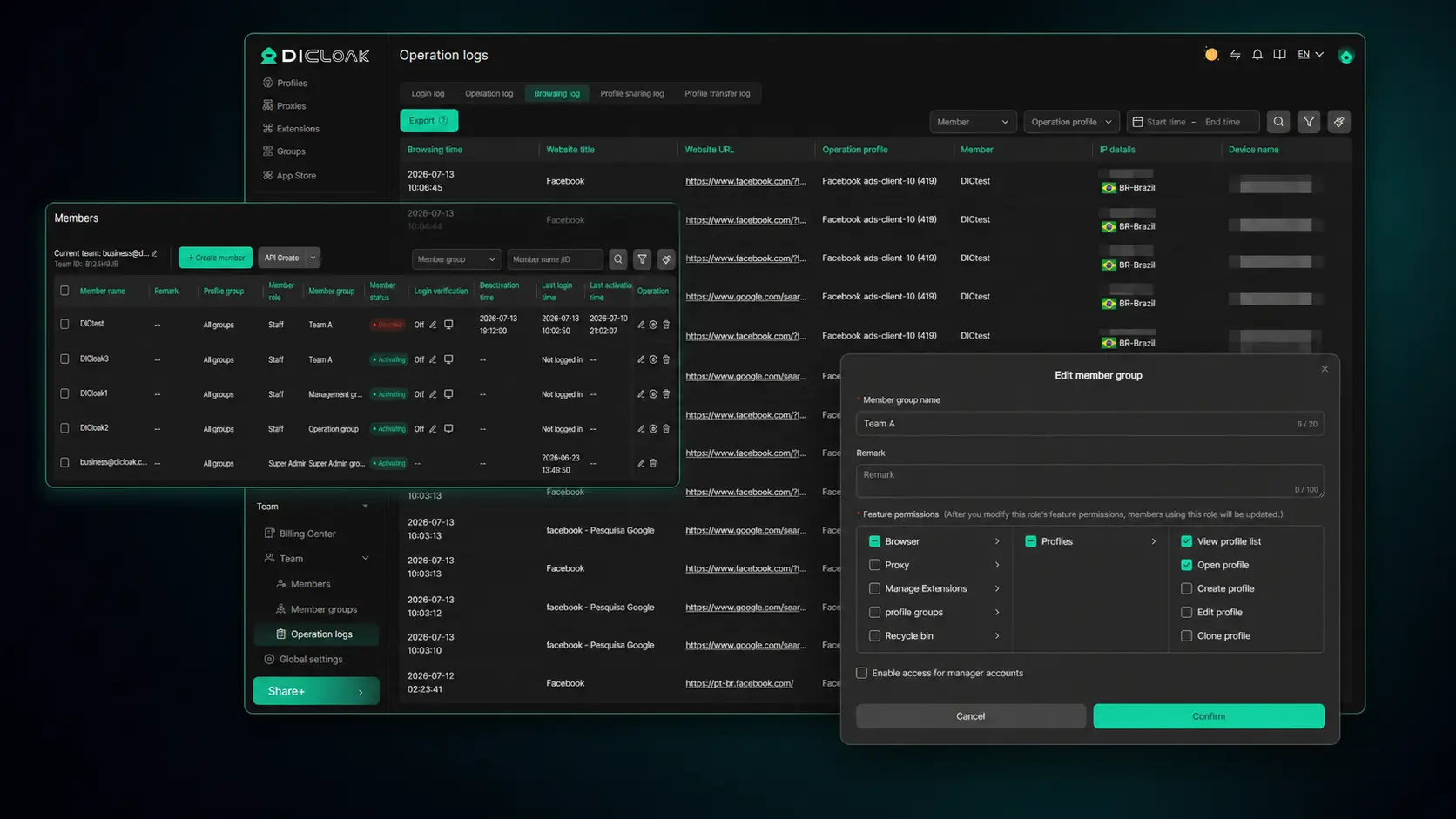
This environment control closes the operational safety loop before thinking about increasing gains or scaling volume.
Final tips to avoid falling into traps and maximize your earnings by watching videos
Avoiding wasting time or even money trying to make money watching videos on YouTube depends on some practical precautions, the difference between just clicking on ads and actually receiving is in simple details, but ignored by those who are just starting out.
Safety and efficiency checklist
- Never pay a fee or subscription to access tasks or release withdrawals, even if the site promises a quick return.
- Use a unique email for each app/website, never mix it with your main email. That way, if it leaks, it doesn't affect other accounts.
- Only trust platforms with recent reviews from real people, look for negative reviews and reports of non-payment before signing up.
FAQs About Making Money Watching Videos On Youtube
Is making money watching videos on YouTube legal?
Yes, it's legal to make money by watching videos on YouTube, as long as you use reliable platforms and follow the rules. Problems can arise if the site asks you to game systems, create fake accounts, or click on ads fraudulently. Always read the platforms' terms of use to avoid blocks or penalties.
How many views do I need to receive any value?
The number of views required to receive depends on the app or website. Usually, each video watched earns pennies or less. To withdraw amounts, some apps require you to watch hundreds of videos or accumulate points, which are then exchanged for cash or prizes. The amount per view is usually low.
What are the best apps to make money watching videos in 2026?
In 2026, popular apps may include ClipClaps, TikTok Bonus, and Kwai, as well as platforms like Swagbucks and Cashzine. Before using it, research reviews and see if the app really pays. Avoid new apps without reputation, as there is a risk of scams or late payments.
Can I use more than one account to increase earnings?
Most apps prohibit having multiple accounts per person to earn more. Using more than one account can lead to blocking and losing your balance. If you want to separate profiles, use different data and devices, but always follow the rules of each platform to avoid punishment.
How to withdraw money earned by watching videos?
The most common methods to withdraw money are transfer to a bank account, PayPal, or gift cards. Some apps require a minimum withdrawal amount, which can take time to reach. Obstacles include fees, delays in approving withdrawals, or even blocking the account for not complying with rules.
Now that you know the possibilities and the necessary precautions, the next step is to choose a reliable platform and start testing the available options. Evaluate your available time, set realistic goals, and see how this alternative can safely supplement your income. Try DICloak for free
 Web Proxy Tools
 Free Tools
 Cookie Plugin
 UA Generator
 MAC Address Generator
 IP Generator
 IP Address List
 2FA Code Generator
 World Clock
 Anonymous Check
 WebRTC Leak Test
 UUID Generator
 Free Web Proxy Site
 Proxy Checker
 FB Ad Checker
 AI Web Scraping
 Free SMM Tools
 Twitter Shadowban Checker
 Instagram Name Checker
 UTM Generator
 Username Generator
 AI Hashtag Generator
 LinkedIn Headline Generator
 Social Media Image Resizer