You've researched countries that don't require a number to create gmail because you want to open an account without handing over your phone on the first screen, but you run into confusing reports, old screenshots, and methods that no longer work. The real problem is not just "which country releases", but understanding when Google asks for verification and what makes that request appear.
Many people treat this as if there were a fixed list of countries where you can create Gmail without a phone number. In practice, this shortcut usually fails. The number request can change according to the age entered, device, IP, browser history, and signs of session risk.
What counts in 2026 is a more careful test. If you want to create Gmail without a phone number, you need to separate myth from actual registration condition. This includes knowing when the form skips the step, when it appears only as a recommendation, and when it becomes mandatory blocking. It also helps to understand why repeating attempts in the same browser tends to make the scenario worse, rather than solve it.
Before trying, it makes more sense to clear these doubts than to randomly change countries. Starting with the point that generates the most error: the idea that the country, alone, decides everything.
Are there really countries that don't require a number to create Gmail?

Short answer: there is no reliable and permanent list of countries where Gmail always allows registration without a phone. The country can influence, but it does not decide alone whether the step will appear, become a recommendation or block.
Why the idea of a fixed list of countries is often misleading
It is deceptive because the rule is not static. The same country may show different routes for two people on the same day, and Google Accounts may change this flow without warning, depending on the perceived risk in each attempt.
What Google usually evaluates beyond location
In practice, the phone request usually appears when the attempt seems out of the standard. This includes a device already used to create multiple accounts, a browser with a confusing history, a session full of old cookies , an IP with a bad reputation, or a sequence of failed attempts in a short time. A common example: the person changes the country in the form, but repeats the registration on the same laptop and in the same browser, right after two refusals. To the system, this doesn't seem like a "new context"; it seems like insistence on the same scenario. Then the phone tends to become a requirement. Informed age also weighs. In some flows, minors' accounts receive different treatment. Another unobvious point: incognito mode doesn't always help. If the rest of the signals remain strange, it only removes part of the local history, but doesn't clear the entire context of the attempt.
When the option to skip number may appear
It usually appears when the registration shows few signs of risk and the flow accepts other forms of recovery.
- device and browser with clean history, without multiple recent creations
- stable session, no repeated errors, excessive reloads, or sudden context switching
- form in which the phone appears as optional and the recovery email is enough
This is the central point: searching for "countries that do not require a number to create Gmail" as if it were a fixed rule leads to error. Before trying again, it makes more sense to understand what signs make Google ask for verification over the phone.
What makes Google ask for phone verification in some registrations
If in the previous section it was clear that there is no stable list of countries that do not require a number to create gmail, here comes the central point: the number usually appears when the registration receives fewer signs of trust. In other words, Google doesn't just look at the country. It looks at the context of the attempt.
Risk signs that can increase the chance of demand
The phone request usually goes up when the session seems "cold" or too rushed. This happens, for example, if you try to open several accounts in a short time, use a browser with no history, change your IP in the middle of the process, or arrive with signals that don't match each other, such as language in one place, time zone in another, and non-existent recent activity. The practical point is simple: the less trust the registration conveys, the greater the chance that the phone will become a mandatory step. If you insist right after a block, the system may interpret this as a continuation of the same risk, not as a new attempt.
How age, device, and consistency of navigation weigh
Here, small details change the result.
- Check the age informed. If it falls near lanes with extra protection, the check may appear.
- Avoid registering on a newly reset device, without previous use, cookies or basic browsing history.
- Keep language, system time, and region consistent throughout the process.
Why repeating the same process over and over again often makes it worse
Repeating too fast almost always accumulates bad signals. The common mistake is to think that the fifth attempt "will pass", when in practice it usually calls for more checks.
- If the form asked for phone or blocked, stop and wait a few hours before trying again.
- Do not redo the registration in sequence with the same browser, same tab and same almost identical data.
- If you see a different error, such as an extra confirmation step or failure to move forward, treat this as a temporary block, not a random bug.
With that in mind, you can move on to the most useful part: how to create Gmail without a phone number in 2026 without making your own session worse right from the start.
How to try to create a Gmail account without a number in 2026

If the idea is to test countries that do not require a number to create gmail, the most correct way is not to change country blindly. It is to make a clean, coherent and unhurried registration, because the result varies per session and forcing several attempts in a row usually worsens the risk signal.
Prepare a more consistent enrollment context
- Use name, date of birth, and region that are consistent with each other. If the age falls into a more sensitive range, the phone request may appear earlier.
- Open a new browser window and make only one attempt. If you've tried multiple times in the same environment, the form may become more rigid.
- Fill it all out calmly. Moving forward too quickly, going back steps, or correcting data all the time often seems like an unusual flow.
Register and check if the skip option appears
- Enter the official Google Account creation page and complete the basic fields.
- In the phone step, see if "Skip", "Not now" or if the field comes as a recommendation, not an obligation. If it does, follow without a number.
- If the system blocks the advance until it fills the phone, stop there. Insisting on random numbers or reloading the page several times rarely helps.

Add a recovery email if the system allows it
- If the registration goes through without a phone, add a recovery email that you already control. This helps if the session expires or if the login is questioned later.
- Confirm this email right after creating the account. If you leave it for later and fall into a new check, you may lose temporary access.
- Don't treat this as a sure replacement for the phone. On some future logins, Google may still ask for extra verification.
What to do if Google requires a number anyway
- Close the attempt and wait before retrying. Trying multiple accounts in a row in the same context often increases the chance of being blocked again.
- Don't change random data just to "see if it passes". If name, age, and region start to vary without logic, the registration tends to seem less reliable.
- If the demand continues, accept that in that session the phone has become a requirement. Then the most useful thing is to identify the errors that most trigger this step.
What mistakes make Gmail ask for a number at the time of registration
If Google always asks for a phone number, the problem is usually in the pattern of the attempt, not in the countries that do not require a number to create gmail. What weighs most is repeating risk signals in the same or similar sessions.
Create multiple accounts at the same pace and in the same environment
If you try to open several accounts in sequence, in the same browser, on the same network and with the same way of filling out, the registration becomes automated. The mistake is not just "creating several", but repeating the same context without pause.
Using inconsistent information in registration
- Keep the name, page language, and country of the retrieval number in the same context.
- Don't change your date of birth in the middle of the process to "test if it passes".
- Avoid switching keyboard, language, and location right before submitting the form.
Switch networks, browsers, or devices mid-creation
Switching from Wi-Fi to mobile data, logging out of the phone and continuing on the PC, or restarting in another browser breaks the continuity of the session. This usually generates extra checking.
Insist after temporary block messages
If unusual attempt warning appeared, stopping helps more than repeating.
- Wait a few hours before trying again.
- Do not reload the page multiple times in a row.
- If the block returns, then it makes sense to test another device, browser or access context.
When it's worth testing another device, browser, or access context
After avoiding the most common mistakes, changing the technical context can help, yes, but only in one case: when you change a specific signal that was weighing against the attempt. If you change your cell phone, browser, and network at the same time, it's impossible to know what you solved or what made it worse.
Mobile vs computer: when a flow can be different
| Scenario |
What can change |
When is it worth testing |
| Mobile in mobile browser |
Shorter form, fewer visible fields, other step order |
If on the computer the number request appears too soon |
| New Gmail or Android app |
Session connected to the device, system account and device signals |
If the cell phone is for personal and stable use |
| Computer with common browser |
More history, extensions and old sessions interfering |
If you want to see the flow with more control |
Test one variable at a time. If the desktop failed with immediate phone order, it makes sense to try it on mobile. If the phone also falls in the same step, the problem is usually in the context of the session, not the type of screen.
Clean browser vs already used browser
Clean browser helps when the old browser is loading sessions, cookies, or repeated attempts. A used browser may work better if it has a stable normal login history. The common mistake is to delete everything without knowing if the history was helping.
Stable network vs frequent access changes
Switching networks once can be used to test bad context. Switching between Wi-Fi, mobile data, and times in a row tends to seem more suspicious. If you want to create Gmail without a phone number, consistency is more important than improvisation.
Where DICloak comes in when you need to separate sessions from multiple platform accounts
If, after testing another technical context, you also work with multiple platform accounts on the same computer, the next problem is often organization, not Gmail registration. At this point, operators can use separate profiles in DICloak so as not to mix session, language, time zone, and network between different routines. The scope is in the browser and in the session; this does not change Google's phone requirement.
Configuring Isolated Profiles and Browser Signals
In a social media flow, it makes sense to create a profile per account or per work routine. An operator can adjust the reported system, user agent, interface language, content language, time zone, geolocation, and other browser signals within each profile, instead of opening everything in the same Chrome and losing control of the context. The real gain here is operational consistency, not the promise of acceptance in registration or platform review. 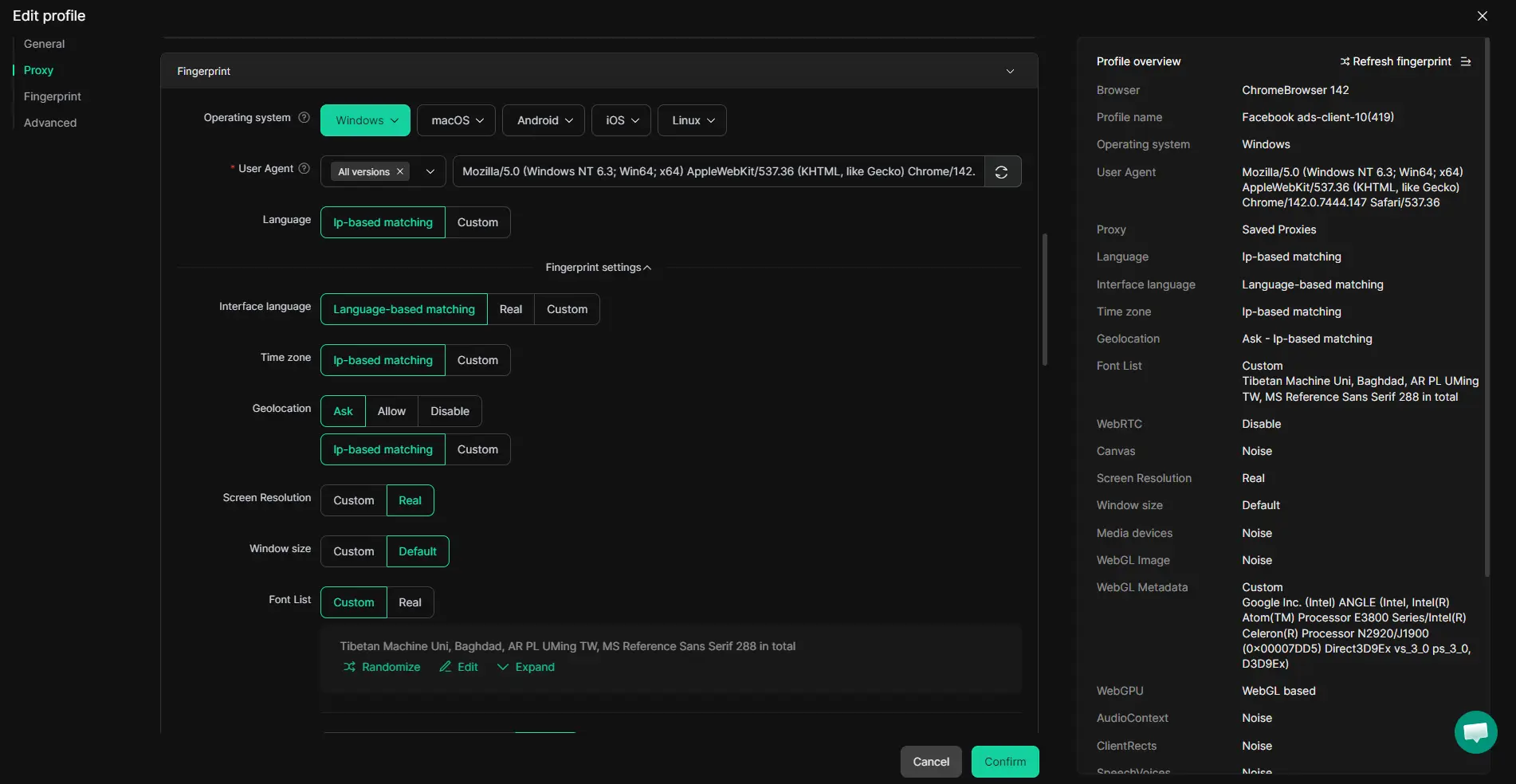
User-provided proxy configuration in each profile
If that routine also asks for separate network exits, the operator can configure its own proxy within each profile and test the connection before saving. In practice, it fills in host, port, and credentials, runs the check, and confirms outgoing IP, country/region, and time zone. This helps keep the environment organized by profile, but it doesn't mean that DICloak provides proxies or that this adjustment solves the creation of Gmail without a number. 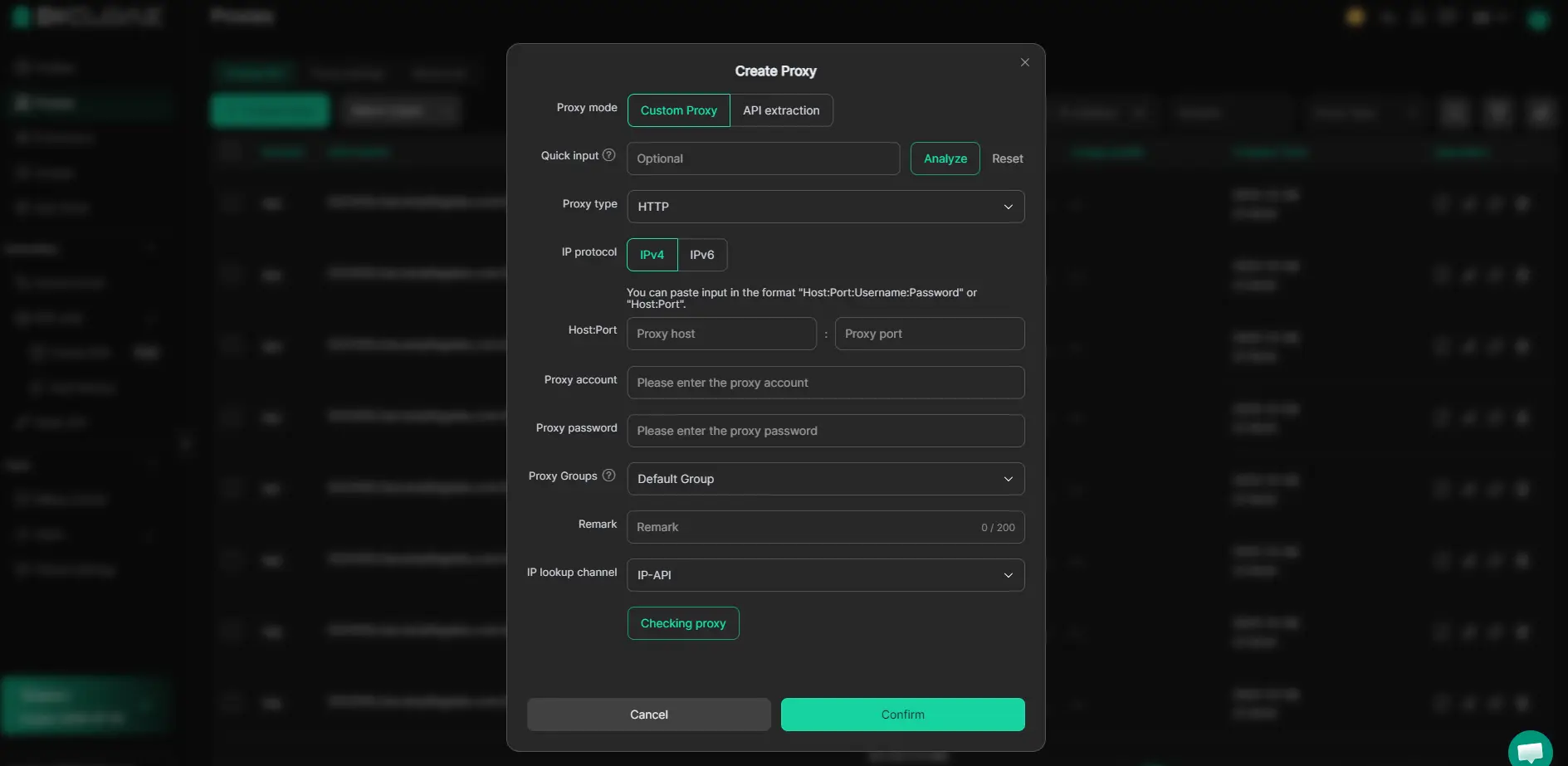
If even with the context well separated Google keeps asking for a phone, it's worth going for the most practical option.
When accepting number verification is the most practical option
If you have already separated session, browser and access context and Gmail keeps crashing at the same point, it is worth accepting the number when the attempt without a phone only repeats validations and does not come to an end.
Signs that insisting without numbers is not paying off
| Situation |
Continue without number |
Accept verification |
| The form asks for confirmation again after several attempts |
You spend more time and tend to trigger more checks |
Closes the registration in the same flow |
| Extra steps appear, such as confirming unusual activity |
The risk of temporary lockdown rises |
You reduce back-and-forth sign-up |
| You need the account today for work or recovery |
Testing country or browser slows everything down |
Completes and moves on to account setup |
If the goal is to finish the registration, not to "win" the step without a number, the practical choice is usually clear.
How to use the number with less headache afterwards
Once you're done, adjust recovery, alternate email, and basic data right at the beginning. Also save which device and browser were linked to the account, so you don't lose context in the next entry.
What to remember before trying again
If the telephone step appeared, the summary is simple: it is almost never the country alone. What weighs more is the context of the attempt and how normal it seems.
Which depends on the context and not on a specific country
The number request usually follows session risk signals, not a fixed list of countries that do not require a number to create Gmail. If you change country, but repeat browser, IP, pace of attempts or incoherent data, the chance of re-verification remains high.
What is worth testing calmly next time
Swap one variable at a time. If nothing changes, stop and come back later.
- Try another device or another clean browser.
- Redo the registration with consistent data, without rushing.
- Avoid multiple attempts in a row in the same context.
Frequently asked questions about countries that don't require a number to create gmail
Is there an updated list of countries that don't require a number to create Gmail?
There is no fixed and reliable list of countries that do not require a number to create gmail. Google changes the requirement according to signs of the session, device, IP, browser and registration behavior. The same country can show different flows to different people, on the same day.
Can you create Gmail without a number on your cell phone?
Yes, in some cases, you can create Gmail without a cell phone number. This happens when the app or browser shows a flow with the option to skip the phone. The result changes depending on the device, the account already used on it, the connection and the risk signals analyzed at that moment.
Does using recovery email help create Gmail without phone?
A recovery email can help with some flows, because it adds an extra form of contact and security to the account. Even so, it does not always replace phone verification. If the system identifies a higher risk, the number request may continue to appear during registration.
Why does Gmail ask for a number even when other people can get it without a phone?
Each attempt receives its own analysis. Google observes signals such as new device, missing cookies, unusual IP, too many creations in a row, and actions that are too fast. As a result, one person may see the option to skip, while another receives phone verification in the same country and in the same period.
How many Google accounts can I create without the system asking for verification?
There is no guaranteed number. Creating multiple accounts in a short time increases the chance of extra validation. Repeating the same device, browser, or connection also weighs. When researching countries that don't require a number to create gmail, remember that volume and usage pattern count more than the country alone.
Now, the most useful thing is to test the options that make sense for you, checking if the registration method works in your country, on the device you use, and with the level of privacy you expect. Before creating the account, prepare a stable connection and review Google's current requirements to avoid blocks, extra verification steps, or wasting time. Try DICloak for free
 Web Proxy Tools
 Free Tools
 Cookie Plugin
 UA Generator
 MAC Address Generator
 IP Generator
 IP Address List
 2FA Code Generator
 World Clock
 Anonymous Check
 WebRTC Leak Test
 UUID Generator
 Free Web Proxy Site
 Proxy Checker
 FB Ad Checker
 AI Web Scraping
 Free SMM Tools
 Twitter Shadowban Checker
 Instagram Name Checker
 UTM Generator
 Username Generator
 AI Hashtag Generator
 LinkedIn Headline Generator
 Social Media Image Resizer