Earning consistent online income is no longer a mystery—it is a process. In 2026, more creators are proving that it is possible to Earn $100 a Day on AdSense by building real websites, targeting high-value search intent, and following Google-compliant strategies. This guide breaks down the exact framework professionals use to turn content into predictable ad revenue, without shortcuts, risky tactics, or account violations. Whether you are starting from scratch or scaling existing sites, this article shows you how to reach the $100/day milestone in a sustainable and ethical way.
Introduction to Achieving Financial Milestones in 2026
Achieving a consistent income through display advertising remains one of the most effective ways to build a digital business in 2026. For many website owners, reaching the $100 per day milestone is a life-changing event. This level of revenue often qualifies as a full-time income, providing the financial freedom to manage projects from anywhere in the world. Consequently, many creators view this mark as the ultimate proof of a successful online venture.
To reach this goal sustainably, professional operators must avoid "get-rich-quick" schemes that risk account safety. Instead, success in 2026 relies on establishing Experience, Expertise, Authoritativeness, and Trustworthiness (EEAT). By following an ethical, long-term approach, you can build an asset that generates revenue for years. For example, this guide utilizes the proven "RPP" framework—Research, Publish, and Promote—to help you scale your earnings efficiently.
Understanding the Math Behind the Goal to Earn $100 a Day on AdSense
To earn $100 a day, you must first understand the metrics that drive AdSense revenue. Your total earnings are determined by three main factors:
- Cost Per Click (CPC): The amount you earn each time a visitor clicks an ad. This is influenced by how much advertisers bid for space on your specific topic.
- Click-Through Rate (CTR): A measure of ad relevance. It is the percentage of visitors who click on an ad compared to total page views.
- Page Views (PV): The total volume of traffic your content receives.
The core formula for your daily income is: Earnings = CPC x CTR(%) x Pageviews. To track your efficiency, professional operators calculate Revenue Per Mille (RPM), which represents how much you earn for every 1,000 visitors.
Depending on your site’s RPM, the amount of traffic you need will vary. For example, here are three concrete calculations of the daily visitors required to reach $100:
- Example 1: With a $2.75 RPM, you require approximately 36,360 visitors per day.
- Example 2: With a $4.50 RPM, you require approximately 22,220 visitors per day.
- Example 3: With a $6.10 RPM, you require approximately 16,390 visitors per day.
Researching High-Value Niches to Earn $100 a Day on AdSense
Keyword research is the essential first step to generating high income. If you publish content without researching what people are searching for, your site will struggle to attract valuable advertisers.
Top RPM Topics
Advertisers pay more for niches where the end product or service is expensive. Moreover, companies in these sectors invest heavily to acquire new customers. In 2026, the highest-paying niches in Tier-1 markets (US, UK, Canada, and Australia) include:
- Insurance
- Online Education
- Marketing and Advertising
- Legal Services
- Cryptocurrency
User Intent
When conducting research, you must understand User Intent. This means identifying whether a user is looking for Information (e.g., "how to..."), a Solution (e.g., "best way to..."), or a Product. For example, "Product" intent keywords often attract significantly higher CPCs. This happens because the user is closer to making a purchase, making the ad space much more valuable to advertisers. For beginners, using keyword tools like Ubersuggest can help you identify exactly what phrases people are typing into Google.
Publishing Quality Content to Earn $100 a Day on AdSense
In 2026, search engines easily distinguish between "crap content" and high-value resources. Your goal is to produce the most comprehensive and helpful article for your chosen keyword.
The Structure of Success
To rank well, you must analyze the current Top 10 Google search results for your target keyword. Observe how these successful articles are structured and note their average word counts. Your content should mirror these successful patterns while filling any information gaps your competitors missed.
The Power of the Edit Button
Content is never truly "finished." Google prioritizes fresh, updated information. Consequently, you must use the edit button to refresh old articles with new data, current trends, and improved insights. Consistently updating your archives signals to search engines that your site is a reliable, living resource.
User Experience (UX)
Technical performance is just as important as the writing. To maximize revenue, your site must meet these UX requirements:
- Fast loading times: Slow sites cause users to leave before ads can load.
- Mobile-friendly design: Most traffic in 2026 comes from mobile devices.
- Clear readability: Use simple fonts and plenty of white space to keep readers engaged.
Promoting Your Website to Earn $100 a Day on AdSense
Publishing content is only half the battle; you must also drive diverse traffic to your pages.
Organic vs. Social Traffic
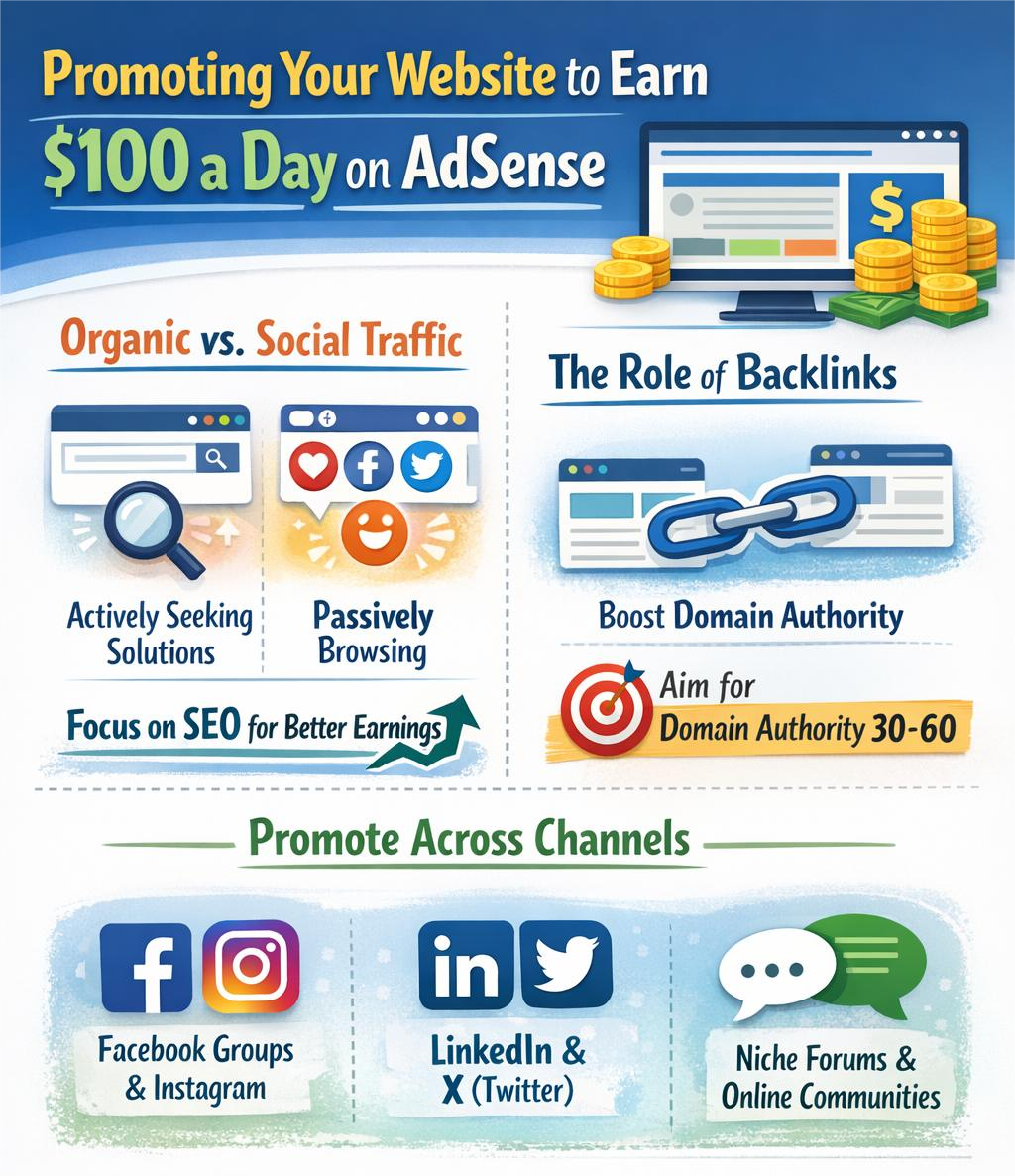
Organic search traffic—visitors coming from search engines—is significantly more valuable than social media traffic. Search engine users are "actively seeking solutions," whereas social media users are often "passively browsing." Passive browsing leads to lower ad engagement and higher "invalid traffic" risks on social platforms. Consequently, while social media is useful for brand awareness, your primary focus must remain on Search Engine Optimization (SEO).
The Role of Backlinks
Inbound links, or "backlinks," act as trust signals for search engines. When other reputable sites link to your content, it boosts your domain authority. Professional operators aim for a domain authority range of 30 to 60 to compete effectively for high-value keywords.
Moreover, you should promote your content across several channels to diversify your reach:
- Facebook Groups and Instagram
- LinkedIn and X (Twitter)
- Niche-specific forums and online communities
Scaling Operations Safely to Earn $100 a Day on AdSense
As your business grows, you may want to manage multiple web projects, affiliate campaigns, or client accounts simultaneously. Doing this from a standard browser can lead to account flagging because websites can link all your accounts to the same digital fingerprint.
Defining Antidetect Browsers
Advanced earners use antidetect browsers like DICloak to scale safely. DICloak creates isolated browsing environments, each with its own unique digital identity. This prevents platforms from linking your different projects together, ensuring each account remains independent and secure.
This scaling strategy involves buying low-cost traffic from one source and directing it to high-value content pages monetized with AdSense. If your revenue from AdSense is higher than the cost of the traffic, you profit from the difference. Professional operators must prioritize high-quality traffic sources to maintain this profitable loop without risking their accounts.
Why DICloak is Essential to Earn $100 a Day on AdSense Operations
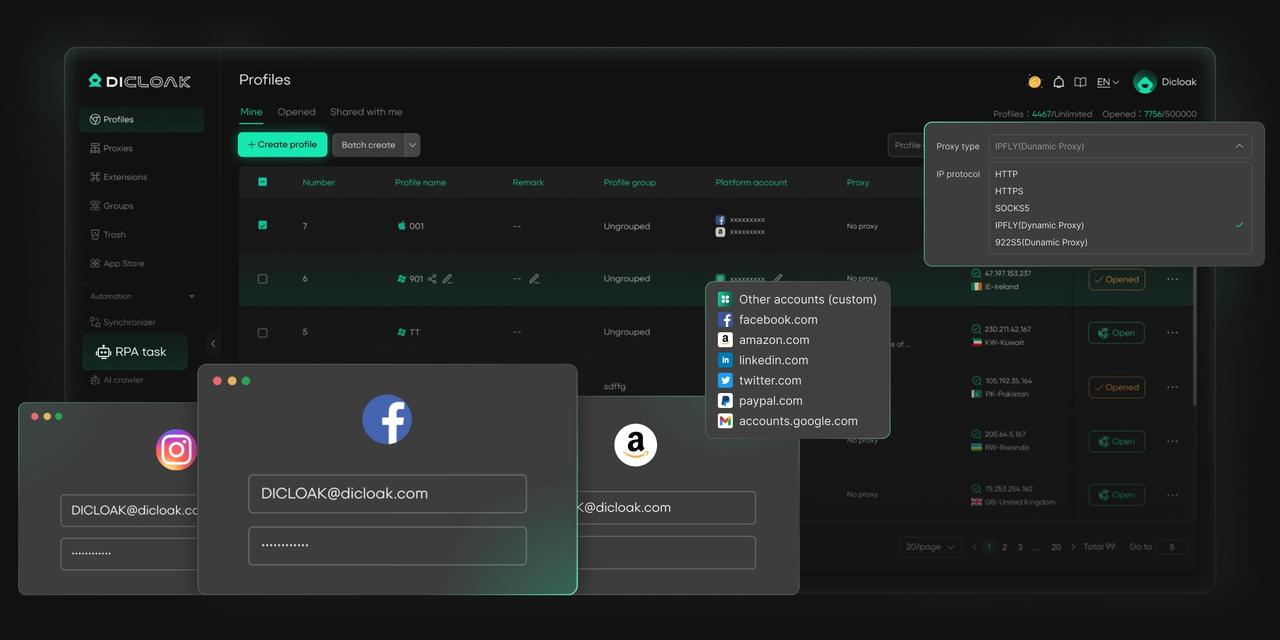
For those managing multiple sites or client portfolios, DICloak Antidetect Browser is the industry standard for operational safety. It provides a secure environment that is 12x cheaper than using multiple virtual machines. Unlike regular browsers, DICloak allows you to spoof key fingerprint elements like IP address, geo-location, cookies, WebGL, WebGPU, and Canvas.
Key features of DICloak include:
- Multi-Account Management: Manage 1,000+ accounts on one device without extra hardware costs.
- Guaranteed Safety: Isolated profiles with custom fingerprints prevent account bans and linking.
- RPA Automation: Use robotic process automation to handle repetitive tasks and save hours of manual work.
- Team Collaboration: Share profiles and set flexible permissions for agencies or marketing teams.
- Synchronizer: Effortlessly sync actions across multiple profiles for maximum efficiency.
DICloak offers a Free version upon registration. For growing teams, the Share+ Plan is an excellent choice because it allows for unlimited member logins.
Optimizing Ad Placements to Earn $100 a Day on AdSense
To maximize your $100/day goal, ads must be integrated smartly. They should complement your content rather than disrupt the reading experience.
- A/B Testing: Regularly test different formats, such as in-article ads versus display ads, to see which drives a higher CTR.
- Strategic Placement: Place ads where users naturally pause.
Warning on Invalid Traffic Google is highly efficient at filtering out bot clicks to protect advertiser ROI. If your traffic is low-quality or looks like fraudulent activity, your account may be penalized. Consequently, maintaining a clean traffic profile by investing in legitimate, organic sources is mandatory for long-term success.
Conclusion
Earning $100 a day on AdSense in 2026 is an attainable milestone for those who apply the RPP method with discipline. Success requires following Google’s policies, investing in high-quality organic traffic, and diversifying your income streams through multiple projects.
While some creators see faster results, hitting the $100/day mark typically takes 6 to 12 months of consistent effort. By combining high-value research with professional tools like DICloak, you can scale your operations safely and build a sustainable digital income.
FAQs on How to Earn $100 a Day on AdSense
1.How long does it take to reach $100 a day?
Typically, it takes 6 to 12 months of consistent work to build enough traffic and authority to reach this income level.
2.Is there a traffic minimum for AdSense approval?
No. Google focuses on the quality and value of your content rather than a specific number of pageviews for approval.
3.Can I use DICloak for AdSense?
Yes. Professional operators use DICloak to manage multiple separate web projects or client accounts ethically without the accounts being linked.
4.Which countries pay the most in ad revenue?
The highest-paying markets are generally the United States, Canada, the United Kingdom, and Australia.
5.Can I have multiple AdSense accounts?
Google strictly allows only one AdSense account per payee. You should use DICloak to manage separate web projects or different client accounts, not to create multiple personal AdSense accounts.
 Web Proxy Tools
 Free Tools
 Cookie Plugin
 UA Generator
 MAC Address Generator
 IP Generator
 IP Address List
 2FA Code Generator
 World Clock
 Anonymous Check
 WebRTC Leak Test
 UUID Generator
 Free Web Proxy Site
 Proxy Checker
 FB Ad Checker
 AI Web Scraping
 Free SMM Tools
 Twitter Shadowban Checker
 Instagram Name Checker
 UTM Generator
 Username Generator
 AI Hashtag Generator
 LinkedIn Headline Generator
 Social Media Image Resizer