If you want to understand how Facebook algorithm works 2026, the first thing to know is that Facebook does not use one simple formula for every post. It uses AI-powered ranking and recommendation systems to decide what each person is more likely to find useful or interesting. These systems learn from signals such as what people watch, like, share, and interact with. Since December 2025, interactions with Meta AI can also help shape some content recommendations, making personalization even broader than before.
For creators and marketers, this means the Facebook algorithm is becoming more focused on matching the right content with the right person, not just showing posts from accounts they already follow. Meta said its Feed and video ranking improvements in late 2025 increased views of organic Feed and video posts by 7%. Facebook has also been showing more fresh Reels, including over 25% more same-day Reels compared with Q3 2025. These changes help explain why recent content can sometimes reach people beyond an existing follower base.
Core Changes Impacting Creators and Marketers
Some of the biggest Facebook algorithm news in 2026 is about original content. Meta says it is giving more reach to content created directly by the person or Page posting it, while reducing the reach of copied or lightly edited material. For example, simply reposting another creator's video with a new border, captions, or speed change may be treated as unoriginal. A creator who adds real analysis, new information, or a meaningful new angle has a better chance of being recommended in Feed or Reels.
Facebook is also taking stronger action against content made mainly to game reach. Posts with unrelated captions, excessive hashtags, or repeated spam-style content may receive less distribution. For creators, this makes clear topics, useful content, and real audience interest more important than tricks designed only to get clicks. It also means that learning how to reset Facebook algorithm recommendations is only one part of understanding Facebook in 2026. For marketers, the bigger challenge is learning what the platform now sees as relevant, original, and worth recommending.

Facebook Algorithm News: Key 2026 Meta Updates
The biggest Facebook algorithm news in 2026 is not one single update. Meta has been changing several parts of its ranking and recommendation systems at the same time. Feed is becoming more personal, while Reels is putting more focus on fresh and original videos. Meta is also using more signals to understand what each person may want to see. These changes are important for anyone trying to understand how Facebook algorithm works 2026.
The results are already visible in Meta's own data. Meta reported that improvements to Facebook Feed and video ranking in the fourth quarter of 2025 led to a 7% increase in views of organic Feed and video posts. Video watch time in the United States also grew by double digits compared with the year before. At the same time, Facebook started showing more recent Reels. By early 2026, users were seeing over 25% more Reels posted on the same day than they saw in the third quarter of 2025.
These numbers point to an important change. Facebook is not only asking, "Is this post popular?" Its systems are getting better at asking, "Is this content useful or interesting to this person right now?" For creators and marketers, that makes relevance, timing, and content quality more important than simply trying to collect as many reactions as possible.
Major Ranking System Shifts for Feed and Reels
Several changes now work together when Facebook decides what to show. Some affect Feed directly, while others have a bigger effect on Reels and recommended content. The table below shows the main shifts that matter in 2026.
| 2026 ranking shift |
What has changed |
What it means for creators |
| Stronger AI personalization |
Facebook uses more activity signals to understand personal interests |
The same post can perform very differently with different audiences |
| More fresh Reels |
Facebook is showing more videos soon after they are posted |
Timely content can have more chances to reach interested viewers |
| More value for original content |
Original and meaningfully changed content can receive more distribution |
Simple reposts and low-value edits may lose reach |
| Less reach for spam tactics |
Unrelated captions, excessive hashtags, and repeated spam can limit distribution |
Clear and relevant posts are safer than tricks made only for reach |
| More signals beyond normal Feed activity |
Meta can use some AI interactions and other activity to improve recommendations |
A user's interests may be understood from a wider set of actions |
One major shift in 2026 is the growing role of AI personalization. Facebook has long learned from actions such as likes, follows, comments, and video views. Since December 2025, Meta has also used some interactions with Meta AI as signals for content recommendations, and in 2026 it expanded the types of information that may help personalize Feed content. For marketers, this means audience fit matters more than chasing broad engagement from people who may not care about the topic.
Original content has also become more important in the Facebook algorithm. Meta says it is giving more reach to original work while reducing the distribution of copied or lightly edited content. For example, reposting another creator’s video with only captions or a new border may add little value, while testing the idea yourself, adding useful analysis, or telling a new story creates a stronger original contribution. Facebook is also reducing reach for spam-style tactics such as unrelated captions, excessive hashtags, repeated content, and other attempts to manipulate distribution.
These changes also explain why how to reset Facebook algorithm is not about deleting one fixed system. Facebook recommendations keep changing as users interact with content and use controls such as Interested, Not interested, Hide, and Unfollow. For creators, there is no single trick that resets reach either. A more practical approach is to create original content for the right audience, avoid spam-like tactics, and give Facebook clear signals about what the content is about.
How the Facebook Algorithm Works in 2026
To understand how Facebook algorithm works 2026, it helps to stop thinking about Facebook as one large list of posts. Every time a person opens Facebook, there may be far more content available than they could ever view. Facebook uses AI ranking systems to narrow that content down and decide what should appear first. The goal is to predict which posts, videos, and Reels will be most useful or interesting to that specific person.
This process is highly personal. Two people can follow the same Page but still see its posts in a different order, or one person may not see a certain post at all. Their past activity, interests, connections, and reactions can lead to different predictions. Meta has also continued to improve these systems in 2026, with recent ranking updates bringing more personalized, original, and timely content into Feed and video recommendations.
The 5-Step Content Ranking Process
The modern Facebook algorithm involves many machine learning models, so the real system is more complex than five simple rules. Still, Meta's public explanations make it possible to break the process into five useful stages. This model shows what happens between a post becoming available and a person actually seeing it in Feed or Reels.
1. Facebook builds a pool of possible content
The process starts with inventory, or the content Facebook could potentially show to a person. In Feed, this can include posts from friends, Pages, groups, and recommended sources. For Reels, the system can also find videos from creators the person does not follow. Facebook's recommendation technology has become more important for discovery because the platform is no longer limited to showing content from existing connections.
Imagine that Sarah follows a local bakery, belongs to a home-baking group, and often watches cake-decorating videos. When she opens Facebook, posts from those sources may enter the pool. A Reel from a creator she has never followed may also become a candidate if Facebook believes it matches her interest in baking. The system first needs this pool before it can decide which item deserves a higher position.
2. Facebook collects signals about each post and viewer
Facebook then looks at many signals related to the content and the person who may see it. Meta has explained that these can include the type of content, who posted it, when it was posted, and how the viewer has interacted with similar content before. Facebook can also learn from actions such as watching videos, liking Pages, and interacting with posts. Since December 2025, interactions with Meta AI can also be used as another signal for personalization in supported markets.
For example, Sarah may usually watch baking videos until the end but scroll past restaurant news. That history gives Facebook useful context. If a new cake tutorial and a restaurant article are both available, the system may see stronger signs that the tutorial fits her interests. The same cake video could receive a very different response when evaluated for another person who rarely watches cooking content.
3. AI predicts what the person may do
Signals alone do not decide the final position. Facebook uses them to make predictions about what a person may do next. Meta has described predictions such as whether someone may like, comment on, share, or spend time with a piece of content. Modern recommendation systems can make many predictions at the same time rather than relying on one action.
Suppose Sarah often saves or watches detailed decorating tutorials but rarely comments on them. Facebook does not need a comment to understand that she finds this kind of content useful. Her predicted chance of watching a new tutorial may be more important for her than her chance of commenting. This is why there is no universal rule saying that one like, comment, or share always has the same ranking value for every user.
4. Facebook scores, filters, and adjusts the candidates
Facebook combines its predictions to estimate the value of each candidate post for that person. It can also apply rules and integrity checks during ranking. Content that appears spammy, misleading, copied, or otherwise unsuitable for recommendation can lose distribution even when it receives engagement. Meta said in 2025 that accounts using unrelated captions, excessive hashtags, spam networks, or fake engagement may receive less reach.
Originality has become especially important in 2026. Meta now says that original creator content can receive greater distribution, while duplicated videos and low-value edits can be deprioritized in Feed and Reels. For example, downloading another creator's Reel and adding only subtitles or changing its speed may not add enough value. Filming a new version with personal testing, useful analysis, and a different story gives Facebook much clearer evidence that the creator has produced something original.
5. Facebook ranks the final content for each person
After these predictions and adjustments, Facebook orders the remaining content. Higher-ranked items have a better chance of appearing earlier or being recommended. The process does not stop there. New actions from the viewer give Facebook more information, so future recommendations can change as interests change.
This is also why people searching how to reset Facebook algorithm should not think of it as deleting one permanent profile. The recommendation system keeps learning from ongoing activity. Using controls such as Interested, Not interested, Hide, and Unfollow can help Facebook learn what a person wants to see more or less often. A change usually develops through new signals over time rather than through one universal "reset" button.
Critical Ranking Signals for Organic Reach
Once the five-step process is clear, the next question is usually simple: what actually helps a post get organic reach? There is no public formula with fixed points for every like, comment, view, or share. Meta's own technical explanation shows that ranking is personalized, so the value of an action can change based on the viewer and the situation. Still, several groups of signals clearly matter when Facebook estimates whether content deserves attention.
| Ranking signal |
What Facebook can learn from it |
Simple example |
| Viewer interest |
Whether the topic matches past behavior |
A person who often watches gardening Reels may receive more gardening content |
| Viewer-creator connection |
How a person has interacted with a creator, friend, Page, or similar source |
Someone who often interacts with a Page may be more likely to see another relevant post |
| Content type |
Which formats the viewer tends to use |
A regular video viewer may receive more Reels |
| Predicted engagement |
Whether the viewer may watch, like, comment, share, or take another meaningful action |
A useful guide may rank well for someone who often spends time on similar guides |
| Recency |
Whether the content is fresh enough to be useful now |
A Reel about today's event may be more relevant today than next week |
| Originality and quality |
Whether the creator made or meaningfully transformed the content |
An original tutorial has a stronger position than a lightly edited repost |
| Negative or spam signals |
Whether people hide content or whether the post uses spam-like tactics |
An unrelated caption packed with hashtags may hurt distribution |
Audience interest and past behavior are among the most important ideas to understand. Facebook tries to predict what each individual person wants, rather than giving every post one fixed global score. If someone often watches home repair videos, content about fixing a leaking sink has a natural advantage with that viewer over a random celebrity clip. This does not guarantee reach, but it gives the ranking system a clearer match between the topic and the audience.
Meaningful interaction also matters, but context matters more than raw numbers. Likes, comments, shares, viewing behavior, and other actions can all give Facebook information. However, creators should not assume that getting 100 comments will automatically push a post above one with 50 comments. Meta's ranking models make several predictions for each user, and those predictions can carry different value depending on that person's normal behavior.
Freshness has become more visible in video recommendations. Meta reported in January 2026 that Facebook was showing more than 25% more same-day Reels than it had in the third quarter of 2025. That does not mean older videos suddenly have no value. It shows that Facebook is putting more effort into bringing recent content into recommendations faster when it is relevant. A sports creator posting useful analysis shortly after a major game, for example, may have a better timing advantage than someone posting the same discussion several days later.
Originality is another clear signal for creators in 2026. Meta says it is increasing distribution for original work while reducing the reach of copied or lightly changed content. This matters because a viral topic does not require everyone to create the same video. A travel creator can cover a popular destination but still film personal footage, explain real costs, show mistakes, and share useful tips. The topic may be common, but the value added by the creator is original.
Finally, creators should pay attention to negative quality signals. Trying to force engagement with unrelated text, fake activity, copied posts, or large amounts of spam content can work against organic reach. Meta has been actively reducing these tactics as part of recent Facebook algorithm news. In practice, a smaller number of relevant reactions from people who care about the topic can be more useful than trying to attract random activity that sends unclear signals about who the content is actually for.
The key lesson from how Facebook algorithm works 2026 is that creators are not really trying to "beat" one algorithm. They are helping Facebook understand three things: what the content is about, who may value it, and whether people have a good experience with it. Clear topics, original work, natural audience interest, and useful content give the ranking system stronger information to work with. That approach is more reliable than chasing a single supposed ranking trick.
What Kills Your Facebook Organic Reach
A post can get low reach simply because people are not interested in it. But sometimes the problem goes deeper. Facebook may reduce the distribution of content that looks spammy, copied, misleading, or low in value. Some content can even stay on Facebook while losing access to wider recommendations. This difference is important when learning how Facebook algorithm works 2026.
Meta has explained that Community Standards and content distribution rules do not always work in the same way. A serious policy violation may cause a post to be removed. Other content may be allowed to stay online but shown to fewer people because Facebook sees it as low quality or not suitable for recommendations. For creators and marketers, this means a post does not need to be deleted to hurt organic reach. A Page can keep publishing while slowly losing discovery if it repeats poor content habits.
Content Violations and Low-Quality Signals to Avoid
Recent Facebook algorithm news shows that Meta is paying closer attention to accounts that try to game distribution. In 2025, Meta said accounts using long distracting captions, too many unrelated hashtags, or captions that have little to do with the actual post may have their content limited to followers. Spam networks that run many accounts and post the same material can also receive lower reach and lose monetization access. These tactics may create short bursts of activity, but they can make it harder for the Facebook algorithm to see the account as a useful source.
Some of the main problems to avoid are:
| Low-quality signal |
What it can look like |
Possible effect |
| Unoriginal content |
Reuploading another creator's Reel with only captions or a border |
Lower Feed and Reels distribution |
| Unrelated captions |
Posting a travel video with a long caption about an unrelated topic |
Content may be limited to followers |
| Hashtag stuffing |
Adding many hashtags that have little connection to the post |
Can look like an attempt to game reach |
| Engagement bait |
Telling people to like, share, or comment only to push the post |
Facebook may reduce distribution |
| Repeated spam content |
Posting the same or very similar material across many accounts |
Lower reach and possible monetization limits |
| Clickbait |
Using a misleading headline that hides key information |
Facebook may show the content less often |
| Fake engagement |
Artificially collecting likes, followers, shares, or comments |
Can lead to policy and reach problems |
Unoriginal content can hurt reach in 2026. Meta says repeated reposts and small edits may receive less distribution, especially when creators add little new value. Simply changing the music, adding subtitles, or placing a border around someone else's video may not be enough. A better approach is to add original testing, useful analysis, new information, or a different story. For example, a fitness Page that tests a viral workout and explains safer options for beginners adds more value than a Page that only reposts the original clip.
Spam-style engagement can also reduce reach. Facebook has long taken action against posts that push people to like, share, or comment only to increase distribution. A real question, such as asking customers which new menu item they prefer, can create useful discussion. Random requests like "LIKE if you agree" or "SHARE with 10 friends" are more likely to look like engagement bait, especially when used repeatedly.
This is also why searching how to reset Facebook algorithm will not fix most creator reach problems. Creators cannot press a reset button to restore organic reach after repeated copied posts, spam captions, clickbait, or fake engagement. A better response is to review the content strategy, remove low-value tactics, and focus on clear topics, original work, and content made for the right audience.
How to Reset Facebook Algorithm
If your Facebook Feed feels stuck on topics you no longer care about, you may start searching for how to reset Facebook algorithm. The important thing to know is that Facebook does not currently describe a single button that completely deletes everything its recommendation system has learned about you. Instead, Meta gives users several Feed controls that can change the signals used to shape future recommendations. In practice, resetting Facebook means teaching the system what you want to see now.
This makes sense when you understand how Facebook algorithm works 2026. Facebook learns from ongoing activity, including the posts you interact with, videos you watch, Pages you follow, and feedback you give directly in Feed. Meta also began using interactions with its AI features as another recommendation signal in December 2025. In some markets, activity that businesses share with Meta can now also be used to personalize non-ad content such as Feed recommendations. Because these signals keep changing, your Feed can also change when your behavior changes.
Steps to Retrain Your Facebook Feed Preferences
A useful reset starts by giving Facebook clearer feedback. Meta says users can mark posts as Interested or Not interested, which can raise or lower the ranking of similar content. Facebook also provides Feed controls such as Favorites, Unfollow, Snooze, and Reconnect. These tools are more useful than simply scrolling past unwanted posts because they give the Facebook algorithm a direct signal about what should appear more or less often.
Here is a practical way to retrain your Feed:
- Mark unwanted posts as Not interested. When Facebook recommends a post or Reel that no longer matches your interests, open its menu and use the available feedback option. Do this consistently instead of only skipping the content.
- Use Interested on content you actually want. Positive feedback can help Facebook understand the topics you want to see more often. This is especially useful when you are trying to move your Feed toward a new interest.
- Review the accounts you follow. Unfollow Pages, people, or groups that fill your Feed with content you no longer want. You can still remain connected in some cases without seeing their posts regularly.
- Add important accounts to Favorites. If there are friends, creators, or Pages you do not want to miss, Favorites can help their posts appear more prominently in your Feed.
- Use Snooze when the problem is temporary. You may still like a Page but want a break from its posts. Snooze is useful when you do not want to unfollow it permanently.
- Interact more with the topics you want to keep. Watch useful videos, open relevant posts, follow suitable Pages, and join discussions you really care about. Your normal activity gives Facebook fresh signals over time.
For example, imagine that you watched several home-buying videos while searching for an apartment. A few weeks later, your Feed may still contain mortgage tips, real estate Reels, and property Pages even though you have finished your search. Instead of waiting for these posts to disappear, you can mark them as Not interested, unfollow temporary Pages, and start interacting with the cooking or fitness content you now want to see. As those new signals build up, Facebook can gradually adjust its predictions about your interests.
This process may not change every recommendation at once. Meta has made clear that Facebook personalization changes as people interact with content, and its recommendation engine continues to learn from new behavior. Facebook also said in late 2025 that users could give feedback about why they did not like certain posts or Reels so future content could become more relevant. That means a practical "reset" is better viewed as retraining rather than wiping the system clean.
Recent Facebook algorithm news makes this even more important in 2026. Meta is using more AI-driven signals to personalize Feed and Reels, so passive scrolling can still help shape what appears next. If you want different recommendations, be more active about the signals you send. Tell Facebook what you do not want, follow the sources you still value, and spend more time with content that matches your current interests. Over time, those choices give the system a clearer picture of what your Feed should look like.
How DICloak Streamlines Your Facebook Workflow
Understanding how Facebook algorithm works 2026 is useful, but creators and marketing teams still need a practical way to manage their daily work. This becomes harder when one team handles several Facebook Pages, client accounts, or different content projects at the same time. Repeated logins, mixed sessions, and manual tasks can make the workflow messy. For teams in this situation, an antidetect browser such as DICloak can provide separate browser profiles, automation tools, and AI-assisted research features in one workspace. These tools do not control the Facebook algorithm or guarantee more reach, but they can help users run a more organized content workflow.
Managing Multiple Accounts Securely for Better Reach
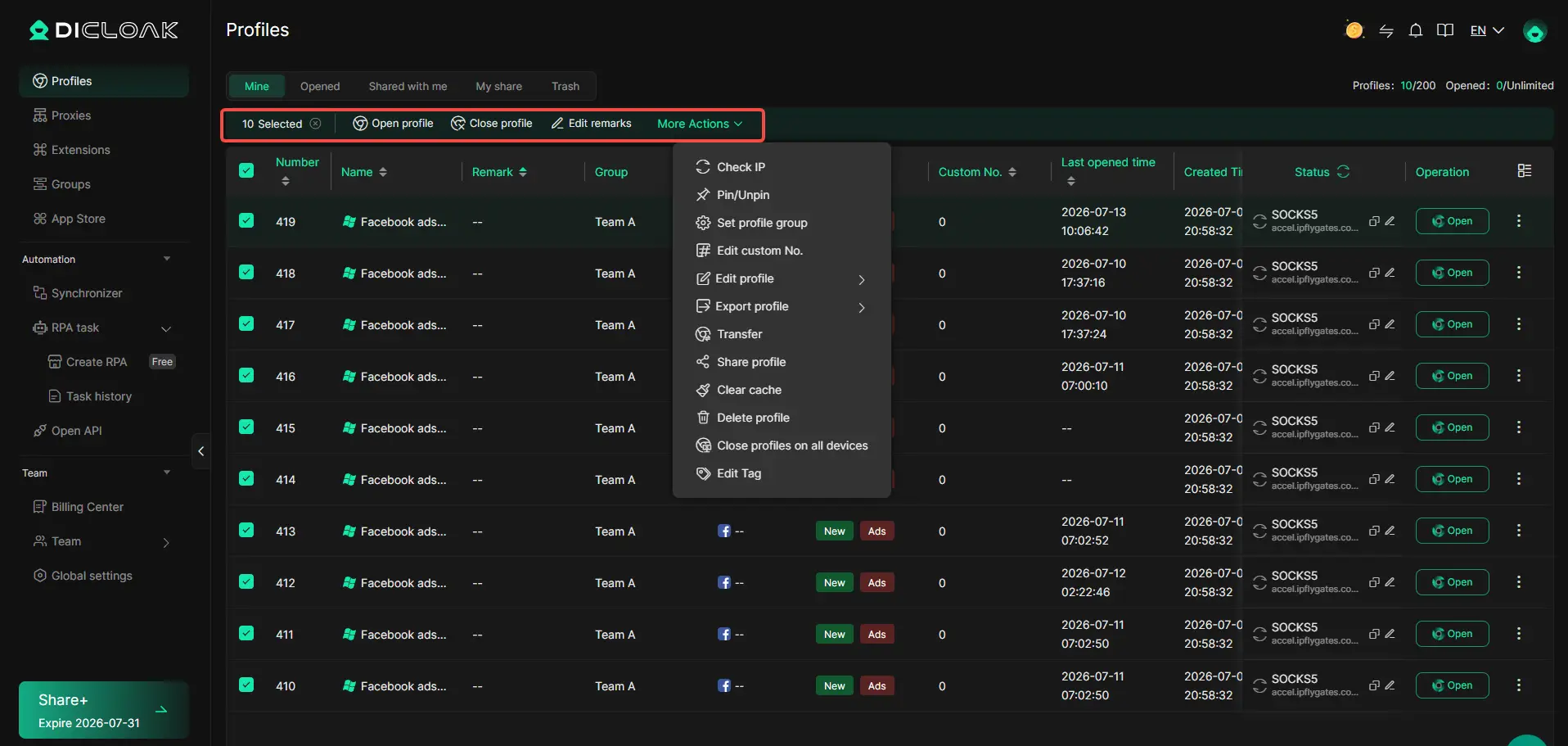
Marketers handling multiple Facebook accounts can use DICloak to create isolated browser profiles for each account. Every profile maintains separate cookies, cache, browser fingerprints, and independent proxy settings.
You can group profiles by client or team, share profiles with teammates in bulk, run batch IP checks, clear cache, and remotely close profiles across devices right from the dashboard. This prevents session cross-contamination and removes constant login/logout hassle.
Important note: DICloak’s profile isolation won’t directly improve Facebook algorithm rankings. It is a secure multi-account management tool. Always follow Meta’s rules and manage only authorized accounts.
Isolated fingerprint profiles to avoid Facebook account association
DICloak generates independent antidetect browser profiles for each Facebook account. Each profile stores fully separated cookies and cache, with customizable browser fingerprint parameters including OS type, user agent, timezone, geolocation and WebRTC settings. You can match language and location automatically based on your assigned proxy. Every profile is equipped with its own dedicated proxy configuration. This strong isolation prevents fingerprint leakage and cross-account association risks when running multiple Facebook accounts for your brand or clients.
Simplify Facebook Multi-Account Tasks with Synchronizer
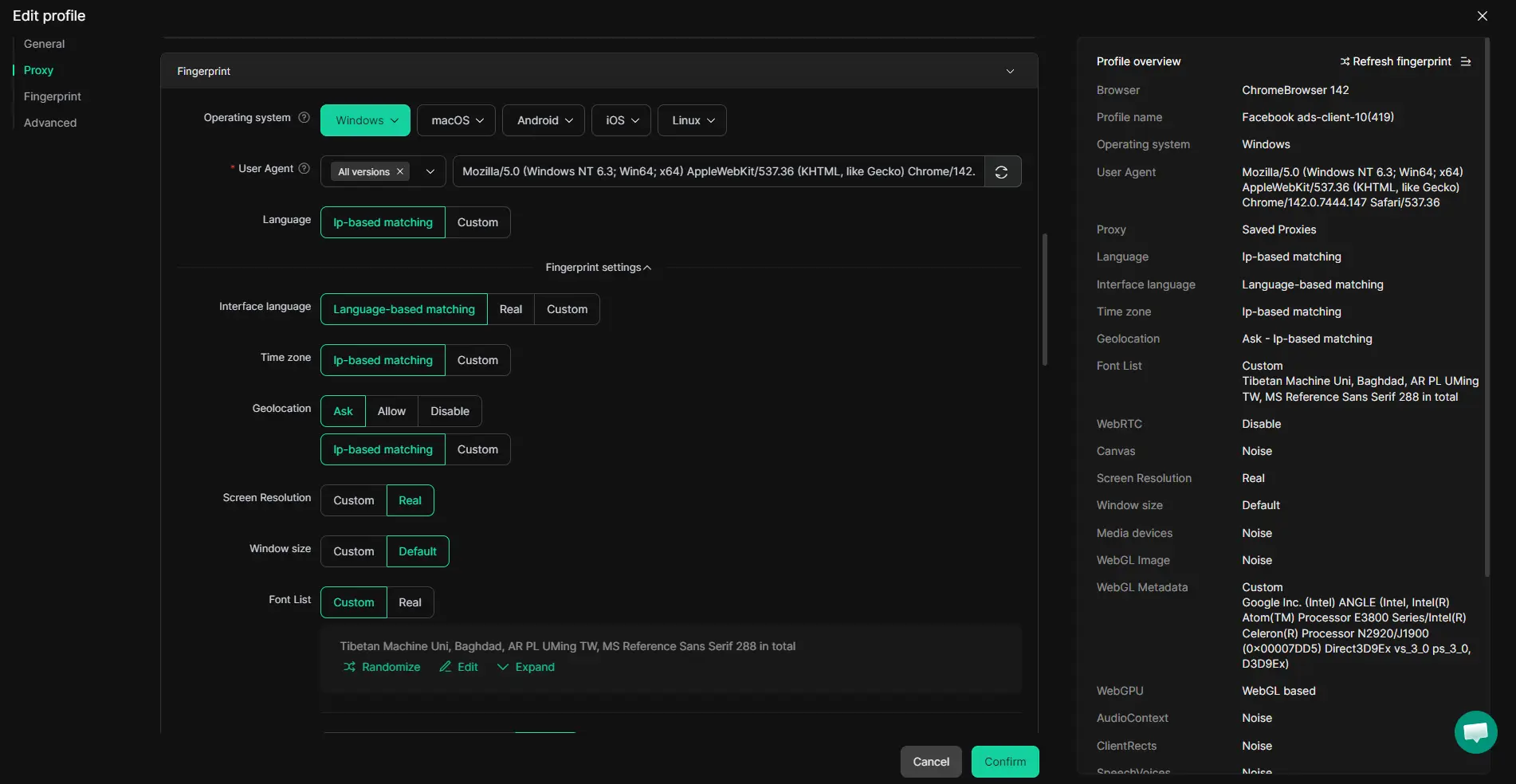
For Facebook teams managing several authorized accounts, DICloak’s Synchronizer can make repetitive browser work easier to handle. Users can select several browser Profiles and mirror actions such as opening the same page, clicking buttons, scrolling, or entering text from one main window to the others. For example, a marketer preparing several Facebook brand accounts could use synchronized windows to open the same settings page or complete the same routine check across Profiles, instead of repeating every step manually. This can help streamline social media management when the workflow involves many accounts, while users can still review each Profile separately before publishing or making account-specific changes.
Frequently Asked Questions About How Facebook Algorithm Works in 2026
1. How does the Facebook algorithm work in 2026?
To understand how Facebook algorithm works 2026, think of it as a personalized ranking system. Facebook uses signals such as your interests, past activity, content type, and predicted engagement to decide what you may want to see.
2. What are the most important Facebook ranking signals in 2026?
The main signals include viewer interest, past interactions, content relevance, freshness, originality, and predicted actions such as watching, sharing, or commenting. There is no public fixed formula that gives one signal the same weight for every user.
3. Can you reset the Facebook algorithm?
There is no single button that fully resets Facebook recommendations. Users can retrain their Feed by using Interested, Not interested, Favorites, Unfollow, and other Feed controls, then interacting more with the content they want to see.
4. Why did my Facebook organic reach suddenly drop?
Reach can fall because of weak audience interest, copied content, spam-style captions, fake engagement, or content that is not suitable for recommendations. Understanding how Facebook algorithm works 2026 can help creators review whether the problem comes from content quality, audience fit, or policy-related signals.
5. Does posting more often help the Facebook algorithm?
Not always. Posting more low-quality content does not guarantee better reach. In 2026, creators may get better results by focusing on original, relevant, and useful posts that match what their audience actually wants to see.
Conclusion
Understanding how Facebook algorithm works 2026 is less about finding one secret trick and more about understanding how Facebook matches content with people. The platform looks at interests, past behavior, content quality, originality, freshness, and predicted actions to decide what may be worth showing. At the same time, spam, copied content, fake engagement, and low-value posts can reduce the chance of wider distribution.
For creators and marketers, the best approach is to focus on content that gives people a real reason to stop, watch, read, or respond. Use original ideas, stay close to your audience's interests, and review what performs well over time. If you manage several Facebook accounts, tools such as DICloak can also help keep profiles, workflows, and routine tasks more organized, but they do not replace good content or real audience engagement.
The Facebook algorithm will keep changing as Meta improves its AI and recommendation systems. Instead of trying to chase every small update, build a content strategy around useful information, clear topics, and real audience value. That gives you a stronger base even as new Facebook algorithm news and ranking changes appear.
 Web Proxy Tools
 Free Tools
 Cookie Plugin
 UA Generator
 MAC Address Generator
 IP Generator
 IP Address List
 2FA Code Generator
 World Clock
 Anonymous Check
 WebRTC Leak Test
 UUID Generator
 Free Web Proxy Site
 Proxy Checker
 FB Ad Checker
 AI Web Scraping
 Free SMM Tools
 Twitter Shadowban Checker
 Instagram Name Checker
 UTM Generator
 Username Generator
 AI Hashtag Generator
 LinkedIn Headline Generator
 Social Media Image Resizer










-01-v15.png?x-oss-process=image/interlace,1/format,webp/quality,q_75)