Starting an e-commerce business is a great way to make money online. One of the best methods is Amazon arbitrage. You buy low and sell high. You find cheap products in stores or online. Then, you sell them on Amazon for a profit. This guide will show you how to start and succeed in 2026.
Why Is Amazon Arbitrage Still a Viable Business Model in 2026?
What makes Amazon arbitrage appealing to new sellers?
You do not need a massive budget to start this business. Many successful sellers begin with just a few hundred dollars. You also do not need to invent a brand new product from scratch. You simply sell products from popular brands that customers already know and trust, like Nike, Lego, or Neutrogena. Because you skip the expensive and confusing manufacturing process, this low startup cost makes Amazon arbitrage perfect for absolute beginners. You can literally buy inventory on a Monday and see your first sale by Friday.
How has the market evolved over the years?
The e-commerce market is actually much healthier for smart, educated sellers in 2026. During the past few years, many lazy "get-rich-quick" sellers quit the platform. Recent data shows that the number of low-quality sellers has dropped significantly. At the same time, global buyer traffic on Amazon continues to rise every single year. This means there is less fierce competition for the Buy Box, and there are millions of eager buyers waiting to purchase your items every single day.
What are the key advantages over other e-commerce models?
Amazon arbitrage is much faster and easier than private label models. Private label requires you to negotiate with overseas factories, design custom packaging, and spend thousands of dollars on pay-per-click advertising. Dropshipping often suffers from terrible shipping times and angry customers. With Amazon arbitrage, you use the Amazon FBA (Fulfillment by Amazon) program. Amazon handles all the packing, shipping, and customer service for you. You get the benefit of fast Prime shipping without doing the heavy lifting yourself.
What Are the Most Common Mistakes in Amazon Arbitrage?
Why do some sellers fail to make a profit?
Many new sellers simply do not calculate their true costs. They might see a toy for $10 at Walmart and see it selling for $25 on Amazon. They think they just made $15 in pure profit. However, they forget to subtract Amazon referral fees, FBA fulfillment fees, and the cost of shipping the item to the warehouse. After all those hidden fees, they might actually lose money on the sale. You must always use a reliable profit calculator before you buy anything.
How can poor product research lead to losses?
Some sellers buy items just because they look cheap or have a red clearance sticker. They rely on "gut feeling" and ignore how often the item actually sells. If you buy a cheap product that nobody wants to buy, it will sit in an Amazon FBA warehouse for months. Amazon will charge you monthly storage fees. Eventually, these storage fees will eat all of your potential profits. This is known as stranded inventory. You must only source products that have a high, proven, and consistent demand.
What are the risks of ignoring Amazon’s policies?
Amazon has extremely strict rules to protect its buyers. If you sell counterfeit items, your business will fail instantly. Also, some big brands do not allow random third-party sellers to resell their items. If you list their products without permission, the brand will file an IP (Intellectual Property) complaint against you. Amazon takes this very seriously. They can suspend your seller account, delete your listings, and freeze all the money you have earned.
How to Start Amazon Arbitrage: A Step-by-Step Guide
How to set up your Amazon seller account
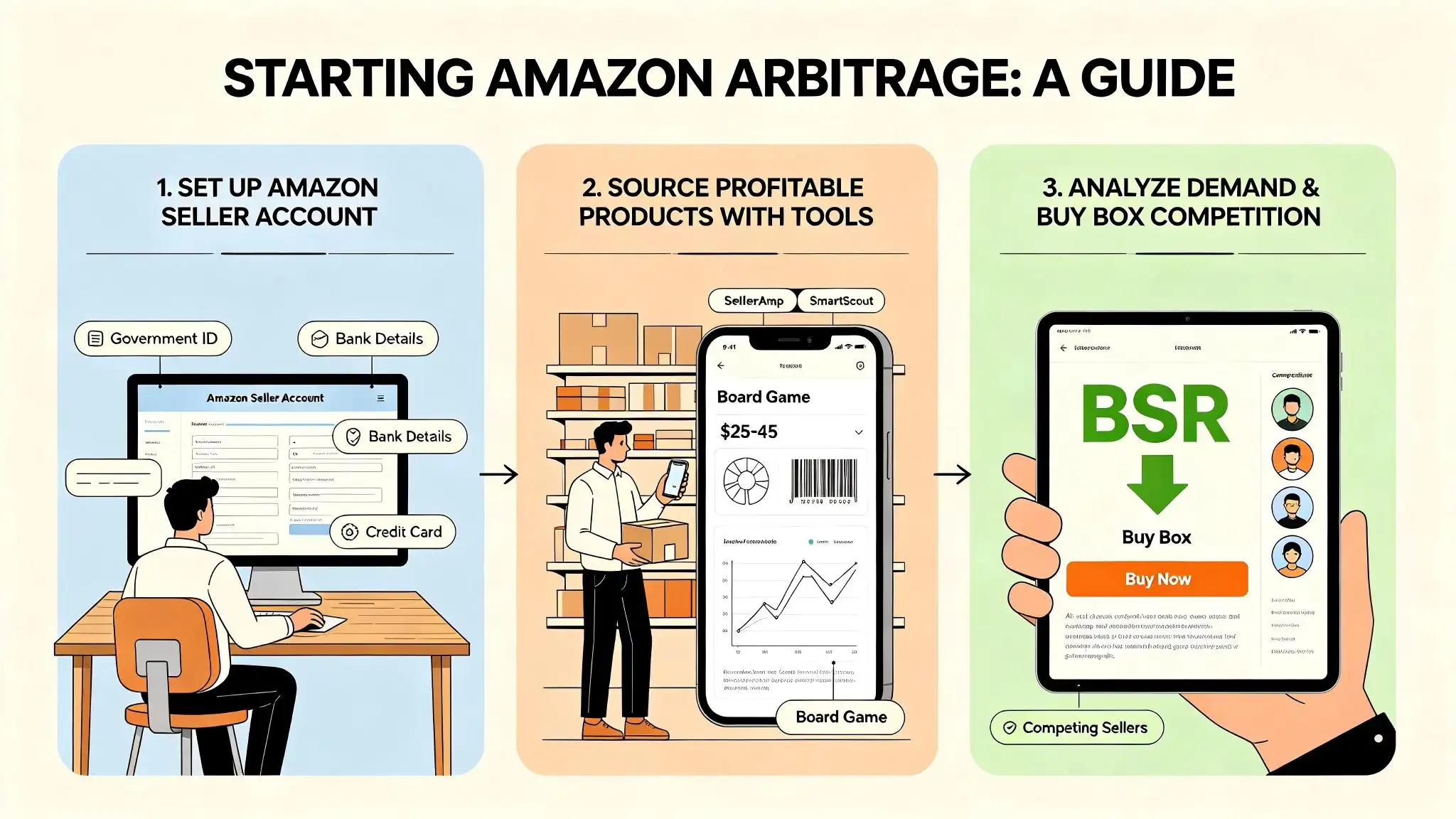
First, you need to go to the Amazon Seller Central website. You can choose between an Individual account or a Professional account. The Individual account is free to open, but charges you $0.99 for every single item you sell. The Professional account costs $39.99 a month, but it removes that per-item fee. If you plan to sell more than 40 items a month, the Professional account is much cheaper. You will need a valid government ID, a bank statement, a credit card, and sometimes a utility bill to finish your registration.
What tools can help you find profitable products?
You cannot guess your way to success; you need the right Amazon seller tools. Apps like SellerAmp are essential for retail arbitrage. You can use SellerAmp on your phone to scan barcodes in retail stores and instantly see your potential profit. Keepa is another absolute must-have tool. Keepa shows you a detailed graph of a product's price history and sales rank over the past year. Finally, tools like SmartScout can help you analyze the market competition for specific brands online.
How to analyze product demand and competition
You must always check the BSR (Best Sellers Rank) of a product. A low BSR number means the item sells very fast. For example, a BSR of 5,000 in the Toys category is fantastic, but a BSR of 1,000,000 is terrible. You also need to look at the Buy Box on the Amazon product page. Make sure that other third-party sellers are actually winning the Buy Box. If Amazon itself is selling the item and never shares the Buy Box with anyone else, you should avoid buying that product.
Where to Source Products for Amazon Arbitrage
What are the best places for retail arbitrage?
Retail arbitrage involves driving to physical brick-and-mortar stores to hunt for deals. The best places for beginners are major big-box retailers like Walmart, Target, and Walgreens. You should always walk straight to the clearance aisles. Look for off-season items that are marked down. For example, buying discounted winter coats in March or pool toys in October can offer huge profit margins when you hold them in your garage until the right season arrives.
How can online arbitrage expand your sourcing options?
Online arbitrage lets you build your business entirely from your living room. You can source products from retail websites like Best Buy, Kohl's, or Home Depot. To increase your profit margins, you can use cashback websites like Rakuten and apply digital coupon codes at checkout. You can order these products online and have them shipped directly to your front door. Alternatively, you can ship them to a professional prep center that will handle the Amazon packaging for you.
What are the pros and cons of liquidation and wholesale sourcing?
Liquidation pallets offer massive volumes of overstock items at a steep 60% to 80% discount. The biggest pro is the incredibly cheap price. The con is that product quality is a major gamble; you might receive damaged or open-box items that cannot be sold as new. Wholesale sourcing involves buying brand-new products directly from authorized distributors in bulk. The pro is a safe, steady supply of inventory. The con is that wholesale margins are usually much lower, and you need a larger budget to meet minimum order quantities.
How to Calculate Profitability in Amazon Arbitrage
What fees should you account for when calculating ROI?
Calculating your Return on Investment (ROI) accurately is the secret to a healthy and safe business. You must count the buy cost of the goods first. Next, you must add the Amazon referral fee, which is usually 15% of the total sale price. Then, add the FBA fulfillment fee, which covers the cost of Amazon packing and shipping the item to the customer. Do not forget to include the inbound shipping costs for sending your heavy boxes to the Amazon warehouse via UPS.
How to use tools to estimate profit margins accurately
You should always use the free Amazon FBA Revenue Calculator or the SellerAmp app. You simply input your buy cost and the final selling price on Amazon. The software automatically subtracts all the correct Amazon fees for you based on the item's weight and size. It will show you your exact net profit. As a general rule for beginners, you should aim for at least $3 of net profit per item and a minimum 30% to 40% ROI to stay safe from sudden price drops.
Case Study: Calculating Real Profit Imagine you find a popular board game on clearance at Walmart for $20. You scan it with your app, and it currently sells for $45 on Amazon. You buy 10 units, spending $200. After deducting Amazon FBA fees, referral fees, and inbound shipping (about $12 in total fees per item), you make $13 in pure net profit per game. Your total net profit is $130. This equals a very strong 65% ROI. This is how small numbers add up to big money.
What are the hidden costs most beginners overlook?
Beginners often forget about the physical supplies needed to run the business. You have to buy cardboard shipping boxes, heavy-duty packing tape, thermal printers, and special labels. If you do retail arbitrage, you must consider the cost of gas and the wear and tear on your car. Furthermore, customer returns are a normal part of e-commerce. You must plan for a 3% to 5% return rate and treat those damaged or unsellable items as a standard business expense. Software subscriptions (like Keepa) also cost money every month.
What Are the Biggest Risks in Amazon Arbitrage?
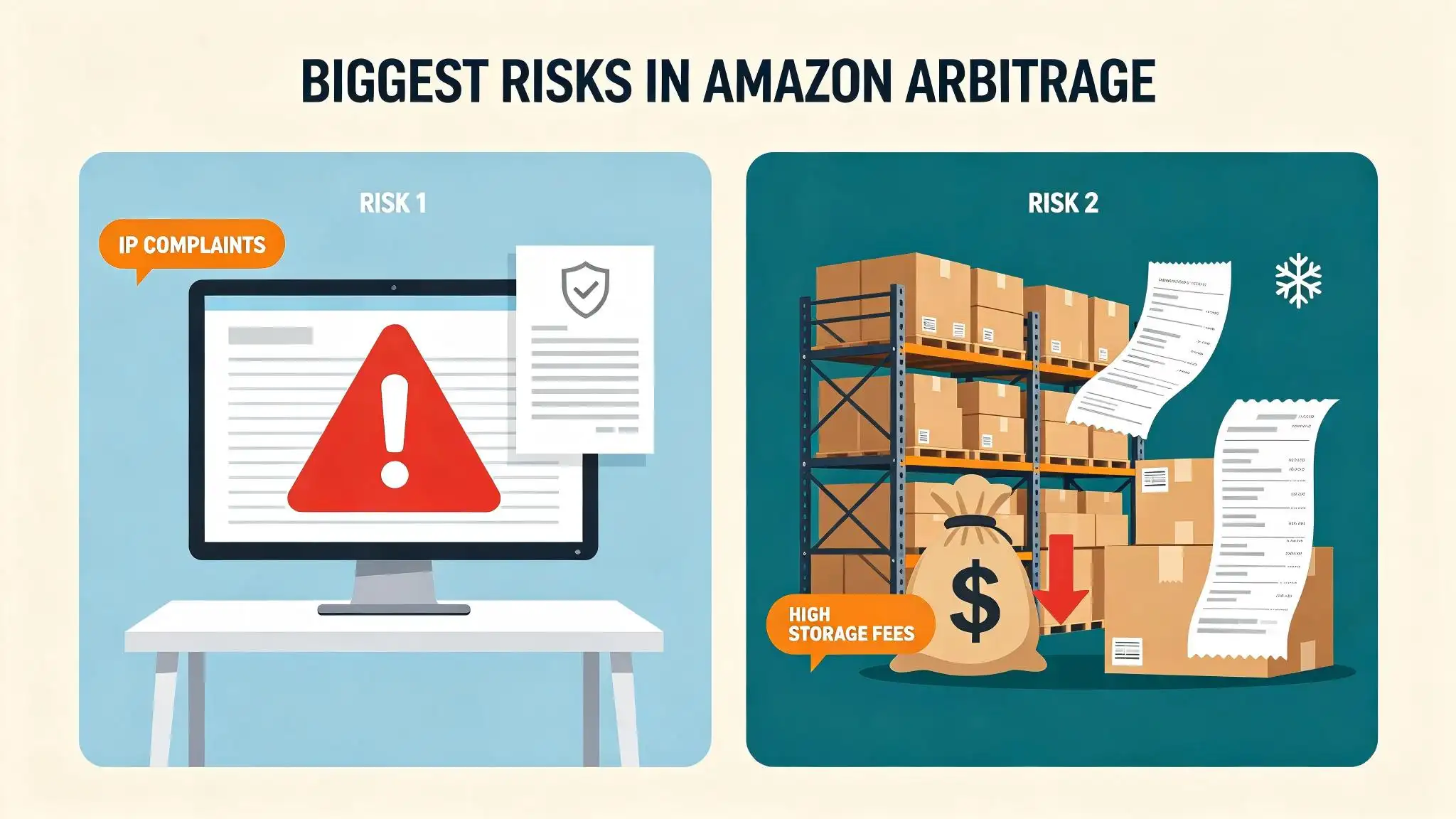
How can IP complaints and brand restrictions affect your account?
As mentioned earlier, some brands strictly prohibit third-party sellers from offering their products. If you list their items anyway, the brand will file an IP complaint. When this happens, Amazon will ask you to provide a commercial invoice directly from the manufacturer. A regular retail receipt from Target does not count as a valid invoice. If you cannot provide an invoice, Amazon will permanently ban your seller account. You can avoid this by using tools like SellerAmp, which automatically alert you if a brand is known to file IP complaints.
Why is inventory management critical to avoid losses?
Sending too much inventory to Amazon can destroy your cash flow completely. You have to pay monthly FBA storage fees based on the volume your items take up on the warehouse shelves. These storage fees go up significantly during the Q4 holiday season (October through December). If your items sit unsold for more than 181 days, Amazon will hit you with massive long-term storage fees. You must manage your stock carefully, track your numbers, and lower prices if necessary to clear out slow-moving inventory.
Tips for Scaling Your Amazon Arbitrage Business
How to reinvest profits to grow your inventory
The absolute fastest way to grow is through the power of compounding capital. When you make your first $500 in profit, do not spend it on a new television or a vacation. Reinvest every single dollar into buying more inventory. If you continuously roll your profits back into the business, your purchasing power will snowball rapidly. Many successful sellers refuse to pay themselves a personal salary for the first six to twelve months so their business can grow as fast as possible.
What strategies can help you automate sourcing and listing?
Once you have extra cash flow, you should stop packing boxes yourself. You can hire a third-party prep center located in a tax-free state to receive, prep, label, and ship your inventory to Amazon. You can also hire Virtual Assistants (VAs) overseas to do online arbitrage sourcing for you while you sleep. Additionally, using automated repricing software is crucial. Repricers adjust your prices 24/7 to help you win the Buy Box more often against other sellers without any manual effort.
How to identify opportunities in underserved niches
Most beginners rush to sell video games, electronics, or popular toys. These categories are highly competitive. To scale easily, look for regional discount chains that big sellers ignore. Underserved niches like specialty groceries, health supplements, pet supplies, and daily beauty items are fantastic. They might not be glamorous to sell, but they have steady, year-round demand. Plus, buyers purchase these consumable items over and over again, giving you reliable repeat sales every month.
How DICloak reduces account suspension risks
As your business grows, you might want to run multiple Amazon seller accounts to separate different niches or to spread out your risk. You can manage multiple Amazon seller accounts securely from a single computer. You can use DICloak to assign a unique digital fingerprint to each browser profile. You can also configure different types of proxies easily for each store. This keeps your accounts completely isolated from each other. As a result, you avoid detection and heavily reduce the risk of account bans.
Using RPA to analyze competitor pricing and reviews
To stay ahead of the competition, you need to collect vast amounts of market data from different marketplaces. You can use external AI tools to deeply analyze competitor prices, customer reviews, and market trends. However, scraping this data manually can get your IP address blocked by websites quickly. To prevent this, you can use DICloak's RPA (Robotic Process Automation) to safely gather data across the web. You can run these automated workflows in isolated environments without getting blocked. Then, you simply feed this clean data into your favorite external AI tools for smarter pricing strategies.
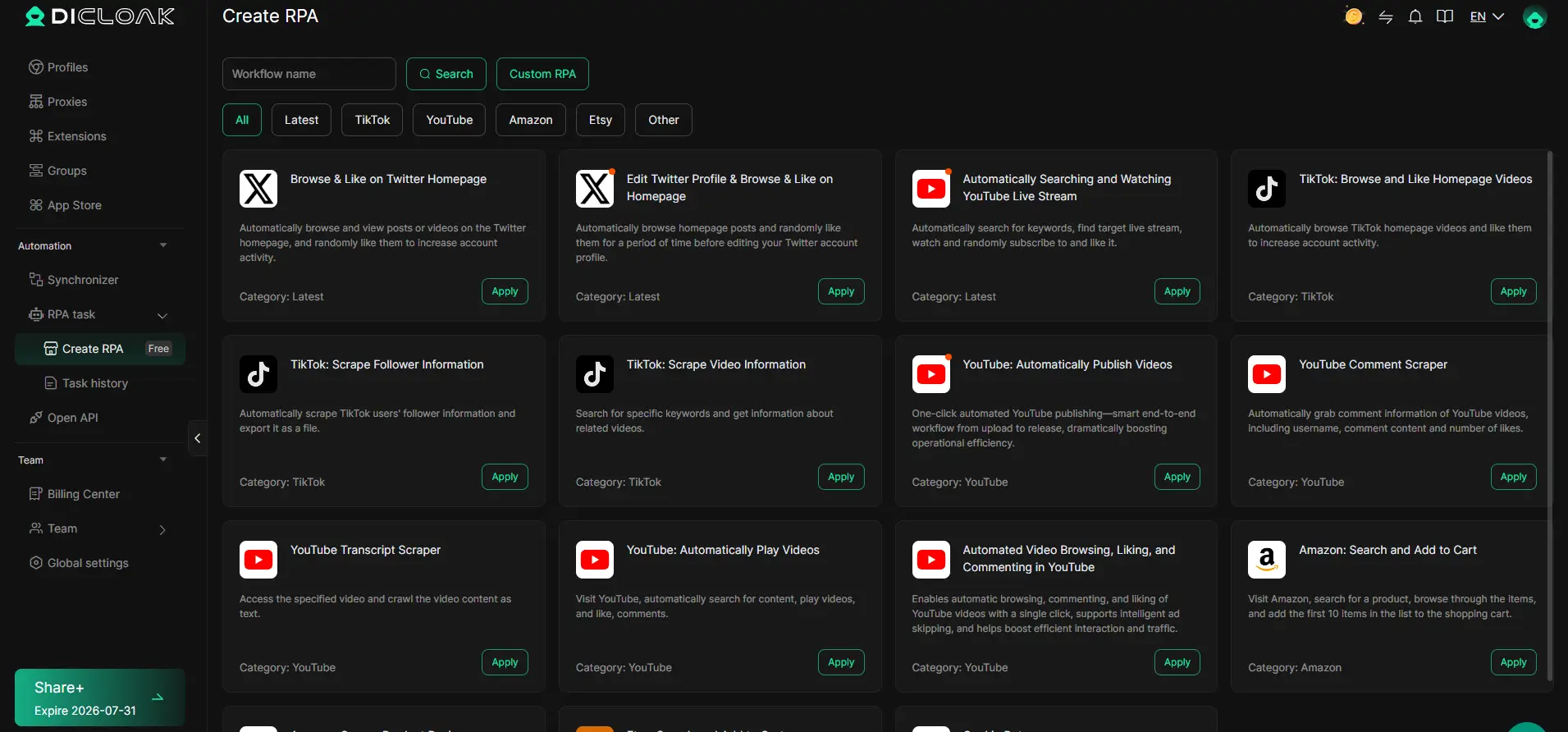
Managing multiple Amazon stores efficiently with DICloak
You can share access to your stores with your team easily. You can assign specific permissions to each team member in DICloak. You can protect your passwords and sensitive data because your team can log in securely. You can also track operation logs to ensure everyone works safely and efficiently.
Frequently Asked Questions About Amazon Arbitrage
Is Amazon arbitrage still profitable in 2026?
Yes, Amazon arbitrage is highly profitable in 2026. The key is strict product research. You must calculate all your Amazon FBA fees to ensure a good margin. With fewer new sellers entering the market and high buyer traffic, there are excellent opportunities.
How much money do I need to start Amazon arbitrage?
You can start retail arbitrage with as little as $500. This low startup cost is a major advantage. As you make sales, you can quickly reinvest your profits to buy more inventory and scale your e-commerce business.
Can I do Amazon arbitrage part-time?
Absolutely. Many people run a successful Amazon FBA business part-time. You can scan products in stores on weekends or do online arbitrage at night. Using the right sourcing tools helps you manage your time effectively.
What tools are essential for beginners in Amazon arbitrage?
Beginners need a sourcing app like SellerAmp and price history tools like Keepa. You also need the Amazon Seller app. If you plan to scale and manage multiple store profiles safely, an antidetect browser is essential.
How do I avoid getting banned from selling on Amazon?
To avoid getting banned, you must follow Amazon policies strictly. Do not sell restricted brands to avoid IP complaints. If you operate multiple accounts, you can use a secure antidetect browser to manage them safely without linking your data.
Conclusion
Amazon arbitrage remains a smart way to build a profitable e-commerce business in 2026. By finding discounted products, calculating your true costs, and managing your inventory, you can succeed. Start small, learn the tools, and grow your Amazon empire step by step.
 Web Proxy Tools
 Free Tools
 Cookie Plugin
 UA Generator
 MAC Address Generator
 IP Generator
 IP Address List
 2FA Code Generator
 World Clock
 Anonymous Check
 WebRTC Leak Test
 UUID Generator
 Free Web Proxy Site
 Proxy Checker
 FB Ad Checker
 AI Web Scraping
 Free SMM Tools
 Twitter Shadowban Checker
 Instagram Name Checker
 UTM Generator
 Username Generator
 AI Hashtag Generator
 LinkedIn Headline Generator
 Social Media Image Resizer