The Strategic Importance of Media Buying in 2026
The digital advertising ecosystem of 2026 is characterized by hyper-sophisticated detection algorithms and intense competition for audience attention. As platforms move toward AI-driven traffic management, the role of the media buyer has shifted from simple ad placement to a high-level technical discipline. A media buyer is a professional responsible for the strategic acquisition of advertising space and traffic, ensuring that marketing budgets are converted into measurable growth through rigorous data analysis.
Understanding what are media buyers in affiliate marketing is essential for any enterprise looking to scale. While media buyers traditionally operate within corporate structures, their role in the affiliate space involves managing large-scale campaigns where the technical infrastructure—specifically "Account Integrity"—is just as vital as the creative assets. In this landscape, the buyer's ability to maintain an isolated, high-reputation environment determines whether a campaign thrives or is terminated by platform security filters.
Defining the Role: What Are Media Buyers in Affiliate Marketing?
In the specialized field of digital growth, a media buyer acts as the primary architect of paid traffic. The core mechanism of this role is the systematic selection of platforms (social media, search engines, or video hosting) and the granular configuration of targeting parameters. By adjusting variables such as font enumeration preferences, geographic location, and behavioral interests, the buyer aligns the product with the highest-intent audience.
A professional media buyer operates through a methodology of constant optimization. Consider a corporate scenario where a buyer is tasked with reducing lead costs for a global brand. The mechanism of success involves the simultaneous testing of dozens of headlines and calls-to-action (CTAs). By monitoring real-time performance data, the buyer reallocates the budget toward the highest-performing combinations, effectively engineering a lower cost-per-acquisition while maintaining the brand's reach.

Media Buyer vs. Affiliate Marketer: Structural and Financial Differences
While the terms are often used interchangeably, their financial frameworks and risk profiles are distinct.
- Source of Funding: Media buyers typically manage a corporate or agency budget. They are stewards of company capital. Conversely, affiliate marketers (or arbitrageurs) utilize their own personal or team capital to purchase traffic, seeking a margin between the cost of the click and the affiliate payout.
- Risk Profiles: The media buyer benefits from "Risk Limitation." They usually receive a stable salary—ranging from $600 to $1,400 for entry-level roles—with performance bonuses. The affiliate marketer operates in a high-risk/high-reward environment where a single algorithm shift can result in significant personal financial loss.
- Operational Scope: Media buyers focus on long-term brand equity and sustainable lead flow within corporate guidelines. Affiliates are often more agile, testing volatile "funnels" to find short-term profitability.
Pro Tip: To achieve long-term career stability, many specialists are moving from solo affiliate work to structured media buying agencies, where they can leverage larger budgets and more robust security infrastructures.
Technical Infrastructure: Why Media Buyers Require Advanced Isolation
Modern advertising networks utilize "Browser Fingerprinting" to identify and link users across multiple accounts. This detection mechanism goes beyond simple cookies; it analyzes hardware-level identifiers including Canvas and WebGL hashes, WebRTC leaks, TCP/IP fingerprinting, and device-specific font lists.
For a media buyer, the mechanism of "Network Isolation" is mandatory. If a buyer attempts to manage 50 accounts from a single standard device, the platform will detect the identical hardware hashes across all 50 instances. This leads to "chain-bans," where the failure of one account triggers the immediate termination of the other 49 due to fingerprint leakage. Professional infrastructure requires each profile to have a unique digital signature and dedicated proxy management to ensure the platform perceives each account as a completely different physical device.
Comparing Account Management Strategies for Media Buyers
| Feature |
Standard Browsers (Chrome/Safari) |
DICloak Antidetect Technology |
| Account Capacity |
Limited; static hardware IDs lead to bans. |
1,000+ isolated accounts on one device. |
| Fingerprint Control |
Hardware-bound and leaked to platforms. |
customizable (Canvas, WebGL, WebRTC). |
| Proxy Support |
Manual and system-wide IP only. |
Custom proxy configuration (HTTP/HTTPS, SOCKS5) per profile. |
| Automation |
Entirely manual execution. |
Built-in RPA for repetitive workflow scaling. |
The Workflow of Scale: How Media Buyers Utilize RPA and Bulk Tools
Scaling a media buying operation from a single campaign to a global presence requires the elimination of manual "grind." Professional buyers use Robotic Process Automation (RPA) to manage the mechanism of "Account Warming." This involves automating natural user behaviors—such as scrolling through feeds, clicking "Like" on non-advertising content, and accumulating cookies—to build a "Resident" profile history that ad networks trust.
Using bulk operation tools, a media buyer can create, import, and launch hundreds of profiles with a single click. This allows for massive scaling without a proportional increase in hardware investment or personnel.
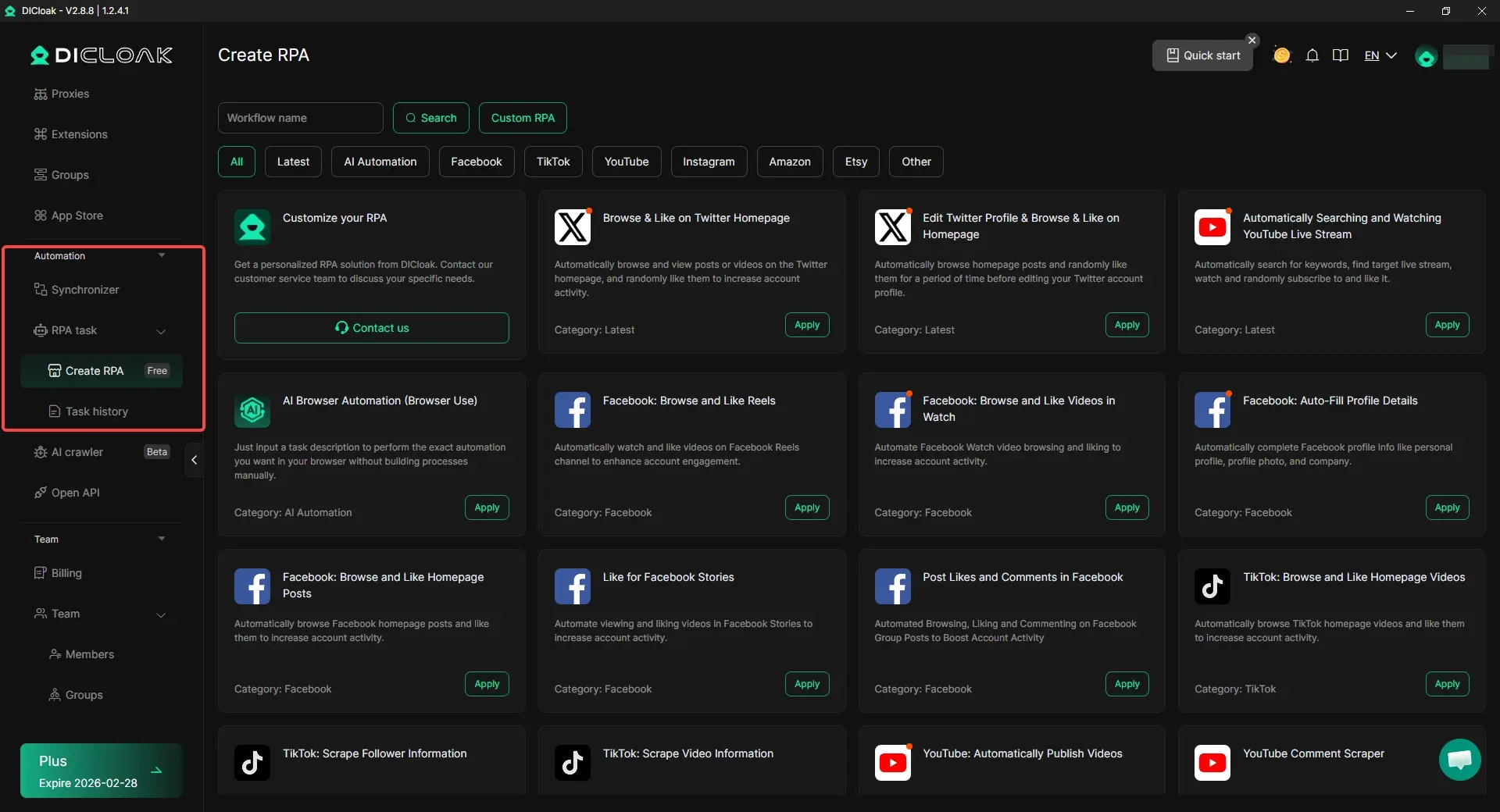
Pro Tip: Use the Synchronizer feature to perform actions across multiple profiles simultaneously. This helps that your account warming and initial campaign setups remain consistent across your entire fleet.
Team Collaboration and Permission Management for Media Buyers
In an agency environment, the mechanism of "Data Isolation" is critical for security. Senior media buyers must be able to delegate tasks to junior staff without compromising the master security of the operation.
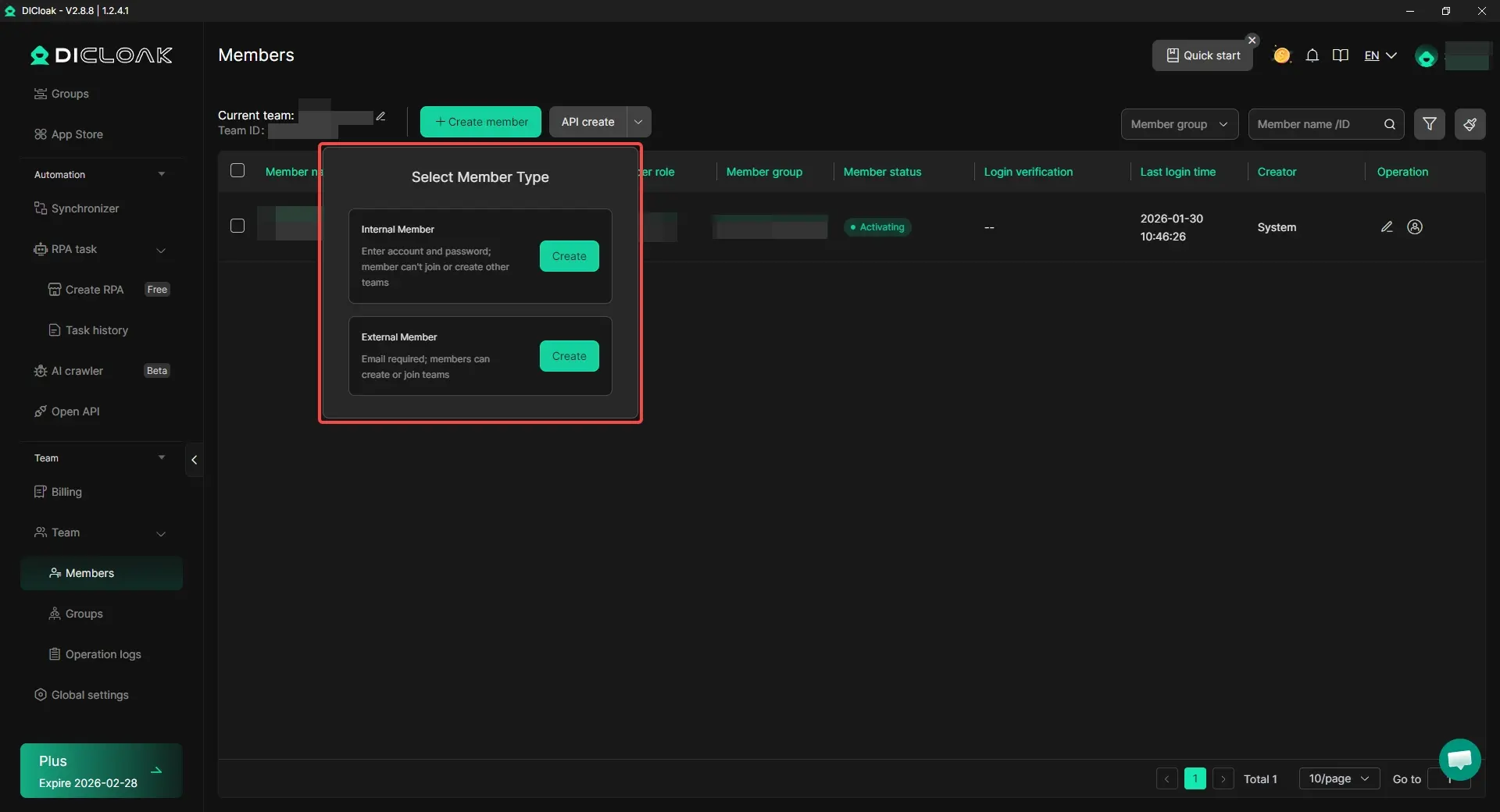
DICloak facilitates this through advanced permission settings and profile sharing. A lead buyer can "push" a specific browser profile to a junior buyer's workspace. The junior buyer can then operate the account and manage ads, but they never see the raw login credentials or passwords. This session-transfer mechanism ensures that even if a junior member's local machine is compromised, the master account remains secure. Additionally, detailed "Operation Logs" provide a audit trail of every change made to a campaign, keeping accountability across the team.
Evaluating the Tools: Pros and Cons of DICloak for Media Buying
As a cybersecurity analyst, I evaluate infrastructure based on its ability to mitigate detection risks while maintaining operational speed.
Pros:
- Comprehensive OS Simulation: Ability to emulate Windows, Mac, iOS, Android, and Linux, allowing buyers to match their browser profile to the target audience's typical hardware.
- Chrome-Core Compatibility: Ensures that all advertising dashboards and extensions function as they would in a standard browser.
- Bulk Scalability: Specifically designed to handle the management of 1,000+ accounts without performance degradation.
- Free Entry Tier: Allows new buyers to test the infrastructure before scaling their budget.
Cons:
- Limited Platform Support: Currently available only on Windows and macOS.
Essential Skillsets and Career Growth for Media Buyers
To advance from a newcomer to a senior analyst, a media buyer must develop a multidisciplinary skillset:
- Technical Analytics: Moving beyond basic ROI to understand how specific metrics (CTR, CPC, CPM) interact with platform algorithms.
- Behavioral Psychology: The ability to craft headlines and creatives that resonate with the target demographic's pain points.
- Platform Mastery: Staying ahead of the evolving rules of Google, Meta, and emerging networks.
- Strategic Risk Management: Balancing aggressive scaling with the preservation of account health.
Entry-level salaries for those with the right educational core typically sit between $600 and $1,400. However, the true "Salary Mechanism" for senior experts is profit-sharing, where compensation is tied directly to the efficiency and volume of the traffic they manage.
FAQ: Common Questions Regarding Media Buyers and Account Safety
Is media buying the same as traffic arbitrage?
No. While the technical execution is similar, the difference lies in the funding mechanism. Media buyers use corporate capital to promote a specific brand's products. Arbitrageurs (affiliates) use their own money to buy traffic and "flip" it for a profit through affiliate offers.
Can I use generic proxies for media buying?
For media buying, relying on generic or heavily shared proxies can increase risk. Professional setups usually involve managing dedicated residential or mobile proxies per account to maintain better consistency and lower exposure to reputation-related issues.
How many accounts can a single media buyer manage efficiently?
In a manual environment, 5 to 10 accounts is the limit. However, by utilizing RPA for warming and bulk management tools, a single buyer can manage hundreds or even 1,000+ accounts, as the "grind" of repetitive tasks is handled by the software.
What are the risks of account banning in 2026?
The primary risk is the "Detection Mechanism" of ad networks, which now uses AI to identify hardware inconsistencies. If your Canvas or WebGL hashes don't match your reported OS, or if your WebRTC leaks your true IP, the account will be banned. Using isolated, customizable browser profiles is the only way to mitigate these modern fingerprinting risks.
 Web Proxy Tools
 Free Tools
 Cookie Plugin
 UA Generator
 MAC Address Generator
 IP Generator
 IP Address List
 2FA Code Generator
 World Clock
 Anonymous Check
 WebRTC Leak Test
 UUID Generator
 Free Web Proxy Site
 Proxy Checker
 FB Ad Checker
 AI Web Scraping
 Free SMM Tools
 Twitter Shadowban Checker
 Instagram Name Checker
 UTM Generator
 Username Generator
 AI Hashtag Generator
 LinkedIn Headline Generator
 Social Media Image Resizer