An Internet Protocol (IP) address is a fundamental component of your online presence, acting much like a "digital home address" for your device. It's the unique identifier that allows information to be sent and received correctly across the vast network of the internet. This guide will explain precisely what “what is an IP address” is, what it reveals about you, the security risks associated with it, and how you can effectively protect your online privacy in an increasingly complex digital world.
So, What Is an IP Address Exactly?
Understanding the fundamental definition of “what is an IP address” is the first step toward managing your digital footprint and bolstering your online security. At its core, it is the bedrock of all internet communication, ensuring data gets where it needs to go.
An IP address is a unique numerical label assigned to every device connected to a computer network that uses the Internet Protocol for communication. "IP" stands for "Internet Protocol," which is the set of rules that governs how data is sent between devices. This address serves two primary functions:
- Identification: It identifies a specific device on a network, whether it's your personal laptop, smartphone, or a massive web server.
- Location: It provides the location of that device, enabling other systems to find it and exchange data with it.
This system works much like a postal address. Just as a physical address ensures a letter reaches the correct house, an IP address ensures that the data you request from a website finds its way back to your specific device.
Most IP addresses you see today are in the IPv4 format, which appears as a string of four numbers separated by periods. An example would be 192.158.1.38, where each number in the set can range from 0 to 255.
Knowing the definition is a great start, but understanding how “what is an IP address” works is even more important for appreciating its crucial role in all internet communication.
How Do IP Addresses Work? Understanding the Digital Mail System
Understanding the mechanics of your IP address demystifies internet communication and highlights key points where your data is exposed. The entire system is a highly efficient, step-by-step process that directs traffic across the globe in milliseconds. So, what is an IP address? It's the key to this entire process, ensuring that your device can communicate with others on the internet.
Here is a breakdown of how IP addresses work to connect you to the internet:
- Assignment: Your journey begins when you connect to a network. Your Internet Service Provider (ISP)—the company that provides your internet connection—assigns a public IP address to your network router. This serves as the primary "return address" for all your online activities.
- Request: When you want to visit a website, your device sends out a request. This data is broken down into smaller, manageable units called packets before being sent across the internet.
- Addressing: Each of these packets is labeled with critical information, including both the source IP address (your network's public IP) and the destination IP address (the unique address of the website's server you are trying to reach).
- Routing: This is where magic happens. Routers and switches all across the internet act like digital mail carriers. They read the destination IP address on each packet and forward it along the most efficient path toward the intended server.
- Response: Once your request packets arrive, the destination server reads them and sends the requested information (such as the website's content) back to your public IP address. These response packets travel back through the internet's network of routers, which use your public IP as the return address to deliver the data directly to your device.
It's important to remember that not all IP addresses are created equal. Different types serve different functions within this complex digital mail system. This is why what is an IP address plays such a crucial role in everything from device identification to ensuring data reaches its proper destination.
What is an IP Address: Exploring the Different Types
The general term "IP address" actually covers several distinct categories, each with a specific purpose. Understanding these different types is essential for grasping key network security and online privacy concepts, as they determine how your devices are seen both inside your private network and on the public internet. So, what is an IP address? It is the unique identifier that allows devices to communicate over the internet or within a local network.
Public vs. Private IP Addresses
The most fundamental distinction is between public and private IP addresses, which work together to connect your devices to the internet.
- Public IP Address: This is the primary address assigned to your network router by your ISP. It is your network's face to the outside world, visible to the entire internet. Think of it as the main street address for an entire apartment building. Any external device trying to communicate with your network will use this public address.
- Private IP Address: This is an internal address that your router assigns to each individual device within your local network (e.g., laptops, smartphones, smart TVs, printers). Following the apartment building analogy, a private IP is like a specific apartment number. These addresses are not visible on the wider internet and are used to allow devices on the same local network to communicate directly with each other and with the router.
Dynamic vs. Static IP Addresses
Public IP addresses can be further categorized as either dynamic or static, based on how permanently they are assigned.
- Dynamic IP Address: This is a temporary IP address that changes periodically. ISPs assign dynamic addresses to the vast majority of consumer accounts because it is a more cost-effective and efficient way to manage their pool of available IP addresses. When you restart your router, your ISP may assign you a new dynamic IP from its available pool.
- Static IP Address: This is a fixed IP address that does not change. Businesses or individuals who host their own websites or servers often require a static IP to ensure that other users can reliably connect to them. While stable, a static IP can make a user easier to track online since their address remains constant.
Just as the types of IP addresses differ, the underlying technology that governs them has also evolved significantly over time to meet the demands of a growing internet.
What is an IP Address: The Evolution from IPv4 to IPv6
The explosive growth of internet-connected devices—from computers and smartphones to smart appliances and IoT sensors—created a massive demand for unique addresses. This necessitated an evolution from the original IP standard, IPv4, to a newer, more expansive version, IPv6.
The following table compares the two protocols:
| Feature |
IPv4 (Internet Protocol Version 4) |
IPv6 (Internet Protocol Version 6) |
| Structure |
32-bit address, written as four numbers separated by periods (e.g., 192.158.1.38). |
128-bit address, written as eight groups of hexadecimal digits separated by colons. |
| Address Pool |
Provides approximately 4.3 billion unique addresses. |
Provides approximately 340 undecillion (trillion trillion trillion) unique addresses. |
| Reason for Change |
The pool of available addresses was nearing exhaustion due to the rapid increase in internet-connected devices. |
Developed to solve the address shortage of IPv4 and support the continued growth of the internet. |
| Potential Benefits |
The original standard that built the internet. |
More efficient data routing, potentially faster and more secure connections. |
Regardless of the version, every public IP address you use reveals certain information about you to the websites and services you interact with.
What Information Does Your IP Address Reveal About You?
While an IP address is essential for using the internet, it also acts as a digital breadcrumb that can expose personal information. This makes understanding its privacy implications a critical topic for any internet user. So, what is an IP address? It’s not just a string of numbers, but a unique identifier that can reveal a lot about you.
Here is what can be deduced from your public IP address:
- Geographical Location: Your IP address can be used to determine your general physical location. It won't pinpoint your exact home, but it can accurately reveal your city, region, and ZIP code.
- Internet Service Provider (ISP): Since your ISP assigns your public IP address, it is directly linked to them. Anyone with your IP can easily identify which company provides your internet service.
- Online Activities: Every time you visit a website, play an online game, or use an online service, that platform logs your IP address. Over time, websites, advertisers, and other third parties can use this log to track your browsing habits, stitch together your activities across different sites, and build a profile of your personal interests.
This exposure of information is not just a passive privacy concern; it can lead to tangible and serious security risks.
Common Security Threats: Why You Should Care About What Your IP Address Is
Understanding the potential threats associated with IP address exposure transforms privacy from an abstract concept into a concrete security necessity. In the wrong hands, your IP address can be used as a starting point for a variety of malicious activities.
Here are some of the most common security threats related to someone knowing your IP address:
- Online Stalking: Malicious actors can use your IP address to track your activity across different platforms, such as forums, social media, and gaming servers. By correlating this activity, they can build a detailed profile of your habits and find your general location, which can lead to harassment or more personal threats.
- Direct Network Attacks: A cybercriminal can use your IP address to launch direct attacks against your network. The most common is a Distributed Denial of Service (DDoS) attack, where they flood your network with an overwhelming amount of traffic. This can slow your connection to a crawl or shut down your internet access completely.
- Hacking into Your Devices: Hackers can use your IP address to scan your network for open ports and other vulnerabilities. If they find a weakness, they can exploit it to gain unauthorized access to your devices, potentially stealing sensitive data, installing malware, or taking control of your system.
- Framing for Illegal Activity: In a more sinister scenario, a criminal can use your IP address to mask their own identity while downloading illegal content or engaging in other illicit activities. If law enforcement traces this activity, it could lead back to you, potentially implicating you in a crime you did not commit.
Given these very real risks, it is only logical to explore effective methods for protecting your IP address from unwanted exposure.
Basic Ways to Protect Your IP Address
There are several common methods available for masking or hiding your IP address, each with its own trade-offs in terms of security, performance, and reliability. These tools work by routing your internet traffic through an intermediary server, so websites see the intermediary's IP address instead of yours.
Using a Proxy Server
A proxy server acts as a middleman between your device and the internet. When you send a request, it goes to the proxy server first, which then forwards it to the destination website. The website sends its response back to the proxy, which in turn forwards it to you.
- How it works: Websites you visit see the proxy server's IP address, effectively hiding your own.
- Key Risks: The level of security depends heavily on the proxy provider. Some unreliable services may track and log your online activities themselves or even insert advertisements into your browser.
Using the Tor Browser
Tor (The Onion Router) is a browser designed for a high degree of anonymity. It hides your IP address by routing your traffic through a series of volunteer-run, encrypted servers called nodes.
- How it works: Your data is wrapped in multiple layers of encryption, and each node in the path only knows the previous and next stop. This makes it extremely difficult to trace the traffic back to its original source.
- Primary Downside: This heavy, multi-layered encryption comes at a cost. Using Tor often results in a significantly slower internet connection compared to a standard browser or other privacy tools.
But is simply hiding your IP address enough to ensure true online privacy in the modern era? The answer, increasingly, is no.
Beyond IP Masking: What is a Full Digital Fingerprint?
While basic IP masking tools like proxies and Tor were once sufficient, they are now critically outdated. Modern websites don't just see your IP address; they analyze your entire "digital fingerprint." This means that even with a hidden IP, you are still exposed and trackable. Understanding this shift is no longer optional—it's essential for anyone serious about online privacy.
Sophisticated websites use a technique called browser fingerprinting. This method collects a wide array of information about your device and browser configuration to create a unique identifier that can be used to track you even if your IP address is hidden or changes.
Some of the unique data points that contribute to your digital fingerprint include:
- Cookies
- Geo-location data
- WebGL and WebGPU parameters
- Canvas fingerprinting
- Device and software information (e.g., operating system, browser version, screen resolution, installed fonts)
These elements, when combined, create a fingerprint so unique that it can distinguish you from millions of other users. As a result, tracking systems can link your accounts and activities across different sessions, rendering basic IP-hiding methods insufficient for achieving true anonymity.
A truly comprehensive privacy solution must therefore address the entire digital fingerprint, not just the IP address.
The Ultimate Solution: DICloak Antidetect Browser
Trusted by over 6,800 teams in more than 135 countries, DICloak Antidetect Browser is an advanced solution designed to address the limitations of basic IP-hiding methods. It moves beyond simple IP masking by giving you complete control over your entire digital fingerprint, providing a robust defense against modern, sophisticated tracking techniques.
How DICloak Creates a Unique Digital Identity
Instead of just hiding one aspect of your online identity, DICloak builds a completely new and unique one for every account you manage. It works by generating a distinct digital identity for each browser profile you create. It spoofs not just your IP address but all the key fingerprinting elements previously mentioned—including cookies, geo-location, WebGL, WebGPU, and canvas data.
This brings us back to “what is an IP address”. While an IP address is critical for identifying your device online, DICloak goes further by hiding it and protecting other key data points, creating a unique digital identity for every account.
The outcome is powerful: each of your accounts appears to websites as a completely separate, unique user accessing the internet from a different device and location. This prevents platforms from linking your activities, drastically reducing the risk of account detection and bans.
Real-World Privacy in Action: DICloak Use Cases
DICloak provides tangible benefits across a range of professional applications where managing multiple accounts securely is critical.
- E-Commerce: Seamlessly manage multiple seller accounts and stores on platforms like Amazon, eBay, Lazada, Shopee, and Shopify without being linked or flagged.
- Social Media Marketing: Securely and efficiently manage numerous client or business accounts on all major social media platforms.
- Affiliate Marketing: Easily manage and launch advertising campaigns across dozens of different accounts without fear of detection.
- Web Scraping: Enable anonymous and effective data scraping by masking your true identity and avoiding blocks from target websites.
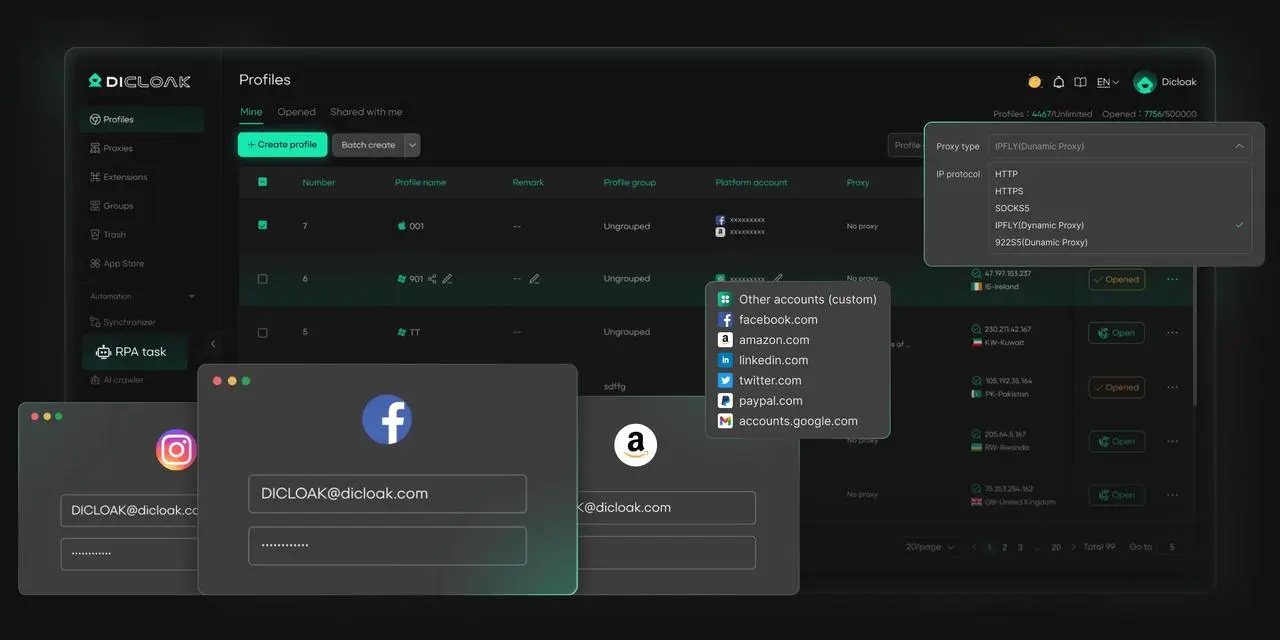
What Makes DICloak Stand Out?
✅ Manage 1,000+ Accounts on One Device:
Stop wasting money on extra hardware! DICloak allows you to manage multiple accounts on a single device, cutting costs and boosting efficiency.
✅ Guaranteed Account Safety, No Ban Risks:
Every account gets its own isolated browser profile with custom fingerprints and IPs, drastically reducing the risk of bans. Your accounts, your control!
✅ Flexible Proxy Configuration for Maximum Performance:
Seamlessly integrate with all major proxy protocols (HTTP/HTTPS, SOCKS5) and manage your proxy pool with bulk operations. No more struggling with IP management—DICloak has you covered.
✅ Streamlined Team Collaboration for Better Results:
Easily manage your team with advanced tools like profile sharing, permission settings, data isolation, and operation logs. Your team works smarter, not harder.
✅ Automate the Grind with RPA:
DICloak's built-in RPA saves you hours of manual work. Automate repetitive tasks, streamline workflows, and focus on what really matters—growing your business.
✅ Powerful Bulk Tools to Scale Your Operations:
Create, import, and launch multiple browser profiles in one click. DICloak makes scaling your business as easy as it gets.
✅ Compatible with All Major Operating Systems:
Based on the Chrome core, DICloak supports simulating Windows, Mac, iOS, Android, and Linux operating systems. No matter what platform you need, DICloak has you covered.
🔗 Ready to Get Started?
Visit the DICloak website to explore more details and choose the plan that’s right for you. Start for free today and experience the power of secure, efficient, and scalable multi-account management!
Conclusion: Take Control of Your Digital Identity
Your IP address is a fundamental component of your digital identity, necessary for navigating the online world but also a source of significant privacy risks. We've explored how it works, the information it reveals, and the threats it can expose you to. So, what is an IP address? It's the key identifier that allows you to connect to the internet, but it also exposes you to tracking and potential security threats.
While basic protection methods like proxy servers and the Tor browser can hide your IP, they are no longer sufficient to counter sophisticated tracking techniques that analyze your entire digital fingerprint.
For true online privacy and secure multi-account management, a comprehensive tool is required. The DICloak Antidetect Browser provides the ultimate solution by allowing you to control not just your IP address but every element of your digital fingerprint. It empowers you to operate multiple accounts as unique, separate users, safeguarding your activities from detection.
Stop leaving your privacy to chance. True anonymity requires controlling your entire digital fingerprint. Download the DICloak Antidetect Browser today and take definitive control of your digital identity.
Frequently Asked Questions (FAQ)
Can my IP address reveal my exact home address?
No. While an IP address can be used to approximate your physical location, it typically only pinpoints your city, region, or neighborhood. It does not reveal your specific street address.
Is it illegal to hide my IP address?
No. In most countries, it is perfectly legal to hide your IP address using private tools. However, using these tools to conduct illegal activities is still against the law.
Does using my browser's Incognito Mode hide my IP address?
No. Incognito Mode only prevents your browser from saving your browsing history and cookies on your local device. It does not hide your IP address from your ISP, websites you visit, or any other third parties.
Will my IP address always stay the same?
Not usually. Most Internet Service Providers (ISPs) assign dynamic IP addresses to consumers, which are temporary and can change periodically, such as when you restart your router. Only static IP addresses, which are often used by businesses, remain fixed.
How is an antidetect browser different from just hiding my IP?
Basic privacy tools like proxy servers and the Tor browser focus only on masking your IP address. What is an IP address? It’s the key identifier used in digital communication, but just masking this one element is no longer enough. An antidetect browser provides a far more comprehensive solution. DICloak spoofs your entire digital fingerprint—including your browser type, operating system, canvas data, and other technical parameters—preventing websites from identifying you through these advanced tracking methods.
 Web Proxy Tools
 Free Tools
 Cookie Plugin
 UA Generator
 MAC Address Generator
 IP Generator
 IP Address List
 2FA Code Generator
 World Clock
 Anonymous Check
 WebRTC Leak Test
 UUID Generator
 Free Web Proxy Site
 Proxy Checker
 FB Ad Checker
 AI Web Scraping
 Free SMM Tools
 Twitter Shadowban Checker
 Instagram Name Checker
 UTM Generator
 Username Generator
 AI Hashtag Generator
 LinkedIn Headline Generator
 Social Media Image Resizer