- ResourcesOnline Tools



EN

You’ve just been locked out of Facebook, your ad account is disabled, and a single question pops into your head: “Did I get a Facebook IP ban?” While this worry is common among marketers and business owners, the truth is that an IP ban is rarely the real reason behind your block.
Facebook’s security system is far more advanced than simply restricting an IP address—which can be changed in seconds. The real enforcement tool keeping you locked out is something called device fingerprinting. This method tracks your computer’s unique signature, created from components like your graphics card, screen resolution, installed fonts, and many other parameters. Understanding this distinction between a Facebook IP Ban and device fingerprinting is crucial for protecting your business and regaining access to your account.
Facebook’s systems are constantly monitoring for suspicious behavior to enforce its Community Standards. If your account has been suspended or restricted, it’s usually due to one of these common reasons:
Understanding these behaviors can help you avoid a Facebook IP Ban and keep your account in good standing.
If you’re worried about a Facebook IP Ban, it’s important to know that the IP address is rarely the real culprit. The key problem lies in device fingerprinting. While a Facebook IP ban is usually easy to bypass, a device ban is much more powerful and is what actually prevents users from accessing their accounts.
| Characteristic | IP Ban | Device Ban |
|---|---|---|
| What Gets Banned | Your Internet Protocol (IP) address. | The unique digital signature of your device, including specific hardware (graphics card), software (browser plugins, fonts), screen resolution, how your browser renders images (Canvas), and more. |
| How to Bypass | Trivial. Reset your router, use a proxy, or switch to mobile data. | Extremely difficult. Requires specialized tools to mask your device's unique fingerprint. |
| Facebook's Primary Use | Stopping large-scale, automated attacks like bot activity and mass spam operations. | Preventing individual users from returning after a permanent ban and linking multiple accounts to a single person. |
The "Whole House" Ban
Many users notice that when one person in a household is banned, others using the same Wi-Fi also face restrictions. This is almost never caused by a Facebook IP ban. Instead, it results from device fingerprint linking. When multiple family members log into separate accounts from the same computer, Facebook’s algorithm connects those accounts. If one account is flagged for a violation, the system may automatically impose restrictions on all other accounts linked to that device’s fingerprint.
Facebook’s Actual Detection Layers:
Layer 1 – IP Address: Quick bot filtering. Easily bypassed.
Layer 2 – Cookies/Browser Data: Tracking through stored data. Easily cleared.
Layer 3 – Device Fingerprinting: Hardware-level identification. Where most people get caught.
Layer 4 – Behavioral Analysis: Usage patterns, typing speed, mouse movements. Hard to detect but patterns emerge.
Layer 5 – Network Analysis: Connection patterns between accounts, interaction networks.
Most people only address Layer 1, maybe Layer 2. Layers 3-5? Don’t even know they exist.
This is why “does Facebook ban IP address” misses the entire point.
For professionals who depend on Facebook, an account ban is more than just an inconvenience—it can seriously harm or even end your business. The real danger usually isn’t the IP itself, but device fingerprint linking, though many still worry about a Facebook IP Ban.
Imagine running an e-commerce store where most of your revenue comes from Facebook ads. One day, your ad account is disabled for a vague policy violation. You try creating a new account from the same laptop, only to have it banned immediately. Your revenue stream is cut off—not because of your IP, but because Facebook recognized your device’s fingerprint and linked your new account to the previously banned one. Even worrying about a Facebook IP Ban won’t help in this case.
As a social media manager, you may handle multiple client accounts from the same computer. If one client’s account gets restricted, Facebook can link all the accounts accessed from that device. Suddenly, one client’s mistake threatens all of your clients and your business—even if no Facebook IP Ban has occurred.
Agencies managing dozens of client accounts from the same office face a similar problem. Facebook notices that multiple accounts are accessed from the same set of computers and flags them as “related ad accounts.” Restrictions follow, one by one, as device fingerprints are linked. Even if your office IP isn’t banned, a Facebook IP Ban isn’t the real issue—the linked devices are what put your campaigns and operations at risk.
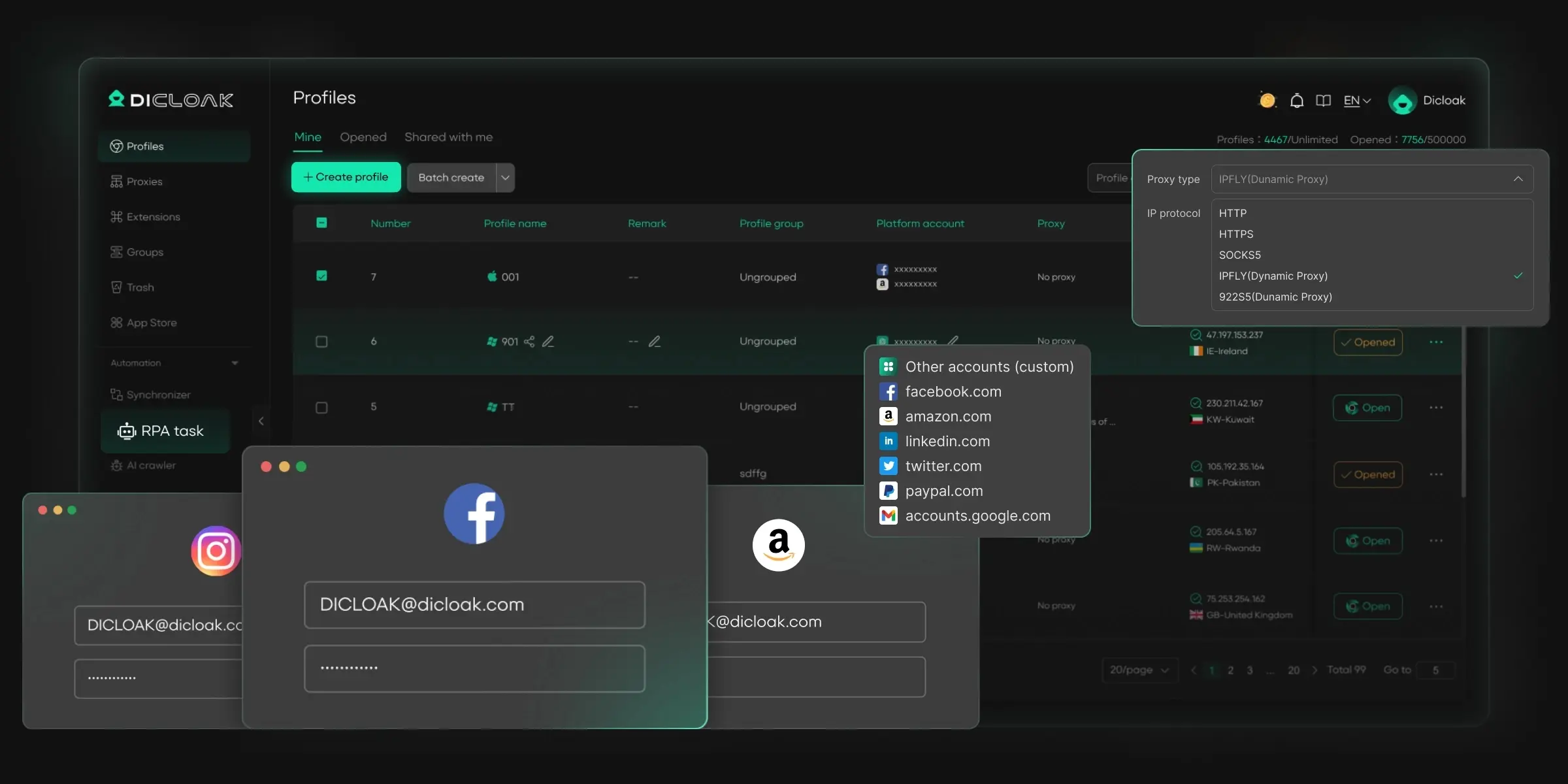
If clearing cookies and changing your IP address don't work, what does? The only effective solution is to make each of your Facebook accounts appear as if it's being accessed from a completely different and unique computer. This means each account needs its own isolated browser profile with a unique device fingerprint. This is exactly what antidetect browsers like DICloak are designed to do.
DICloak creates separate browser profiles, and each one spoofs a unique digital identity. To Facebook, one profile looks like a Windows laptop in New York, while another looks like a MacBook Pro in Chicago. This isolation prevents Facebook from linking your accounts together.
⚡The DICloak Antidetect Browser has become a global favorite for its unparalleled ability to efficiently and securely manage multiple accounts. Designed for professionals in social media management, and more, DICloak offers powerful features like RPA automation, bulk operations, and a synchronizer. Additionally, it allows you to customize fingerprints and integrate proxies for each profile, ensuring top-level security and operational efficiency. It’s the ultimate tool for seamless, secure, and scalable operations.
✅ Manage 1,000+ Accounts on One Device: Stop wasting money on extra hardware! DICloak allows you to manage multiple accounts on a single device, cutting costs and boosting efficiency.
✅ Guaranteed Account Safety, No Ban Risks: Every account gets its own isolated browser profile with custom fingerprints and IPs, drastically reducing the risk of bans. Your accounts, your control!
✅ Flexible Proxy Configuration for Maximum Performance: Seamlessly integrate with all major proxy protocols (HTTP/HTTPS, SOCKS5) and manage your proxy pool with bulk operations. No more struggling with IP management—DICloak has you covered.
✅ Streamlined Team Collaboration for Better Results: Easily manage your team with advanced tools like profile sharing, permission settings, data isolation, and operation logs. Your team works smarter, not harder.
✅ Automate the Grind with RPA: DICloak's built-in RPA saves you hours of manual work. Automate repetitive tasks, streamline workflows, and focus on what really matters—growing your business.
✅ Powerful Bulk Tools to Scale Your Operations: Create, import, and launch multiple browser profiles in one click. DICloak makes scaling your business as easy as it gets.
✅ Compatible with All Major Operating Systems: Based on the Chrome core, DICloak supports simulating Windows, Mac, iOS, Android, and Linux operating systems. No matter what platform you need, DICloak has you covered.
Visit the DICloak website to explore more details and choose the plan that’s right for you. Start for free today and experience the power of secure, efficient, and scalable multi-account management!
Frequently Asked Questions About Facebook IP Ban
Facebook can block an IP address, but permanent bans are extremely rare and largely ineffective because IPs can be changed quickly. Most users who think they are permanently banned are actually experiencing a device fingerprint ban. Facebook has flagged the device itself, so any login or new account creation from that computer will be blocked, regardless of the IP address used.
The easiest way to check is to try accessing Facebook from a completely different device and network. If you can log in from a friend’s phone or public Wi-Fi, your IP is not banned; the problem is with your device. Even if you change your home Wi-Fi, a true Facebook IP Ban is extremely rare. The definitive test is that if a new account cannot be created from your device—even with a different IP—the issue is a device fingerprint ban.
This happens because Facebook links accounts through a shared digital fingerprint. This includes device specifications, browser version, installed fonts, cookies, payment methods, and behavioral patterns. When one account is flagged, Facebook may review all connected accounts and issue a mass ban.
The most reliable method is to use an antidetect browser like DICloak. This allows you to create isolated browser profiles for each account, with each profile having a unique digital fingerprint and IP address. Facebook sees each profile as a completely separate device and person, preventing account linking, mass bans, and confusion over a Facebook IP Ban.
Many marketers worry about a Facebook IP Ban, but the real threat comes from device fingerprinting, not the IP itself. Changing your IP or clearing cookies won’t solve the problem—Facebook links accounts through device fingerprints, which can lead to bans across multiple accounts. Tools like DICloak provide isolated browser profiles with unique fingerprints, helping advertisers, agencies, and social media managers protect their accounts, secure client relationships, and grow their business on Facebook without constantly fearing a Facebook IP Ban.