What Are Temu Coupon Codes for Existing Users?
In the high-velocity e-commerce landscape of 2026, the distinction between "New User" and "Existing User" is a fundamental data segment within Temu’s retention algorithm. While new user acquisition involves high front-end costs, the platform utilizes incentives for established accounts to maximize Customer Lifetime Value (LTV). For the cybersecurity professional or digital growth expert, these codes are not merely discounts but technical triggers designed to reactivate dormant segments or reward high-frequency shoppers.
Existing user incentives are governed by strict industry-standard logic. These include "one per order" constraints, minimum spend thresholds, and item-specific eligibility. Unlike broad-spectrum marketing, these promotions are often targeted based on account history and geographic metadata, making them highly specific to the individual data profile.
Navigating the In-App Ecosystem for Native Rewards
The highest integrity data for promotional codes resides within Temu’s internal infrastructure. Before seeking third-party sources, users should audit the native environment.
- In-App Messages and Promotions: The primary distribution point is the "Messages" tab. Users should monitor the "Promotions" sub-section where account-specific "claim" triggers are deployed.
- Notification-Based Triggers: Time-sensitive codes are frequently pushed via Email and Push notifications. These are often tied to specific user behaviors—such as cart abandonment or milestone shopping dates—and possess rapid expiration timestamps.
- Operational Claiming: It is an industry practice for these codes to require a manual "Claim" action within the app interface before they are recognized as active by the checkout engine.
Analyzing the Role of Official Campaign Channels
Official social media streams (X, Instagram, TikTok) serve as verified data sources for broader campaigns. However, a critical verification step is required for any code sourced here. A user must input the code and confirm a visible price reduction in the checkout summary before initiating the "Place Order" transaction. This "Price Drop" verification is the only absolute proof of a code's validity within a specific account segment.
Evaluating Third-Party Platforms for Temu Coupon Codes for Existing Users
Third-party aggregators such as Slickdeals, Groupon, and CouponFollow serve as crowdsourced repositories for promotional data. While useful for identifying trending offers, these platforms vary in reliability.
Users must remain vigilant for "Red Flags" common to fraudulent directories. Indicators of malicious intent include requests for Temu account credentials, mandatory third-party software downloads, or pop-ups making unrealistic "90% off everything" claims.
The Risks of Fraudulent Coupon Directories and Data Harvesters
From a cybersecurity perspective, unofficial coupon sites often function as fronts for phishing or session hijacking. Malicious actors may use these sites to harvest browser cookies or personal data. Technically, if a code does not trigger an immediate "Price Drop" in the official Temu app, it should be discarded. Persistent attempts to use invalid third-party codes can occasionally trigger "unusual activity" flags on an account.
Technical Barriers: Why Your Temu Coupon Codes for Existing Users May Fail
Coupon rejection is a result of the platform's checkout logic detecting a mismatch in required conditions. Key failure points include:
- Expiration Timestamps: Precisely programmed end-dates based on UTC or local server time.
- Minimum Spend Logic: Spend thresholds are calculated on the net item total, frequently excluding shipping, insurance, and taxes.
- Methodological Constraints: Certain codes are restricted to specific shipping methods or checkout flows (e.g., standard vs. express shipping) and will fail if the user's selection does not match the promotion's parameters.
- Usage and Quantity Limits: Hard limits on the total number of global redemptions or a "one-per-account" restriction.
The Impact of Geographic and Network Metadata on Code Validity
Temu utilizes IP address and region-locking to restrict high-value codes to specific markets. If a user’s network metadata or shipping address is outside the intended geographic segment, the code will be rejected. Furthermore, "New-User Only" flags are embedded in account metadata, preventing existing users from accessing acquisition-tier discounts.
Systematic Troubleshooting for Temu Coupon Codes for Existing Users
When a code is rejected with an "Invalid" error, the following technical workflow should be implemented:
- Audit the Metadata: Re-examine the coupon details for minimum spend, category exclusions, and regional requirements.
- Verify Item Eligibility: Confirm that every item in the cart is eligible; a single excluded item can sometimes invalidate a category-specific code.
- De-stack Prohibited Promos: Ensure no other "stacked" codes are active, as Temu's engine typically prioritizes one code per order.
- Refresh Session Data: Close the application and clear the local cache or update to the latest version to ensure the checkout logic is synchronized with the server.
If a code continues to fail after these steps, it is likely targeted to a different user segment, restricted by region, or has reached its global limit. In these instances, continuing to force the code is inefficient; the recommended action is to pivot to a different promotional tier.
Risk Control: Protecting Account Integrity During Scale Operations
For professionals managing multiple e-commerce profiles, account association is the primary risk. Platforms use device fingerprinting to detect when a single user is operating multiple accounts. This goes beyond IP addresses—security systems track hardware identifiers such as IMEI, Android ID, and MAC addresses.
Simple browser clearing is insufficient against these persistent IDs. Maintaining account integrity requires "Network Isolation" and "Proxy Management." By creating isolated environments for each account, users prevent the cross-contamination that leads to account flagging and "Existing User" exclusions.
How DICloak Helps You Use Temu Coupon Codes More Safely
Optimizing the Environment for E-commerce Workflows
To achieve robust account isolation, infrastructure-level tools are required. DICloak provides a specialized environment for managing distinct digital fingerprints and network profiles.
Implementing Proxy Management and Network Isolation
DICloak allows users to assign dedicated proxy IPs to specific account profiles, ensuring that no two accounts share network metadata. This is vital for ad verification and testing how promotional interfaces appear to different geographic segments without triggering security blocks.
Multi-Account Management via Cloud Infrastructure and Fingerprint Control
Utilizing DICloak’s cloud-based Android emulators and phone farm capabilities allows for superior multi-account management. DICloak isolates critical hardware identifiers—including Canvas hashes, IMEI, and device IDs—for each profile. This "Cloud Android" approach is particularly effective because it bypasses mobile-only verification checks that often fail on standard desktop browsers. This technical isolation allows users to scale workflows while maintaining the appearance of unique, legitimate mobile devices.
Comparative Analysis: Standard Browsing vs. DICloak Environments
| Feature |
Standard Mobile App/Browser |
DICloak Infrastructure |
| Hardware Identifiers |
Leaks persistent IMEI/Android ID |
Isolated & Unique per Profile |
| IP Management |
Shared/Local (High Risk) |
Proxy Managed (Isolated) |
| Fingerprint Control |
Static/Revealed Canvas Hash |
Controlled/Modified Canvas Hash |
| Account Security |
High Risk of Association |
Risk Mitigated via Environment Isolation |
| Verification Capability |
Limited to Single Device |
Scalable Cloud Android Emulators |
When people search for Temu coupon codes for existing users, they are often trying to find more working offers across different accounts, promotions, or shopping workflows. In this kind of setup, managing accounts clearly becomes just as important as finding the code itself. That is where DICloak can be useful.
Built for multi-account management, DICloak lets users create separate browser profiles for different Temu accounts. Each profile can have its own cookies, fingerprint settings, proxy setup, and session data, which makes it easier to manage many accounts in one place without mixing browsing environments. For users who want to handle multiple Temu accounts, check more promotions, and organize coupon-related workflows more efficiently, this kind of setup can save time and reduce confusion.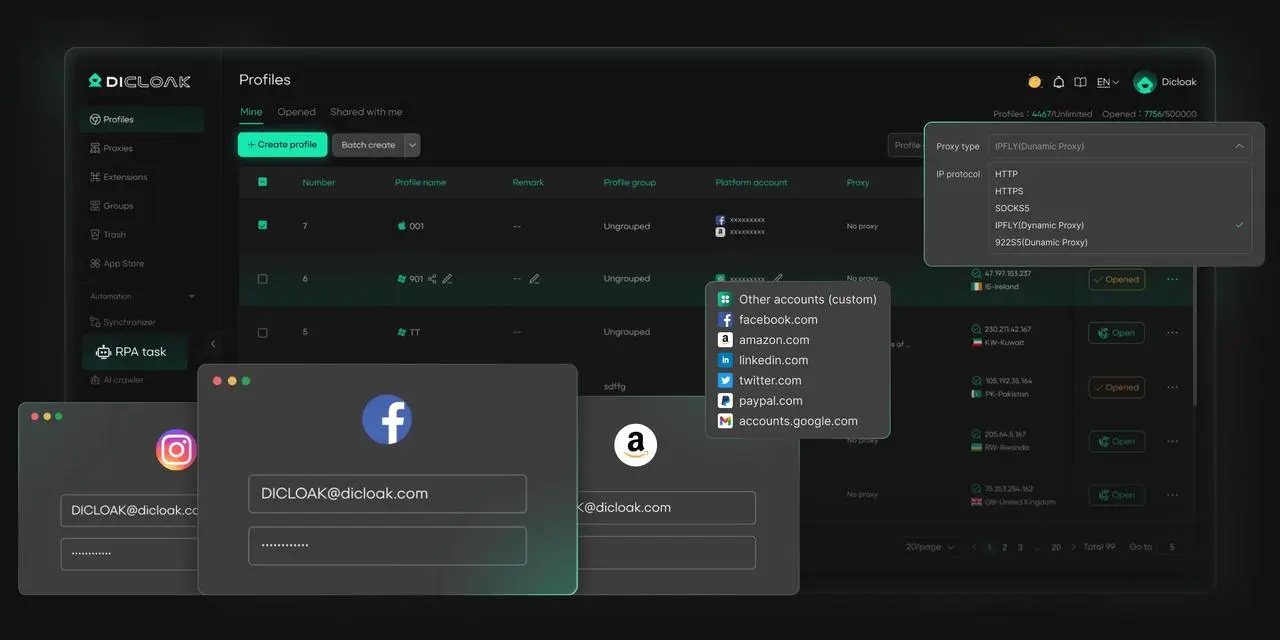
DICloak offers several advantages for Temu account management:
- Batch manage multiple Temu accounts: Create and run many browser profiles on one device, making it easier to handle more accounts and check more coupon code opportunities.
- Clear account separation: Keep each Temu account in its own isolated browser profile, with separate cookies, sessions, and fingerprint settings.
- Flexible proxy configuration: Assign a different proxy to each profile, which helps users manage different account environments more easily.
- Faster repeated work: With Multi-Window Synchronizer, users can repeat similar actions across multiple profiles more efficiently.
- Better team collaboration: Features like profile sharing, permission settings, operation logs, and website access restrictions help teams manage accounts in a more organized way.
- Easier scaling: Bulk profile creation and management tools make it easier to expand Temu account operations when needed.
FAQs About Temu Coupon Codes for Existing Users
Q1、Can you stack coupons on Temu?
Technically, Temu allows only one coupon code per order. However, there is a nuance: you can often combine a "sitewide discount" (automatically applied by the platform) with a "category-specific coupon code." You cannot, however, use two separate alphanumeric codes in a single transaction.
Q2、Are existing user codes real?
Yes. While "Welcome Offers" for new users are more prominently marketed, Temu relies heavily on retention coupons for existing users. These are distributed through the app's promotion tab and email newsletters to maintain high user engagement.
Q3、How can I access new user deals on an old account?
Accessing new user deals requires a new account. To do this without being flagged for "Account Association," you must use an isolated environment with unique hardware IDs and network proxies, such as those provided by DICloak. Note that the "code for code" approach found in some communities is generally ineffective for time-limited or highly targeted sales and is not recommended for professional workflows.
Conclusion
Finding Temu coupon codes for existing users is not just about trying random codes. It is about knowing where real offers appear, how Temu’s rules work, and why some codes fail. Users should always check official in-app promotions first, review the code terms carefully, and avoid unsafe third-party pages that may put account data at risk.
For users who manage more than one shopping workflow, browser setup also matters. A cleaner and more organized environment can help reduce session mix-ups and make account handling easier. Tools like DICloak can help by keeping profiles separate, supporting proxy setup, and making repeated tasks more stable. In the end, the best approach is simple: use trusted sources, understand the rules behind each offer, and keep your browsing environment safe and well organized.
 Web Proxy Tools
 Free Tools
 Cookie Plugin
 UA Generator
 MAC Address Generator
 IP Generator
 IP Address List
 2FA Code Generator
 World Clock
 Anonymous Check
 WebRTC Leak Test
 UUID Generator
 Free Web Proxy Site
 Proxy Checker
 FB Ad Checker
 AI Web Scraping
 Free SMM Tools
 Twitter Shadowban Checker
 Instagram Name Checker
 UTM Generator
 Username Generator
 AI Hashtag Generator
 LinkedIn Headline Generator
 Social Media Image Resizer