The music monetization ecosystem has evolved from a casual consumer activity into a structured professional domain for "curators," "reviewers," and "playlist architects." In this professionalized environment, generating a significant Return on Investment (ROI) requires moving beyond single-account usage toward high-volume engagement strategies. However, the primary challenge for the professional operator is not the monetization itself, but the maintenance of a stable, multi-account infrastructure.
From a cybersecurity perspective, platforms like Spotify employ highly sophisticated anti-fraud engines. These systems are designed to distinguish between genuine organic engagement and professionalized activity by monitoring telemetry for "bot-like" patterns. Sustaining a profitable operation requires a risk-aware approach where the focus shifts from simple interaction to the management of digital identities and the mitigation of profile interlinking.
The Technical Barrier: Why Platforms Detect Multi-Account Operations
Modern platforms utilize advanced browser fingerprinting to link disparate accounts to a single physical entity. This process involves the silent collection of hardware and software parameters that, when combined, form a highly accurate "handshake" or digital signature.
Consider a scenario where an operator attempts to manage five accounts from a single device using standard browsing methods. Even with different login credentials, the platform's security layer observes a collision of unique identifiers. Specifically, when multiple sessions present the same WebGL Unmasked Renderer string, Canvas 2D hash, and AudioContext sample rate simultaneously, the anti-fraud engine flags the activity. This typically results in a "403 Forbidden" error, an immediate security checkpoint, or a forced password reset across the entire cluster.
To scale safely, professionals must move away from standard browsers and implement "Network Isolation" and "Proxy Management." This ensures that each account session possesses a unique set of hardware identifiers and a distinct network origin.
Infrastructure Requirements to Get Paid to Listen to Music on Spotify Safely
High-volume growth—managing 100 to 1,000+ accounts—demands a specialized software stack designed to prevent "association." Association is the metadata-level interlinking of accounts that occurs when fingerprints overlap, leading to catastrophic "chain-bans" where the loss of one account results in the termination of the entire network.
A professional infrastructure must provide isolated environments that simulate diverse hardware. One key strategy involves Operating System (OS) simulation. Platforms often apply different detection thresholds for mobile versus desktop traffic; simulating an iOS or Android environment can help bypass desktop-specific browser fingerprinting challenges. By utilizing a centralized system to emulate these environments on a single physical machine, operators can significantly reduce the capital expenditure required for physical hardware.

Implementing Advanced Browser Fingerprint Isolation
The process of customizing browser fingerprints is a technical necessity for bypassing sophisticated graphical rendering tests.
Understanding Canvas and WebGL Fingerprinting Mechanisms
Canvas and WebGL fingerprinting force the browser to draw a hidden image or perform complex 3D rendering. The hardware’s GPU and the installed drivers handle anti-aliasing and sub-pixel rendering in a way that is unique to that specific hardware configuration. Because these tests reveal the underlying hardware signature, a senior analyst must ensure that each profile generates a unique, randomized graphical output to deceive the platform’s "device marking" protocols.
Isolating AudioContext for Seamless Profile Discrepancy
As an audio-centric application, Spotify likely maintains deeper hooks into the AudioContext API than standard websites. This API reveals the technical nuances of the device's audio processing stack. If multiple accounts share the same AudioContext signature, it serves as a high-priority risk factor for detection.
Tools like DICloak mitigate this by providing unique audio signatures per profile. By automating the isolation of these fingerprints across 1,000+ profiles on a single device, it keeps each account appears to be utilizing distinct audio hardware.
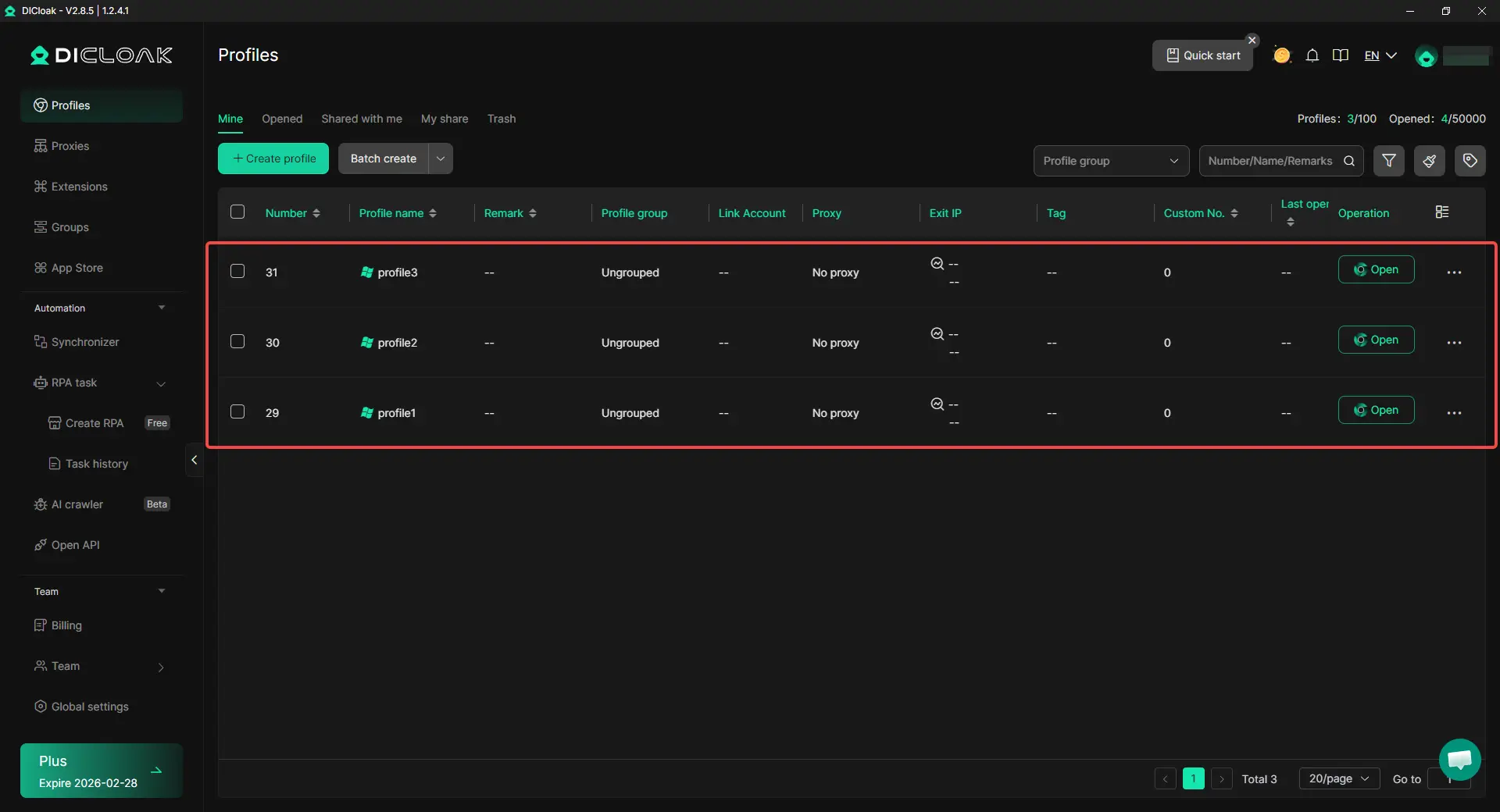
Streamlining Workflows with Synchronizer and Bulk Management
In professional operations, automation is not merely an efficiency tool; it is a risk management strategy used to reduce the human errors that lead to profile interlinking. A "Synchronizer" tool allows a lead operator to perform actions in a "master" window that are replicated across dozens of "sub-windows" in real-time. This is essential for maintaining large account clusters, allowing for simultaneous navigation and interaction without the manual labor of individual profile management.
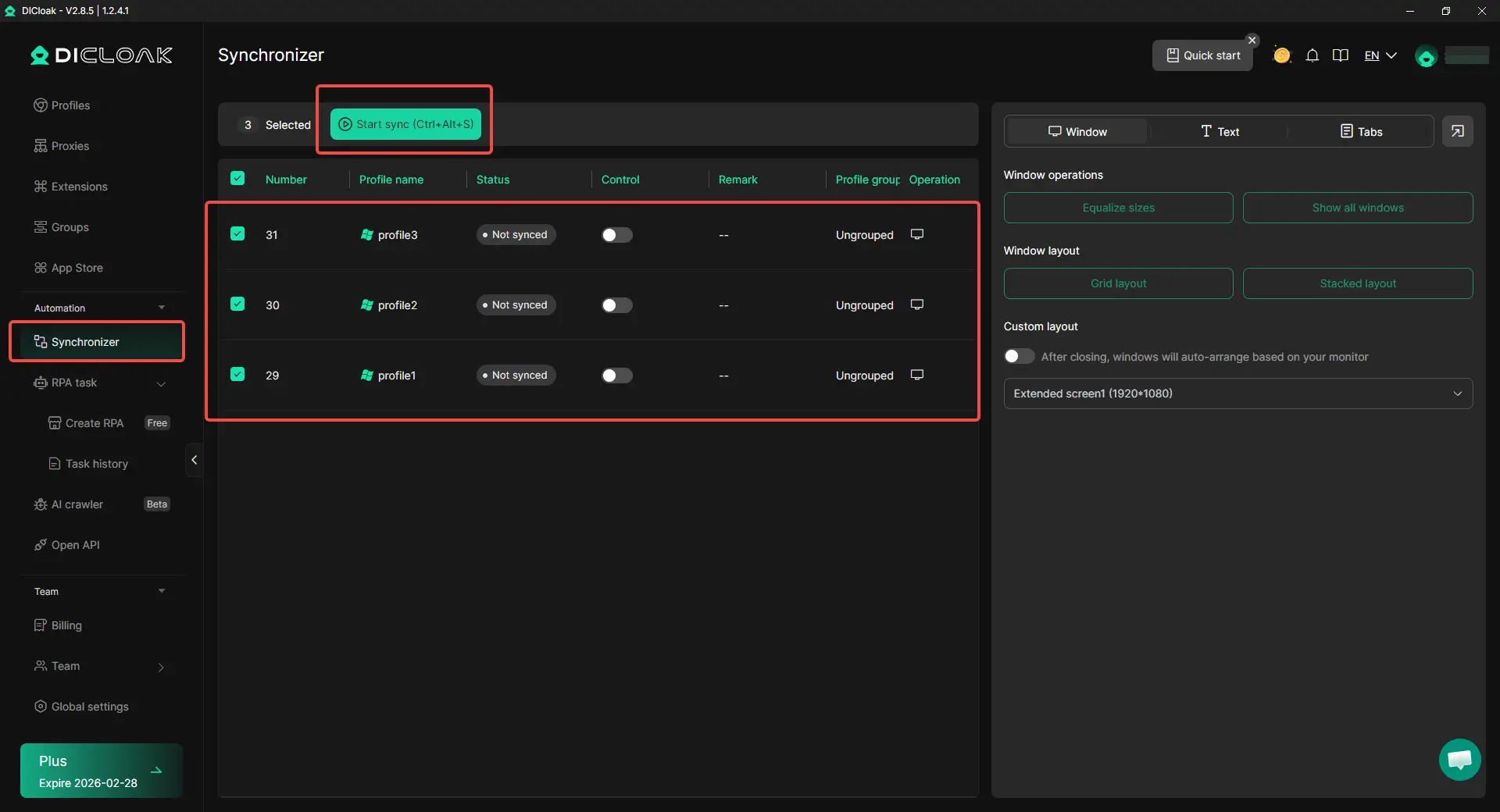
Managing Network Integrity through Proxy Orchestration
An account's IP address remains its most visible identifier. Managing this requires strict geographic consistency and protocol discipline.
Protocol Selection: HTTP/HTTPS vs. SOCKS5
Professional environments require compatibility with both HTTP/HTTPS and SOCKS5 protocols to maintain operational flexibility. DICloak’s infrastructure supports all major protocols, allowing for the integration of diverse proxy pools. SOCKS5 is often preferred for music-based applications due to its superior handling of complex data streams and varied traffic types.
Maintaining Geographic IP Consistency per Profile
An account must always appear to originate from the same geographic region to avoid "impossible travel" flags. If a profile logs in from London and then New York within an hour, the account is immediately flagged for review.
Pro Tip: Avoid mixing residential and datacenter proxies within the same account cluster. Datacenter IPs are frequently flagged as "non-residential traffic" by fraud detection partners such as MaxMind or IP2Location, increasing the risk of pattern detection.
Comparing Conventional Methods vs. DICloak Infrastructure
| Feature |
Standard Browsers |
DICloak Antidetect |
| Multi-account Capacity |
Limited (Usually 1-2) |
1,000+ Profiles |
| Fingerprint Isolation |
None (Shared Hardware ID) |
Fully Customizable / Isolated |
| OS Simulation |
Restricted to Host OS |
Windows, Mac, iOS, Android, Linux |
| Automation (RPA) |
Manual / Third-party extensions |
Built-in RPA & Synchronizer |
| Network Management |
System-wide only |
Individual Proxy per Profile |
| Hardware Requirements |
High (Multiple physical devices) |
Low (Simulated on one device) |
Note: DICloak is built on a Chrome core, ensuring compatibility with modern web standards while providing the infrastructure for bulk operations (one-click create, import, and launch).
Scaling Operations: Team Collaboration and Resource Management
As an operation grows, the need for team-based resource management becomes paramount. Industry practice dictates the use of strict permission settings (e.g., Admin vs. Operator roles) to prevent unauthorized data exports or accidental modifications to fingerprint settings.
Professional infrastructure supports data isolation between team members, keeping that one operator’s activity does not compromise the security of another’s profiles. Furthermore, the use of operation logs allows for the auditing of activity across the entire organization, making that all actions adhere to established Operational Security (OpSec) protocols.
Objective Analysis: Pros and Cons of Professional Antidetect Tools
Pros
- Scalability: Efficiently manages 1,000+ accounts on a single physical machine.
- Risk Mitigation: Advanced isolation of Canvas, WebGL, and AudioContext signatures reduces the probability of linked bans.
- Time-Savings: Bulk operations and RPA automate hours of manual input.
- Cross-OS Simulation: Simulating mobile environments (iOS/Android) provides access to potentially more lenient detection thresholds.
Cons
- Learning Curve: Technical configuration of proxies and fingerprint randomization requires specialized knowledge.
- Ongoing Costs: Maintaining high-quality residential proxies is a recurring operational expense.
- Operational Discipline: Success requires strict OpSec; for example, logging into a personal social media account and a "work" Spotify account within the same profile creates a data leak that bypasses even the best technical isolation.
Frequently Asked Questions about Getting Paid to Listen to Music
Is it possible to manage accounts on different operating systems?
Yes. Professional antidetect tools can emulate multiple operating systems—including Windows, Mac, iOS, Android, and Linux—all from a single interface. Simulating mobile operating systems like Android is a common industry practice to bypass the more stringent fingerprinting challenges associated with desktop browsers.
How do I prevent my accounts from being banned?
Prevention is based on maintaining absolute profile isolation and IP consistency. Each account should be assigned a dedicated proxy and a unique set of hardware fingerprints (Canvas, WebGL, AudioContext) to ensure the platform’s anti-fraud engine cannot identify a link between accounts.
Can I use automation for my Spotify playlists?
Yes. Built-in RPA functionality is designed to handle repetitive tasks like searching for tracks and adding them to playlists. By using variable delays and human-like interaction patterns, these tools allow for the management of large-scale engagement without triggering behavioral detection alerts.
 Web Proxy Tools
 Free Tools
 Cookie Plugin
 UA Generator
 MAC Address Generator
 IP Generator
 IP Address List
 2FA Code Generator
 World Clock
 Anonymous Check
 WebRTC Leak Test
 UUID Generator
 Free Web Proxy Site
 Proxy Checker
 FB Ad Checker
 AI Web Scraping
 Free SMM Tools
 Twitter Shadowban Checker
 Instagram Name Checker
 UTM Generator
 Username Generator
 AI Hashtag Generator
 LinkedIn Headline Generator
 Social Media Image Resizer