The Science of Algorithmic Trust
In the domain of digital growth infrastructure, "warming up" is the strategic process of establishing a history of authentic behavioral heuristics to mitigate risk and build foundational influence. From the perspective of a cybersecurity analyst, this is not a "hack"—it is the systematic reduction of an account's "bot-likelihood" score.
The underlying mechanism of TikTok’s recommendation engine relies on a trust-based ranking system. When an account demonstrates consistent, human-like activity patterns, its internal reliability score increases. High-trust accounts are granted expanded reach into higher-tier traffic pools, resulting in superior visibility on the For You Page (FYP). Without this phase, an account exists in a "sandbox" where its content is subject to heightened scrutiny and potential suppression by automated fraud detection systems.
Why Algorithmic Warming is Essential for Infrastructure Scaling
Managing digital identities at scale requires the mitigation of account association and batch bans. TikTok’s automated security protocols prioritize "aged" and "active" telemetry over raw volume. An account that immediately attempts aggressive posting or high-frequency follows without a warming protocol is flagged as a high-risk entity.
- The Un-warmed Account (High Attack Surface): A fresh account is created and immediately uploads multiple videos. TikTok’s behavioral analysis detects a lack of browsing history or niche interest, triggering a "0 views" restriction or a shadowban, as the activity pattern matches automated spam scripts.
- The Warmed Account (Trust-Hardened): By following a disciplined protocol, the account develops a profile of "probabilistic human behavior." When the first post is deployed, the algorithm has already categorized the account's niche, ensuring the content is served to a relevant, high-conversion audience.
How TikTok Detects Authentic User Behavior
TikTok monitors specific interaction signals to differentiate between human actors and automated processes. To build a robust profile, you must optimize for these primary behavioral indicators:
- Video Completion (Watch Time): Watching a video to its conclusion signals that the content is high-quality and the user is genuinely engaged. Frequent skipping indicates disinterested or automated behavior.
- Active Engagement (Likes and Comments): While passive browsing is standard, active engagement—specifically relevant, non-spammy comments—demonstrates account "vitality" and human cognitive involvement.
- Search History and Niche Training: Utilizing the search function for specific keywords (e.g., "SaaS marketing" or "pet care") allows the algorithm to classify the account’s interest profile, stabilizing the FYP recommendations.
- Shares, Saves, and Negative Signals: Shares and saves are the highest indicators of account strength. Conversely, utilizing the "Not Interested" button is a powerful trust signal, as it demonstrates a user refining their own experience.
- Third-Party Authority: Linking established accounts from platforms like Instagram or YouTube provides external validation and boosts account credibility within TikTok's ecosystem.
Pro-Tip: Avoid "speed-running" interactions. Rapid-fire engagement triggers security flags. Maintain a natural cadence of activity to avoid triggering rate-limits or behavioral heuristics designed to catch "farmed" accounts.

Determining if Your Account Requires Infrastructure Hardening
Four primary categories of accounts require the warming protocol before they are viable for content deployment:
- Newly Created (Fresh) Accounts: Zero history, zero assigned niche. These accounts require a full 2–14 day cycle to develop a recognizable interest profile.
- Inactive (Zombie) Accounts: Aged accounts with no recent telemetry. These require a revival phase to signal to the platform that the user has returned to active status.
- Restricted Accounts: Profiles facing reduced exposure due to policy violations. Rescue is viable only if the account has significant existing followers; otherwise, starting fresh is more cost-effective.
- Low-View Accounts: Profiles consistently stuck under the 1,000-view threshold. These accounts require niche recalibration to escape the "low-quality" traffic bucket.
The 60% Exit Criterion: The warming phase is only complete when 60% of the content on the For You Page aligns precisely with your target niche.
Establishing a Daily Infrastructure Routine
The professional protocol spans 2 to 14 days, focusing on mimicking natural human sessions.
Behavioral Session Analysis
Spend 30 to 60 minutes daily on the FYP. Critically, this time must be fragmented into multiple sessions throughout the day (e.g., morning, lunch, evening) to reflect natural usage patterns. Avoid late-night scrolling if your target audience is in a different time zone; align your activity with the peak hours of your target geography (e.g., 7-9 AM or 8-10 PM local time).
Niche Classification via Search and Sentiment
If the FYP is delivering irrelevant content, use the search function to force-feed the algorithm your niche keywords. Interact with competitor content, study their captions/hashtags, and use the "Not Interested" feature on any content that deviates from your desired niche to accelerate categorization.
Technical Infrastructure and Network Isolation
To manage multiple accounts without triggering association-based bans, a professional-grade technical stack is mandatory.
Fingerprinting Vectors and Device Safety
TikTok’s detection system analyzes complex browser fingerprints. To remain undetected, you must isolate the following vectors:
- Canvas & WebGL: Ensuring unique graphical rendering profiles.
- AudioContext: Isolating audio hardware signatures.
- Media Device IDs: Preventing the platform from seeing the same microphone/camera IDs across accounts.
- WebRTC & DNS Consistency: Preventing leaks that reveal your true IP or show a discrepancy between your proxy and your system clock/DNS.
The industry standard is "one profile, one account."
"Network Isolation" is achieved through high-quality Residential IPs. Datacenter IPs are easily flagged as commercial or bot-related.
Warning: Avoid "IP Hopping." Switching IPs frequently within a short interval is a primary trigger for "No Network Connection" errors and immediate account suspension. Ensure your proxy usage is stable and geographically consistent.
Scaling Operations with DICloak Infrastructure
For enterprise-level growth, manual management is a liability. DICloak is the specialized antidetect browser designed for secure, multi-account scalability.
Bridging the Mobile-First Gap
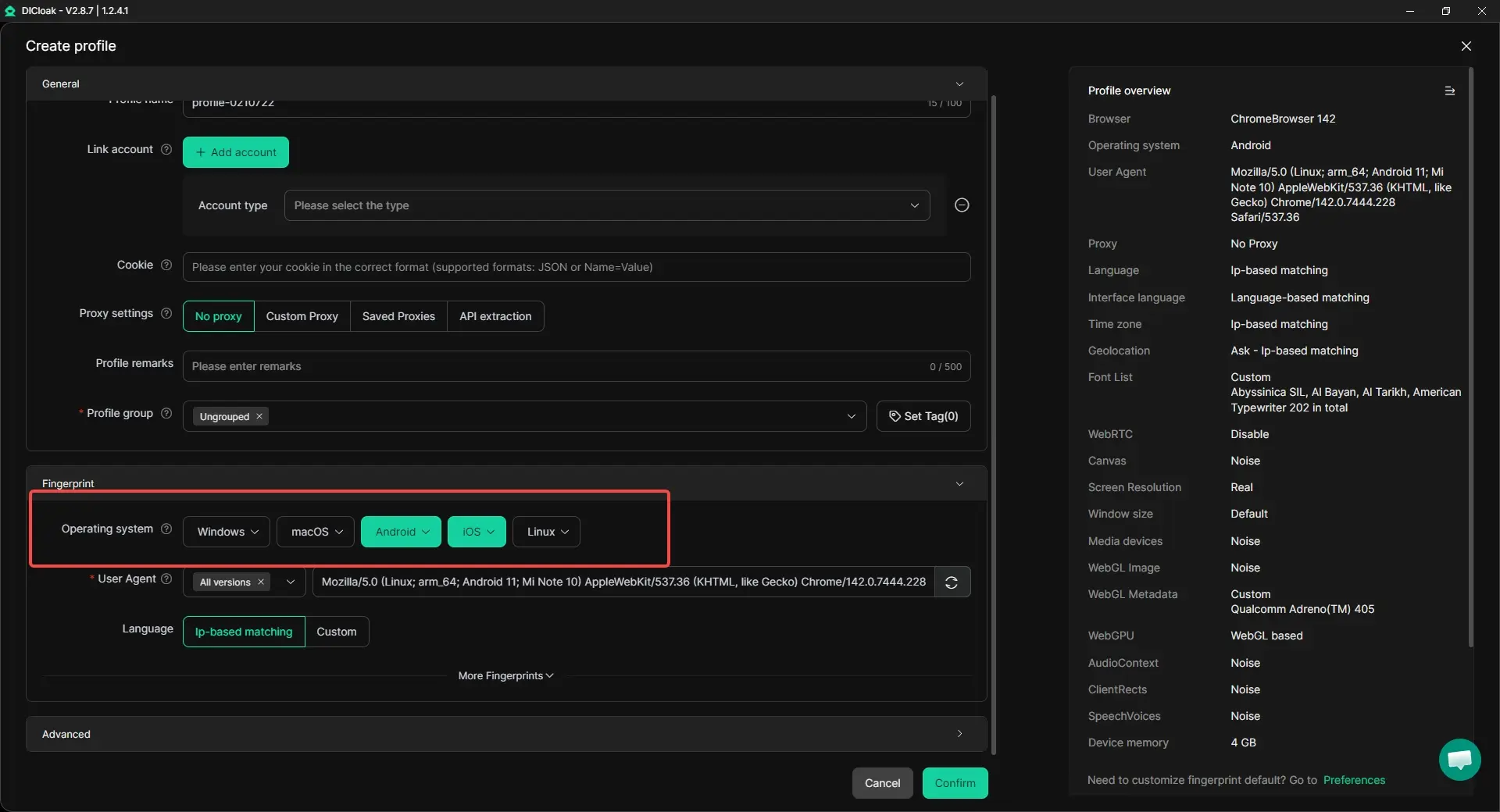
TikTok is mobile-centric. Based on the Chrome core, DICloak supports simulating Windows, Mac, iOS, Android, and Linux operating systems, helping align profiles with mobile-first workflows and reduce environment mismatch signals.
Automating Repetitive Tasks with RPA and Synchronizer
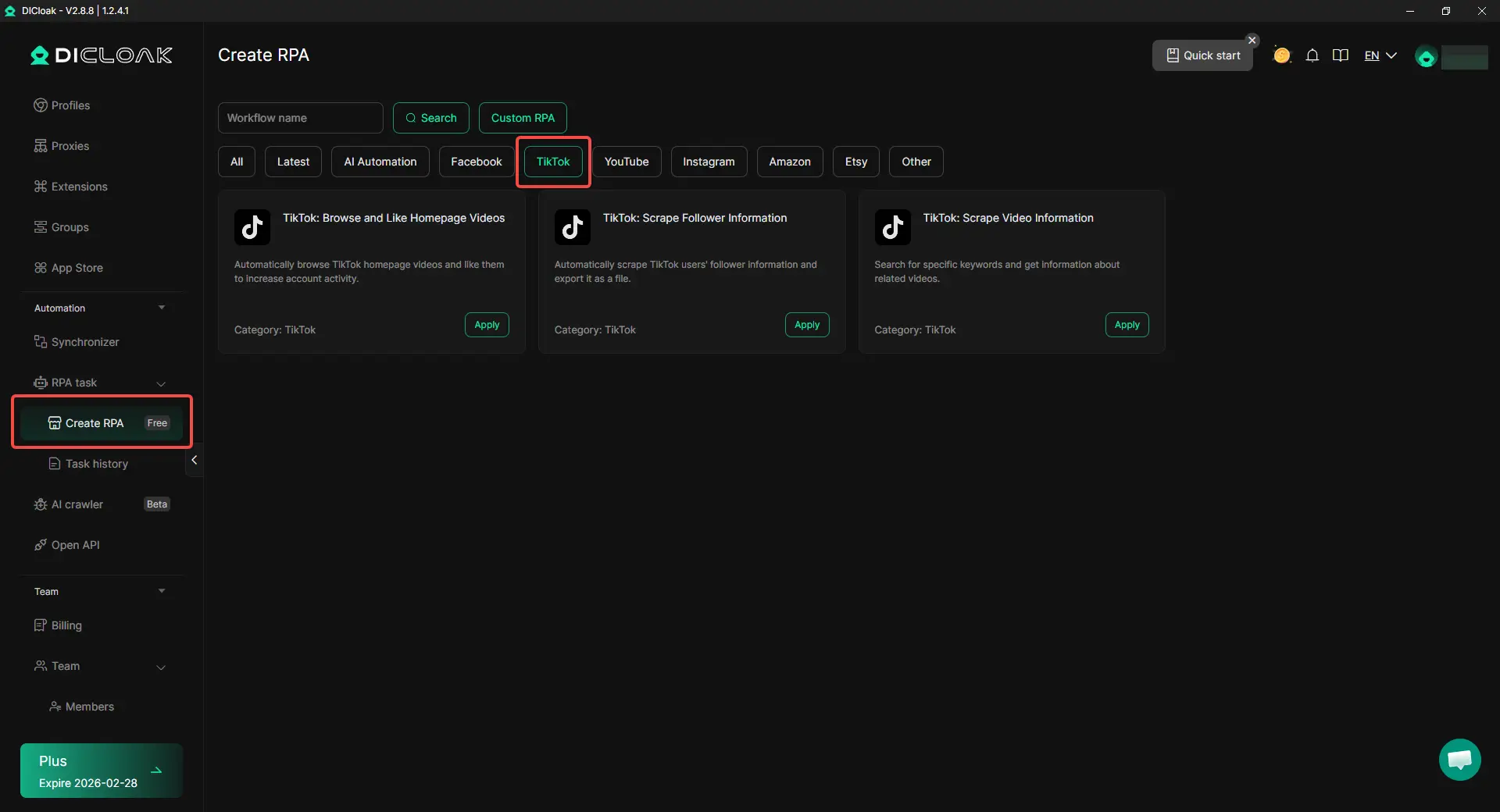
DICloak provides built-in Robotic Process Automation (RPA) templates to handle common, repetitive actions across platforms such as TikTok. These workflows can automate routine behaviors like browsing content, interacting with videos, and collecting publicly available data, reducing the need for constant manual operation.
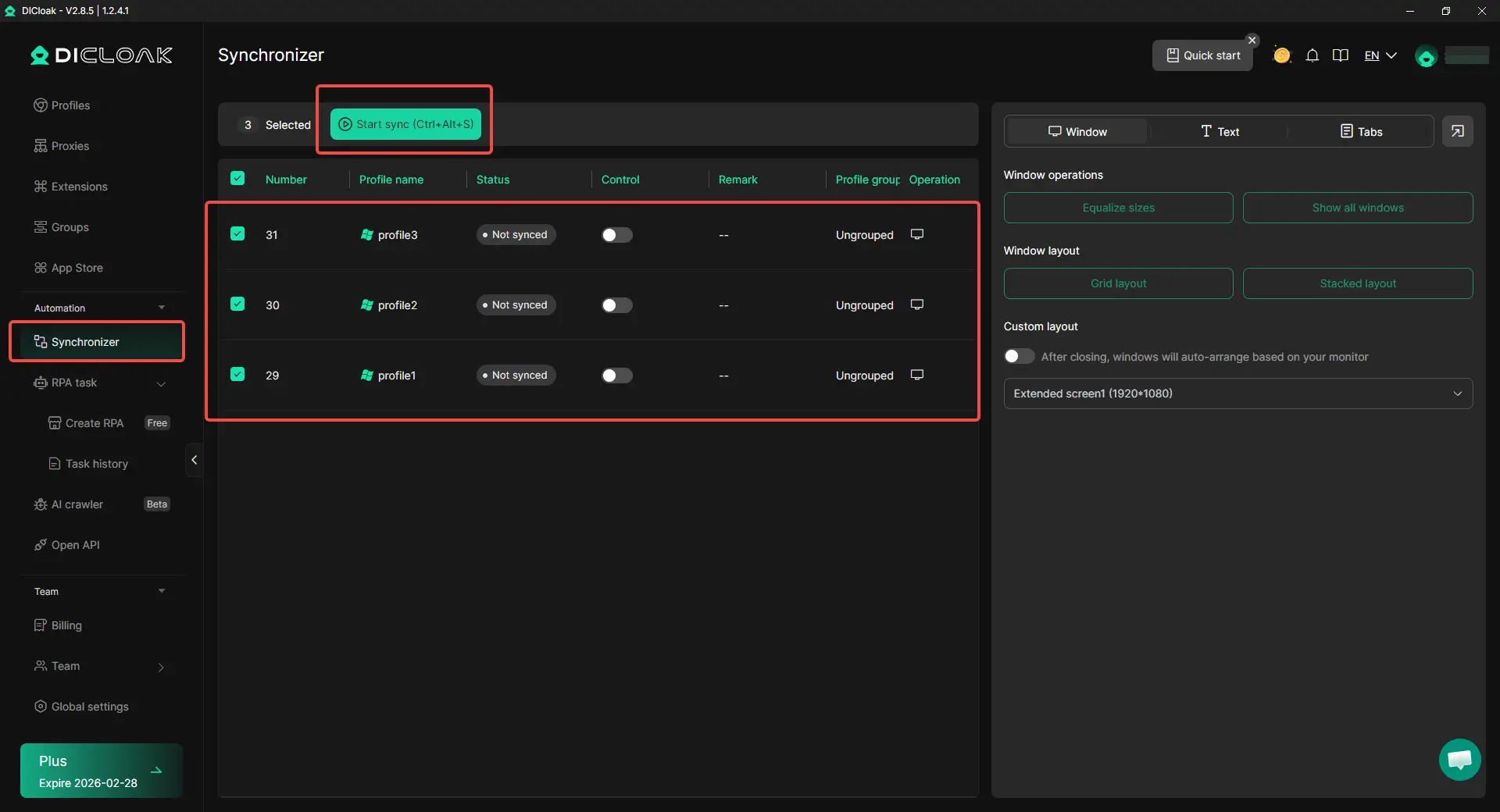
 In addition, DICloak’s Synchronizer allows actions performed in one browser profile to be mirrored across multiple active profiles in real time. Together, RPA and synchronization tools help teams improve efficiency and maintain consistency when managing large numbers of profiles.
Infrastructure Comparison Table
| Feature |
Standard Method (Hardware Farms) |
DICloak Infrastructure Solution |
| Hardware Costs |
High (Dozens of physical devices) |
Low (Managed on a single workstation) |
| Account Isolation |
Physical separation |
Virtual isolation (Canvas, WebGL, WebRTC) |
| OS Diversity |
Limited by physical stock |
Full simulation (Android, iOS, Win, Mac) |
| IP Management |
Manual / Hardware-bound |
Custom Proxy Configuration |
| Scaling Speed |
Slow & labor-intensive |
Instant (Bulk profile creation & RPA) |
| Automation |
None (Manual scrolling) |
RPA and Synchronizer |
Post-Warmup: The Exit Criteria and Content Delivery
Once the 60% Niche Rule is satisfied, the account moves to the posting phase.
Readiness Checklist:
- FYP Accuracy: >60% niche relevance.
- Third-Party Linkage: Instagram/YouTube connected.
- Search Result Stability: Searching niche terms returns relevant "For You" suggestions.
Troubleshooting 0 Views
If initial posts yield zero views, utilize "Creator Tools" to diagnose the restriction. Common triggers include:
- Low Originality: The automated review system detected non-original content or a simple mirror of existing videos.
- Technical Triggers: Presence of QR codes or low-resolution clarity (under 720p).
- Infrastructure Flag: The device fingerprint or IP has been blacklisted due to "cross-contamination" with other banned accounts.
Common Questions (FAQ)
How many accounts per IP?
The professional standard is one IP per account. Sharing IPs creates a fingerprint "footprint" that risks a chain-reaction ban across all associated profiles.
How long does the warming process take?
Typically 2 to 14 days. The process is complete when your FYP is calibrated and your initial 2-3 posts consistently clear the 200-view threshold.
Why is my "Following" count stuck at zero?
This is a security restriction. Rapid following on a fresh account is flagged as bot behavior. Wait for the account to stabilize through browsing before following others.
How to fix "No Network Connection" errors?
Check for IP restrictions or WebRTC leaks. If your proxy is detected as a datacenter IP or if you have jumped geographic locations too quickly, TikTok will sever the connection to protect the platform.
Conclusion: Building a Sustainable Digital Growth Infrastructure
Warming up a TikTok account is a marathon of trust-building, not a sprint for engagement. Success in account farming and social media management is dependent on the quality of your underlying infrastructure.
By utilizing high-level behavioral strategies and professional tools like DICloak, you transition from manual, high-risk activity to a secure, scalable, and automated business workflow. Professional growth is built on the foundation of technical isolation and algorithmic trust.
 Web Proxy Tools
 Free Tools
 Cookie Plugin
 UA Generator
 MAC Address Generator
 IP Generator
 IP Address List
 2FA Code Generator
 World Clock
 Anonymous Check
 WebRTC Leak Test
 UUID Generator
 Free Web Proxy Site
 Proxy Checker
 FB Ad Checker
 AI Web Scraping
 Free SMM Tools
 Twitter Shadowban Checker
 Instagram Name Checker
 UTM Generator
 Username Generator
 AI Hashtag Generator
 LinkedIn Headline Generator
 Social Media Image Resizer