In 2026, protecting your digital privacy has become more difficult due to advanced tracking systems that seek to uncover your unique "digital fingerprint." These systems expose personal data, jeopardizing your online safety. One crucial test for measuring privacy is the BrowserLeaks test, which helps identify how much information your browser is unintentionally sharing. In this article, we'll explore how to pass the BrowserLeaks test and explain why traditional privacy methods often fall short in today’s digital landscape.
Understanding the Importance of Browser Privacy in 2026
In 2026, the digital world is a challenging place for privacy. Advertising trackers and anti-fraud systems are now very advanced. These systems try to find your "digital fingerprint," which is a unique set of details about your computer and browser. If these details reveal who you are, your privacy is gone. Therefore, you must learn how to hide these details to stay safe. The purpose of this article is to show you how to pass the BrowserLeaks test using powerful tools like DICloak. In addition, we will explain why standard privacy methods often fail in today’s landscape.
What is BrowserLeaks and Why Should You Care?
BrowserLeaks is a group of online tools that test how secure your browser really is. It identifies "leaks," which are pieces of data that your browser accidentally gives away to websites. By using these tests, you can see if a website can find your real location or identify your device.
Common Data Points Exposed by BrowserLeaks
Websites use BrowserLeaks to find several important pieces of information. These include:
- IP Address: This shows your country, city, and internet provider.
- WebRTC Leaks: This can reveal your real home IP address, even if you are using a VPN.
- Canvas and WebGL Fingerprints: These are unique images created by your graphics card to identify your device.
- Font Fingerprinting: This looks at the specific fonts installed on your system.
- TLS/SSL Fingerprinting: This checks your security settings and creates a unique "JA3" or "JA4" code to track you.
- JavaScript Environment: This includes your screen size, language, and the type of processor your computer uses.
Passing the test means that these data points show a fake, consistent profile instead of your real identity.
Key Features to Pass BrowserLeaks Test Successfully
To pass these tests in 2026, you need to fix the specific ways websites track you.

WebRTC and IP Address Masking
WebRTC is a system that helps browsers talk to each other. However, it is a major privacy risk because it can reveal your real IP address even when you use a proxy. For example, a user in New York might use a proxy to look like they are in London. If WebRTC leaks the New York IP, big sites like Amazon or eBay will see both addresses. Therefore, they will link the accounts together and issue an immediate ban. To pass the test, you must use a tool that masks WebRTC data.
Defeating Canvas and WebGL Fingerprinting
Websites use your graphics card (GPU) to draw hidden images. Because every GPU is slightly different, this creates a unique "fingerprint." To pass BrowserLeaks, you must use "Intelligent Canvas Spoofing." This technology creates a unique visual code for every browser profile you use. By changing how the browser draws these images, your device looks different every time you visit a site.
Real-Life Example: Scaling a Digital Agency in 2026
Imagine a digital agency that handles social media for 50 different clients. Before using DICloak, they were worried that if one client’s account had a problem, all 50 accounts would be banned. By using DICloak, they created separate profiles for every client. Because each profile has its own fingerprint, the accounts are never linked. Moreover, the agency uses team features to let different employees work on the same accounts safely.
Why DICloak is the Best Tool to Pass BrowserLeaks Test in 2026
DICloak is a professional antidetect browser. It is built for people who need to run many accounts at the same time without getting caught.
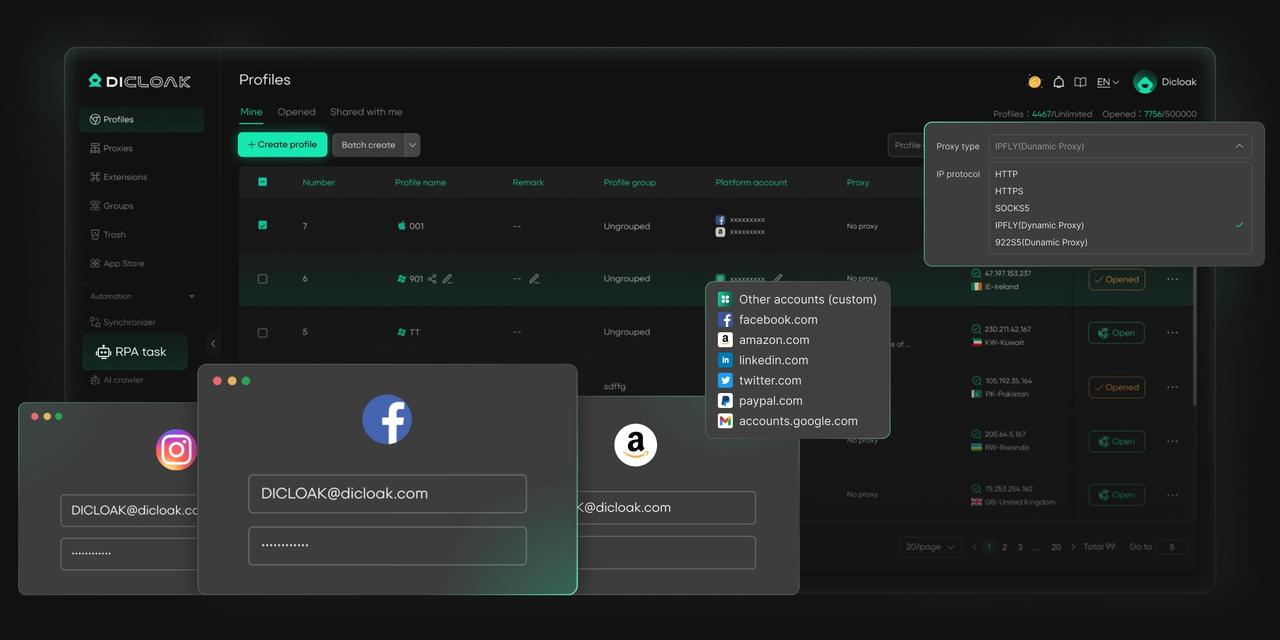
Advanced Security and Fingerprint Customization
DICloak provides high-level safety by creating a new digital identity for every account. Its key features include:
- Custom Fingerprints: You can change your IP, location, and WebGPU settings.
- Cookie Management: It keeps your login data safe and encrypted.
- Virtual Machine Efficiency: Each DICloak profile works like a private computer. However, it is 12x cheaper than buying a real PC and runs just as fast.
Practical Use Cases for DICloak Antidetect Browser
DICloak is a tool that helps businesses grow while staying private.
With DICloak, you can manage over 1,000 accounts on one laptop. This is perfect for selling on Amazon, eBay, or Shopify. Every account stays in its own "bubble." This means websites cannot link your accounts together. Therefore, you can scale your business without the fear of being banned.
Automating Tasks with RPA and Synchronizer
DICloak has a built-in RPA tool, which stands for Robotic Process Automation. This saves you hours of work by doing repetitive tasks for you, like clicking buttons or collecting data. Moreover, the Synchronizer tool lets you control many browser windows at the same time with just one mouse.
Comparing DICloak with Other Privacy Tools
In 2026, different tools are built for different needs. Here is how they compare.
DICloak vs. Pixelscan, CreepJS, and Whoer
- Pixelscan: This tool gives you a simple pass or fail score. However, it does not show detailed information about your security settings or JavaScript environment.
- CreepJS: This is a very technical tool for researchers. It is often too complicated for most people to use for daily work.
- Whoer.net: This is a basic tool for VPN users. However, it lacks advanced tests for things like Canvas or WebGL.
Therefore, DICloak is the best middle ground. It provides powerful security but is still easy for professionals to use.
Step-by-Step Guide: How to Pass BrowserLeaks Test with DICloak
Follow these steps to make your browser profile look like a real, separate person:
- Download and Install: Get the DICloak browser from the official website.
- Create a Profile: Start a new profile and use the built-in "base profiles." Note: Do not change these pre-set settings manually. They are already optimized to pass tests, and changing them is the most common reason people fail.
- Set Up a Proxy: Add your proxy (HTTP or SOCKS5) to hide your real internet connection.
- Turn on WebRTC Spoofing: Make sure the WebRTC settings are set to match your proxy IP.
- Check Your Results: Open the profile and go to browserleaks.com. You should see that your real identity is completely hidden.
Conclusion
Using a reliable anti-detect browser like DICloak is the best way to stay hidden in 2026. To pass the BrowserLeaks test every time, you need "Realistic Browser Masking." DICloak does this by using proprietary Chrome-based cores that look like normal web browsers to tracking systems.
Download DICloak today and pass your first BrowserLeaks test for free.
Frequently Asked Questions (FAQ)
1.What is the easiest way to pass BrowserLeaks test for multiple accounts?
The best way is to use DICloak profiles. Each profile creates a unique digital identity. This makes every account look like it is on a completely different computer.
2.Is it safe to use browserleaks.com?
Yes. BrowserLeaks is a safe tool used for testing. It does not save your personal data or store your fingerprints.
3.Why did I fail to pass BrowserLeaks test despite using a proxy?
This usually happens because your fingerprint details do not match. For example, if your proxy is in London but your computer clock shows New York time, the test will flag you as suspicious.
 Web Proxy Tools
 Free Tools
 Cookie Plugin
 UA Generator
 MAC Address Generator
 IP Generator
 IP Address List
 2FA Code Generator
 World Clock
 Anonymous Check
 WebRTC Leak Test
 UUID Generator
 Free Web Proxy Site
 Proxy Checker
 FB Ad Checker
 AI Web Scraping
 Free SMM Tools
 Twitter Shadowban Checker
 Instagram Name Checker
 UTM Generator
 Username Generator
 AI Hashtag Generator
 LinkedIn Headline Generator
 Social Media Image Resizer