For any serious freelancer, e-commerce seller, or digital agency, Manage Multiple PayPal Accounts isn’t a choice—it’s a necessity. The core challenge is learning how to manage multiple PayPal accounts without triggering automated security flags, account holds, or even permanent bans. When you manage multiple PayPal accounts at scale, maintaining clear separation and compliance becomes critical.
This guide provides a clear, practical roadmap to manage multiple PayPal accounts lawfully in 2026. We’ll cover everything from proper account setup to proven best practices, and explain how modern tools can help you manage multiple PayPal accounts with strict separation, allowing you to stay compliant, secure, and operational over the long term.

Why You Need to Manage Multiple PayPal Accounts
There are many legitimate reasons why professionals find it necessary to manage more than one PayPal account. Proper separation simplifies bookkeeping, enhances client management, and streamlines development workflows. Moreover, keeping business and personal finances distinct is a fundamental accounting principle that multiple accounts can facilitate.
- For Freelancers and Small Businesses
Freelancers and small business owners often use separate accounts to distinguish personal funds from client payments. This ensures cleaner bookkeeping and makes tax preparation significantly easier. For example, a freelance writer can have a Personal account for household expenses and a Business account where all client invoices are paid, preventing any commingling of funds.
Online sellers frequently use different accounts to manage various operational needs. For instance, an e-commerce entrepreneur might operate two distinct online stores and use a separate PayPal Business account for each one. This allows them to track revenue streams independently and test new checkout processes or promotional campaigns on one store without affecting the other.
- For Digital Marketing Agencies
Digital marketing agencies that manage campaigns for multiple clients may need to handle individual PayPal accounts for each one. This maintains strict financial separation and transparency, ensuring that a client's ad spend or service payments are processed through their dedicated account, which the agency manages on their behalf.
- For Developers and Testers
Developers building or maintaining applications with PayPal integrations require separate accounts for testing. They might use one account in a sandboxed development environment to test payment gateways and APIs before deploying a feature live. This prevents test transactions from getting mixed up with real customer payments on the production account.
Understanding PayPal's Rules to Manage Multiple PayPal Accounts
To manage multiple accounts successfully, it's crucial to understand PayPal's official policies. PayPal allows users to have multiple accounts—typically one Personal and one Business account—as long as each is created transparently and verified with unique information. Each account must have its own email address, phone number, and linked financial details. As PayPal's security algorithms become even more sophisticated in 2026, its core requirement is transparency. Ensure each account serves a distinct, legitimate purpose.
PayPal Account Types Explained
PayPal offers different account types, each tailored to specific use cases. Understanding their features will help you choose the right one for your needs.
- Personal account: This is best for individual use, such as sending money to friends, shopping online, or receiving occasional payments. It’s simple to set up and does not require a registered business.
- Business account: Designed for companies, freelancers, and online sellers. It allows you to operate under a business name, create professional invoices, manage access for staff members, and integrate PayPal with your website or e-commerce platform.
- Premier account: This option serves as a hybrid between Personal and Business accounts, offering higher transaction limits. However, it is important to note that the Premier account is not available in all regions.
How to Create a New Personal Account to Manage Multiple PayPal Accounts
Opening a personal PayPal account is a straightforward process. Follow these steps to get set up quickly and correctly.
1. Visit PayPal’s official website and click on the Sign Up button.
2. Choose the “Personal Account” option. This account type is ideal for everyday transactions like shopping and sending money.
3. Enter an email address that is not already linked to another PayPal account and create a secure password.
4. Provide your full legal name and residential address. These details must match your official identification to prevent verification problems.
5. Check your email inbox for a confirmation message from PayPal and click the verification link inside.
6. Link a bank account or debit/credit card to your new PayPal account to enable sending and withdrawing funds.
7. Complete the identity verification process by following the on-screen prompts, which may include uploading identification or confirming your phone number.
Tips for a Smooth Setup
- If you don't receive the confirmation email, check your spam or junk folder before requesting a new one.
- If a card is declined during setup, wait a day before trying again or use a different card registered in your name.
- If your account shows transaction limits, complete the full identity verification (KYC) process, and the limits should be removed automatically.
How to Set Up a Business Account to Manage Multiple PayPal Accounts
A Business account is essential for freelancers, e-commerce stores, and agencies. Here’s how to create one.
1. Navigate to the PayPal signup page and select the Business Account option.
2. Enter your business email address. Using a branded email from your own domain adds a layer of professionalism.
3. Fill in your official company information, including your business name, type, address, and contact number.
4. Provide any required business and tax details, such as a registration number or VAT/TIN, depending on your region's requirements.
5. Link a business bank account or corporate card to keep your business finances clearly separated from your personal funds.
6. Customize your account settings by uploading your company logo, creating invoice templates, and granting access permissions to team members like accountants or staff.
7. Verify your business ownership by uploading any requested documents, which might include a registration certificate, proof of address, or a business ID.
Key Considerations for Business Accounts
- Ensure the business name on your PayPal profile is consistent with your invoices and tax documents.
- If you operate under a "doing business as" (DBA) name, add it to your profile so it appears correctly on client receipts.
- Maintain complete separation between your business and personal accounts by using different bank accounts, cards, and email addresses.
- As your business scales to multiple stores or clients, manual separation becomes risky. Proactively adopt a tool like DICloak to isolate browser profiles from day one, ensuring your digital hygiene practices can scale with your operations.
The Biggest Challenge When You Manage Multiple PayPal Accounts
The primary risk of managing several PayPal accounts is not about breaking rules, but about maintaining perfect operational hygiene in an environment where even minor overlaps in digital fingerprints can trigger a lockdown. When you log into different accounts from the same device, you leave behind digital traces. PayPal employs highly sophisticated pattern-recognition systems designed to flag anomalies. Shared device signals, browser cookies, and cache can allow these systems to link your accounts, leading to verification requests, temporary fund holds, or even permanent bans.
How DICloak Helps You Safely Manage Multiple PayPal Accounts
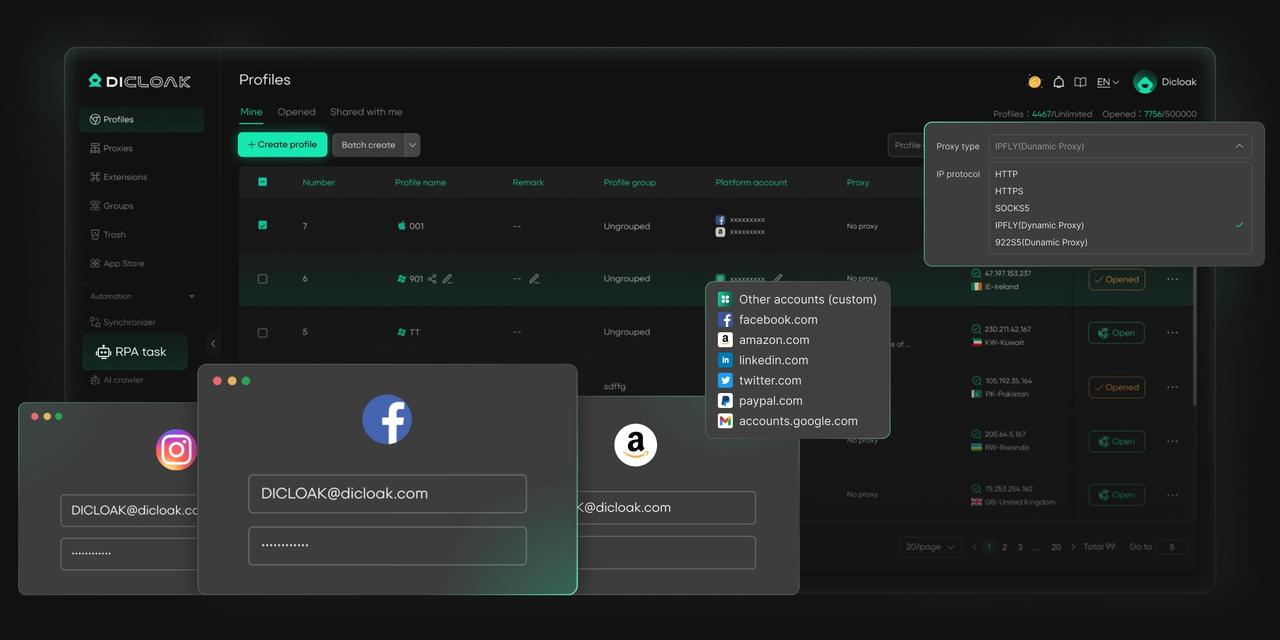
DICloak solves the digital fingerprint problem by building a virtual wall around each account. It doesn't just clear cookies; it assigns each PayPal profile a unique, consistent digital identity, making each login appear to PayPal as if it's originating from a completely separate physical device every time. As an antidetect browser, it is specifically designed to create these isolated browsing profiles, preventing the data leakage that leads to accidental account linking.
What Makes DICloak Stand Out
✅ Manage 1,000+ Accounts on One Device: Stop wasting money on extra hardware! DICloak allows you to manage multiple accounts on a single device, cutting costs and boosting efficiency.
✅ Guaranteed Account Safety, No Ban Risks: Every account gets its own isolated browser profile with custom fingerprints and IPs, drastically reducing the risk of bans. Your accounts, your control!
✅ Flexible Proxy Configuration for Maximum Performance: Seamlessly integrate with all major proxy protocols (HTTP/HTTPS, SOCKS5) and manage your proxy pool with bulk operations. No more struggling with IP management—DICloak has you covered.
✅ Streamlined Team Collaboration for Better Results: Easily manage your team with advanced tools like profile sharing, permission settings, data isolation, and operation logs. Your team works smarter, not harder.
✅ Automate the Grind with RPA: DICloak's built-in RPA saves you hours of manual work. Automate repetitive tasks, streamline workflows, and focus on what really matters—growing your business.
✅ Powerful Bulk Tools to Scale Your Operations: Create, import, and launch multiple browser profiles in one click. DICloak makes scaling your business as easy as it gets.
✅ Compatible with All Major Operating Systems: Based on the Chrome core, DICloak supports simulating Windows, Mac, iOS, Android, and Linux operating systems. No matter what platform you need, DICloak has you covered.
Step-by-Step: How to Use DICloak to Manage Multiple PayPal Accounts
Follow this structured guide to responsibly manage your PayPal accounts using DICloak and maintain compliance.
1. Plan Your Accounts: Before you begin, define the purpose of each account (e.g., personal, e-commerce store A, client B, testing). Create a simple spreadsheet to track each account's name, email, linked bank/card, and verification status.
2. Meet PayPal’s KYC and Business Rules: Provide accurate and unique identity or business details for every account. Link a separate, corresponding bank account or card to each PayPal account to maintain clear financial separation.
3. Separate Contact and Payment Info: Use unique email addresses, phone numbers, and bank accounts for each PayPal account. Avoid reusing the same card or bank account across unrelated business accounts.
4. Isolate Browser Profiles with DICloak: Create one dedicated DICloak browser profile for each PayPal account you manage. Name each profile clearly in your inventory spreadsheet so you know which profile maps to which account.
Pro-Tip: Use a clear naming convention or color-coding system within DICloak for your browser profiles. For instance, name profiles like [ClientName] - PayPal, [StoreName] - PayPal, or [Test] - PayPal, Dev to instantly identify the purpose of each session and avoid costly mistakes.
5. Import Cookies and Restore Profiles Safely (If Needed)
If you are moving existing sessions, you can import cookies into a DICloak profile so that logins persist. Only do this for accounts you own and have fully verified.
6. Perform Verification Checks Before Use
Launch each DICloak profile and log into its assigned PayPal account. Confirm that the email is verified, the linked bank/card is visible, and there are no pending account limits.
7. Automate and Test with Compliance in Mind
If you automate tasks, ensure your scripts run at a human-like pace to avoid triggering PayPal's fraud detection systems. Use DICloak's automation features responsibly and keep detailed logs of all automated actions.
8. Manage Team Access with Roles and Audits
Use DICloak’s role-based access features to grant team members the minimum required permissions. Keep an audit trail of who accessed which profile and when.
9. Monitor and Respond Quickly
Set up alerts for account limits or verification requests. If PayPal places a hold on an account, respond promptly with the correct documentation.
10. Scale Gradually and Safely
Roll out new accounts in small batches. Validate that everything is working correctly with a few accounts before scaling up your operations to avoid raising false flags.
Tips: Before you click "Sign Up," make sure you have these non-negotiable items ready for each new account to ensure a smooth and successful setup:
- A Unique Email Address: Not associated with any other PayPal account.
- A Dedicated Phone Number: For verification and security alerts.
- A Separate Bank Account or Card: To maintain financial separation.
- Official Identification: Your legal name and address must match your ID.
- Business Documents (for Business Accounts): Registration certificate, tax ID, and proof of address.
- An Account Inventory Log: A spreadsheet to track the details of each account.
Best Practices to Manage Multiple PayPal Accounts Without Issues
Follow these best practices to ensure your accounts remain secure, compliant, and fully operational.
Foundational Rules
- Separate Everything: Always use separate emails, bank accounts, and contact details for each logical business entity or purpose.
- Maintain Consistency: Ensure your business information is consistent across your PayPal profile, invoices, and legal documents to avoid verification issues.
Operational Discipline
- Keep a Detailed Log: Maintain a log for each account, tracking its purpose, credentials, linked financials, and verification status.
- Isolate Logins: Use different browser profiles to log into each account to prevent accidental cross-linking of sessions and cookies.
Advanced Tooling (with DICloak)
- Leverage Isolated Environments: Use DICloak to create a completely isolated browser profile for each PayPal account, naming profiles clearly for easy management.
- Automate Responsibly: Keep scripts running slowly, close to human operation. Use role-based permissions to control script execution permissions.
- Scale Gradually: Roll out new accounts in batches to monitor their performance and avoid sudden activity spikes that could trigger reviews.
Conclusion
Manage Multiple PayPal Accounts is entirely possible when you prioritize transparency, organization, and clear separation. When you manage multiple PayPal accounts correctly by following the fundamentals—using different emails, linking distinct bank accounts, providing accurate verification, and keeping detailed records—you greatly reduce the risk of limits and ensure payments flow smoothly. A well-structured approach to manage multiple PayPal accounts helps maintain long-term account stability and compliance.
Tools should be used to reduce accidental errors, not to hide activity. DICloak supports professionals who need to manage multiple PayPal accounts by making profile isolation simple and effective. By creating one browser profile per PayPal account, you can manage multiple PayPal accounts more efficiently without mixing cookies, logins, or browser states. For those looking to scale, DICloak offers automation features that help manage multiple PayPal accounts while staying compliant. Always follow PayPal’s rules and maintain a clear, auditable workflow when you manage multiple PayPal accounts.
🔗 Ready to Get Started?
Visit the DICloak website to explore more details and choose the plan that’s right for you. Start for free today and experience secure, efficient, and scalable ways to manage multiple PayPal accounts.
Frequently Asked Questions About How to Manage Multiple PayPal Accounts
How many PayPal accounts can I legally have when you manage multiple PayPal accounts
PayPal’s policy generally allows one personal and one business account per user. Each must have unique email and financial details. If you plan to manage multiple PayPal accounts, always check the PayPal user agreement for your country, as rules may vary.
What happens if PayPal detects my multiple accounts on one computer while I manage multiple PayPal accounts?
If PayPal’s systems suspect accounts are improperly linked, it may trigger a security review. This can result in verification requests, temporary fund holds, or restrictions. Proper tools and workflows are essential to safely manage multiple PayPal accounts.
Do I need a separate bank account for each PayPal account when I manage multiple PayPal accounts?
Yes, absolutely. This is the most critical step when you manage multiple PayPal accounts. Separate bank accounts ensure clear financial records and compliance, especially when handling personal and business accounts.
How does an antidetect browser like DICloak help manage multiple PayPal accounts without detection?
It creates a unique digital fingerprint for each profile. This includes parameters like time zone, screen size, and fonts, making it appear that each login comes from a separate device. This makes it safer and more reliable to manage multiple PayPal accounts.
Can I manage my clients’ PayPal accounts using DICloak to manage multiple PayPal accounts?
Yes. Agencies can use DICloak’s team features to manage multiple PayPal accounts securely. Isolated browser profiles for each client prevent data crossover and help maintain confidentiality while you manage multiple PayPal accounts at scale.
 Web Proxy Tools
 Free Tools
 Cookie Plugin
 UA Generator
 MAC Address Generator
 IP Generator
 IP Address List
 2FA Code Generator
 World Clock
 Anonymous Check
 WebRTC Leak Test
 UUID Generator
 Free Web Proxy Site
 Proxy Checker
 FB Ad Checker
 AI Web Scraping
 Free SMM Tools
 Twitter Shadowban Checker
 Instagram Name Checker
 UTM Generator
 Username Generator
 AI Hashtag Generator
 LinkedIn Headline Generator
 Social Media Image Resizer