The FBI logged $5.6 billion in reported cryptocurrency investment-fraud losses in 2023, based on the IC3 annual report. Not every loss came from airdrops, but fake claim pages and risky wallet approvals keep hitting users who chase points, and that risk sits right next to real opportunities like the genius airdrop.
You are likely here for three outcomes: qualify for the campaign, farm points without burning extra gas, and claim rewards without exposing your main wallet. You will get a practical playbook for each step: how to verify official links, how to track tasks that count, what on-chain activity tends to matter, and how to use a clean claim flow with a separate wallet. You will also see how to check signatures with MetaMask safety guidance and clear old token approvals in Etherscan Token Approval Checker or Revoke.cash.
By the end, you should know what to do each week and what to avoid right before you click “Claim.” Start with eligibility rules, since farming the wrong tasks drains time and fees fast.
How can you verify the real Genius airdrop before connecting any wallet?
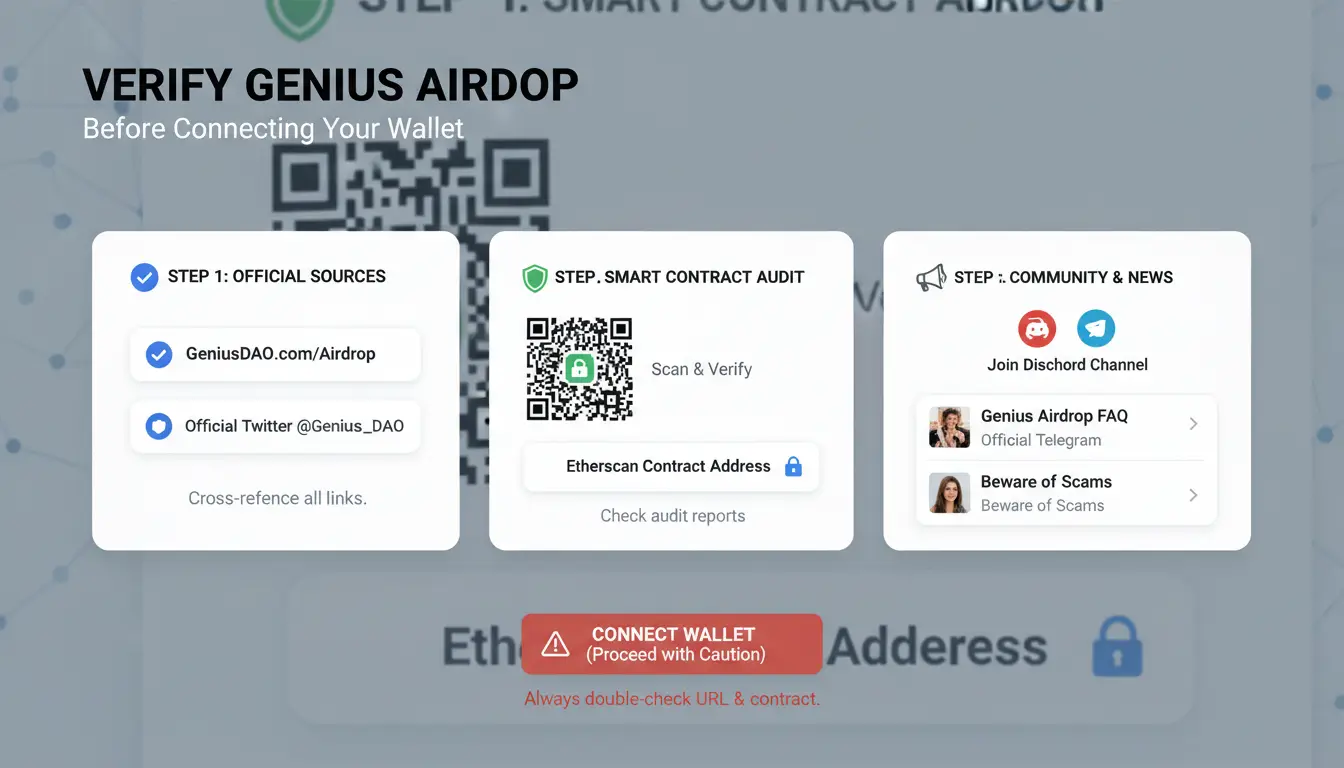
Before you connect any wallet for the genius airdrop, confirm where the campaign started. Clone sites can copy branding fast. You need one clean path from announcement to claim page.
Check the official source trail first
Open the project’s official social profile, then follow the website link from that profile only. Do not trust links from replies, ads, or private messages. Match domain spelling, logo, and post dates across channels. If the site is new, check domain records in ICANN Lookup. If the campaign page appeared today but posts claim it has run for weeks, stop. You can also compare older snapshots in the Wayback Machine to catch sudden domain swaps.
Spot copycat pages and impersonation patterns
Scam pages push panic lines like “claim in 10 minutes or lose rewards.” Real campaigns give clear windows and repeat the same name across posts and site pages. Check token or claim contract addresses in a public explorer such as Etherscan. If one page shows a different address than official posts, treat it as fake. Never sign a message you cannot read. Use MetaMask safety guidance before any signature.
Build a pre-join safety checklist
Use a separate low-balance wallet for your test interaction. Approve only what the task needs; avoid unlimited token allowances. After each task, review and remove old approvals in Etherscan Token Approval Checker or Revoke.cash. If a page asks for seed phrase, remote screen share, or direct transfer to “verify eligibility,” leave immediately.
What makes you eligible for the Genius airdrop, and what gets users disqualified?
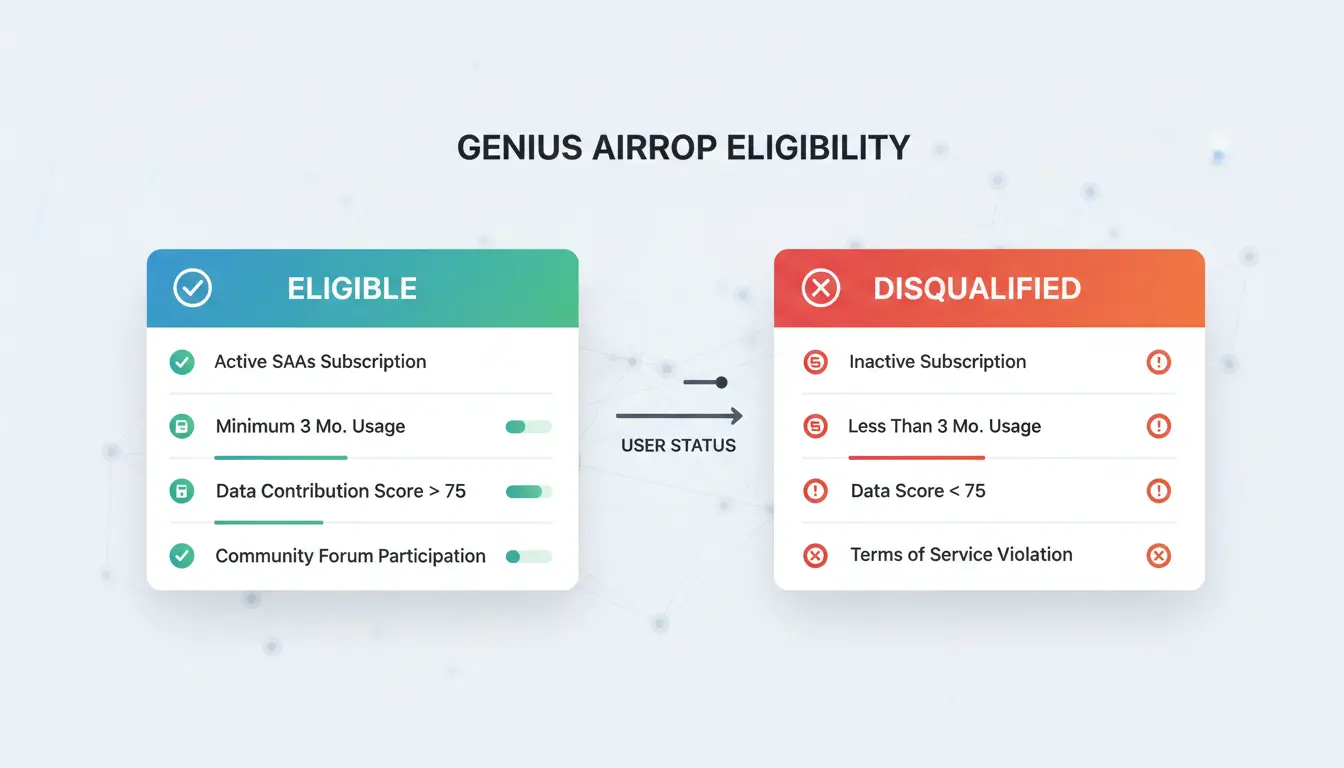
For the genius airdrop, projects usually score behavior quality, not just task count. One real wallet with consistent behavior beats ten wallets with copied patterns.
Core eligibility signals most campaigns use
Teams usually check three things: wallet history, task completion, and behavior consistency. A wallet with normal activity over time often looks safer than a fresh wallet that appears only during campaign week. They also check if you completed required actions in full, not partial clicks.
| Signal |
Usually accepted |
Often flagged |
| Wallet timeline |
Activity spread across days or weeks |
Brand-new wallet with sudden heavy activity |
| Task quality |
Full on-chain + social tasks done as required |
Repeated low-effort clicks with no follow-through |
| Interaction pattern |
Normal timing and varied transaction sizes |
Same amount, same order, same timing across wallets |
High-risk actions that trigger anti-sybil filters
Copied behavior is the fastest way to get excluded. Examples: funding many wallets from one source, running the same task sequence within minutes, or sending identical transaction amounts across addresses.
Abnormal bursts also hurt. If wallet activity, login pattern, and network location keep changing in ways that do not match normal use, filters may tag it as coordinated farming. Before claim day, check wallet safety with MetaMask safety guidance.
How to document proof of participation correctly
Keep a simple log for each task: date, wallet address, task link, transaction hash, and screenshot. Use one sheet per wallet so you can answer disputes fast.
Rule updates can invalidate old assumptions. Track official campaign channels daily and re-check requirement text before claim. Right before claiming, remove stale token permissions with Etherscan Token Approval Checker or Revoke.cash. That record set gives you a clean audit trail if the genius airdrop team reviews your wallet manually.
How do you join the Genius airdrop step by step without missing key tasks?
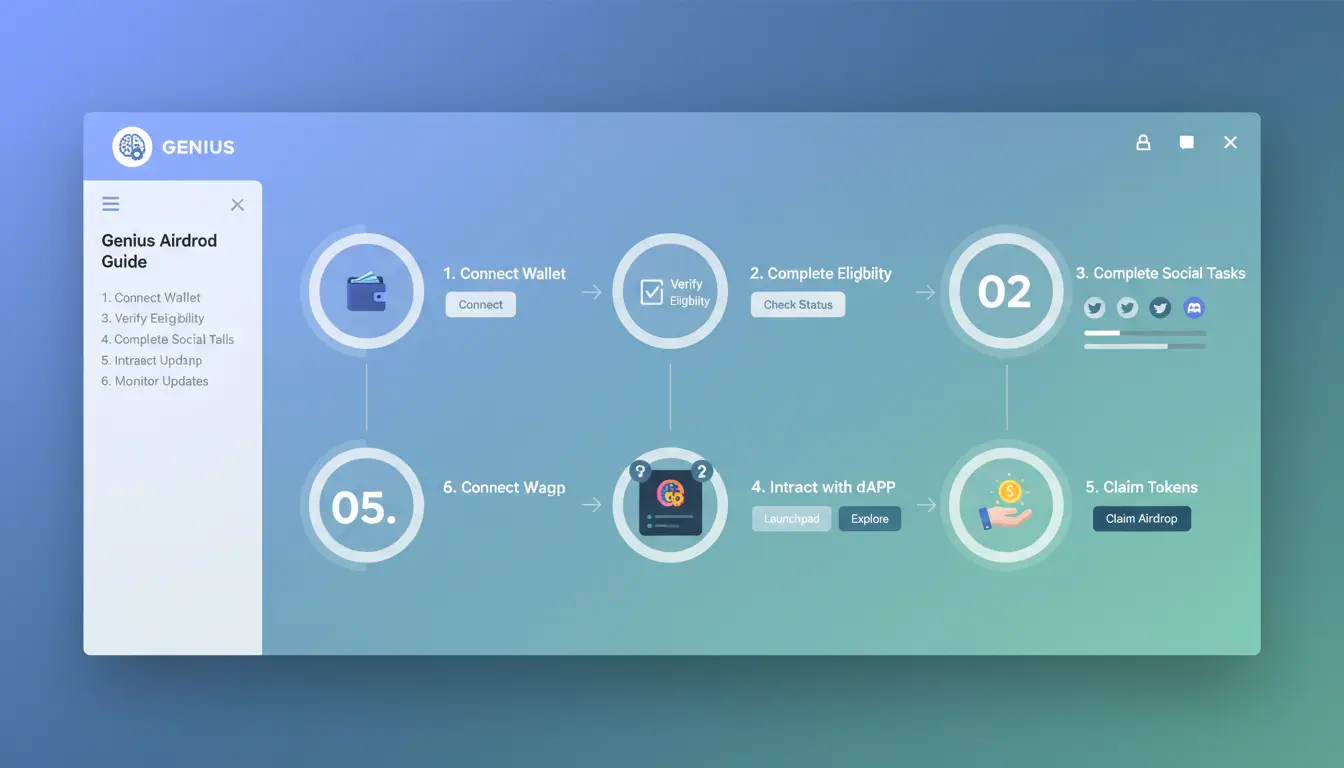
Account and wallet setup sequence
Start by confirming you are on official campaign links from the project’s verified social channels. Open the task page, connect a fresh wallet, and complete profile fields that the campaign marks as required.
Use a separate wallet for claim tasks, not your main wallet. Keep only the funds you need for task gas and one small test transaction. This lowers loss risk if you sign a bad message.
Before you sign anything, check wallet safety prompts in MetaMask safety guidance. If the campaign asks for token approval, review old approvals in Etherscan Token Approval Checker or Revoke.cash.
Then do one qualifying on-chain action shown in the task list, such as a swap or bridge action, and save the transaction hash.
Task execution routine for points and consistency
Treat the genius airdrop like a weekly checklist, not random clicks. Do recurring tasks on a fixed day and keep social tasks in one short batch.
| Task type |
Repeat window |
Weight signal |
What to do |
| Daily check-in |
Every day |
Low |
Do only if it takes under 1 minute |
| Weekly on-chain task |
Weekly |
High |
Prioritize this before social tasks |
| Trading/volume task |
Weekly/event |
Medium to high |
Use small size, avoid overtrading |
| Social task |
Daily/weekly |
Low to medium |
Batch posts and proofs at one time |
| Referral |
Ongoing |
Variable |
Track real joins, not raw invites |
If you have limited gas budget, complete high-weight on-chain tasks and skip low-value noise.
Progress tracking and error recovery
Set two reminders: one before task reset and one before leaderboard snapshot. Keep a simple log with date, task, wallet, and transaction hash.
If points do not update, check explorer confirmation, reconnect the same wallet, and refresh task proof links. Pending status can lag after chain congestion, so wait for index updates before repeating paid actions.
If a task still fails, submit support with wallet address, task name, timestamp, and hash. This gives support what they need to fix credit fast for your genius airdrop progress.
How can you farm Genius points more efficiently without looking like a bot?
Focus on high-impact actions first
Treat the genius airdrop like a weekly workflow, not a speed run. Start with tasks that repeat and pay points each cycle, then add milestone tasks that unlock larger boosts.
| Task type |
Typical effort |
Point pattern |
Priority rule |
| Recurring tasks |
Low to medium |
Small, repeatable |
Do these on a fixed schedule |
| One-time milestones |
Medium to high |
Larger, one-off |
Do early if they unlock later tasks |
Use a quick score: points earned divided by minutes spent plus gas paid. If two tasks give similar points, pick the one with lower on-chain cost. Your scorecard should drive actions, not hype in chat groups.
Referral and competition strategy that still looks organic
Referrals work better when they come from real conversations. Share one clear guide, answer setup questions, and invite over several days. Avoid sending large invite bursts in one hour.
Keep your own actions spaced out. Mix social tasks and on-chain tasks across the week. A human pattern usually has gaps, retries, and varied timing. For wallet safety during campaigns, check signatures with MetaMask safety guidance.
Common farming mistakes that reduce final allocation
Rules can change during a season. Recheck task pages before each weekly batch. A task that counted last week may have a new condition today.
Another common miss is chasing tiny tasks while skipping qualifier tasks that gate rewards. Track qualifiers in a short checklist and clear them early. After each cycle, remove stale approvals in Etherscan Token Approval Checker or Revoke.cash. This keeps your genius airdrop routine cleaner and lowers avoidable risk.
Where do people get scammed in the Genius airdrop process, and how do you avoid it?
Scams around any airdrop usually hit at one point: the claim click. In the genius airdrop flow, attackers copy official pages, rush users in DMs, and ask for risky signatures.
Most common scam paths in airdrop communities
You will see fake claim sites that look real, fake support staff asking for wallet access, and fake “early access” forms asking for seed phrases. You will also see phishing links posted in comment threads right after official posts, then repeated in direct messages.
| Scam signal |
Safe action |
| “Claim now” link from DM or comment |
Open only links from the project’s official site and pinned social posts |
| “Support agent” asks for seed phrase or remote access |
Stop chat. Real teams do not need your seed phrase |
| “Approve” pop-up with unlimited token spend |
Reject it, then inspect approvals before retrying |
Table: Scam checks adapted from MetaMask safety guidance, Etherscan, and Revoke.cash.
Wallet security rules that prevent expensive mistakes
Use one wallet for tasks and claims, and a different wallet for long-term storage. Keep only the gas you need in the task wallet. Never sign a message you do not understand. Review token approvals every week in Etherscan Token Approval Checker or Revoke.cash, then revoke old permissions.
How to verify claims, contracts, and token announcements
Check claim window dates in primary channels only: official website, official X profile, and official Discord announcements. Match the contract address across those channels before you sign anything. For the genius airdrop, treat screenshots as noise until the same contract appears on-chain in a block explorer.
How can DICloak reduce risk when managing multiple Genius airdrop wallets or team accounts?
Why multi-account airdrop workflows fail without isolation
A genius airdrop workflow breaks when wallets share the same browser profile. Sites can read signals from browser fingerprinting, login timing, and IP history, then connect accounts that should stay separate. Teams also fail when one person edits tasks, another signs, and no one can trace who changed what.
| Setup style |
Linkage risk |
Human error risk |
Traceability |
| One browser for all wallets |
High |
High |
Low |
| One isolated profile per wallet |
Lower |
Lower |
Higher |
Sources: device fingerprinting, audit trail
Set up isolated profiles with dedicated proxies in DICloak
Use one DICloak profile for each wallet or team account. Keep fingerprint settings unique per profile. Bind each profile to its own proxy endpoint and keep that pairing fixed. Do not rotate profiles between wallets.
This setup gives each account a stable identity over time. That cuts accidental linkage from mixed cookies, mixed extensions, or shared local storage. The core rule is simple: one wallet, one profile, one proxy, always.
Use team permissions, logs, and automation to scale safely
For team work, assign access by role with RBAC principles: operator can run tasks, signer can approve claims, admin can edit settings. Share only the profile needed for each role.
Turn on operation logs so you can review who opened a wallet profile, who changed proxy settings, and when a claim step ran. For repeat actions, use batch actions and RPA for click paths. This reduces missed steps and keeps your genius airdrop routine consistent across accounts.
When are snapshots and claims likely to happen, and how should you prepare?
For a genius airdrop, your score is only half the job. Timing and clean records decide if you can claim.
How seasons, snapshots, and allocation windows usually work
Projects usually score activity during season checkpoints, then lock eligibility at a final snapshot. Treat the final snapshot day like an exam date. If your wallet state changes at the wrong time, your tier can drop.
| Cycle marker |
What it affects |
What to record |
| Weekly checkpoint |
Ongoing points |
Task IDs, tx hashes, wallet used |
| Final snapshot |
Eligibility and tier |
Wallet balance/state at cutoff |
| Allocation/claim window |
Whether you can collect |
Official claim link, deadline, gas wallet |
Track announcements only from official channels like project docs.com/), X, and Discord.
Pre-claim checklist to avoid last-minute disqualification
The common failure is account mix-up across wallets and operators. Tools like DICloak let you map each wallet to a separate browser profile, with unique fingerprint settings and a fixed proxy per profile, so environments do not overlap during snapshot and claim days.
If you run a team, use role-based access and operation logs so you can audit who signed what. For repeated tasks, use batch actions or RPA to reduce manual errors. Re-check wallet approvals in Etherscan Token Approval Checker and Revoke.cash before claim.
Post-claim decisions: hold, stake, or rotate
After the genius airdrop claim, check unlock terms and live liquidity before any trade. Use CoinGecko to confirm market depth and token contract details. Avoid rush selling in the first volatile hours unless you already set rules before claim day.
Is the Genius airdrop worth your time compared with other airdrop opportunities?
Treat the genius airdrop like a weekly investment decision, not a loyalty test. Use one scorecard each Sunday: time spent, cash spent, and probability of qualifying.
Estimate effort-to-reward before committing more time
Set a hard weekly cap, such as 2 hours and $20 in gas plus slippage. If you cross the cap, stop new tasks until expected reward improves. Use three scenarios in your sheet: low, base, high allocation. Then divide each by your weekly cost. If your base case gives less value than your time target, scale down. Track hidden costs in your wallet history and approval tools like Revoke.cash and Etherscan Token Approval Checker.
Compare Genius with similar task-based airdrops
Check alternatives on DefiLlama Airdrops, quest hubs like Galxe, and chain activity data on Dune.
| Campaign |
Weekly hours |
Out-of-pocket cost |
Rule clarity |
Keep farming? |
| genius airdrop |
Your log |
Your log |
Clear / mixed / vague |
Yes / No |
| Campaign B |
Your log |
Your log |
Clear / mixed / vague |
Yes / No |
| Campaign C |
Your log |
Your log |
Clear / mixed / vague |
Yes / No |
Decision triggers for continue, pause, or exit
Continue when rules stay stable and your base-case value beats alternatives for 2 straight weeks. Pause when task criteria change without notice or qualification checks become unclear. Exit when another campaign shows better expected value with lower gas and cleaner rules.
Frequently Asked Questions
Is the genius airdrop available globally or restricted by region?
The genius airdrop is not automatically open in every country. Projects set country lists in their terms, and they may block regions due to sanctions rules, securities laws, or exchange partner limits. Check the eligibility page, blocked-country list, and your exchange’s token support before you spend time farming points.
Does the genius airdrop require KYC before claiming rewards?
Some genius airdrop campaigns ask for KYC only when you claim or withdraw tokens, not during task farming. Others require identity checks earlier to stop fraud. Read the rules for required documents, deadline, and name-match policy. If KYC is mandatory, incomplete verification usually means you cannot receive rewards.
Can one person use multiple wallets in the genius airdrop safely?
Using multiple wallets in the genius airdrop can trigger anti-sybil filters. Teams review wallet links, repeated transaction patterns, shared IP or device fingerprints, and reused social accounts. If activity looks scripted or coordinated, wallets can be grouped and removed. A weak setup can cause full disqualification, including rewards in your main wallet.
When do genius airdrop points usually convert into tokens?
Points from a genius airdrop convert to tokens on a timeline set by the project team. Most teams announce conversion near season end, around the snapshot date, or close to the Token Generation Event (TGE). Watch for ratio, vesting, and claim-window updates, since those terms decide your actual token amount.
How can I track official genius airdrop updates without missing deadlines?
To avoid missing genius airdrop deadlines, follow only official channels: the project website, X account, Discord announcements, and Telegram news channel. Keep a simple tracker for snapshot dates, claim windows, and KYC cutoffs. Before taking action, verify every link and post against the project’s main domain to avoid fake update scams.
The key to benefiting from a genius airdrop is combining early research, wallet security, and consistent participation so you can qualify without exposing yourself to unnecessary risk. Focus on legitimate projects with clear tokenomics and transparent teams, and treat every airdrop as part of a long-term strategy rather than a quick win. Try DICloak For Free
 Web Proxy Tools
 Free Tools
 Cookie Plugin
 UA Generator
 MAC Address Generator
 IP Generator
 IP Address List
 2FA Code Generator
 World Clock
 Anonymous Check
 WebRTC Leak Test
 UUID Generator
 Free Web Proxy Site
 Proxy Checker
 FB Ad Checker
 AI Web Scraping
 Free SMM Tools
 Twitter Shadowban Checker
 Instagram Name Checker
 UTM Generator
 Username Generator
 AI Hashtag Generator
 LinkedIn Headline Generator
 Social Media Image Resizer