Choosing between Claude Opus 4.1 vs ChatGPT 5 can be challenging, as both AI models offer unique features and strengths. Whether you’re looking for precision in coding, versatility in multimodal tasks, or cost‑effective access for your team, understanding how these models differ is essential. In this comprehensive comparison, we will explore their key features, performance benchmarks, integration options, and real‑world applications, helping you make the best choice for your needs.
What is Claude Opus 4.1?
Claude Opus 4.1 is one of the latest advancements in AI language models, designed to handle complex tasks across various domains. Developed by Anthropic, it aims to provide powerful solutions for coding, research, and data analysis. Let’s dive into its key features and development.
Key Features and Development
Claude Opus 4.1, released in August 2025, excels in tasks like coding, research, and data analysis. With a score of 74.5% on the SWE‑bench Verified coding test, it’s especially strong at handling complex tasks. Claude Opus 4.1 also shines in long, multi-step projects, making it ideal for developers and analysts.

ChatGPT 5, released on August 7, 2025, is OpenAI's latest AI model. It excels in text generation, coding, research, and more. Let’s explore its key features and development.
Key Features and Development
GPT‑5 is known for its versatility. It writes text, helps with coding, and even handles multimodal tasks like analyzing images.
- Improved reasoning. GPT‑5 is better at managing complex tasks, offering clearer and more accurate answers.
- Strong coding support. It can quickly generate code, build apps, and even create games from simple prompts.
- Adaptive modes. GPT‑5 can be fast for simple tasks or use more power for deep reasoning when needed.
- Reliable and safe. GPT‑5 reduces errors, ensuring more trustworthy results compared to previous versions.
These features make GPT‑5 a powerful tool for businesses, developers, and researchers.

Claude Opus 4.1 vs ChatGpt 5: Key Feature Comparisons
When we compare Claude Opus 4.1 vs ChatGPT 5, we see different strengths. Each model shines in some areas. Let’s look at four key features: coding, context window & memory, multimodal, and reasoning.
1. Coding Capabilities
Claude Opus 4.1 is very strong for coding work. In real‑world coding tests (like SWE‑bench Verified), it shows high accuracy and reliability. It works well with multi-file projects. That means it can handle many files at once, fix bugs, and refactor code across a project.
On the other hand, ChatGPT 5 (GPT‑5) can also code. It can build apps or scripts with a single prompt. But in tasks needing precise, bug‑free code — especially big projects — many developers still favor Claude 4.1 for its stability and consistency.
2. Context Window & Memory
Claude Opus 4.1 supports a large context window — up to 200,000 tokens. That lets it read or “remember” big documents or long conversations. This helps a lot when working on long codebases, reports, or big research tasks. You can feed the model many pages at once.
GPT‑5 aims for even bigger context or long-term memory (reports say GPT‑5 improves context permanence). This means GPT‑5 might better keep track of a long chat, long document, or a long project plan.
3. Multimodal Capabilities
GPT‑5 supports multimodal tasks — meaning it can understand or work with text plus other media (images, possibly audio or more) in many cases. This helps when tasks need more than text. For example, generating image-based designs, interpreting charts or screenshots, or mixing text + visuals.
Claude Opus 4.1, by contrast, is more focused on text and code. Its strength is in writing, coding, long‑text work, and reasoning — rather than media mixing.
4. Reasoning and Thinking
GPT‑5 shines in deep reasoning. It handles complex logic tasks, deep analysis, multi-step reasoning, and hard questions better than many previous models. For general tasks — essays, research summaries, planning — GPT‑5 tends to give clear and strong answers.
Claude Opus 4.1 also shows good reasoning, especially on long or multi-step tasks. It can stay “focused” over hours — making it suited for long research, complex bug tracking, or big projects. Some developers say that Opus 4.1 is more stable for “agentic workflows” — workflows where the model keeps working by itself for many steps.
Claude Opus 4.1 vs ChatGpt 5: Performance Benchmarks
When comparing Claude Opus 4.1 vs ChatGPT 5, benchmark scores offer helpful clues. They show how each model handles coding tasks and complex reasoning — in measurable ways. Here are what we know so far.
Quantitative Performance Analysis
Claude Opus 4.1
- Claude Opus 4.1 achieves 74.5 % on the real‑world coding benchmark SWE‑bench Verified. This result reflects its ability to solve real software engineering problems from public code repositories.
- Compared to its predecessor, this shows a clear improvement: the previous version (Claude Opus 4.0) scored 72.5 %.
- For modeling tasks beyond code — such as data analysis or long‑text reasoning — Anthropic highlights that Opus 4.1 improved its “agentic” abilities. That means it can better handle multi-step tasks or long interaction sessions with more stable reasoning over time.
ChatGPT 5
- ChatGPT 5 (GPT‑5) also reports strong numbers. On SWE‑bench Verified, GPT‑5 scores 74.9 %, slightly ahead of Opus 4.1 in coding tasks.
- GPT‑5 also shows improvements in reasoning, mathematics, and broader tasks. Its official documentation notes advances in speed, accuracy, and versatility compared to earlier models.
- Some public analyses suggest GPT‑5 uses fewer “tokens” to complete tasks than Opus 4.1 in certain applications — meaning it might be more efficient in cost or resource usage for some workflows.
These data show that both models are near the top for coding and general AI tasks. Neither “wins everything.” Instead, each shows strengths depending on the benchmark or workload.
Specific Benchmark Comparisons
Let’s look at a few concrete comparisons from recent tests and reports:
| Model / Version |
SWE‑bench Verified (Coding) |
Notes / Strengths |
| Claude Opus 4.1 |
74.50% |
Good at multi-file refactoring, stable for large codebases |
| GPT‑5 (ChatGPT 5) |
74.90% |
Slight edge in raw coding performance; efficient token use in some workflows |
Beyond coding: For long‑form reasoning and multi-step workflows, Opus 4.1 seems more stable — especially when projects require tracking state over many steps (e.g. research, data analysis, multi-file refactoring).
On the other hand, GPT‑5’s broader improvements and token efficiency make it a good generalist — for varied tasks like writing, math, planning, or mixed workloads.
What This Means — Benchmark Insights
- If your main focus is coding, especially large or legacy codebases, Claude Opus 4.1’s proven SWE‑bench scores and stable refactoring behavior make it a very strong choice.
- If you want flexibility, speed, cost‑effectiveness, or mixed tasks (coding + writing + planning + reasoning), ChatGPT 5 might give you better value overall.
- Benchmarks show only part of the story. Real world performance depends on context: what your project needs (code precision vs quick turnaround), how big or complex the task is, and how much you value cost/efficiency vs reliability.
Claude Opus 4.1 vs ChatGpt 5: Integration and Ecosystem Comparison
When you choose between Claude Opus 4.1 vs ChatGPT 5, how they plug into tools and systems matters a lot. Their ecosystems are different. Each gives you advantages — depending on what you want to build.
Integration and Tool Support
Claude Opus 4.1
Claude Opus 4.1 is available not only via API, but also through big cloud platforms. It works via Amazon Bedrock and Google Cloud Vertex AI. That means companies can embed it inside their own cloud workflows without big change.
If you already use tools like GitHub, Visual Studio or other IDEs, many developers report that Claude fits smoothly — especially for big coding jobs or long‑term projects.
ChatGPT 5 (GPT‑5)
On the other hand, ChatGPT 5 (GPT‑5) benefits from a large, mature developer ecosystem. Its API is well supported by many SDKs and libraries. That means building a prototype or integrating GPT‑5 into your app can be faster — many helper libraries are ready to use.
GPT‑5 also tends to have more third‑party plugins or tools connected to it. For teams that need features like webhooks, automation, or varied integrations (e.g. with web apps, productivity tools, or external data sources), this “ecosystem richness” can save time and effort.
Ecosystem Focus: Stability vs Flexibility
- Claude’s ecosystem seems optimized for stable, large‑scale, technical workflows. Its integration with cloud platforms and developer tools makes it solid for enterprise‑scale projects, backend systems, and long‑term maintenance work.
- GPT‑5’s ecosystem leans more toward flexibility, speed, and broad use cases — everything from simple scripts to web apps to creative tools. Because of its developer‑friendly integrations and plugin ecosystem, many teams pick GPT‑5 when they want fast setup, quick iteration, or mixed‑use (text, code, automation).
What This Means for You
When you weigh Claude Opus 4.1 vs ChatGPT 5, think about what you need beyond just “which writes better code or text.” Ask:
- Do you need cloud or enterprise integration and long-term stability → Claude Opus 4.1 is a strong fit.
- Do you need fast setup, wide tool support, or varied use cases (scripts, apps, web tools) → ChatGPT 5 gives more flexibility.
- Is your project large, complex, and long-running? Then Claude may offer more consistency.
- Is your project small, dynamic, or experimental? Then GPT‑5’s rich ecosystem helps you move fast.
Claude Opus 4.1 vs ChatGpt 5: Architectural Differences
When you compare Claude Opus 4.1 vs ChatGPT 5, you also compare what is inside — how each model is built. Their “architecture” — design, training, and internal setup — shapes how they work in real use.
Claude Opus 4.1
- Claude Opus 4.1 is built as a transformer-based model, like many modern AI systems.
- Importantly, Claude’s design includes a focus on “agentic tasks” and stable long‑term reasoning. In its announcement, the creators note that version 4.1 improves over earlier versions for real‑world coding, multi-step reasoning, and tasks that require keeping track of many steps.
- The model also uses a “safety and alignment” design: before release, Claude is tuned with rules and principles meant to make it helpful and avoid harmful outputs. This “alignment first” design influences how it answers questions, especially in sensitive or ambiguous contexts.
Because of this architecture, Claude tends to be stable and cautious. It is good at long code sessions, big projects, and detailed tasks that need consistency. This gives it strength when you need reliability over “flash speed.”
ChatGPT 5
- ChatGPT 5 (GPT‑5) builds on the same basic transformer‑based approach used in earlier models. Many recent models use “transformer + massive data training + reinforcement learning or fine‑tuning.”
- GPT‑5 aims for versatility: high speed, efficient token use, and ability to handle many task types (code, text, multimodal, reasoning). According to a developer comparison, in some tasks GPT‑5 uses far fewer tokens and works faster than Opus 4.1 — which suggests optimization in token efficiency and inference speed.
- GPT‑5’s architecture appears tuned for a broad range of tasks — from coding to app prototypes to general reasoning — prioritizing flexibility and efficiency.
Because of this design, GPT‑5 tends to be more “lightweight and fast.” It works well when users want quick results, prototyping, mixed tasks, or many short interactions.
Architectural Trade‑offs: Stability vs Flexibility
No architecture is “perfect.”
- Claude’s structural design gives reliability, consistency, and safety — but sometimes at the cost of speed or token cost.
- GPT‑5’s design gives speed and efficiency — but may trade off some depth or cautiousness that matters in big or sensitive tasks.
Claude Opus 4.1 vs ChatGpt 5: User Experience and Practical Applications
When you choose between Claude Opus 4.1 vs ChatGPT 5, it helps to see how real people use them. Their design and features lead to different user experiences. Here are common ways people use each model — and how easy they are to work with.
Claude Opus 4.1
- Complex programming and code maintenance. Many developers use Claude Opus 4.1 to handle large codebases. For example, Opus 4.1 can refactor dozens of files, fix bugs across a project, and maintain consistency. People say it works well for “deep, careful” coding.
- Long research and technical writing. Opus 4.1 is good at reading long documents, combining information, and producing structured, detailed output. That makes it helpful for research reports, technical specs, or documentation.
- Enterprise‑level or heavy‑duty tasks. Because it's built for “agentic tasks” and complex workflows (multi-step, long-term), Claude Opus 4.1 suits teams or businesses working on serious projects — where accuracy, consistency, and stability matter more than speed.
Many users value Opus 4.1 when they need reliable code output or deep analysis. One developer, for instance, reported that Opus 4.1 helped them find and fix a critical bug across hundreds of lines — a task that would have taken hours manually.
ChatGPT 5
- Rapid prototyping and small‑scale projects. GPT‑5 (ChatGPT 5) is often used when someone needs quick results. It can generate working front‑end code, scripts, or small applications from a short prompt in minutes. That makes it useful for early-stage projects, prototypes, or hobby coding.
- Creative content, mixed tasks, and multimodal use. Because GPT‑5 supports multimodal and varied tasks — from writing, planning, design‑related code to mixed content creation — it's good for users who need flexibility. For example, web designers using GPT‑5 may combine text, code, and layout ideas quickly.
- Fast iteration and agile workflows. Teams that value speed — quick feedback, fast changes, short lifecycles — often choose GPT‑5. It can produce drafts, mockups, web‑app sketches, or simple utilities fast. That helps when time matters more than deep precision.
One user story: a small startup used GPT‑5 to build a prototype app in under a day. They coded the UI, backend scaffolding, and basic logic. Later, they switched to a more stable tool for production — sometimes Opus 4.1.
What This Means — Practical Advice
- If you are building or maintaining large software, important systems, or long-term projects, consider Claude Opus 4.1. It gives stability, careful output, and handles complexity with less risk.
- If you are doing small projects, rapid prototypes, mixed content (code + design + text), or fast iterations, ChatGPT 5 may offer better speed, flexibility and convenience.
- Many teams might benefit from using both: Opus 4.1 for serious code and backend tasks; GPT‑5 for front-end, prototypes, content generation, or mixed tasks.
Claude Opus 4.1 vs ChatGpt 5: Safety, Ethics, and Reliability
When you choose between Claude Opus 4.1 vs ChatGPT 5, safety, ethics, and reliability matter a lot. These aspects affect real‑world use. Below is how each model handles them.
Claude Opus 4.1
- The team behind Claude Opus 4.1 makes safety a core goal. The model is released under a strict standard, called ASL‑3.
- According to public info, Claude Opus 4.1 refuses nearly all harmful or policy‑violating requests. Its refusal rate for such requests is high (for example, 98.76% refusal on problematic asks), while keeping a very low refusal rate (0.08%) for harmless requests.
- This design makes Claude Opus 4.1 good for sensitive tasks. For example, when used for enterprise coding, data analysis, or long research — environments where mistakes or unsafe output could cause problems — the built‑in safety guardrails help keep output reliable.
- Also, because the model is developed by a team focused on “agentic tasks” with long‑chain reasoning, it tends to behave more carefully when handling complex instructions or multi‑step logic. This reduces risk when the tasks are heavy or sensitive.
ChatGPT 5
- The makers of ChatGPT 5 (often called GPT‑5) also highlight safety improvements. Compared with older models, GPT‑5 uses a new approach: instead of simply refusing risky prompts, it often returns a “safe completion,” giving partial or carefully framed answers when a prompt is ambiguous or potentially sensitive.
- This “safe completions” method aims to balance usefulness and caution. For users working in education, business, or general creative tasks, GPT‑5 may give more helpful output — even when topics are delicate — while still trying to follow safety rules.
- In evaluations shared publicly, GPT‑5 shows fewer factual mistakes than previous versions. One recent independent test claims GPT‑5 makes “80% fewer factual mistakes” than an older OpenAI model.
- For many everyday tasks — writing, summarizing, planning, coding small scripts — GPT‑5 seems reliable and safe for general use. Its flexibility and improved safety make it suitable for a wide audience of users.
What This Means: Picking Based on Risk Sensitivity
- If you need strong safety, compliance, and reliability — for sensitive projects, enterprise code, or regulated content — Claude Opus 4.1 tends to be more robust thanks to its strict safety framework (ASL‑3) and high refusal rate on risky requests.
- If you need flexibility, friendly user experience, and broad use (writing, general research, content, small coding) — ChatGPT 5 can be a good fit, especially when you value smoother interaction and faster results while still having decent safety.
- In both cases, you should not trust the AI blindly. AI can help a lot — but human review remains important, especially for critical work.
Claude Opus 4.1 vs ChatGpt 5: Cost and Accessibility
Claude Opus 4.1
- For Claude Opus 4.1, pricing is based on “tokens” — how much text you send in (input) and how much you get back (output).
- The cost is US$15 per 1 million input tokens, and US$75 per 1 million output tokens.
- If you are doing many tasks together (batch processing) or reusing prompts, costs can drop — there are ways to reduce cost when usage is heavy or repetitive.
- Because of this, Claude Opus 4.1 is more expensive than many lighter models. Some users see high cost when output is long or frequent.
- For heavy coding, data analysis, or long document work, the premium may be worth it — but for light or occasional tasks, the cost can add up fast.
ChatGPT 5
- For ChatGPT 5 (GPT‑5), access is usually via subscription plans from OpenAI.
- A common plan is “Plus” for US$20/month. This unlocks better performance, priority access, and access to advanced features of GPT‑5 — enough for many regular users.
- For heavy or business use, there is a “Pro” tier (e.g. ~US$200/month) that gives higher limits and best model access.
- There are also free or lower‑cost (or limited‑use) plans. Free users may access GPT‑5 under limits, though with some restrictions in message volume or feature set.
- Because subscription pricing is fixed, GPT‑5 can be more budget‑friendly for frequent users — especially when usage volume is high — compared with a per‑token billing model like Claude’s.
What This Means in Practice
- If you run many big tasks — writing long reports, large-scale code work, heavy data processing — with Claude Opus 4.1, expect higher cost, but also higher power and precision.
- If you do frequent, moderate tasks — writing, planning, small code, general chat — ChatGPT 5 may be more cost‑effective and has simpler billing (subscription).
- For users unsure about volume, subscription‑based GPT‑5 offers predictable cost and easy access. If you need “pay‑as‑you‑go” and only occasional heavy tasks, Claude Opus 4.1’s per‑token pricing can work — but you must watch your usage.
Claude Opus 4.1 vs ChatGpt 5: Complete Comparison Table
To make it easier for you to compare Claude Opus 4.1 vs ChatGPT 5, here's a side-by-side table that highlights the key features, performance benchmarks, and other differences. This comparison will help you choose the model best suited to your needs.
| Feature |
ChatGPT 5 (GPT-5) |
Claude Opus 4.1 |
| Release Date |
August 7th, 2025 |
August 5th, 2025 |
| Availability |
Default for all users, Plus/Pro tiers available |
API, Amazon Bedrock, Google Cloud Vertex AI, Claude Code |
| Context Window |
Up to 1,000,000 tokens (5x larger) |
200,000 tokens (optimized for consistent performance) |
| Multimodal Support |
Text, image, audio, video, and code processing |
Text and code only (specialized focus) |
| SWE-bench Verified Score |
74.9% with thinking mode enabled |
74.5% with precision-focused approach |
| Aider Polyglot Score |
88% performance rating |
Not specified |
| AIME 2025 Math Score |
94.60% |
78% |
| MMMU Multimodal Score |
84.2% multimodal understanding |
No native multimodal capabilities |
| Reasoning Architecture |
Dual modes: quick response + extended thinking |
Agentic task handling with detailed tracking |
| Token Efficiency |
50-80% fewer tokens than competitors for similar performance |
Consistent performance across full context length |
| Coding Strength |
One-prompt app creation with aesthetic sensibility |
Multi-file refactoring with surgical precision |
| Debugging Capability |
Complex repository debugging with design awareness |
Pinpoint exact fixes without introducing bugs |
| Memory Management |
Smart routing based on complexity |
Optimized for sustained coding sessions |
| Interface Personalization |
Custom personalities, themes, voice integration |
Drop-in replacement maintaining familiar interface |
| Voice Features |
Enhanced ChatGPT Voice for natural conversations |
Not available (text-focused) |
| Platform Integration |
Apple Intelligence, Siri, API platform |
GitHub Copilot, Amazon Bedrock, Google Cloud |
| Developer Tools |
Minimal reasoning mode, verbosity controls |
GitHub optimization, Apidog integration |
| Enterprise Focus |
Workforce productivity and automation |
Production-proven reliability and precision |
| Best Use Cases |
Creative content, multimodal applications, healthcare |
Enterprise software development, technical workflows |
| Hallucination Rate |
45% less likely than GPT-4, 80% less with extended thinking |
Minimal hallucination with production-ready output |
| Performance Consistency |
Variable based on routing between modes |
Consistent across full context without degradation |
Maximize Savings and Enhance Security:Using DICloak Antidetect Browser to Share Your Claude and ChatGPT Account
When you pick between Claude Opus 4.1 and ChatGPT 5, you may worry about cost, access, and account security. That’s where DICloak can help. It offers a way to share, manage, and protect your AI accounts — for savings and safety.
1. Cost Savings and Simplified Team Collaboration
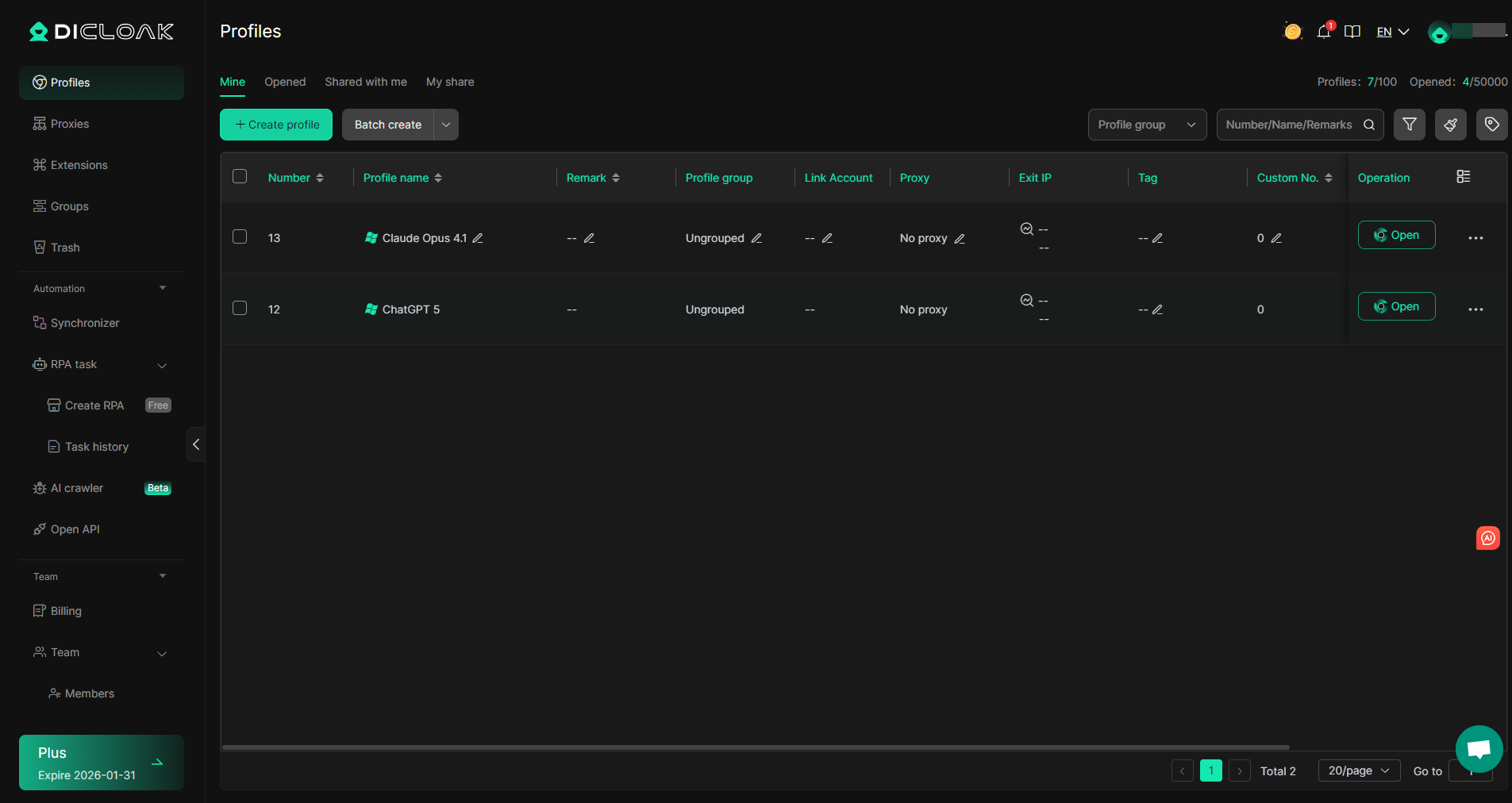
With DICloak, businesses don't need to purchase separate subscriptions for each team member for Claude and ChatGPT. By sharing a single account, companies can save costs while still gaining full access to the advanced features of Claude AI and ChatGPT. Additionally, DICloak simplifies team management by offering centralized control over account access, making collaboration more efficient and reducing the complexity of managing multiple accounts or subscriptions.
- Lower individual license expenses
- Securely share ChatGPT accounts across multiple users
- Optimize resource allocation for your team, ensuring efficient use of tools and features
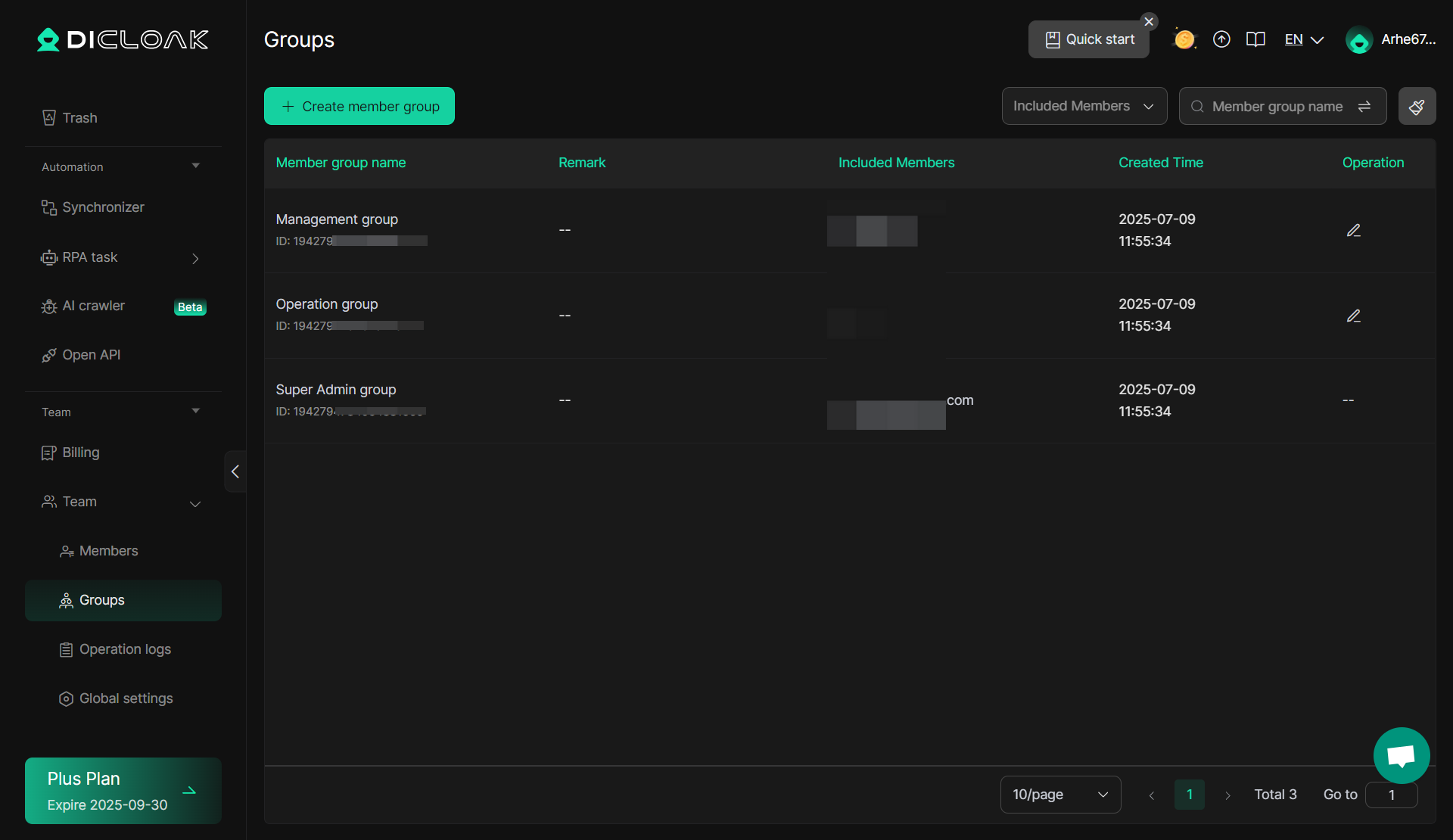
2. Multiple Users, Unified Browser Fingerprints
With DICloak, even when multiple users access shared Claude and ChatGPT accounts, all activities are conducted under a unified fingerprint and IP configuration. This ensures that platforms recognize the actions as coming from a single user, preventing detection, restrictions, or verification challenges, and enabling secure and seamless account sharing.
- Unified fingerprint and IP configuration for all shared Claude and ChatGPT users
- Prevent detection, restrictions, and access conflicts
- Minimize costs related to potential account bans from shared Claude and ChatGPT usage
3. Avoid Account Theft and Protect Sensitive Data
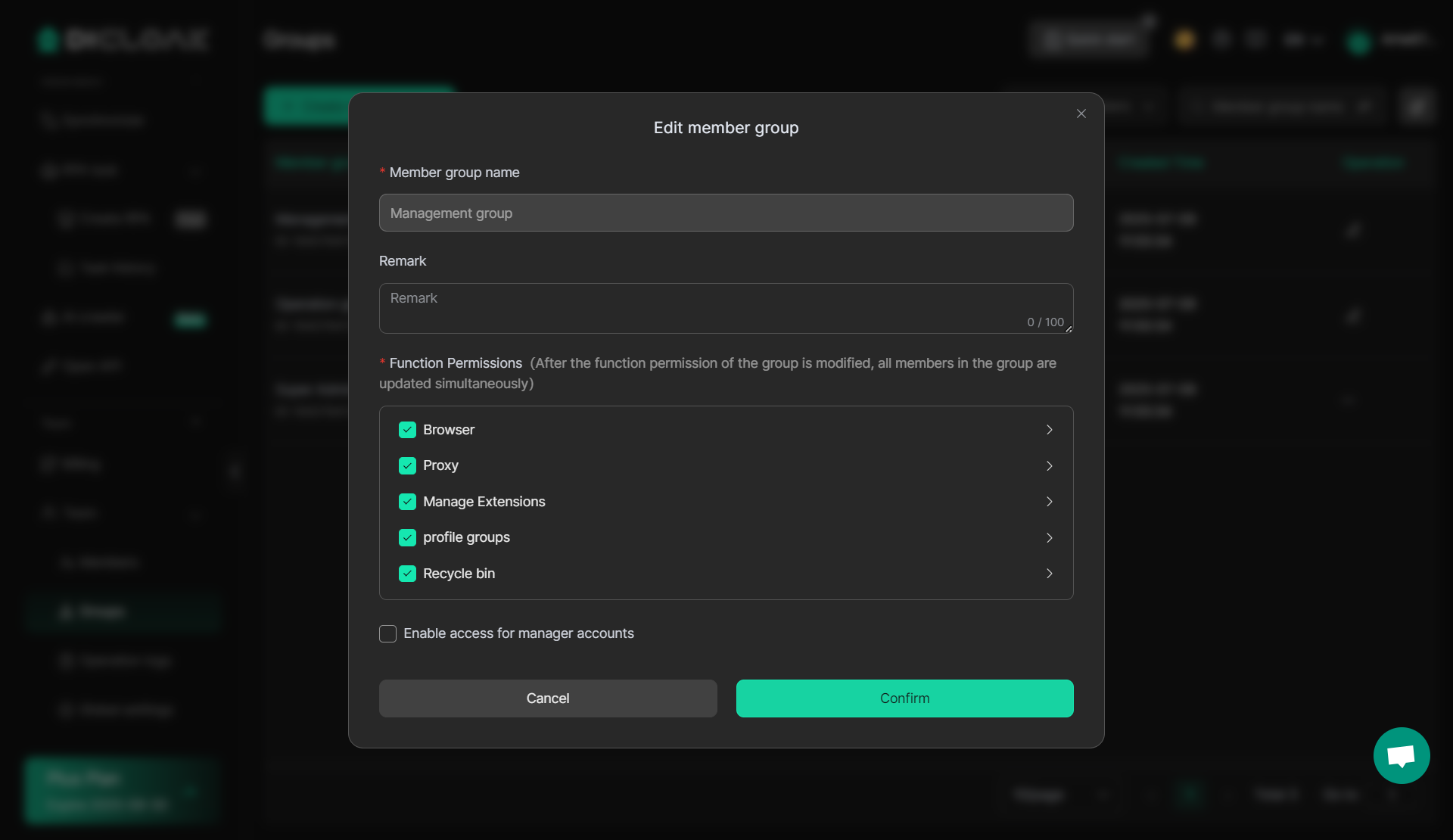
With DICloak, you can securely share your ChatGPT or Claude account without worrying about credential theft or misuse. Each user operates within a protected profile, ensuring passwords, subscription plans, and sensitive data remain secure. Account owners maintain full control, as DICloak allows for setting specific permissions and tracking login activities.
- Prevent unauthorized access and credential theft
- Protect sensitive data from misuse or leaks
- Ensure only authorized users can access or modify critical information
Conclusion
In the Claude Opus 4.1 vs ChatGPT 5 comparison, both models offer powerful features tailored to different needs. Claude Opus 4.1 is best for long‑term, high‑precision tasks, like coding refactoring, enterprise work, and research, where stability and accuracy are crucial. On the other hand, ChatGPT 5 shines with its multimodal capabilities and flexibility, making it a great choice for creative projects, fast prototyping, and general purpose tasks.
Choosing between the two depends on your use case and budget. For shared access, DICloak Antidetect Browser provides a cost‑effective solution to securely share both models within teams, ensuring privacy and account security.
By understanding these strengths, you can make an informed decision about which AI tool best suits your requirements, whether it's precision, flexibility, or overall performance.
FAQs Related to Claude Opus 4.1 vs ChatGPT 5
1. What are the main differences between Claude Opus 4.1 vs ChatGPT 5?
Answer: The key differences between Claude Opus 4.1 vs ChatGPT 5 lie in their features, pricing, and performance. Claude Opus 4.1 excels in coding accuracy and long‑term stability, making it ideal for enterprise and technical tasks. In contrast, ChatGPT 5 offers broader multimodal support, allowing for text, image, and video processing, and is often preferred for quick prototypes or creative work.
2. Which model is better for coding tasks: Claude Opus 4.1 or ChatGPT 5?
Answer: For coding tasks, Claude Opus 4.1 is generally more reliable due to its precision-focused architecture and high performance on coding benchmarks like SWE-bench. It performs better in multi-file refactoring and bug fixing. However, ChatGPT 5 can handle coding tasks more quickly, especially for smaller projects or rapid prototyping, making it more efficient for less complex programming.
3. Which model provides better multimodal capabilities: Claude Opus 4.1 or ChatGPT 5?
Answer: ChatGPT 5 outperforms Claude Opus 4.1 when it comes to multimodal capabilities. It supports text, image, audio, video, and code processing, making it suitable for tasks that require working with different types of media. Claude Opus 4.1, on the other hand, is specialized in text and code, lacking native multimodal features.
4. Which AI is more cost-effective: Claude Opus 4.1 vs ChatGPT 5?
Answer: ChatGPT 5 offers more predictable pricing, with its monthly subscription plan being more cost‑effective for users with moderate or frequent needs. Claude Opus 4.1 uses a pay-per-token model, which might be cost‑effective for smaller, less frequent tasks but can become expensive for heavy or long‑term usage. For shared team use, ChatGPT 5 also offers better flexibility and ease of access.
5. Can I share my Claude Opus 4.1 or ChatGPT 5 account with my team securely?
Answer: Yes, you can use DICloak Antidetect Browser to securely share both Claude Opus 4.1 and ChatGPT 5 accounts. DICloak allows multiple users to share a single account while keeping fingerprints isolated, which helps avoid detection and account bans. By using profiles in DICloak, you ensure that each user operates in a safe, isolated environment without risking account theft or security breaches.
 Web Proxy Tools
 Free Tools
 Cookie Plugin
 UA Generator
 MAC Address Generator
 IP Generator
 IP Address List
 2FA Code Generator
 World Clock
 Anonymous Check
 WebRTC Leak Test
 UUID Generator
 Free Web Proxy Site
 Proxy Checker
 FB Ad Checker
 AI Web Scraping
 Free SMM Tools
 Twitter Shadowban Checker
 Instagram Name Checker
 UTM Generator
 Username Generator
 AI Hashtag Generator
 LinkedIn Headline Generator
 Social Media Image Resizer