The Conflict Between E-commerce Giants
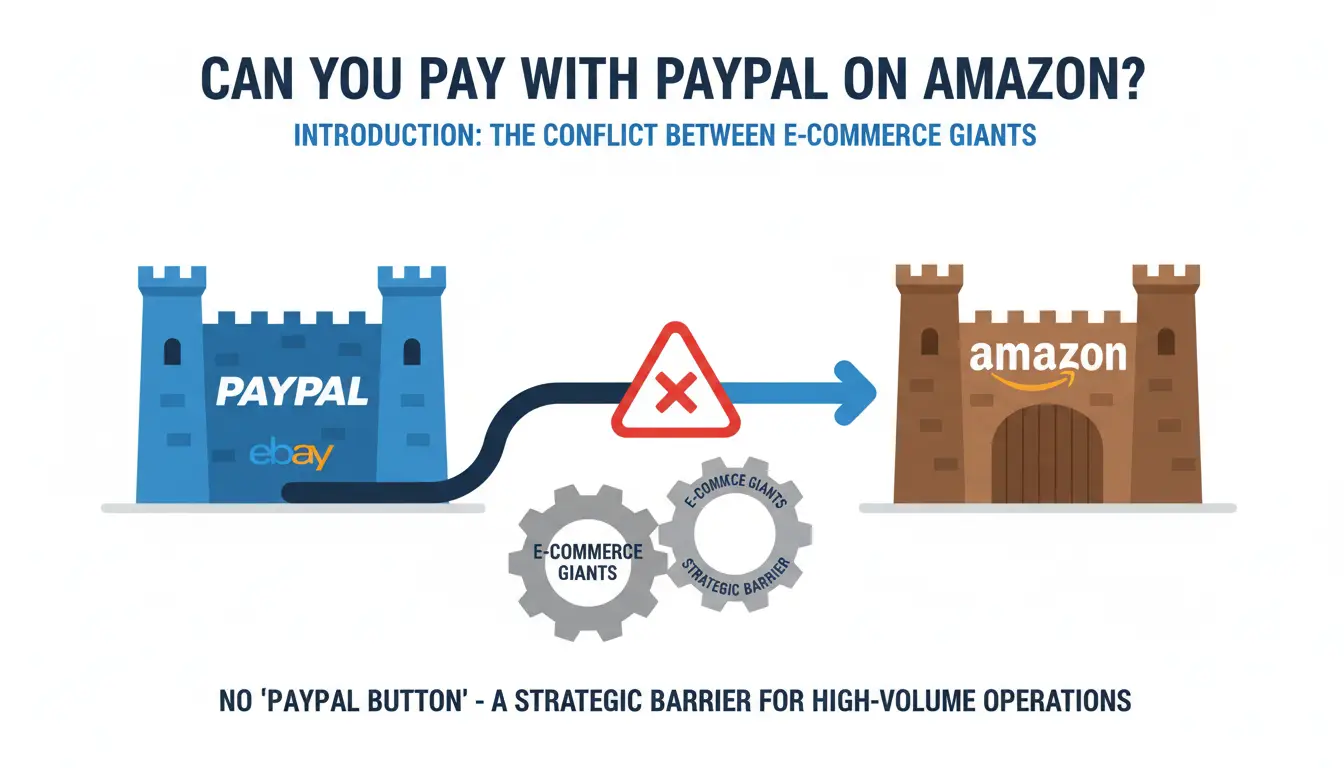
For digital operators and infrastructure architects, the lack of a "PayPal button" on Amazon is not a technical oversight but a strategic barrier. From a historical perspective, the absence of direct integration stems from PayPal’s former ownership by eBay—Amazon’s primary competitor—and the subsequent push for Amazon Pay. Amazon’s goal is to maintain absolute control over the payment stack, transaction metadata, and fee retention.
While direct support is non-existent, professional entities utilize infrastructure-level abstractions to bridge this gap. Understanding these indirect methodologies is essential for maintaining liquidity and operational flow without compromising account integrity.
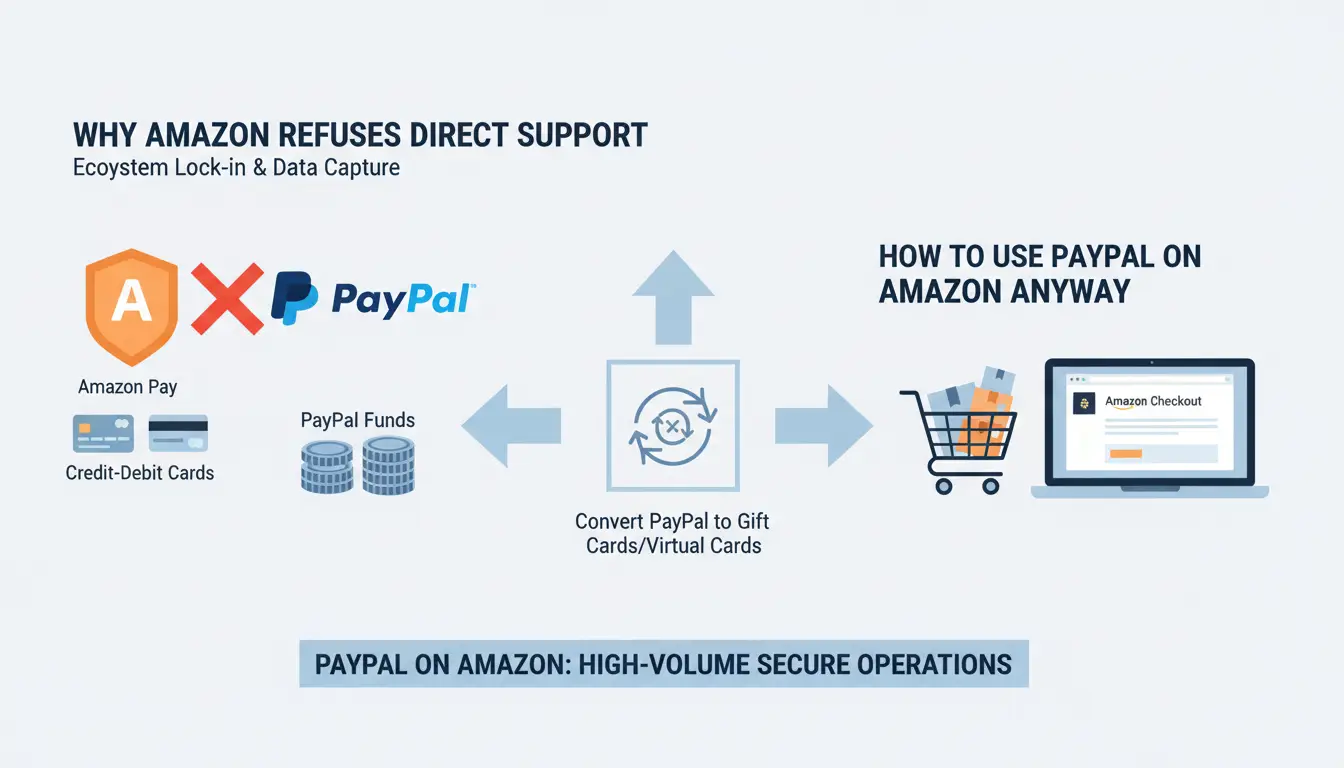
Why Amazon Refuses Direct Support and How to Use PayPal on Amazon Anyway
Amazon’s refusal to support PayPal is a fundamental exercise in ecosystem lock-in. By forcing the use of Amazon Pay and standard credit/debit rails, Amazon mitigates third-party dependency and captures 100% of the customer’s purchase data.
To bypass this restriction, operators must convert PayPal liquidity into a medium that Amazon’s payment processor recognizes as a standard Mastercard or native balance. This requires moving beyond consumer-level thinking and adopting a systematic approach to fund conversion and identity isolation.
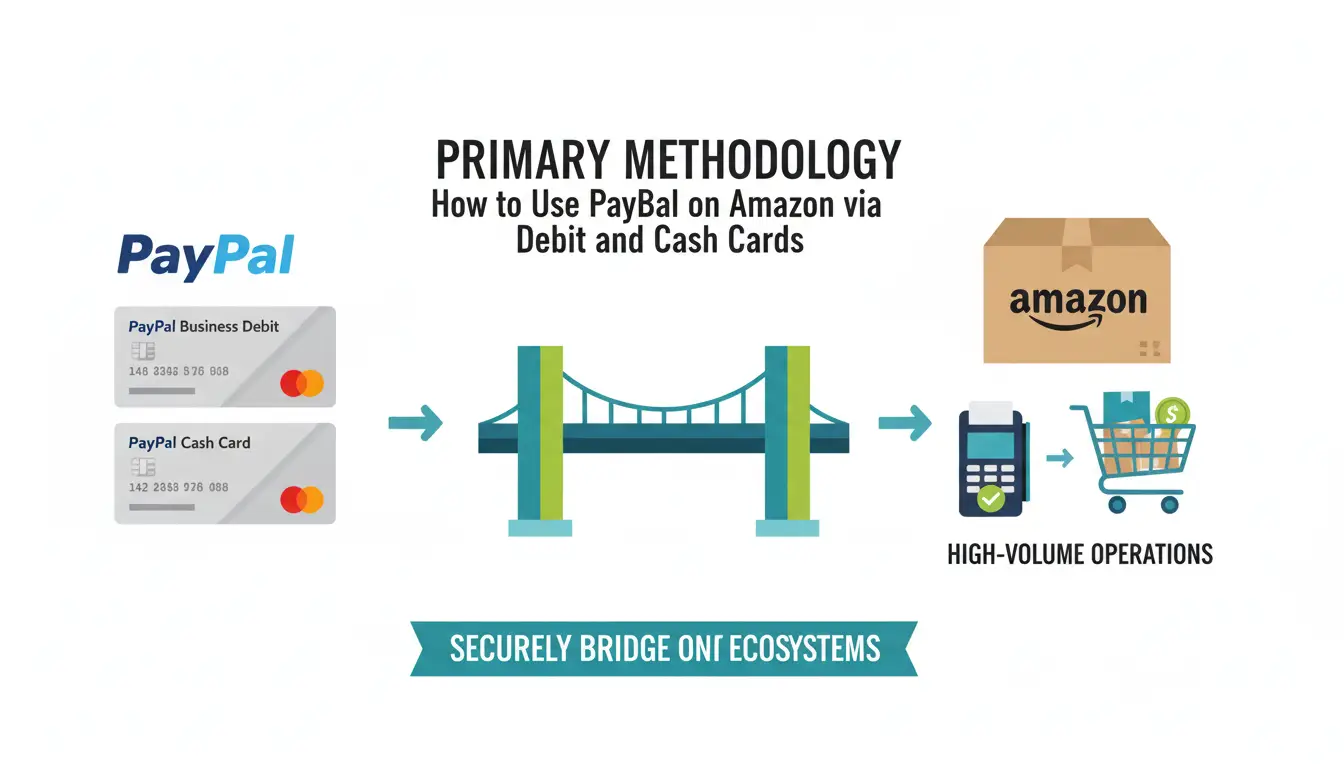
Primary Methodology: How to Use PayPal on Amazon via Debit and Cash Cards
The most efficient way to bridge the two ecosystems is through the Mastercard network. PayPal offers physical and virtual instruments that are indistinguishable from standard bank cards to Amazon’s gateway.
PayPal Business Debit Mastercard and Cash Cards
The PayPal Business Debit Mastercard is the preferred tool for high-volume operators. It allows for direct access to a PayPal balance with the added benefit of cashback on eligible inventory or supply purchases. For personal entities, the PayPal Cash Card provides a similar mechanism, pulling funds directly from the PayPal balance at the point of sale.
The Legacy Status of PayPal Key and Virtual Cards
The PayPal Key was previously a highly effective virtual card abstraction. However, according to current technical status and regional data, this feature is increasingly deprecated or "not always available" in various jurisdictions. For 2026-era operations, relying on virtual card ranges (BINs) that are frequently flagged by Amazon’s fraud detection algorithms is a high-risk strategy. Physical cards or well-aged business instruments remain the more resilient choice.
Strategic Workarounds: Can You Pay With PayPal on Amazon Using Third-Party Gift Cards?
When card-based methods are not viable, operators utilize "currency conversion" via third-party retailers. Digital gift card vendors such as Walmart, eGifter, and Gyft accept PayPal for the purchase of Amazon Gift Cards. This method effectively converts PayPal credit into Amazon-native currency.
Pro Tip: When scaling, monitor your redemption velocity. Rapidly loading high-value gift cards from multiple third-party sources into a single account can trigger Amazon’s anti-fraud "batch-processing" filters, potentially leading to a locked balance or account suspension.
Risk Mitigation: How to Use PayPal on Amazon Without Triggering Account Bans
In the current 2026 digital landscape, platforms use hyper-sophisticated "Account Association" protocols. Amazon and PayPal track users not just by IP, but through complex browser fingerprints. Logging into multiple accounts via a standard browser—even when using different payment methods—often results in a "linked account" ban because the hardware footprint remains identical.
The Risks of Hardware Acceleration and Entropy Tracking
Modern tracking goes beyond cookies. Platforms utilize Canvas fingerprinting and WebGL metadata to extract unique identifiers from your GPU and hardware acceleration settings. Even with a fresh IP, the "entropy" of your system—the unique combination of screen resolution, fonts, and hardware rendering—allows Amazon to link your PayPal-funded account to previously banned or restricted identities.
Scaling Operations: Using DICloak to Isolate Digital Fingerprints
For professional growth infrastructure, manual isolation is insufficient. DICloak serves as the technical solution for managing multi-account workflows by isolating the runtime environment of every browser profile.
How DICloak Prevents Canvas and WebGL Tracking
Instead of simply masking data, DICloak generates unique, consistent Canvas hashes and WebGL parameters for each profile. This ensures that Amazon’s security systems perceive every login as a unique hardware entity, preventing the cross-contamination of digital signatures across multiple payment workflows.
Step-by-Step Logic for Scaling Multi-Account Amazon Orders
- Profile Initialization: Deploy a unique DICloak environment for each discrete Amazon account.
- Environment Isolation: Configure the browser's hardware parameters (AudioContext, WebGL, and Canvas) to ensure distinct hardware entropy.
- Proxy Routing: Assign a dedicated proxy to each profile to maintain geolocation consistency (ensure no unmasked environments are used).
- Payment Mapping: Allocate a specific PayPal Business Debit card or gift card pool to each isolated profile to prevent financial linkage.
Comparing Standard Methods vs. DICloak Workflows
| Feature |
Standard Browsers |
DICloak Environment |
| Fingerprint Masking |
Low (Entropy is easily leaked) |
High (Unique Canvas/WebGL/API Spoofing) |
| Account Isolation |
Shared hardware signatures |
Complete runtime environment isolation |
| Proxy Management |
Manual/Prone to leaks |
Integrated per-profile routing |
| 2026 Scalability |
High risk of mass "linked account" bans |
Resilient for high-volume operations |
Technical Protocol: Can You Pay With PayPal on Amazon via Bank Settlement?
The most stable, though least immediate, method is utilizing the banking "fail-safe." By transferring PayPal funds to a linked bank account, the capital is moved onto standard banking rails.
Understanding the Settlement Lag and Verification
While this method is the most reliable because it uses a bank-issued card that Amazon fully trusts, it involves a settlement lag of 1–3 business days. For operators requiring high-velocity inventory turnover, this lag must be accounted for in the liquidity cycle. This method is the "gold standard" for security but the weakest for immediate operational needs.
Pros and Cons of Using PayPal for Amazon Operations
Pros:
- Arbitration Layer: Access to PayPal’s dispute resolution for third-party purchases.
- Operational Liquidity: Spend PayPal balances immediately via Debit/Cash cards.
- Business Rewards: Cashback benefits through the Business Debit Mastercard.
Cons:
- Abstraction Steps: Requires intermediate card management or gift card procurement.
- Transaction Costs: Potential fees from third-party gift card vendors.
- Detection Risk: High-volume operations risk account flagging if the digital footprint is not properly isolated.
Conclusion: Building a Resilient E-commerce Payment Strategy
While you cannot find a native PayPal button on Amazon, the strategic use of Mastercard-linked cards and gift card conversions allows for professional-grade operations. The defining factor for success in 2026 is not just the payment method, but the infrastructure used to deploy it. By combining PayPal’s financial flexibility with the isolation capabilities of DICloak, operators can scale their Amazon activities while remaining invisible to aggressive account-linking algorithms.
Expert FAQ: Technical Insights on How to Use PayPal on Amazon
Can I link PayPal to Amazon directly?
No. Amazon excludes direct PayPal integration to prioritize Amazon Pay and maintain absolute control over the transaction metadata and fee structures.
Is it safe to buy Amazon Gift cards with PayPal?
It is a standard industry practice, provided you use reputable vendors. However, you must manage your redemption velocity to avoid triggering Amazon’s anti-fraud filters.
Can I use PayPal Credit on Amazon?
Indirectly. You can use PayPal Credit as the funding source for a PayPal Cash Card or use it to purchase Amazon gift cards from authorized third-party retailers.
What is the most reliable way to manage multiple Amazon accounts?
The industry standard is environment isolation. Using DICloak to manage unique browser fingerprints and hardware hashes, combined with dedicated proxy management, prevents the "Account Association" bans that standard browsers cannot stop.
 Web Proxy Tools
 Free Tools
 Cookie Plugin
 UA Generator
 MAC Address Generator
 IP Generator
 IP Address List
 2FA Code Generator
 World Clock
 Anonymous Check
 WebRTC Leak Test
 UUID Generator
 Free Web Proxy Site
 Proxy Checker
 FB Ad Checker
 AI Web Scraping
 Free SMM Tools
 Twitter Shadowban Checker
 Instagram Name Checker
 UTM Generator
 Username Generator
 AI Hashtag Generator
 LinkedIn Headline Generator
 Social Media Image Resizer