If you've ever experienced a sudden, significant drop in engagement—fewer likes, replies, and retweets—on your X (formerly Twitter) posts, you may be dealing with an "X shadowban." While the platform has shifted its content moderation approach, Elon Musk's philosophy of "freedom of speech, not freedom of reach" confirms that content suppression policies are still active. While frustrating, a shadowban is a solvable problem if you understand how X's algorithms work. This article will explain what an X shadowban is, how to check if your account is affected, and provide actionable steps to fix it.
What is an X Shadowban?
A shadowban is a form of content suppression where an account's visibility is reduced without any direct notification to the user.

An X shadowban can affect your account in several specific ways:
- Your tweets do not appear when someone searches for your username.
- Your posts do not show up under the hashtags you used.
- Your replies to other users' tweets are hidden or very difficult to find.
- Your overall account engagement drops significantly and without a clear reason.
Shadowban vs. Deboosting: What's the Difference?
"Deboosting" is a more subtle form of shadowbanning where your tweets are not completely hidden but are deprioritized in search results and recommendations, making them less likely to be seen by users who don't already follow you. Since both a shadowban and deboosting limit your reach and are triggered by similar causes, this article will use the term "X shadowban" for simplicity, as this is how users commonly refer to both forms of content suppression.
While X has officially denied the practice of "shadowbanning," user reports and experiences strongly suggest that the platform's algorithms do limit the visibility of certain accounts based on perceived violations of its rules.
How to Know if You Have an X Shadowban
Use a Shadowban Checker
Online tools, such as the Circleboom shadowban checker, can serve as a quick starting point to analyze if your account is restricted. While these third-party tools are not affiliated with X, they can provide a useful initial assessment of your account's visibility.
The most reliable way to check for a shadowban is to perform a manual search. Open a new incognito or private browser window (or log out of your X account) and search for your username, a recent tweet, or a hashtag you've recently used. If your content is missing or difficult to find, it is a strong indicator that your account has been shadowbanned.
Look for Sudden Drops in Engagement
Review your account's analytics. Compare your recent engagement metrics (likes, retweets, replies) to your historical performance. A sharp and unexplained decline in these numbers could signal that your content is being suppressed by X's algorithm.
Test Your Visibility in Conversations
You can perform a simple test to confirm a shadowban. Reply to a popular tweet and then ask a friend to check if your reply is visible to them from their account. If your friend cannot see the reply in the conversation thread, it likely confirms that your account's visibility has been restricted.
Common Reasons for an X Shadowban
X's algorithms flag specific behaviors as spammy or harmful. To protect your account, avoid these common triggers:
- Violating X’s Rules: Engaging in activities that go against X's community guidelines, such as sharing hate speech, misinformation, or explicit content.
- Excessive Automation or Spammy Behavior: Using bots or other automated tools for mass liking, retweeting, or aggressive following/unfollowing.
- Posting Repetitive Content: Repeatedly tweeting the same links, phrases, or hashtags. This behavior can trigger X's spam filters and make your account appear inauthentic.
- Linking to Suspicious Websites: Sharing links to websites that X's algorithms have flagged as harmful, spammy, or untrustworthy.
- Participating in Abusive Conversations: Frequently getting involved in heated, toxic, or abusive discussions, which can draw negative attention to your account.
How Long Does an X Shadowban Last?
An X shadowban is typically a temporary measure. For most users, the restriction lasts from 48 hours to a week.
The exact duration depends on several factors, including the severity of the violation and your account's behavior after being restricted. Minor infractions may lead to shorter bans, while repeated or major violations can result in longer restrictions. While waiting, it's crucial not to create a new account in a panic or spam X support with repeated messages, as these actions can worsen the situation. Patience is key, as demonstrating compliance with X's rules can help expedite the process.
How to Fix an X Shadowban
If you've confirmed that your account is shadowbanned, follow these steps to restore your visibility.
Step 1: Identify the Cause of the Shadowban
First, review X's terms of service and community guidelines. Then, carefully examine your recent activity to identify any tweets, replies, or behaviors that might have violated these rules. Pinpointing the likely cause is essential for fixing the issue.
Step 2: Remove Problematic Content
Immediately delete any tweets or interactions that may have triggered the shadowban. This includes posts with excessive or irrelevant hashtags, links to flagged websites, or content that could be considered spammy or abusive.
Step 3: Pause Posting Temporarily
Stop posting any new content for a few days. X's algorithms often reset an account's status after a period of inactivity, especially if no further violations occur during this time. A 48-72 hour break is a good starting point.
Step 4: Appeal to X Support
If you believe the shadowban is a mistake and you haven't violated any rules, contact X's support team. When you submit your appeal, be specific, professional, and provide evidence to support your case if possible. A polite and clear message increases the likelihood of a positive outcome.
Step 5: Build Positive Engagement
Once the ban is lifted, focus on creating organic, positive interactions. Respond to comments, participate constructively in relevant discussions, and share high-quality, original content. This helps rebuild your account's good standing with the algorithm.
Step 6: Use Tools Responsibly
If you use any third-party management tools, ensure they comply with X's policies. Limit automation and avoid aggressive actions like mass following or retweeting. Focus on genuine, human-like interactions to rebuild your account's credibility.
Step 7: Monitor Your Progress
After taking these steps, continue to monitor your engagement metrics and check your visibility using the methods described earlier. Improvement may take time, but persistence and compliance with X's rules will eventually yield positive results.
Pro Tip — Safely Manage Multiple Accounts and Avoid an X Shadowban with DICloak
While the steps above are crucial for individual users, social media managers and agencies face a unique challenge: managing multiple accounts without them being linked. This is where a proactive strategy becomes essential. If one account is flagged for a violation, others managed from the same device are at risk of being shadowbanned as well.
The solution to this problem is an antidetect browser like DICloak.
DICloak provides fully isolated browser profiles, each with its own unique digital identity. It works by spoofing key fingerprint elements like WebGL, WebGPU, and canvas, and integrating unique IP addresses for each profile. This technology makes every account appear as a separate, authentic user operating from a different device, drastically reducing the risk of your accounts being linked and banned. DICloak also offers features like RPA automation to streamline repetitive tasks and seamless team collaboration tools, making it a comprehensive solution for agencies and marketing teams.
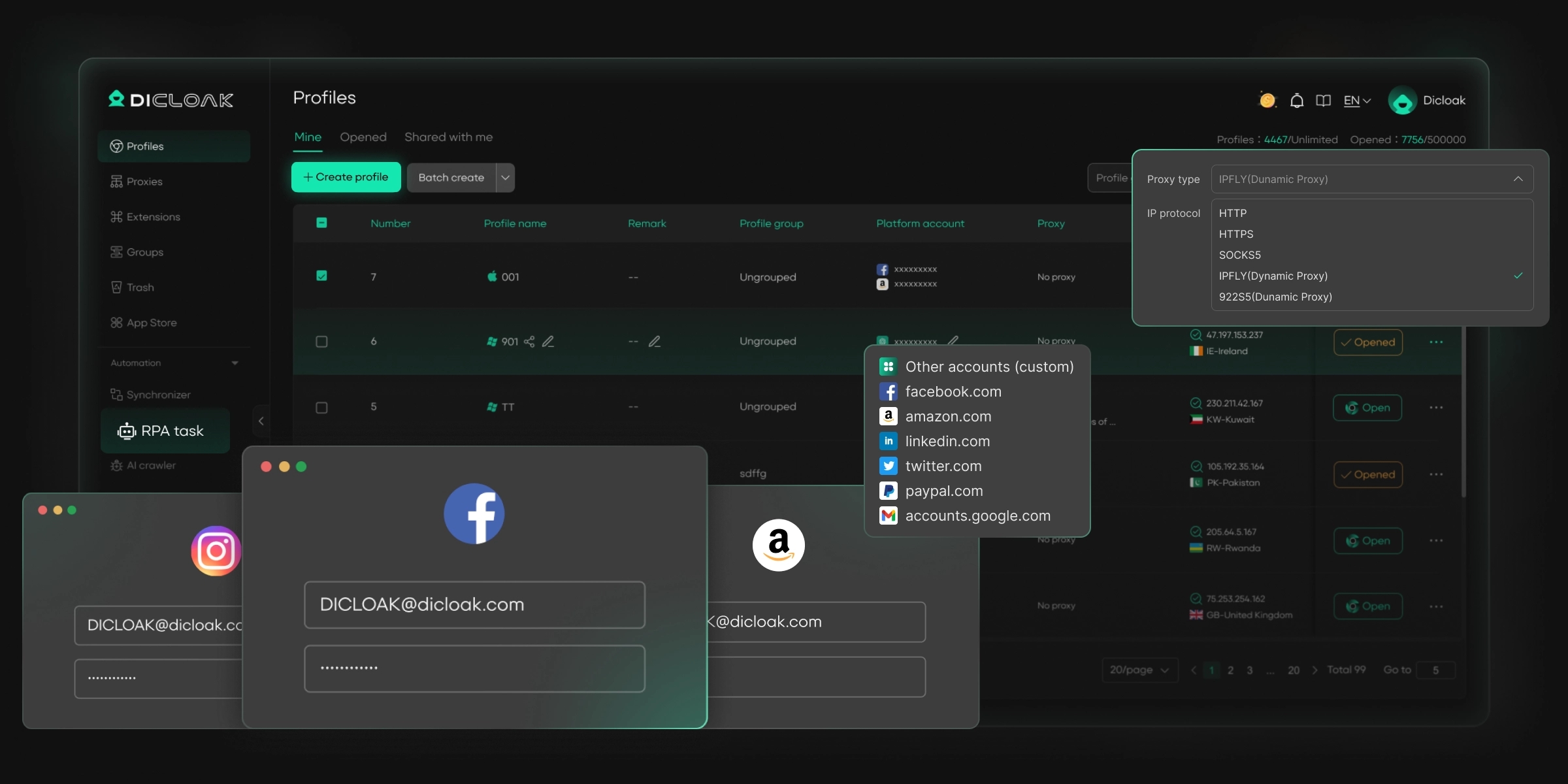
Here is a simple guide to setting up DICloak for managing your X accounts safely:
- Visit the DICloak website to learn more about its features and choose a plan. A free version is available upon registration, so you can start right away.
- Download and install the application. DICloak is compatible with all major operating systems, including Windows and macOS.
- Create a new browser profile within the DICloak application. This will serve as the dedicated, isolated environment for your first X account.
- Configure a unique proxy for the profile to ensure complete IP address isolation. DICloak supports all major proxy protocols, including HTTP/HTTPS and SOCKS5.
- Repeat the process for each additional X account you manage, creating a new, isolated profile with a unique proxy for each one.
By following this setup, you can enhance your security and privacy while preventing a violation on one account from affecting all the others you manage.
Common Myths About the X Shadowban
To effectively deal with a shadowban, you first need to separate fact from fiction. Let's debunk the most common myths:
Myth 1: Only Controversial Users Get Shadowbanned
This is false. Any user can be shadowbanned for behavior that X's algorithm flags as spammy. This includes common actions like overusing hashtags, posting the same link repeatedly, or using excessive automation, regardless of the content's nature.
Myth 2: Shadowbans Are Permanent
This is incorrect. Shadowbans are typically temporary and can be resolved by fixing the underlying issue, removing problematic content, and waiting for the algorithm to reevaluate your account.
Myth 3: Deleting Tweets Immediately Fixes a Shadowban
While removing problematic content is a crucial step, it does not guarantee an immediate fix. It takes time for X's systems to process these changes and restore your account's visibility.
Myth 4: X Will Notify You If You’re Shadowbanned
A key feature of a shadowban is its subtlety. X does not send notifications or warnings to users whose accounts have been restricted. You must identify the problem yourself by noticing the signs.
Myth 5: All Third-Party Checkers Are Reliable
Not all third-party shadowban checkers are accurate. It's best to use them as a starting point and cross-reference their findings with manual checks, such as searching for your content in an incognito browser window.
Conclusion
Experiencing an X shadowban can be frustrating, but it is a manageable issue. The key to resolving it is to stay informed about X's rules, monitor your account's behavior, and focus on authentic engagement. By following the diagnostic steps and solutions outlined in this article, you can diagnose the issue, restore your reach, and build a resilient presence on the platform.
Frequently Asked Questions (FAQs) About the X Shadowban
What is the fastest way to check for an X shadowban?
While online checker tools can offer a quick first look, the most reliable method is a manual check. Searching for your username or recent tweets from an incognito browser window provides the most accurate confirmation of whether your content is visible in search.
Will X notify me if my account is shadowbanned?
No. Shadowbanning is a subtle, non-transparent process designed to reduce visibility without direct alerts. Users must identify a potential shadowban by noticing a drop in engagement or by performing the manual checks outlined in this article.
Can using too many hashtags cause an X shadowban?
Yes. Repeatedly using the same set of hashtags or posting tweets with an excessive number of irrelevant hashtags can be flagged as spammy behavior by X's algorithm, which is a common trigger for a shadowban.
Does an X shadowban stop my followers from seeing my tweets?
A shadowban primarily limits your reach to non-followers by removing your content from search results, hashtag feeds, and recommendations. While your followers may still see your tweets directly on their timelines, your content's overall visibility and potential to reach a wider audience will be significantly reduced.
How can I prevent an X shadowban when managing multiple business accounts?
The best way to prevent linked bans is to ensure each account has a unique digital footprint. Tools like the DICloak antidetect browser accomplish this by creating completely isolated browser profiles. This makes each account appear to operate from a separate device with a different IP address, which drastically reduces the risk of X linking them together and banning them all for a single violation.
 Web Proxy Tools
 Free Tools
 Cookie Plugin
 UA Generator
 MAC Address Generator
 IP Generator
 IP Address List
 2FA Code Generator
 World Clock
 Anonymous Check
 WebRTC Leak Test
 UUID Generator
 Free Web Proxy Site
 Proxy Checker
 FB Ad Checker
 AI Web Scraping
 Free SMM Tools
 Twitter Shadowban Checker
 Instagram Name Checker
 UTM Generator
 Username Generator
 AI Hashtag Generator
 LinkedIn Headline Generator
 Social Media Image Resizer