Have you ever wondered how power scrapers, affiliate marketers, and social media managers avoid bans and stay under the radar while running dozens of accounts? Getting blocked, flagged, or banned is a constant threat that can derail critical business operations. The not-so-secret weapon to overcome this challenge is the mobile proxy.
With over 6.8 billion smartphone users globally, websites trust mobile traffic more than any other source. This inherent trust makes mobile proxies—which route your traffic through real 3G, 4G, and 5G connections—the gold standard for stealth and success.
If you manage multiple accounts, run web scraping tasks, or automate workflows on sensitive platforms like Instagram, TikTok, or Amazon, this is your comprehensive guide. We will provide a complete overview of the best mobile proxy services available, explain how they work, and reveal how to pair them with an antidetect browser like DICloak for maximum, long-term protection.
What is a Mobile Proxy and How Does It Work?
In the world of online operations, a mobile proxy is the gold standard for stealth and success. Its strategic importance comes from a simple fact: websites trust traffic originating from mobile devices more than any other source. This makes mobile proxies an essential tool for anyone whose work depends on avoiding detection and maintaining account integrity.
A mobile proxy is a server that routes your internet traffic through real mobile devices connected to cellular carrier networks (like 3G, 4G, or 5G). This process masks your original IP address with a legitimate mobile IP, making your online activity appear as if it's coming from an authentic smartphone user. From a website's perspective, this traffic is indistinguishable from that of its regular mobile audience, which is why platforms almost never block it.
How a Mobile Proxy Works
The technology behind mobile proxies is built on actual mobile carrier infrastructure, which gives it a unique level of authenticity.
- Real SIM Cards: Each connection originates from a physical SIM card housed in a mobile device or a dedicated modem. This ensures the IP address is genuinely part of a mobile carrier's network.
- Carrier-Grade NAT (CGNAT): Mobile networks use CGNAT (Carrier-Grade Network Address Translation), a system where thousands of real users share the same pool of IP addresses. This enhances anonymity because your activity blends in with the traffic of countless other legitimate users.
- Dynamic IP Rotation: As mobile devices naturally connect and disconnect from different cell towers, their assigned IP addresses change. This dynamic rotation mimics real user behavior, making it incredibly difficult for platforms to track and flag a single user's activity.
- Geographic Authenticity: The IP addresses are genuinely registered to mobile carriers like Verizon, AT&T, or Vodafone in specific geographic regions, providing an unparalleled layer of legitimacy.
This robust architecture makes mobile proxy traffic virtually undetectable, granting it the highest trust scores across all major platforms. Understanding the mechanics behind this technology is the first step, but choosing the right type of mobile proxy is just as critical.
Analyzing the Different Types of Mobile Proxy Technology
Understanding the different generations of mobile proxy technology is crucial for aligning the right tool with your specific tasks. The choice you make directly impacts performance, cost, and reliability. Whether you need a simple, low-cost solution or a high-speed connection for data-intensive work, knowing the difference between 3G, 4G, and 5G proxies is key to building a successful operational strategy.
3G Mobile Proxies
- Older technology with slower speeds, typically between 0.5-2 Mbps.
- Lower in cost but often less reliable than newer generations.
- Suitable only for basic, low-bandwidth tasks.
- Becoming increasingly rare as carriers phase out 3G networks.
4G LTE Mobile Proxies
- The current industry standard for mobile proxies.
- Offers typical speeds of 5-25 Mbps, providing an excellent balance of performance and authenticity.
- Widely available from most providers and is considered the best choice for the majority of use cases, including social media management and web scraping.
- Represents a perfect blend of speed, reliability, and cost-effectiveness.
5G Mobile Proxies
- Cutting-edge technology with breakthrough speeds that can exceed 100 Mbps.
- Comes at a premium price due to the advanced infrastructure required.
- Availability is still limited, primarily concentrated in major urban areas.
- Ideal for high-bandwidth tasks like streaming or large-scale data extraction and is a future-proof investment.
These technological advancements are what enable the powerful benefits that set mobile proxies apart from all other options.
The Core Benefits: Why You Need a Mobile Proxy
The value of using a mobile proxy extends far beyond simple IP masking. In a digital landscape dominated by sophisticated bot detection and aggressive account flagging, mobile proxies offer a powerful strategic advantage. They leverage the inherent trust that websites place in mobile traffic, making your online activities appear completely organic and legitimate.
Harder to Detect and Ban
Mobile IPs originate from legitimate carrier networks that serve millions of real users. Websites are extremely reluctant to block entire mobile IP ranges because doing so would inevitably impact thousands of genuine customers. This gives mobile proxies a powerful shield against detection.
- High Trust Scores: Platforms automatically assign a high level of trust to traffic from mobile carrier IPs.
- Shared IP Pools: Because your IP is shared with countless other real users via CGNAT, it's ineffective for a platform to ban your specific IP.
- Natural Rotation: The inherent, dynamic rotation of IPs mimics real mobile user behavior, making your activity look organic.
- Carrier Reputation: The established reputation of major carriers like Verizon or T-Mobile provides a built-in layer of legitimacy.
Trusted by Websites as Real User Traffic
Anti-bot systems evaluate traffic based on a wide range of factors, and mobile proxies excel in every category. Their IP reputation is excellent, their usage patterns appear natural, and their geographic authenticity is verifiable. When combined with an antidetect browser that creates a perfect mobile signature, the traffic becomes indistinguishable from that of a real user.
Superior IP Rotation via Carrier-Grade NAT
Unlike other proxy types that rely on provider-controlled rotation, mobile networks rotate IPs automatically and naturally as devices move between cell towers. This provides a level of randomness that is nearly impossible to track.
- Automatic Rotation: No manual intervention is needed to change IPs.
- Unpredictable Timing: IP changes occur at irregular intervals, preventing detection through pattern analysis.
- Shared and Clean IPs: The IP you use is shared with thousands of other legitimate users, making it clean and highly reputable.
Ideal for Sensitive Platforms and High-Stakes Tasks
Mobile proxies are the preferred solution for tasks where account bans or blocks result in significant financial or operational losses. They excel where other proxy types consistently fail.
- Social Media Management: Managing multiple accounts on Instagram, TikTok, Facebook, or X (formerly Twitter).
- E-commerce: Operating multiple seller accounts on platforms like Amazon, eBay, and Shopify.
- Web Scraping: Gathering data from social media, verifying ads, and monitoring prices on protected sites.
- Account Verification & Creation: Bypassing phone verification requirements, creating accounts in specific regions, and participating in airdrop farming with multiple wallets.
While the benefits are significant, it's important to approach this technology with a complete understanding of its limitations as well.
A Balanced View: The Downsides of a Mobile Proxy
Transparency is crucial for making informed decisions. While mobile proxies are incredibly powerful, they are not a one-size-fits-all solution. Understanding their limitations is key to developing a successful and cost-effective strategy. Acknowledging these trade-offs ensures you invest in the right tool for your specific needs.
Higher Cost Compared to Alternatives
The most significant drawback of mobile proxies is their price. The complex infrastructure required—including real SIM cards, physical mobile devices, and carrier data plans—makes them considerably more expensive than other proxy types.
- A single mobile proxy can cost $50 to $300+ per month.
- In contrast, datacenter proxies can be as low as $0.50 to $2 per IP per month.
- This investment is best reserved for high-value tasks where the cost of an account ban is greater than the cost of the proxy.
Slower Speeds
Mobile networks are designed for consumer use, not for the high-throughput demands of large-scale data operations. While fast enough for most automation and management tasks, they are slower than datacenter alternatives.
- Typical 4G LTE speeds range from 5-25 Mbps.
- This is significantly slower than datacenter proxies, which can offer speeds of 100-1000 Mbps.
- This makes them less ideal for use cases that involve transferring massive amounts of data quickly.
Limited Geographic Availability
The availability of high-quality mobile proxies is tied to the real-world infrastructure of cellular networks. This creates certain geographic and provider-based constraints.
- Not all countries have mature 4G or 5G networks, limiting the availability of proxies in some regions.
- The IP pools for mobile proxies are generally smaller than those of large residential providers.
- Premium locations, such as major cities in the US and UK, often command higher prices due to high demand.
To contextualize these trade-offs, a direct comparison with other proxy types is essential for making the right strategic choice.
Mobile Proxy vs. Residential vs. Datacenter Proxies
Choosing the right proxy is a critical strategic decision. Each type offers a different balance of anonymity, speed, cost, and trust, making them suitable for different tasks. This comparison is designed to help you select the perfect tool based on your specific needs, budget, and risk tolerance.
| Feature |
Mobile Proxies |
Residential Proxies |
Datacenter Proxies |
| IP Source |
Real mobile devices on 3G/4G/5G carrier networks (e.g., Verizon, Vodafone) |
Real desktop and mobile devices connected to home Wi-Fi (ISPs) |
Servers in commercial data centers |
| Anonymity Level |
Highest |
High |
Low |
| Trust by Websites |
Very High |
High |
Low |
| Cost |
Expensive ($50 - $300+/month) |
Moderate ($5 - $15/GB) |
Affordable ($0.50 - $2/IP) |
| Speed |
Medium (5-25 Mbps for 4G) |
Medium (10-50 Mbps) |
Fast (100-1000 Mbps) |
| Typical Ban Rate |
Lowest |
Low to Medium |
High |
| Best For |
Social media automation, ad verification, high-stakes account management, scraping sensitive sites. |
General web scraping, e-commerce price monitoring, accessing geo-restricted content. |
Bulk data collection from tolerant sites, high-speed transfers, internal testing. |
Now that you understand the different types of proxies and their unique strengths, the next step is to learn how to identify a high-quality provider.
How to Choose the Best Mobile Proxy Provider
Not all mobile proxy services are created equal. With the growing demand, many providers have entered the market, some with questionable infrastructure. Conducting due diligence is essential to ensure you are investing in a reliable and effective solution. Focusing on the following technical and operational criteria will help you distinguish top-tier services from the rest.
IP Authenticity
This is the most critical factor. The entire value of a mobile proxy comes from its genuine carrier IP.
- Key Question: Does the provider use real SIM cards and physical mobile devices, or do they route traffic through emulated connections?
- Red Flag: Vague descriptions of their infrastructure or prices that are significantly below the market average often indicate emulated or low-quality IPs that will be easily flagged.
Rotation Control
The ability to control when and how your IP address changes is crucial for different tasks.
- Key Question: Does the provider offer flexible rotation options, such as time-based (e.g., every 30 minutes), request-based (a new IP for each connection), or sticky sessions (keeping the same IP for an extended period)?
- Why It Matters: Account warming requires a consistent IP, while web scraping may benefit from rapid rotation.
GEO and Carrier Targeting
For many use cases, the ability to target specific locations and mobile carriers is non-negotiable.
- Key Question: Can you target specific countries, cities, or even mobile carriers like AT&T or T-Mobile?
- Why It Matters: This is essential for testing geo-restricted content, creating accounts in specific regions, or verifying ads targeted at local audiences.
Reputation & IP Cleanliness
A proxy is useless if its IPs are already blacklisted or have a poor reputation.
- Key Question: Does the provider actively monitor their IP pools for blacklisting and maintain high IP quality scores?
- Best Practice: Look for providers that offer a trial or a money-back guarantee, allowing you to test the IPs on your target platforms before committing.
Connection Stability and Speed
While mobile proxies are naturally slower than datacenter proxies, they must be reliable.
- Key Question: What is the provider's guaranteed uptime (should be 95%+)? How consistent are their connection speeds?
- Why It Matters: Frequent connection drops or slow speeds can disrupt automated tasks and lead to data loss.
Customer Support and Documentation
When issues arise, responsive and knowledgeable support is invaluable.
- Key Question: Does the provider offer 24/7 technical support? Is their documentation clear, with setup guides for popular tools and antidetect browsers?
- Best Practice: Good support can save you hours of troubleshooting and ensure your operations run smoothly.
Pricing Structure
Understand how you will be charged to avoid unexpected costs.
- Key Question: Does the provider charge per proxy (a fixed monthly fee) or by bandwidth (per GB of data used)?
- Why It Matters: Per-proxy pricing is often best for consistent, long-term use, while bandwidth pricing can be more cost-effective for variable usage patterns.
With these criteria in mind, you are now equipped to evaluate the top providers on the market.
The Top Mobile Proxy Services: A Detailed Review
Based on performance, reliability, features, and customer support, we have curated a list of the top-tier mobile proxy providers. These services have been selected for their proven track records in providing high-quality, authentic mobile IPs suitable for a range of professional use cases.
NodeMaven is a leading provider known for its true 4G/5G rotating mobile proxies built for stealthy scraping, ad verification, and multi-accounting. While many providers offer broad coverage, NodeMaven's value lies in its transparent infrastructure and focuses on high-demand regions like the USA and UK, making it a reliable choice for agencies whose clients primarily target Western markets.
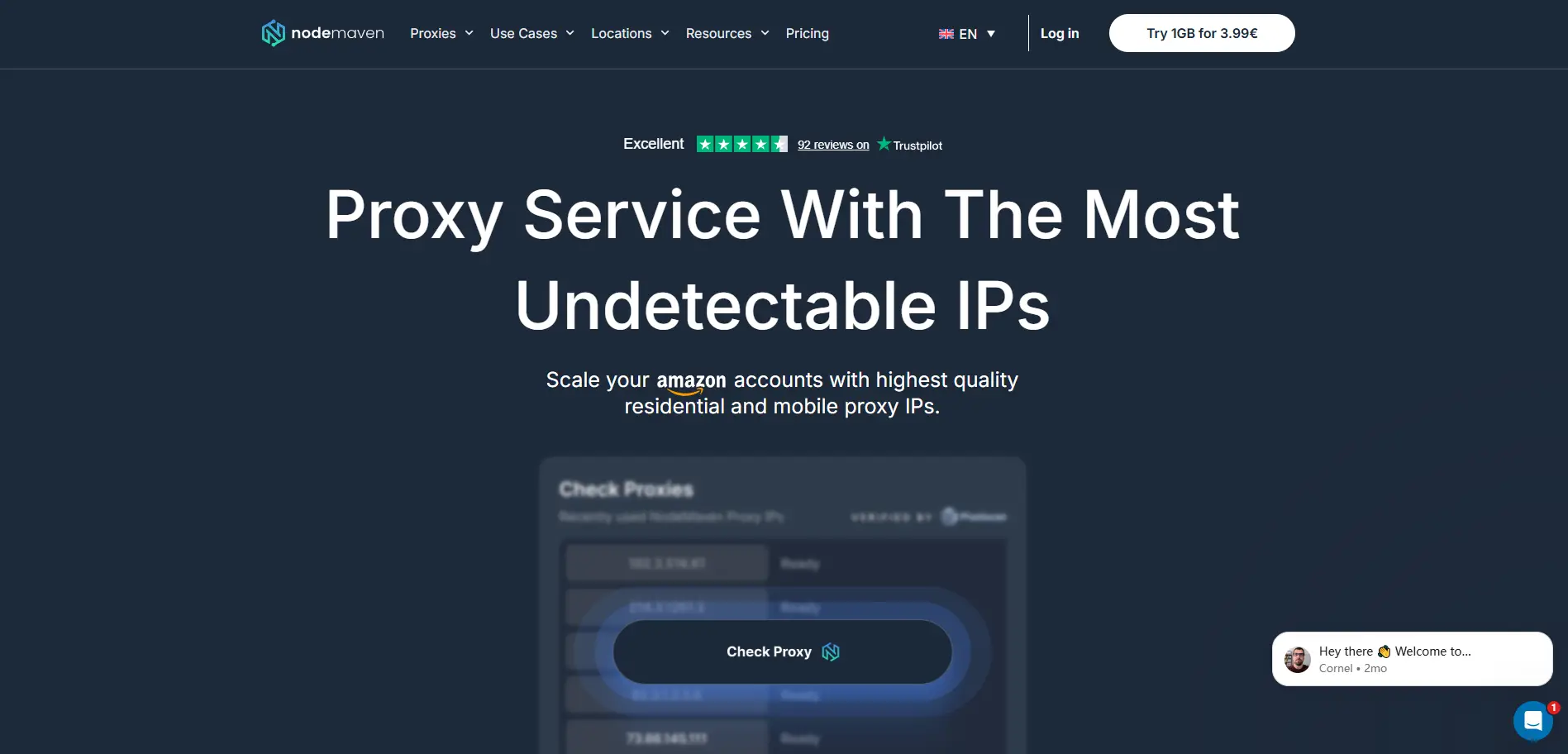
- Key Features: Real mobile IPs from live devices, custom rotation intervals (static, time-based, or request-based), and locations in 50+ countries including the USA and UK.
- Best For: Social media managers, e-commerce sellers, and web scrapers.
- Pricing: Starting at $80/proxy/month.
- Why it stands out: Transparent infrastructure with confirmed real SIM cards and reliable uptime of over 98%.
Soax offers clean, rotating mobile proxies with highly granular geo-targeting options and an intuitive dashboard that is ideal for both beginners and professionals. Its strategic position is as the user-friendly powerhouse; for professionals who value ease of use and precision, Soax's city and carrier-level targeting make it a top choice for ad verification and SEO monitoring tasks.
- Key Features: 100% ethically sourced 3G/4G LTE proxies, city and carrier-level targeting, SOCKS5 and HTTP(S) support, and coverage in over 100 countries.
- Best For: Ad verification, SEO monitoring, and price scraping.
- Pricing: Starting at $99/month for 8GB.
As one of the largest proxy networks on the market, Bright Data provides enterprise-level mobile proxies with the most comprehensive global coverage. It is the go-to provider for large-scale operations where budget is secondary to unmatched geographic reach and robust compliance tools, making it ideal for data intelligence firms that cannot compromise on scale or data integrity.
- Key Features: Instant IP rotation with advanced controls, carrier and city-level targeting in 195+ countries, and a 99.9%+ uptime guarantee.
- Best For: Large enterprises and data intelligence firms requiring high-scale scraping.
- Pricing: Starting at $500/month (enterprise-focused).
Oxylabs delivers enterprise-grade mobile proxies from a global pool of over 20 million IPs, known for their stability and extensive documentation. Competing directly with Bright Data for the enterprise market, Oxylabs differentiates itself with a reputation for rock-solid stability and comprehensive support, making it a trusted choice for organizations running high-volume, mission-critical scraping projects.
- Key Features: Support for 3G/4G/5G/LTE networks from a 20M+ IP pool, precise geo-targeting in 140+ countries (country, state, city, ASN), 30-minute sticky sessions, and SOCKS5 support.
- Best For: Large-scale scraping, market research, and ad verification.
- Pricing: Pay-as-you-go starts at $9/GB; monthly plans start at $59/month for 12GB.
IPRoyal focuses on rotating mobile proxies that offer fast speeds and stable connections from physical devices, optimized for automation tools. It occupies a strong position in the mid-market, offering a compelling balance of performance and affordability that appeals to users who need reliable social media automation without the premium cost of enterprise-tier providers.
- Key Features: Customizable rotation intervals, clean IP pools from verified carriers, API integration, and multiple authentication methods.
- Best For: Social media automation and account management.
- Pricing: Starting at $70/month for mobile proxies.
Designed specifically for social media automation, TheSocialProxy provides dedicated private IPs from mobile modems to ensure the highest level of trust. Unlike larger, more generalized providers like Bright Data, TheSocialProxy's laser focus on social media automation is its key differentiator. By providing a dedicated IP per SIM card, it minimizes the 'bad neighbor' risk inherent in shared pools, which is critical for protecting high-value Instagram or TikTok accounts.
- Key Features: One dedicated IP per real SIM card (no sharing), IPs from clean subnets, and a focus on Instagram, TikTok, and Snapchat automation.
- Best For: Social media agencies and professionals managing high-value accounts.
- Pricing: 75-120 per proxy/month.
IPFoxy provides a range of proxy types with a strong focus on IP cleanliness, stability, and team management features, making it suitable for growing teams. Its strategic advantage is scalability for agencies; the built-in team features and emphasis on stable, clean IPs make it an excellent choice for mid-sized organizations managing complex social media and ad verification workflows across multiple users.
- Key Features: Mobile network IPs from real carriers in 200+ countries, dynamic rotation, and API access.
- Best For: Ad verification, social media workflows, and mid-sized teams.
- Pricing: Starting at $0.80+/GB.
Geonode delivers cost-efficient proxy services designed for scraping and SEO monitoring, with a simple dashboard and API for easy integration. Geonode's market position is developer-friendly, budget-conscious choice. It strips away enterprise complexity to offer straightforward, reliable API access, making it perfect for marketing teams and developers who need to integrate proxies quickly without enterprise contracts.
- Key Features: A network spanning 150+ countries, mobile-compatible proxy options, fast rotation, and session control.
- Best For: Developers and marketing teams needing reliable proxy access without complex enterprise contracts.
- Pricing: Not specified in the source.
Even with the best proxy provider, your setup is only halfway complete. To achieve true anonymity, you must address the other half of the detection equation: your browser fingerprint.
The Unstoppable Combo: Pairing Your Mobile Proxy with an Antidetect Browser
Using a mobile proxy alone is a critical but incomplete strategy. A proxy successfully hides your IP address, but modern websites use far more sophisticated methods to track and identify you. They analyze your browser fingerprint—a unique collection of data points like your screen resolution, fonts, browser type, and hardware specifications. If you use the same browser to manage multiple accounts, they can all be linked and banned, regardless of your IP.
This is where an antidetect browser like DICloak becomes essential. DICloak creates multiple, completely isolated virtual browser profiles on a single computer. Each profile has a unique and authentic browser fingerprint, making it appear as if each account is being accessed from a different physical device. When you pair a mobile proxy with a DICloak profile, you create a truly undetectable identity.
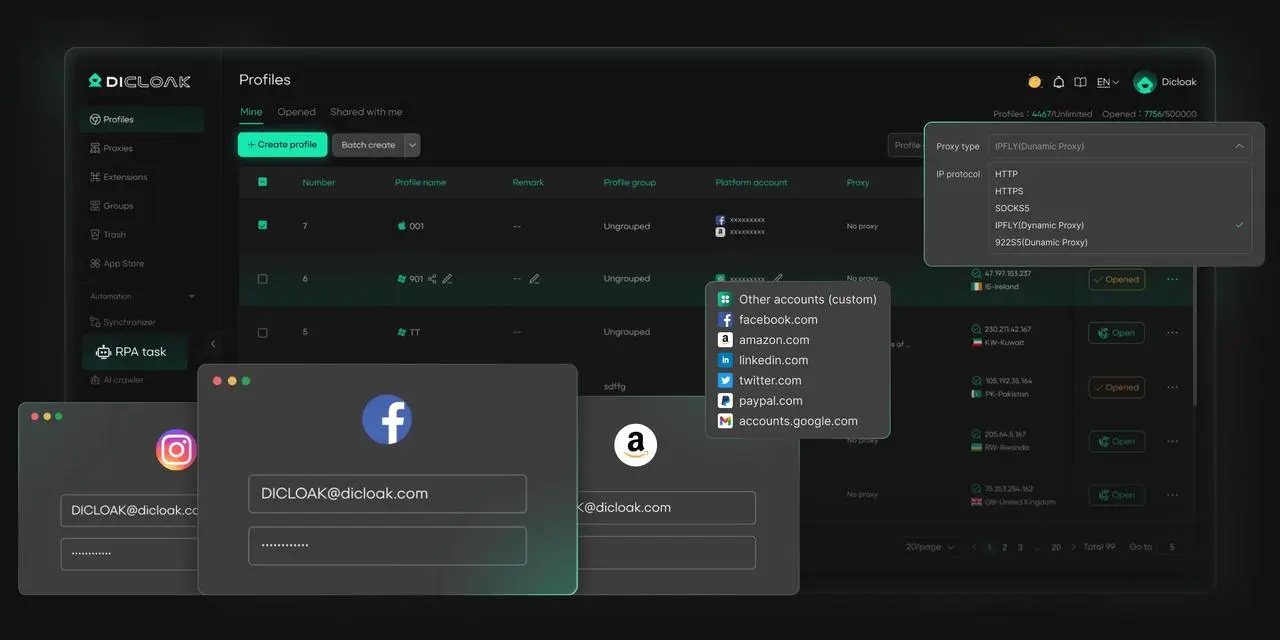
Why Use DICloak with a Mobile Proxy?
- Avoid Fingerprinting and Tracking: DICloak spoofs dozens of key fingerprint elements that websites use to track you, including Canvas, WebGL, audio context, fonts, client hints, and hardware specifications like GPU and memory. This prevents websites from linking your accounts together based on your device's unique digital signature.
- Securely Manage Hundreds of Accounts: Each DICloak profile is a separate, isolated profile. This allows you to manage hundreds of social media, e-commerce, or ad accounts from one dashboard, with each appearing as a completely distinct user on a unique device.
- Automate and Streamline Workflows: DICloak includes powerful automation features, such as the Synchronizer, which lets you mirror actions across multiple profiles simultaneously. Its AI-powered capabilities can automate scraping and browsing tasks, dramatically improving efficiency.
- Enable Effortless Team Collaboration: DICloak is built for teamwork, allowing you to securely share accounts and manage access with flexible permissions. This ensures your team can collaborate on projects without compromising account security.
How to Set Up Your Mobile Proxy in DICloak
Integrating your mobile proxy with DICloak is a straightforward process:
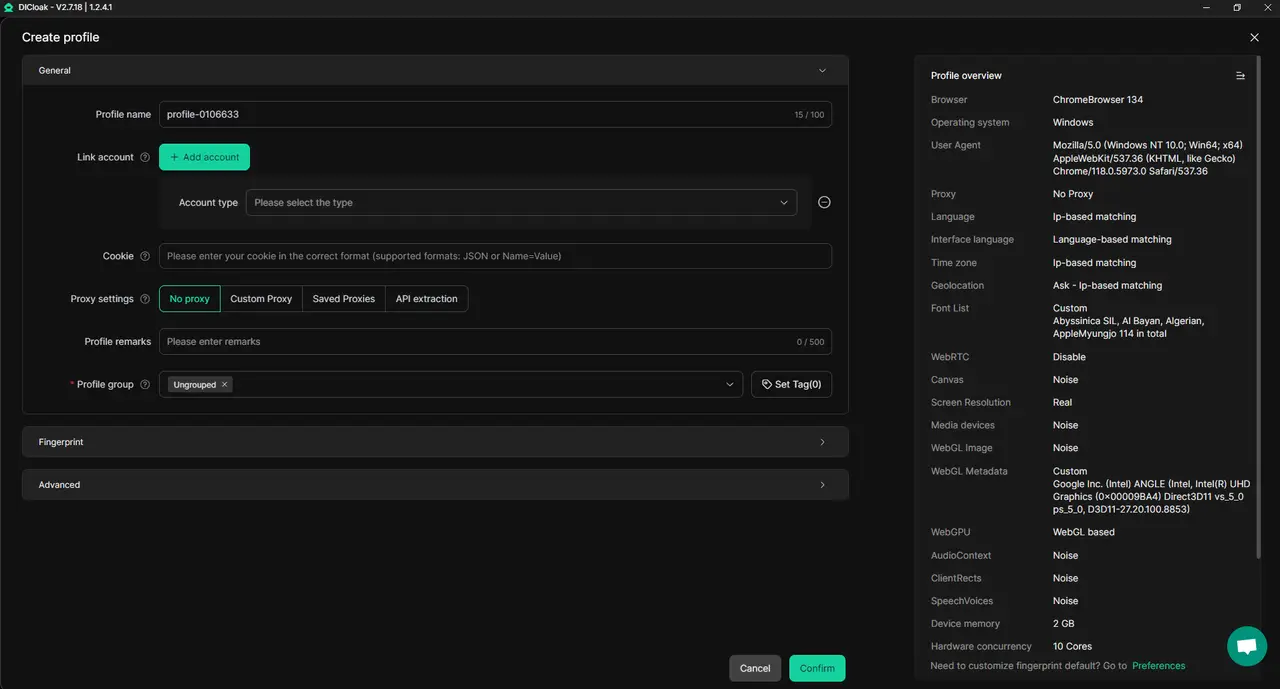
- Navigate to the 'Proxy' settings section within the new profile's configuration.
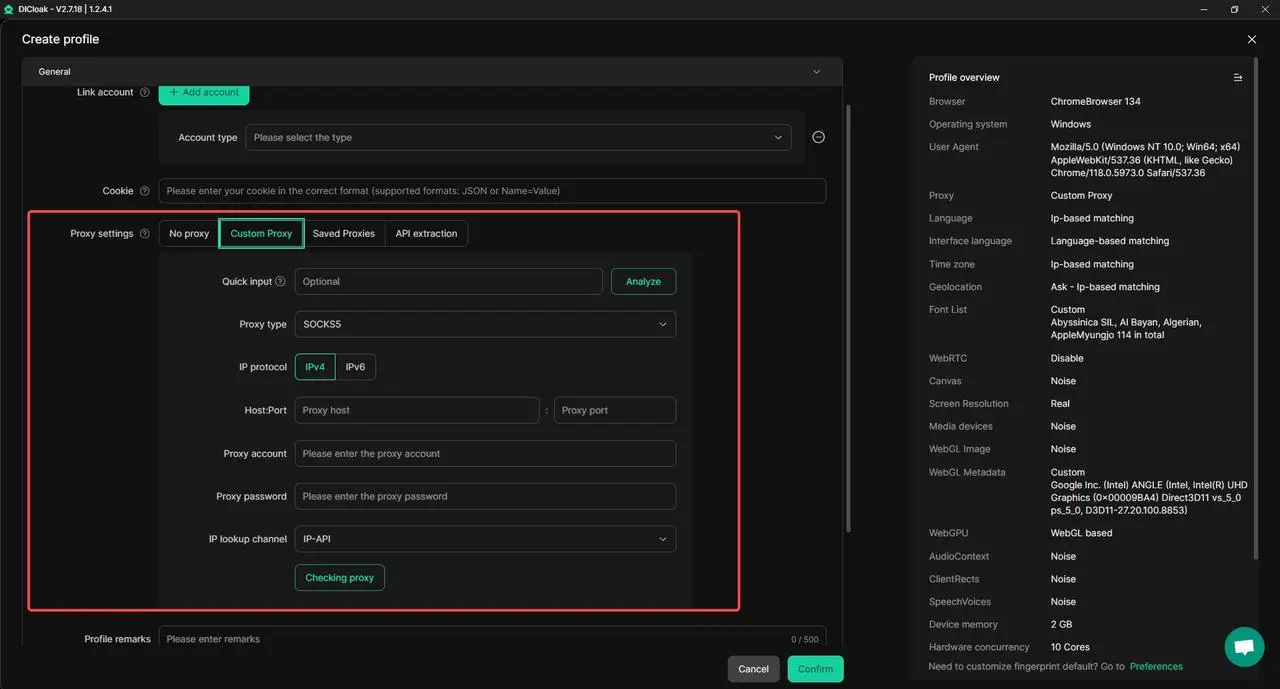
- Enter the proxy information (e.g., IP, port, username, and password) provided by your service.
- Save the profile and start browsing securely and undetectably.
This powerful combination raises an important question: is the combined investment truly worthwhile for your operations?
Frequently Asked Questions about Mobile Proxies
Here are clear, concise answers to some of the most common questions about mobile proxies, based on the information covered in this guide.
Why is a mobile proxy better than a residential or datacenter proxy?
A mobile proxy is better for sensitive tasks because it uses real mobile carrier IPs, which are highly trusted by websites. This results in the highest level of anonymity and the lowest ban rate, making them almost impossible for platforms to block without impacting genuine users.
Can I use a mobile proxy for social media automation, like on Instagram?
Yes, absolutely. Mobile proxies are considered the safest and most effective option for platforms like Instagram, TikTok, and Facebook. They significantly reduce the risk of account bans, shadowbans, and other restrictions associated with automation.
What is the difference between a 4G and a 5G mobile proxy?
The primary difference is speed and cost. 4G proxies are the industry standard, offering speeds of 5-25 Mbps. 5G proxies are much faster, with speeds over 100 Mbps, but they come at a premium price and have limited geographic availability.
Will using a mobile proxy alone prevent all account bans?
Not necessarily. A mobile proxy only hides your IP address. Websites also use sophisticated browser fingerprinting to track and link your accounts. To prevent bans effectively, you must pair your mobile proxy with an antidetect browser like DICloak to mask your digital fingerprint as well.
Are mobile proxies worth the higher cost?
Yes, mobile proxies are worth the investment when your accounts have long-term value and the cost of a ban is high. For high-stakes operations like managing multiple e-commerce stores, running ad campaigns, or providing social media services, the security they provide far outweighs their cost.
Final Thoughts: The Smartest Way to Operate Undetected
Mobile proxies represent the gold standard for maintaining anonymity and avoiding bans on sensitive platforms. With genuine carrier IPs, natural rotation patterns, and unmatched trust scores, they decisively outperform both datacenter and residential proxies for social media management, ad verification, and any mobile-focused operation.
However, a mobile proxy alone is an incomplete defense. The most sophisticated platforms you are targeting do not just look at your IP address; they analyze your browser fingerprint to identify and link your accounts. Relying solely on a proxy leaves your valuable assets exposed to detection and suspension.
The complete, professional solution is to pair a high-quality mobile proxy with a powerful antidetect browser. This combination creates an unstoppable setup that addresses both sides of the security equation. While the proxy provides a trusted IP, an antidetect browser ensures your digital fingerprint is unique and authentic. We recommend DICloak as the essential tool to complete your security setup. It provides the advanced fingerprint protection, automation capabilities, and team collaboration features needed to protect your accounts from bans, streamline your workflows, and ensure long-term operational success.
Your accounts are too valuable to risk. Make the smart investment in a complete protection strategy today.
 Web Proxy Tools
 Free Tools
 Cookie Plugin
 UA Generator
 MAC Address Generator
 IP Generator
 IP Address List
 2FA Code Generator
 World Clock
 Anonymous Check
 WebRTC Leak Test
 UUID Generator
 Free Web Proxy Site
 Proxy Checker
 FB Ad Checker
 AI Web Scraping
 Free SMM Tools
 Twitter Shadowban Checker
 Instagram Name Checker
 UTM Generator
 Username Generator
 AI Hashtag Generator
 LinkedIn Headline Generator
 Social Media Image Resizer