Understanding the Role of Boostly Discord Bot in Modern Community Building
The Boostly Discord bot has emerged as a specialized utility designed for rapid server escalation, focusing on increasing server levels, visibility, and organic engagement. In the high-stakes environment of digital community management, server "boosts" are essential for unlocking premium features—including superior audio quality, expanded upload limits, and custom vanity URLs—that signal authority to new members.
Boostly’s service architecture is tailored for gamers, community managers, and enterprise-level businesses looking to scale their digital footprint. Its core offerings include Nitro tokens, member enhancements, and—most critically—"Boost Bots." These automated assets allow for the immediate injection of server level-ups upon payment confirmation. Integrating such services into a high-growth digital strategy requires a sophisticated understanding of infrastructure; while Boostly provides the growth assets, maintaining the longevity of those assets requires a professional approach to account management and platform interaction.
Technical Challenges When Deploying Boostly Discord Bot at Scale
Deploying third-party Discord services at scale introduces significant operational risks, primarily revolving around "Account Association." Discord’s anti-sybil telemetry is designed to analyze patterns of coordinated behavior. When multiple accounts interact with a single server in a synchronized manner, the platform’s security algorithms scan for technical commonalities to identify clusters.
Modern platforms identify users through complex browser fingerprints that measure browser entropy. This includes data points such as Canvas and WebGL rendering, screen resolution, and hardware IDs. The mechanism functions by requesting the browser to render a hidden graphic; because every hardware and software combination produces microscopic variations in rendering, a unique hash is generated. This hash serves as a persistent digital signature. If multiple Discord accounts share the same hash, they are flagged as being linked to a single hardware ID, often resulting in immediate account termination or "shadow-banning" of the associated server.
Isolating Browser Environments for Account Longevity
To mitigate these risks, analysts utilize environment isolation. This methodology involves containerizing each account profile within a dedicated browser instance. By keeping each profile operates with independent local storage, cookies, and cache, the infrastructure prevents data leakage. This isolation is the primary defense against platform telemetry that seeks to associate disparate accounts with a single operator.

How Boostly Discord Bot Users Reduce Fingerprinting Risk With DICloak
To operate multiple Boostly-related Discord accounts in parallel, experienced teams treat the environment layer as part of the infrastructure—not an afterthought. The goal is to keep each account’s browsing context separated, consistent, and independently configurable, so routine logins and bot management don’t leak signals across accounts.
A practical approach is to run each account inside a dedicated DICloak browser profile, where storage, sessions, and fingerprint-related settings remain isolated from other profiles. This reduces cross-profile interference and helps multi-account workflows stay stable as the account fleet scales.
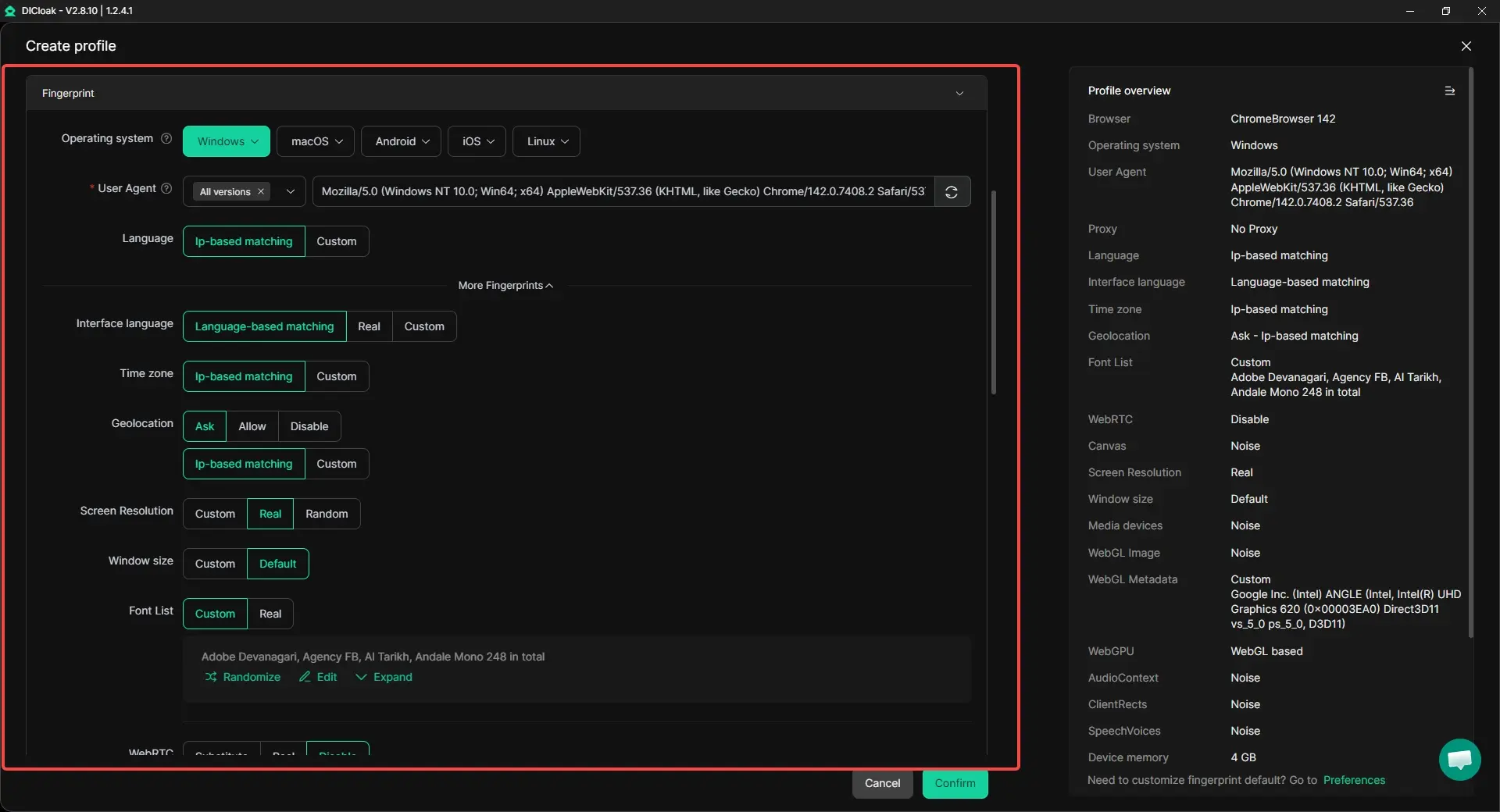
Simulation of Mobile and Desktop Operating Systems
In real-world Discord usage, accounts do not all originate from the same device type or operating environment. A multi-account setup looks more natural when accounts are operated across a mix of environments.
With DICloak, users can configure profiles to simulate common operating environments such as Windows, macOS, iOS, Android, and Linux, which helps operators avoid an overly uniform setup where every account appears to behave like the same machine.
For Boostly users, this matters because large fleets often fail for simple reasons: the environment layer becomes too repetitive, and routine actions start to look mechanically identical across accounts. A profile-based environment mix helps reduce that uniformity without changing the operational workflow.
Custom Fingerprint Configuration
Default, generic browser setups tend to be highly repeatable. In scaled operations, repeatability is the enemy of stability—especially when many accounts share the same workstation, the same browser defaults, and the same usage patterns.
With DICloak, each profile can be configured as its own independent workspace, allowing teams to adjust fingerprint-related parameters per profile rather than running everything under one shared configuration. This makes it easier to maintain separation between accounts and reduce accidental linkage caused by identical environments.
Pro-Tip: Once you’re managing multiple Discord accounts, avoid running them under identical “default” profile settings. A more stable approach is to assign each account its own DICloak profile and keep the profile configuration consistent over time. The objective isn’t constant randomization—it’s avoiding a situation where many accounts share the same technical footprint and session environment, which increases the chance of group-level disruption.
Strategic Comparison: Standard Methods vs. DICloak Infrastructure
Managing Discord infrastructure at a professional level requires a transition from consumer-grade tools to dedicated management solutions like DICloak.
Comparison Table
| Feature |
Standard Method (Browser) |
DICloak Antidetect Browser |
| IP Management |
Shared/Static IPs |
Independent Proxy Integration (HTTP/SOCKS5) |
| Hardware Fingerprinting |
Constant/Leaked |
Customizable & Isolated |
| Account Isolation |
Weak (shared cache/cookies) |
Strict Containerization |
| Scalability |
Limited by physical hardware |
1,000+ accounts on one device |
Operational Efficiency
Scaling a community often requires the management of 1,000+ accounts to simulate active growth. Relying on standard network-level masking or physical hardware for this volume is financially and logistically unsustainable. Professional management solutions utilize software-level hardware virtualization, allowing a single workstation to run hundreds of isolated, secure environments simultaneously without compromising system performance or account security.
Network isolation is as critical as hardware isolation. Each account must appear to originate from a unique network location to prevent "neighboring effect" bans, where the suspension of one account triggers a domino effect across all other accounts sharing the same IP address.
Integrating SOCKS5 and HTTP Proxy Protocols
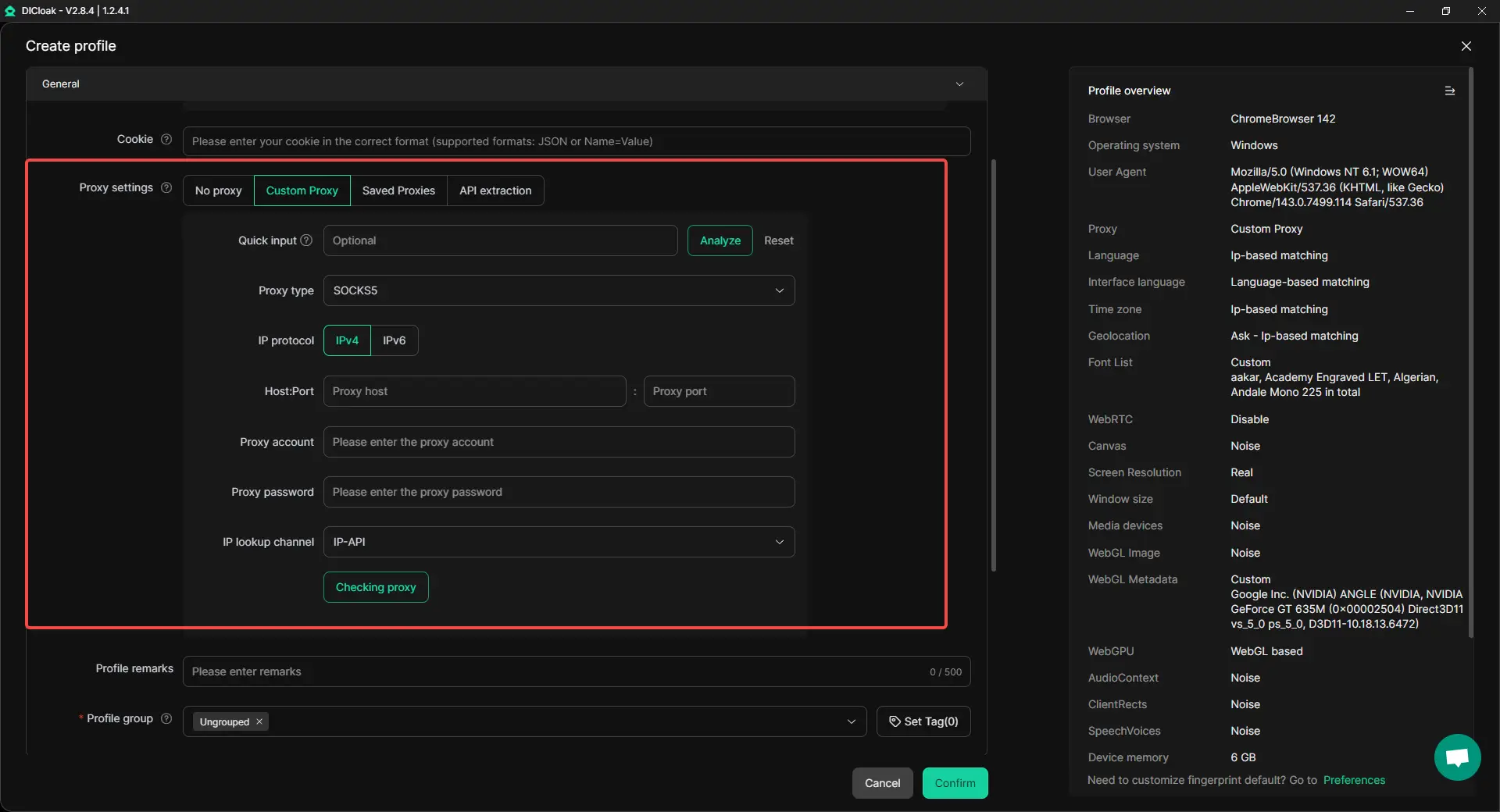
Modern growth infrastructure relies on flexible proxy protocols such as HTTP, HTTPS, and SOCKS5. In a multi-account Discord environment, the goal is not simply IP rotation, but consistent identity separation across all operational layers.
When Boostly Discord bot instances are deployed inside dedicated DICloak browser profiles, each profile can be paired with its own proxy configuration. This keeps that every Boostly-operated account maintains an independent network signature, including IP address, protocol behavior, and session routing.
By binding each Boostly bot account to a fixed DICloak profile and proxy pair, teams avoid shared IP reuse, cross-session leakage, and behavioral overlap—three of the most common triggers behind Discord account linkage and rate-limit enforcement. This profile-based approach transforms proxy usage from a tactical workaround into a repeatable, auditable infrastructure layer, making large-scale server growth both safer and easier to manage over time.
IP Protection Methodology
The quality of the network connection directly determines account longevity and reputation.
Pro-Tip: Prioritize high-quality proxies to ensure stable operations. In the context of Discord, this typically means utilizing Residential or Mobile IPs rather than datacenter IPs, as platforms are less likely to flag residential traffic as suspicious.
Optimizing Boostly Discord Bot Workflows with DICloak's Synchronizer
When Boostly users manage multiple Discord accounts, the bottleneck is rarely “creating accounts.” It’s the daily operations: logging in, checking account status, reviewing server access, and repeating the same steps across many profiles without mixing sessions or losing track.
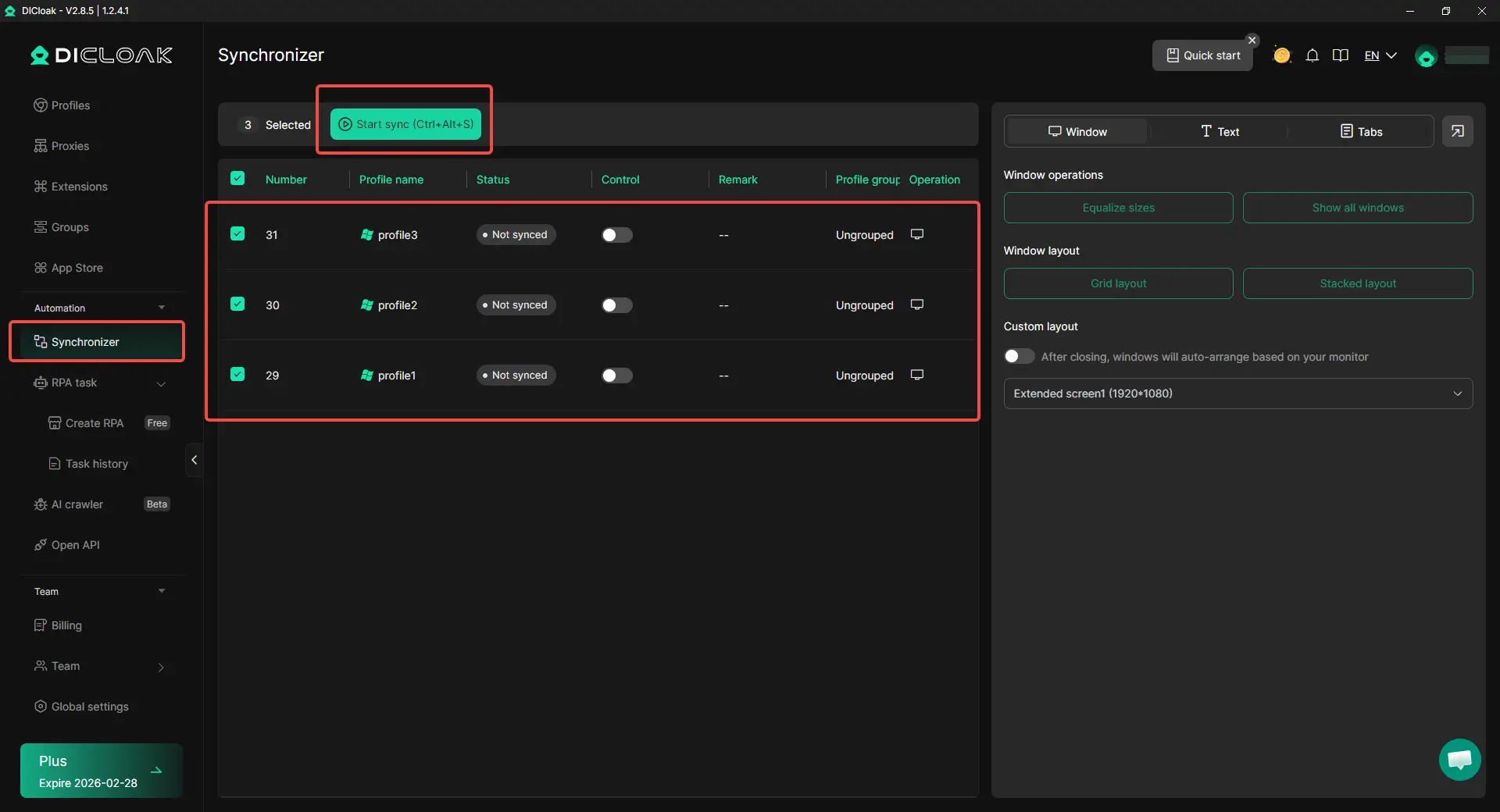
DICloak addresses this by combining isolated browser profiles with a Synchronizer workflow. Each Boostly-related account runs inside its own dedicated profile, and the Synchronizer lets operators mirror the same actions across multiple profile windows in a controlled, repeatable way.
Streamlining Repetitive Multi-Profile Tasks with Synchronizer
Instead of manually clicking through identical steps in 20, 50, or 100 separate windows, teams can use DICloak’s Synchronizer to:
- open multiple profiles at once while keeping sessions separate
- mirror standard navigation steps (for example, open Discord → enter a specific page → check a status point)
- reduce operator mistakes caused by fatigue, window switching, and inconsistent steps
This is particularly useful in Boostly workflows where accounts need routine checks or updates across a fleet, but where profile isolation must remain intact to prevent cross-session conflicts.
Reviewing a Batch of Accounts Without Session Mix-Ups
If a manager needs to review a batch of Boostly-related accounts across multiple DICloak profiles (for example, confirming they can access the expected Discord server pages), Synchronizer helps keep the process consistent:
- The same sequence of clicks can be mirrored across multiple profile windows.
- Each profile still retains its own cookies, session storage, and network settings.
- The manager gets a faster review loop while reducing the risk of mixing the wrong account in the wrong window.
In practice, this makes multi-account operations more standardized and less error-prone, which is often the difference between a workflow that stays stable at scale and one that collapses under daily operational friction.
Why Multi-Account Isolation is Essential for Discord Growth
Robust infrastructure provides the "Experience" signal that platforms monitor. If the underlying technology is flawed, even the highest quality growth service will fail.
Collaborative Workflows and Permission Control
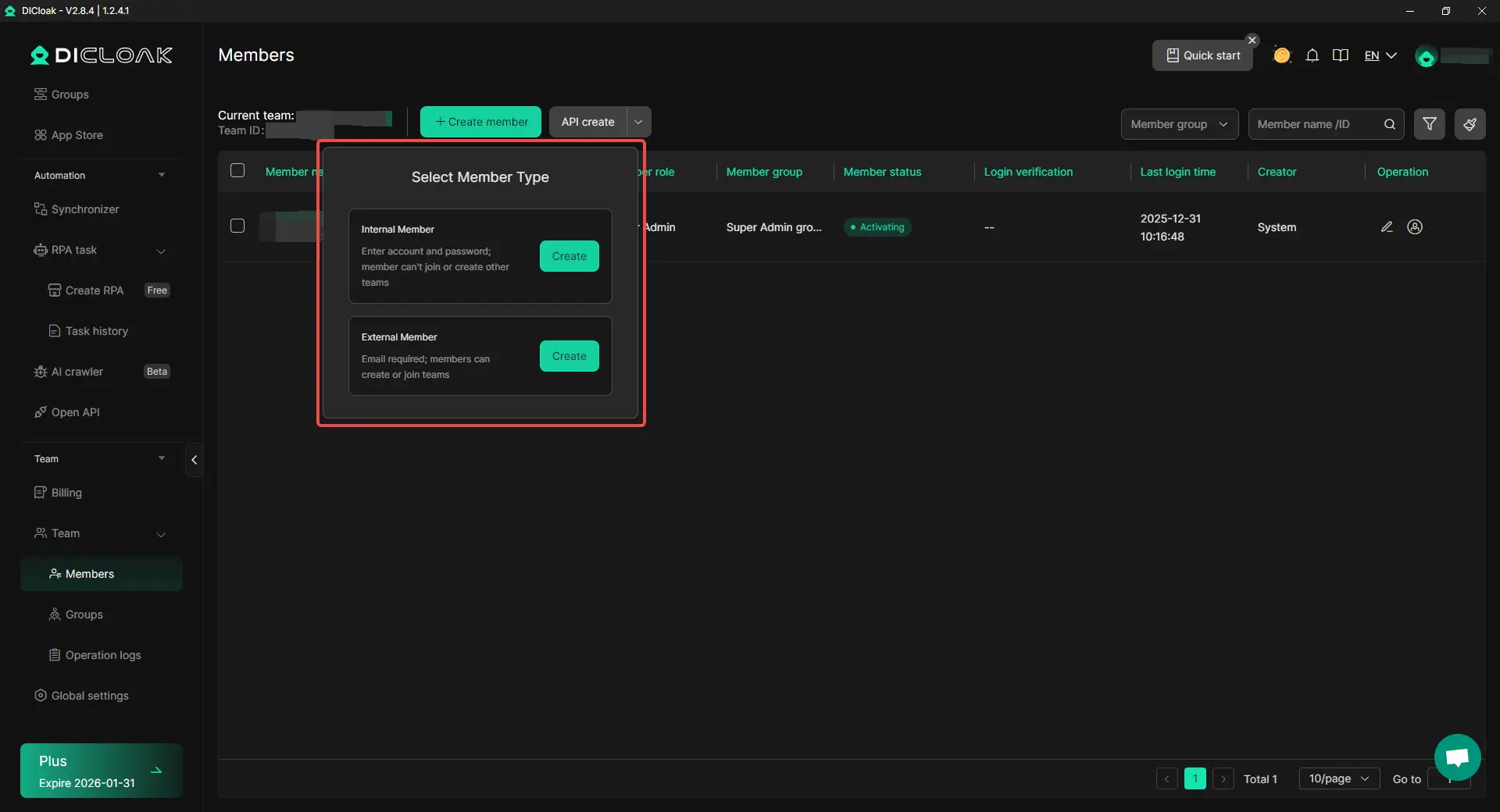
Managing large-scale Discord growth is often a collaborative effort. Professional tools like DICloak provide profile sharing and granular permission settings, ensuring data isolation while maintaining operation logs. This allows teams to manage 1,000+ accounts without accidental overlaps or security breaches between team members.
Risk Analysis of Third-Party Services
While Boostly provides rapid growth assets, it remains a third-party service that may conflict with Discord’s Terms of Service (TOS). Multi-account isolation is a standard industry practice that may help mitigate these risks. By maintaining a layer of technical separation between a user's primary assets and experimental growth tactics, managers can scale their communities with a risk-aware posture.
Evaluating Boostly Discord Bot vs. Market Alternatives
A neutral market analysis indicates that Boostly offers several distinct advantages over competitors such as Quickboosts.gg.
Service Variety and Pricing
Boostly is recognized for its aggressive pricing and diverse service catalog. While competitors like Quickboosts.gg offer limited options for Nitro tokens or member enhancements, Boostly provides a comprehensive suite including Boost Bots and Nitro tokens. For instance, Boostly offers packages such as 8 boosts for $6, a significantly more accessible entry point for community managers than the premium-priced alternatives.
Payment and Support Infrastructure
Operational reliability is supported by 24/7 customer assistance and flexible financial integration. Boostly supports traditional credit cards and CashApp, alongside Cryptocurrency, which is preferred by tech-savvy users for its speed and privacy.
Pros and Cons List
Operational Advantages (Boostly.to)
- Instant delivery of boosts, Nitro tokens, and Boost Bots.
- Industry-leading pricing (e.g., $6 for 8 boosts).
- 24/7 round-the-clock technical support.
- Broad support for payment methods (Crypto/CashApp/Credit).
Risk Factors
- Inherent potential for Discord TOS conflicts.
- Lack of an explicit refund policy on the primary domain.
- Requires professional browser isolation to prevent account association.
- High risk of loss if managed through standard, non-isolated browsers.
Frequently Asked Questions About Boostly Discord Bot Operations
How does the Boostly Discord Bot impact server level?
The bot facilitates the injection of server boosts and Nitro tokens. As the number of boosts increases, the server reaches higher levels, unlocking features such as 384Kbps audio, increased upload limits (up to 100MB), and aesthetic upgrades like vanity URLs and animated icons.
Why do I need an antidetect browser like DICloak for Discord?
Antidetect browsers provide the isolation required to prevent Discord from linking multiple "Boost Bots" to a single user. They create unique profiles with independent browser entropy (fingerprints) and IPs, which are essential for managing many accounts without triggering anti-sybil protections.
Can I manage these accounts on a Mac if the bot is running on Windows?
Yes. Professional management solutions like DICloak are cross-platform. They allow you to manage profiles on a Mac while simulating Windows, iOS, or Android environments, ensuring full compatibility regardless of your host machine's operating system.
What is the risk of account association?
Account association occurs when platform telemetry identifies multiple accounts as belonging to one entity via shared technical data (IPs, Canvas hashes, hardware IDs). This usually results in a "chain ban," where every associated account is terminated simultaneously.
Conclusion
The synergy between growth-oriented services like Boostly and robust infrastructure tools like DICloak is essential for the modern community builder. While Boostly provides the critical "Boost Bots" and tokens required to catalyze server growth, the underlying browser isolation technology ensures that the management of those assets remains professional, scalable, and risk-aware. By addressing the technical challenges of fingerprinting and network association, managers can execute their growth strategies with the precision and security required in today's digital landscape.
 Web Proxy Tools
 Free Tools
 Cookie Plugin
 UA Generator
 MAC Address Generator
 IP Generator
 IP Address List
 2FA Code Generator
 World Clock
 Anonymous Check
 WebRTC Leak Test
 UUID Generator
 Free Web Proxy Site
 Proxy Checker
 FB Ad Checker
 AI Web Scraping
 Free SMM Tools
 Twitter Shadowban Checker
 Instagram Name Checker
 UTM Generator
 Username Generator
 AI Hashtag Generator
 LinkedIn Headline Generator
 Social Media Image Resizer