Ever needed to reach your Telegram account when your phone battery is dead or unavailable? I've experienced that, and that's precisely when Telegram Web Login became my preferred method.
It provides a swift, protected, and handy way to utilize Telegram in any web browser, eliminating the need to install the mobile or desktop application.
Over recent months, I've trialed Telegram Web access across various browsers and gadgets, including segregated browser profiles using DICloak. Whether I was reviewing messages, joining group discussions, or managing several accounts, the overall performance was fluid and trustworthy.
In this guide, I'll outline everything I discovered: how to sign in using your mobile number or a QR code, how Telegram Web updates your chats and groups, the features it supports, and how to employ tools like DICloak to handle numerous Telegram profiles without conflicts. Let's get started.
What is Telegram Web Login?
Telegram Web Login allows users to reach their Telegram profile through any web browser without requiring any software downloads or installations. The service began as a simple backup utility but has evolved into a full-featured platform mirroring the mobile Telegram experience.
The web iteration of Telegram functions instantly in any modern browser, needing none of the setup, storage utilization, or device linking that the Telegram Desktop client demands. This offers users a rapid and versatile solution functional across diverse devices and settings.

Why Choose Telegram Web Login in 2026?
If you're assessing the utility of Telegram Web Login in 2026, here's what my testing across various setups revealed—and why it became an essential tool for me:
- Zero Installation Required: Ideal for shared or public computers, particularly beneficial for professionals operating across different locations or devices.
- Application-Like Functionality: Delivers almost all the primary features of the desktop and mobile apps—such as message scheduling, creating groups, sending voice notes, and using stickers—all accessible via the browser.
- Coordinated Communication: Real-time updates between your browser and mobile ensure conversations remain continuous, irrespective of where you are logged in.
- Independent Operation: There's no need to have your phone nearby or connected to the internet—Telegram Web functions autonomously, offering superior dependability.
- Browser-Based Voice Calls: Initiate secure voice calls directly through your browser using your device's built-in microphone.
Telegram Web Login proved vital during my travels and work sessions on assorted hardware. It granted me immediate access to chats, seamless group administration, and ongoing conversations, all without needing any installs. In school labs, remote workstations, or temporary machines, it’s the prime choice when flexibility meets efficiency.
Signing into Telegram Web via Phone Number or QR Code
Accessing Telegram Web Login is fast and straightforward, with two methods available: using a QR code or your phone number. Here is the step-by-step approach I utilized:
- Launch your browser and navigate to web.telegram.org.
- You will see two sign-in paths—either scanning a QR code or signing in with your phone number.
- If you opt for the QR code, open the Telegram mobile app, navigate to Settings > Devices > Link Desktop Device, and scan the displayed code.
- Should you pick the phone number route, input your number and authenticate using the code Telegram sends to your mobile app.
I examined both procedures, and personally, I found the QR method quicker, especially when toggling between multiple profiles using DICloak.
Telegram Web functions flawlessly on Chrome, Firefox, Safari, and other modern browsers, whether you're using Windows, macOS, or Linux.
Navigating the Telegram Web Login Layout – Capabilities
Upon logging into Telegram Web, you'll encounter a layout that feels both familiar and intuitive. The sidebar on the left lists your recent conversations, alongside groups and channels. The search field at the top assists in finding discussions, contacts, and specific phrases within your communication history.
You can readily open any ongoing chat, dispatch messages, upload files, employ stickers, and review your chat history just as you would on the mobile or desktop versions. I tested this while running Telegram Web inside DICloak, and all my pinned messages, group discussions, and attached files synchronized perfectly without any lag.
However, a few constraints are worth noting, primarily concerning Secret Chats and specific media or notification permissions exclusive to the mobile application.
Supported Telegram Web Features:
- Standard chats, groups, and channels
- Sharing of files, images, videos, and voice messages
- Stickers, emojis, and message reactions
- Pinned messages and chat searching
- Desktop alerts (with user authorization)
Telegram Web Limitations:
- Secret Chats
- Calling functionality is not fully implemented in Telegram Web.
- Management of certain privacy or advanced settings
- Access to local device information like contacts, calendar, or hardware permissions
For fundamental messaging, group oversight, and quick access, Telegram Web Login is very competent. When combined with DICloak, I managed several accounts across distinct sessions—all without any interface disruptions.
Managing Multiple Telegram Profiles Within a Single Browser Profile Using Telegram Web Login
If you've attempted to sign into more than one Telegram Web Login profile using a standard browser, you've likely encountered obstacles. Browsers like Chrome or Firefox generally do not permit simultaneous logins for multiple Telegram sessions. Even private browsing modes or distinct user profiles often result in conflicts or log you out of one session when you launch another.
This is where DICloak proved transformative for me. DICloak allows you to generate separate browser containers, each with its unique digital signature, cookies, and session data—perfect for running several Telegram Web accounts concurrently without interference.
Why choose DICloak Antidetect Browsers for your business?
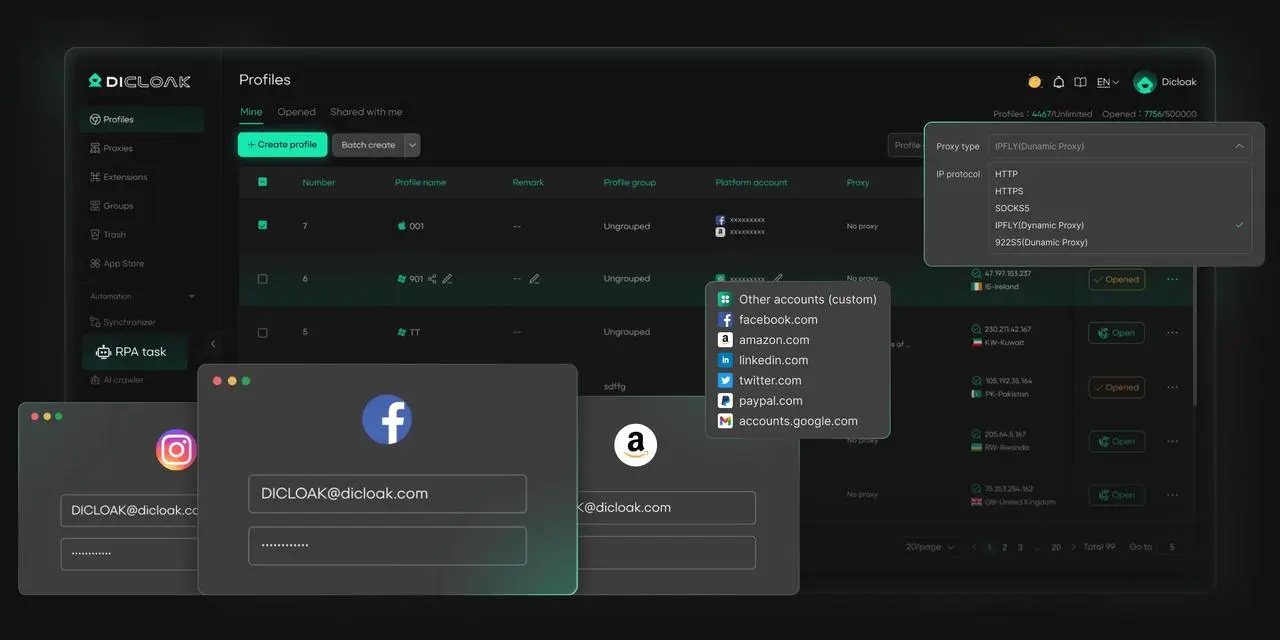
⚡The DICloak Antidetect Browser has become a global favorite for its unparalleled ability to efficiently and securely manage multiple accounts. Designed for professionals in social media management, affiliate marketing, traffic arbitrage, e-commerce, account farming, airdrops, and more, DICloak offers powerful features like RPA automation, bulk operations, and a synchronizer. Additionally, it allows you to customize fingerprints and integrate proxies for each profile, ensuring top-level security and operational efficiency. It’s the ultimate tool for seamless, secure, and scalable operations.
What Makes DICloak Stand Out?
✅ Manage 1,000+ Accounts on One Device:
Stop wasting money on extra hardware! DICloak allows you to manage multiple accounts on a single device, cutting costs and boosting efficiency.
✅ Guaranteed Account Safety, No Ban Risks:
Every account gets its own isolated browser profile with custom fingerprints and IPs, drastically reducing the risk of bans. Your accounts, your control!
✅ Flexible Proxy Configuration for Maximum Performance:
Seamlessly integrate with all major proxy protocols (HTTP/HTTPS, SOCKS5) and manage your proxy pool with bulk operations. No more struggling with IP management—DICloak has you covered.
✅ Streamlined Team Collaboration for Better Results:
Easily manage your team with advanced tools like profile sharing, permission settings, data isolation, and operation logs. Your team works smarter, not harder.
✅ Automate the Grind with RPA:
DICloak's built-in RPA saves you hours of manual work. Automate repetitive tasks, streamline workflows, and focus on what really matters—growing your business.
✅ Powerful Bulk Tools to Scale Your Operations:
Create, import, and launch multiple browser profiles in one click. DICloak makes scaling your business as easy as it gets.
✅ Compatible with All Major Operating Systems:
Based on the Chrome core, DICloak supports simulating Windows, Mac, iOS, Android, and Linux operating systems. No matter what platform you need, DICloak has you covered.
🔗 Ready to Get Started?
Visit the DICloak website to explore more details and choose the plan that’s right for you. Start for free today and experience the power of secure, efficient, and scalable multi-account management!
Note: This material is provided strictly for educational purposes. Users bear the responsibility of ensuring their utilization of multiple Telegram accounts adheres to Telegram’s Service Regulations. DICloak does not endorse mass messaging, spamming, or any practices that contravene platform guidelines.
Frequent Telegram Web Access Problems (And My Solutions)
The Telegram Web Login interface functions reliably, yet I encountered several hiccups during my initial setup and regular use, particularly when I needed to switch between accounts or devices. The following section details the typical issues I faced with Telegram Web, along with the remedies that resolved them.
Verification Code Not Arriving
When using the phone number sign-in path, there were instances where the confirmation code didn't appear. In nearly every instance, relaunching the Telegram mobile app prompted the code to be delivered. Occasionally, switching from Wi-Fi to cellular data proved helpful as well.
Also, be mindful—repeatedly requesting the code can trigger a brief lockout on logging in from Telegram's end.
QR Code Failure to Scan
The QR code refused to scan regardless of how I positioned my phone. The primary cause of this issue was poor lighting conditions and smudged camera lens. An error occurred while processing your request. Please try again.
Web Interface Not Updating with Mobile
At times, a message I sent from the browser wouldn't show up on my phone, or conversely. This was usually due to a minor delay in synchronization. Reloading the Telegram Web Login tab or restarting the mobile application always corrected this.
Fixes That Proved Effective for Me
- Wiping the browser's temporary files and cookies
- Regenerating the QR code or switching to the phone number method
- Confirming your mobile application is running and connected
- Employing DICloak to ensure session consistency and keep each login isolated
Your 2026 and Beyond Telegram Web Toolbox
Telegram Web Login has evolved past being merely a secondary choice—it's now a versatile, feature-rich method to access your Telegram profile instantly, everywhere, needing zero software installation. Whether you're quickly reviewing messages at the office, handling client correspondence, or navigating several profiles, the browser interface offers swiftness, dependability, and a surprisingly comprehensive array of functions.
For my needs, pairing Telegram Web Login alongside DICloak has transformed my operations. I’ve managed to handle numerous accounts, avoid session clashes, and safeguard privacy for every browsing instance—all without needing to sign out or wipe cookies. If serious mobile workflow optimization for Telegram Web in 2026 is your goal, this combination is definitely worth experimenting with.
Test out DICloak at no cost now and streamline the handling of your multiple Telegram Web profiles.
Telegram Web Query & Answer Section (Actual Inquiries I’ve Addressed)
Following thorough testing of Telegram Web Login across practical situations—particularly when utilizing aids like DICloak—here are the most frequent user queries I receive, along with my experienced-based replies:
How safe is Telegram Web?
Telegram Web Login is adequate for your standard messaging needs. Since it relies on cloud-based ciphering, all communications are encrypted during transit and kept safely on Telegram’s servers. Nevertheless, as Telegram Web lacks Secret Chats (available on the mobile client), it omits end-to-end encryption. Consequently, Telegram (the provider) theoretically retains the capacity to view your messages.
Recommended steps:
- Ensure you log out after using Telegram Web on communal or public hardware
- Activate two-step confirmation within your Telegram settings
- Steer clear of dubious browser add-ons
Are secret chats accessible via Telegram Web?
Telegram Web does not offer support for secret chats, which utilize end-to-end encryption. This protection feature is exclusive to the Telegram mobile application.
What is the account limit for Telegram logins?
Telegram permits users to integrate up to three profiles on its mobile application. However, the desktop client and the web interface only permit the use of one profile per session. To oversee several Telegram identities concurrently on a computer, you will require utilities such as DICloak to segment browser profiles.
 Web Proxy Tools
 Free Tools
 Cookie Plugin
 UA Generator
 MAC Address Generator
 IP Generator
 IP Address List
 2FA Code Generator
 World Clock
 Anonymous Check
 WebRTC Leak Test
 UUID Generator
 Free Web Proxy Site
 Proxy Checker
 FB Ad Checker
 AI Web Scraping
 Free SMM Tools
 Twitter Shadowban Checker
 Instagram Name Checker
 UTM Generator
 Username Generator
 AI Hashtag Generator
 LinkedIn Headline Generator
 Social Media Image Resizer