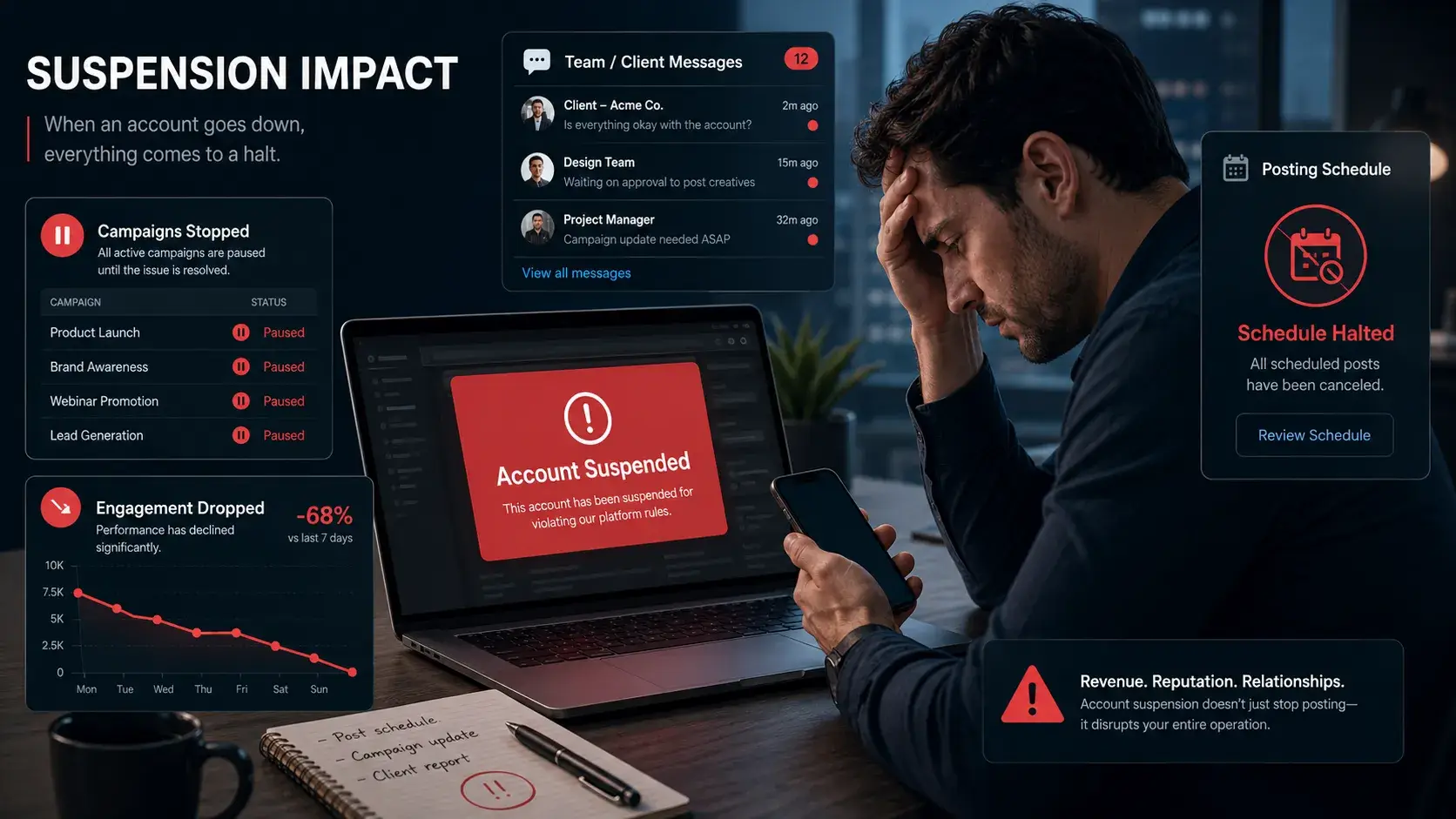
A suspended Twitter/X account can instantly disrupt your entire social media operation, especially if you manage multiple client accounts or run campaigns at scale. Posts stop, ads pause, and engagement drops to zero without warning.
If you are asking how long to recover suspended twitter account, the honest answer is that recovery can take anywhere from a few hours to several weeks, depending on the type of suspension and how complex the review process becomes.
This guide will walk you through what affects recovery time, what to expect during the appeal process, why suspensions happen in the first place, and how you can reduce the risk of it happening again in the future.
How Long Does It Take to Recover a Suspended Twitter Account?
Recovery time depends heavily on the type of suspension and how quickly the appeal is reviewed by the platform’s support team. In most cases, there is no fixed deadline, but there are clear patterns based on real user experiences.
Typical recovery timeline (24 hours to several weeks)
In practice, recovery speed varies widely depending on the situation. Some accounts are restored quickly, while others take significantly longer due to manual review queues.
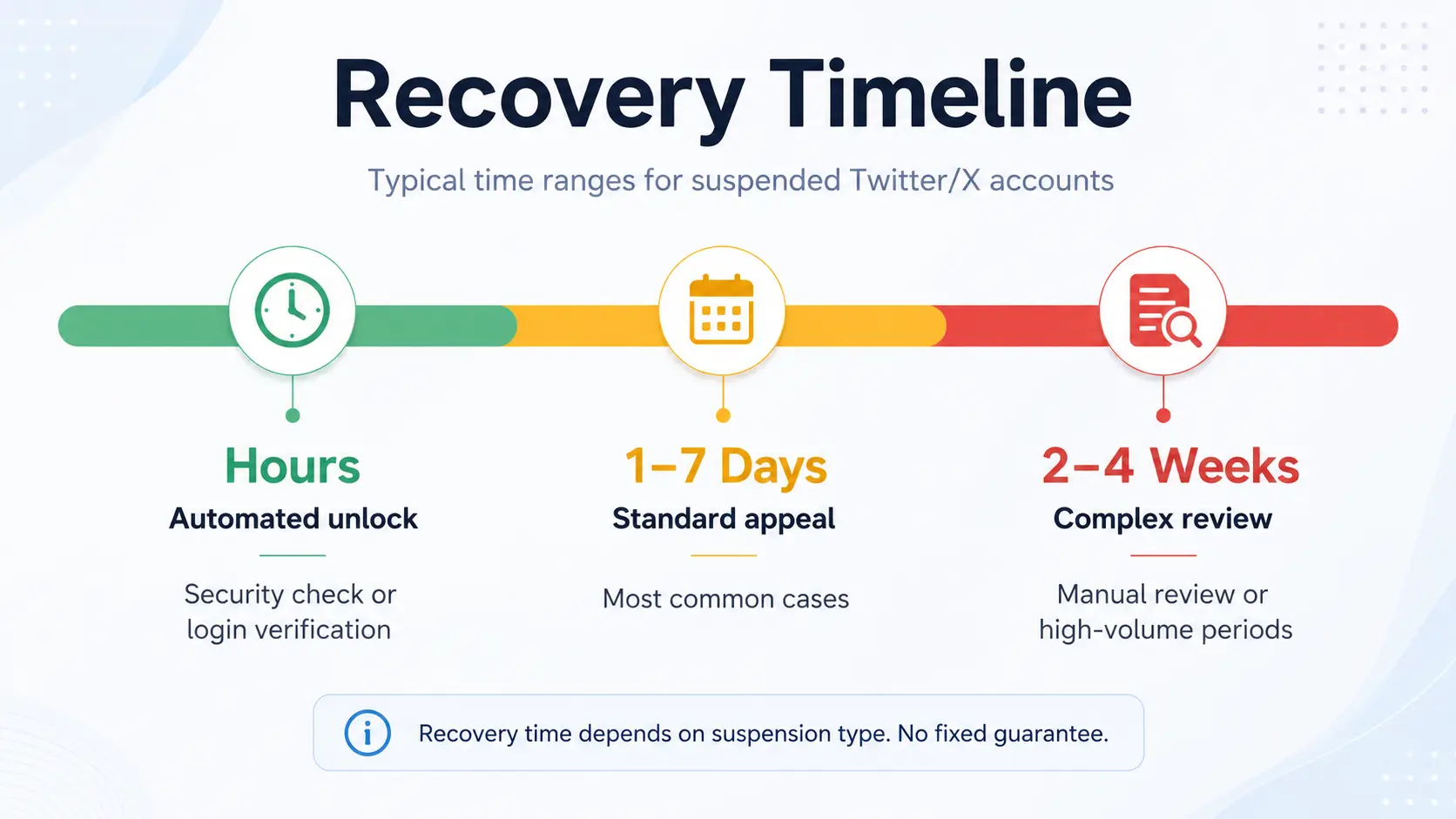
· Automated unlocks: In simple cases like suspicious login activity or minor verification issues, accounts may be restored within a few hours after completing required steps.
· Standard appeals: For most policy-related suspensions, users often see responses within 1–7 days after submitting an appeal.
· Complex or high-volume periods: When enforcement teams are overloaded or the case requires deeper review, the process can stretch to 2–4 weeks.
These timeframes are estimates based on common outcomes, not guaranteed service-level commitments. If you are searching how long to recover suspended twitter account, it is important to understand that timing depends more on case complexity than on when the appeal is submitted.
How long does Twitter suspension last in different cases
Different suspension types lead to very different timelines, and understanding the category of your account helps set realistic expectations.
· Temporary/locked account: These are usually short-term restrictions caused by unusual login activity or security checks. They often resolve within hours to a few days once verification is completed.
· Suspension under review: This is the most common category for policy-related issues. The account remains inactive while the appeal is reviewed, typically lasting from several days to a few weeks.
· Permanent suspension: In this case, there is no recovery timeline. These situations are handled separately in H2-5 and are generally not reversible through standard appeal flow.
If you are trying to understand how long does twitter suspension last, the key factor is whether your account is under temporary restriction or formal review.
What "no response yet" actually means
When you submit an appeal, silence does not necessarily mean rejection. In most cases, your request is simply in a queue waiting for review.
Twitter/X processes a large volume of appeals daily, and delays are normal, especially during enforcement spikes or policy updates. Receiving no response for several days is common and does not indicate a negative outcome.
A critical mistake many users make is submitting multiple appeals too quickly. This does not speed up the process and can sometimes push your case further down the queue or create duplicate tickets.
A practical rule is to wait at least 7 days before sending any follow-up request unless the platform specifically asks for additional information.
Why Is Your Twitter Account Suspended?
Understanding the reason behind a suspension is the first step before you try to recover it. In most cases, Twitter/X uses a mix of automated systems and user reports to detect behavior that may violate platform rules.
Why is my Twitter account suspended (common triggers)
Most suspensions happen because the system detects behavior that looks unsafe, spam-like, or against platform rules. If you are asking why is my twitter account suspended, the most common causes usually fall into a few clear categories.
· Spam behavior: This includes mass following or unfollowing, posting repetitive or low-quality content, and sending large volumes of unsolicited DMs. These patterns often trigger spam filters.
· Automation violations: Using unauthorized bots, scripts, or third-party tools to post, like, or follow can lead to immediate restriction, even if the activity feels “light.”
· Suspicious login activity: Logging in from multiple countries, devices, or rapidly changing IP addresses can trigger security-based suspensions.
· Policy violations: Content issues such as hate speech, harassment, misleading information, or copyright infringement can also lead to account action.
These triggers are well-documented in Twitter/X platform enforcement rules and user safety policies, and they are usually enforced through automated detection first, followed by review if needed.
Twitter account suspended for no reason (what users miss)
Many users feel their suspension happened under twitter account suspended for no reason, but in most cases, there is still an underlying trigger that is not immediately obvious.
One common factor is mass reporting. If multiple users report an account in a short time, the system may automatically restrict it even before a full review confirms a violation. Another hidden trigger is unusual login behavior, such as switching devices or networks frequently, which can look like automated access.
Some accounts are also flagged because their activity resembles bot-like behavior, even if the user is operating manually. For example, fast engagement patterns or repetitive posting schedules can appear suspicious. In other cases, accounts get caught in broader enforcement sweeps where the platform reviews and flags large groups of accounts at once.
While this can feel frustrating or unfair, these systems are designed to prioritize platform safety over individual context at the first stage.
Risk patterns for multi-account operators
Managing multiple Twitter/X accounts increases exposure to automated detection systems, especially when account environments are not clearly separated.
· Same IP address: Running multiple accounts from the same network can signal coordination or automation, even if each account is legitimate.
· Shared browser fingerprint: If accounts are accessed from the same browser profile, the system may link them together based on device-level signals.
· Cross-account impact: If one account gets flagged for policy issues, other accounts in the same environment may also come under review.
· Shared credentials: When team members reuse login sessions or switch between accounts without structure, it creates unusual access patterns that increase risk.
Over time, these patterns make account activity look less like independent users and more like a coordinated system, which raises the likelihood of restrictions.
This is why account isolation matters for professional operators before issues escalate.
Twitter Suspension Appeal Process and Timeline
Understanding the appeal process is critical when your account is suspended. This is the stage where Twitter/X reviews your case and decides whether your account should be restored, restricted, or permanently limited.
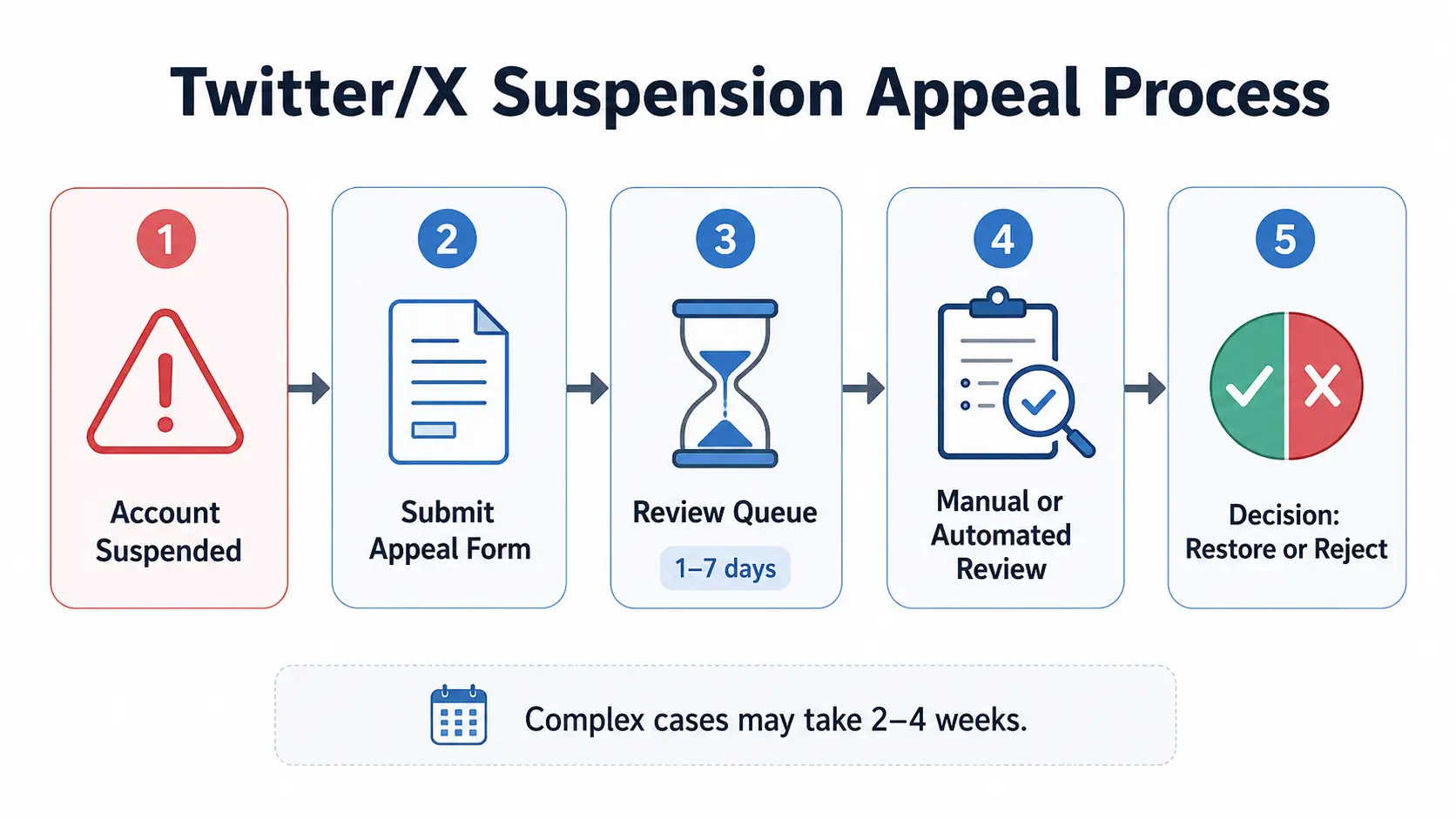
Twitter suspension appeal process step-by-step
The twitter suspension appeal process is handled through an official support form, and it usually follows a structured flow.
First, you access the appeal form through the Twitter/X Help Center and select the issue related to account suspension. You then provide your account details, including email, username, and any verification information requested.
Next, you submit a clear explanation of your situation. This is where you describe why you believe the suspension may be a mistake or provide context for your activity. In some cases, you may be asked to verify identity through email or phone.
After submission, your case enters a review queue. A support agent or automated system evaluates the account based on platform rules and prior activity history. You will then receive a decision via email.
How long does Twitter suspension appeal take
If you are asking how long does twitter suspension appeal take, the timeline varies depending on case complexity and system workload.
In many common cases, users receive a response within 1–7 days after submitting an appeal. Simple issues, such as security-related locks, are often resolved faster. However, policy-related suspensions usually require manual review, which can extend the process.
During high-traffic periods or enforcement spikes, responses may take 2–4 weeks. There is no guaranteed turnaround time, and faster submission does not always mean faster review.
Because of this variability, it is important to track your email and avoid unnecessary repeated submissions while waiting.
What delays appeal decisions
Several factors can slow down the appeal process, even when your case is valid and properly submitted.
One common reason is high appeal volume. When many accounts are flagged at once, cases are placed in a queue and processed in order, which increases waiting time.
Another factor is incomplete or unclear information in the appeal form. If the support team needs more details, your case may be paused until clarification is provided.
Repeated submissions can also delay processing. Each new appeal can create duplicate entries, which may slow down review instead of speeding it up.
In some cases, complex policy reviews require additional verification steps, especially when account behavior appears unusual or involves multiple risk signals.
How to Recover a Suspended Twitter Account
At this stage, the focus shifts from understanding the process to taking action. If your account is eligible for review, recovery depends on how clearly you submit your appeal and how you behave during the waiting period.
How to Submit a Twitter Suspension Appeal (Requirements & Steps)
To start the recovery process, you must use the official Twitter/X appeal form in the Help Center.
Begin by selecting the option related to account suspension and entering your username, email address, and any required verification information tied to your account.
Next, describe your situation in a clear and factual way. Keep your explanation simple, neutral, and focused on what happened before the suspension. If you believe it was a mistake, explain it without emotional language or accusations.
In some cases, you may be asked to verify your identity through email or phone confirmation. Complete all requested steps accurately.
Once submitted, your appeal enters the review queue and updates will be sent to your registered email. This is the standard recovery path for a suspended Twitter account when it is still eligible for reinstatement.
What to Include in Your Appeal to Improve Success Rate
A strong appeal should be clear, calm, and consistent. It does not need to be long, but it must be easy for the review team to understand.
Start by confirming your account details and acknowledging the suspension. Then briefly explain your activity in a neutral tone. If you believe there was an error, state it clearly without blaming or using emotional language.
Avoid sending duplicate appeals or copy-paste messages, as this may reduce clarity and slow down review.
The key to improving your chances is not only submitting the appeal, but ensuring your explanation is accurate and does not suggest repeated or suspicious behavior.
What to Do While Waiting for a Response
After submitting your appeal, the waiting period is an important part of the recovery process.
Avoid sending repeated appeals, as this can delay processing. Also avoid repeatedly logging into a fully restricted account, as it may trigger additional security checks.
Monitor your email inbox regularly, including spam or junk folders, for updates from Twitter/X.
In most cases, no further action is required during this stage. The outcome depends on the platform’s review process, so allowing it to complete without interference is important.
Can You Recover a Permanently Suspended Twitter Account?
Not all suspensions are the same. Some accounts can be restored through appeal, while others are classified as permanently restricted after policy enforcement decisions. This section helps you understand the difference and set realistic expectations.
How to tell if your suspension is permanent vs temporary
The first step is identifying what type of restriction you are dealing with. A temporary suspension usually allows login access with limited features or shows instructions to verify your account or submit an appeal.
A permanent suspension is different. You may see a message indicating that the account has been suspended for violating platform rules with no further standard recovery options. In many cases, repeated appeals receive the same automated rejection response.
If you are unsure whether your case is final, review the email from Twitter/X carefully. It usually contains the clearest signal about whether further review is possible.
Understanding this distinction is important when asking how to recover permanently suspended twitter account, because the strategy changes completely depending on the status.
Can a permanently suspended account ever come back
In most situations, a permanently suspended account does not return through the normal appeal process. These decisions are typically based on serious or repeated policy violations, and the system is designed to enforce them consistently.
However, in limited cases, accounts may be reinstated if the suspension was triggered by an error, false detection, or after successful escalation through support review. These cases are not common and usually require strong evidence.
For most users, it is safer to assume that permanent suspension means the account will not be restored, even if appeals are submitted multiple times.
This is why it is important to focus on prevention and account management structure, rather than relying on reversal after enforcement.
What to do if reinstatement is not possible
If recovery is no longer an option, the focus shifts to rebuilding your presence in a stable and compliant way.
Start by creating a new account with clear separation from past activity. Avoid repeating the same behavior patterns that may have triggered the suspension, especially around automation, login patterns, or posting behavior.
For professional operators, this is also the point where account structure becomes critical. You should ensure each account runs in a clearly separated environment, with controlled access and consistent behavior patterns across teams.
If you are still asking can i get suspended twitter account back, and the answer is no in your case, the priority becomes minimizing risk for future accounts rather than trying to restore the previous one.
How to Prevent Future Suspensions with DICloak
Once an account is recovered or a new one is created, the real challenge is keeping it stable. For social media marketers and operators who manage multiple social media accounts, most future suspensions come from account linkage, inconsistent behavior, or unclear team access patterns rather than a single action mistake.
This is where structured account isolation and workflow control matter. The goal is to make each account behave like a separate, natural user while keeping operations efficient and organized.
Isolated browser profiles with unique fingerprints
When you run multiple Twitter/X accounts on the same device, the biggest risk is that platforms can detect shared browser or device signals. This often leads to accounts being linked or reviewed together.
You can use DICloak to create isolated browser profiles, where each account runs in its own separate environment. Each profile has a unique digital fingerprint, independent cookies, and isolated session data. This helps ensure one account’s activity does not overlap with another.
For example, if you are a social media marketer managing several brand accounts, you can assign one browser profile per client. This keeps each account’s activity clean and separated, reducing the risk of being banned on social media due to cross-account signal mixing or accidental overlap in browsing behavior.
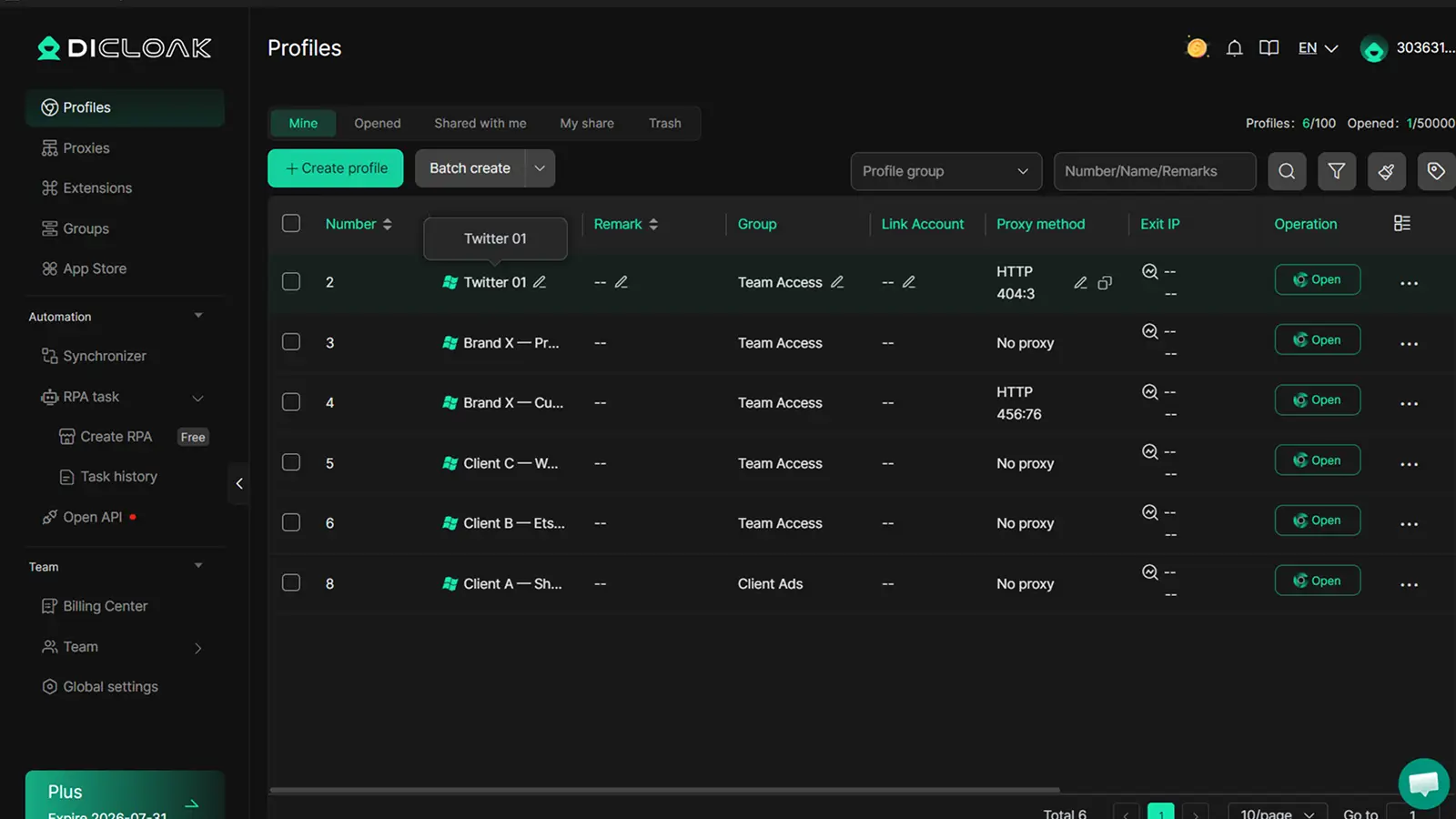
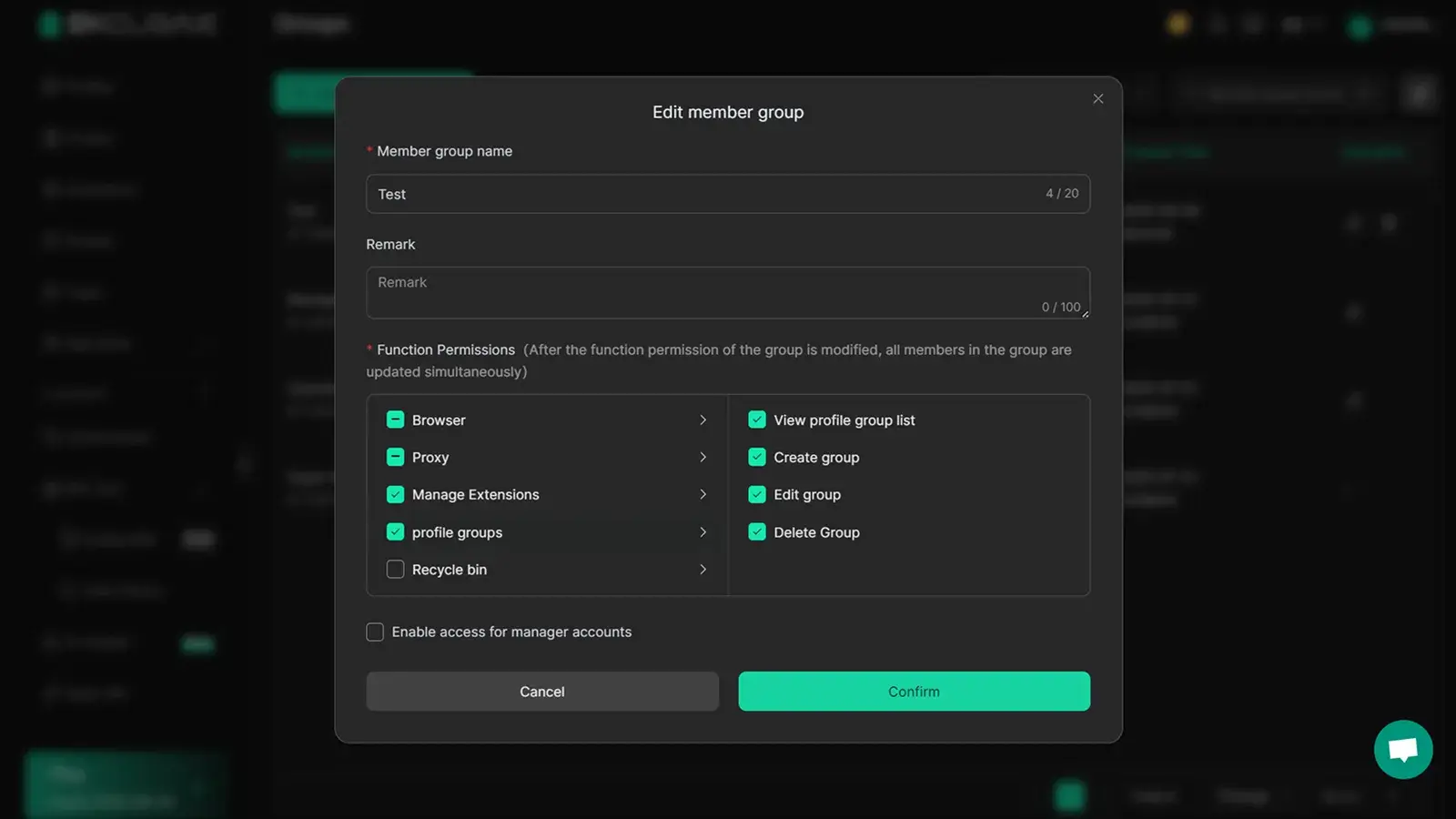
Team member permission control for account safety
In team-based workflows, account risk often comes from uncontrolled access. When multiple people log into the same accounts or switch between accounts freely, activity patterns become inconsistent and harder to track.
You can use DICloak to assign specific accounts or profiles to individual team members. Each person only accesses the accounts they are responsible for, instead of sharing logins across the entire team.
For example, a social media agency handling social media marketing for small business clients can separate responsibilities: one team member manages posting, another handles engagement, and another handles analytics. This reduces accidental misuse and helps prevent accounts from being banned on social media due to overlapping actions or unclear access history.
Synchronizer tool for stable multi-account operations
Managing multiple accounts manually can easily lead to inconsistent timing, uneven activity patterns, or repetitive actions that look unnatural.
You can use DICloak’s synchronizer tool to operate multiple accounts across separate browser windows at the same time. Actions like browsing, posting, or engaging can be performed in sync, while still keeping each account’s behavior natural and independent.
For example, when running coordinated campaigns across multiple Twitter/X profiles, you can manage engagement actions across accounts without constantly switching sessions. This improves efficiency in social media browsing workflows while maintaining consistent, human-like behavior across accounts.
You can also combine this with automation workflows to reduce repetitive manual work, helping scale social media marketing operations while keeping each account environment stable and separated.
FAQs about how long to recover suspended twitter account
Can a suspended Twitter account come back?
Yes, a suspended Twitter account can come back in many cases, but it depends on the reason for the suspension. Temporary suspensions and policy review cases are often reversible after a successful appeal. If the issue was a misunderstanding, login security trigger, or minor policy violation, recovery is more likely.
However, accounts involved in serious or repeated violations may not be reinstated. The final outcome is decided by Twitter/X during the review process.
Is Twitter suspension permanent?
Not always. Many suspensions are temporary or under review, meaning the account can still be restored after verification or appeal. A permanent suspension usually means the platform has determined a serious or repeated violation of its rules.
In these cases, standard appeals often do not lead to reinstatement. It is important to check the notification email carefully, as it usually indicates whether the decision is final or still under review.
Twitter suspension appeal form — where do I find it?
You can find the Twitter suspension appeal form in the official Twitter/X Help Center. Go to the support section, select “account access” or “suspended account,” and follow the prompts to submit your case.
You will need to provide your username, email address, and a short explanation of your situation. In some cases, identity verification may also be required before the appeal is processed.
How long does Twitter suspension appeal take on average?
On average, Twitter suspension appeals take about 1–7 days for common cases. Security-related locks may be resolved faster, sometimes within hours.
More complex policy-related cases can take 2–4 weeks, especially during high-volume periods or when manual review is required. There is no fixed guarantee, and timing varies based on case complexity and system workload.
What is the fastest way to recover a suspended account?
The fastest way to recover a suspended account is to submit a complete and clear appeal the first time. Make sure your explanation is simple, accurate, and aligned with platform rules. Avoid sending multiple appeals, as this can slow down the review process.
Also, respond quickly if Twitter/X requests additional verification. In most cases, delays happen because of incomplete information or repeated submissions rather than the appeal itself.ecovering a suspended account is only part of the process — keeping your Twitter/X accounts stable matters even more when you manage multiple profiles.
You can use DICloak to isolate each account in a separate browser profile, assign access to team members, and manage multiple accounts more efficiently with synchronized workflows.Try DICloak for Free.
 Web Proxy Tools
 Free Tools
 Cookie Plugin
 UA Generator
 MAC Address Generator
 IP Generator
 IP Address List
 2FA Code Generator
 World Clock
 Anonymous Check
 WebRTC Leak Test
 UUID Generator
 Free Web Proxy Site
 Proxy Checker
 FB Ad Checker
 AI Web Scraping
 Free SMM Tools
 Twitter Shadowban Checker
 Instagram Name Checker
 UTM Generator
 Username Generator
 AI Hashtag Generator
 LinkedIn Headline Generator
 Social Media Image Resizer