Yes, you can learn how to start affiliate marketing with no money in 2026 without paying for ads, building a website, or buying premium tools. However, “no money” does not mean “no effort.” You still need a phone or computer, internet access, useful knowledge, and enough time to create and test content.
The biggest mistake is trying to promote many products across several platforms at once. A better starting point is one audience, one recurring problem, one relevant affiliate offer, and one free content channel you can maintain.
This guide will help you build that first setup, create content around real buying questions, and read the signals that show what is working. You will also learn when to adjust your content, change an offer, or expand into more affiliate projects.
Can You Really Start Affiliate Marketing with No Money?
The real question is not whether affiliate marketing can be started for free, but what a realistic zero-budget setup looks like. You need to remove optional costs while keeping the parts that help people discover and trust your recommendations.
What “No Money” Actually Means
Starting affiliate marketing for free means avoiding unnecessary costs at the beginning. You can publish videos on YouTube or TikTok, write on Medium or Substack, and use the free analytics offered by most content platforms. You can also join many affiliate programs without paying an application fee.
The trade-off is that you must earn attention through content rather than buy it with advertising. Organic traffic may take longer to build, and your early content may not receive much exposure. This is why a zero-budget beginner should focus on one clear audience, one problem, and one content channel instead of spreading limited time across several platforms.
Can You Start Without a Website or Followers?
You do not need a website or an existing audience to publish your first affiliate content. Search-based platforms such as YouTube can help useful tutorials reach people who are already looking for an answer. Recommendation-based platforms such as TikTok and Instagram can introduce content to users who do not already follow the creator. At the same time, communities can help people with relevant experience contribute to existing discussions.
However, affiliate marketing without a website or followers does not mean posting links from an empty account. People still need a reason to trust the recommendation. A clear profile, a consistent topic, and several useful pieces of content can show both users and affiliate managers how the product will be promoted.
Some affiliate programs may still require a website, established content, a specific traffic source, or an audience from an eligible country. Always check the program requirements before building a content plan around an offer.
Build One Affiliate Setup Worth Testing
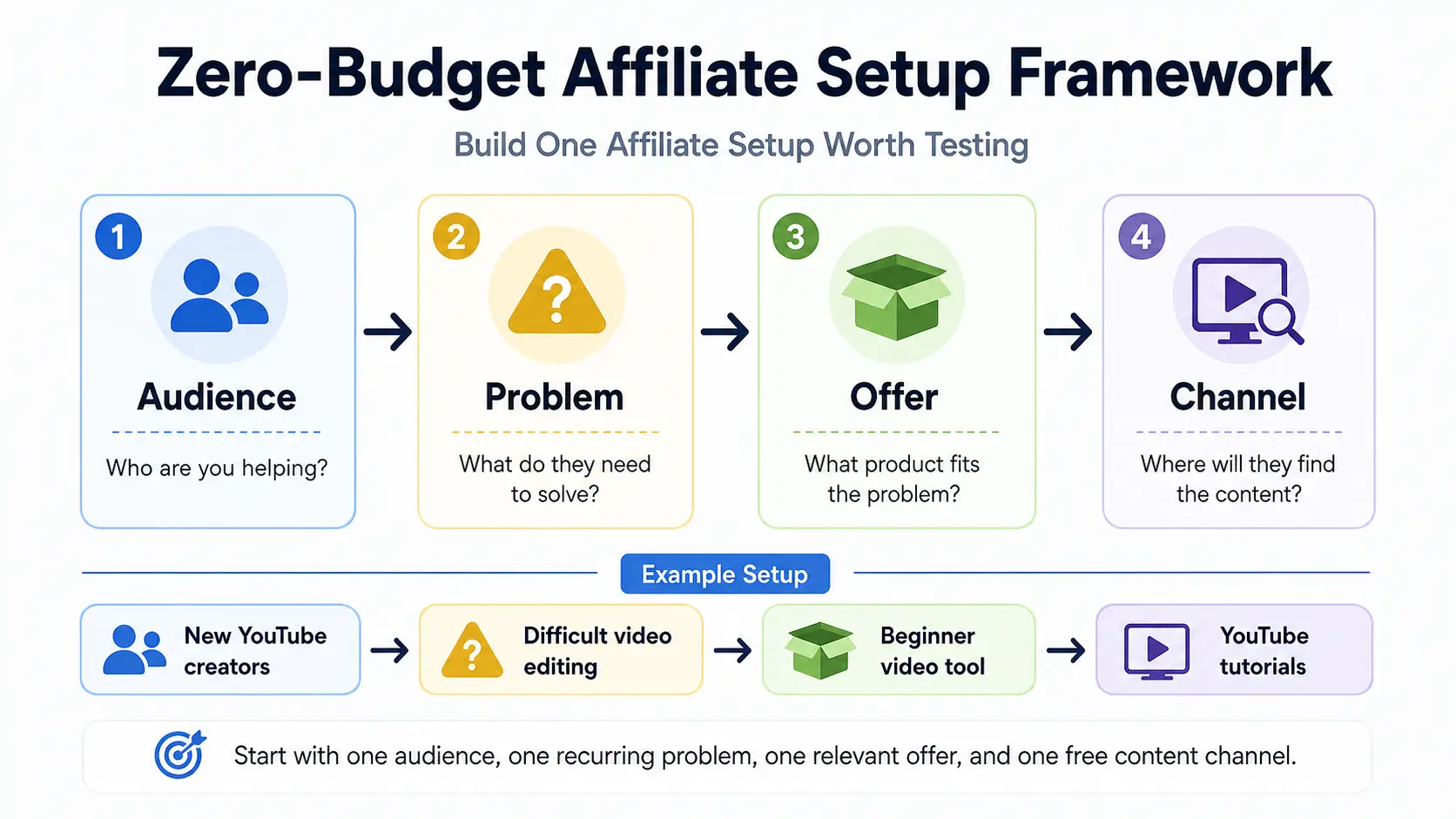
The first goal is not to build a large affiliate business. It is to create one focused setup that can show whether a real audience is interested in the problem, the content, and the product being recommended.
For affiliate marketing for beginners, that setup should include one audience, one recurring problem, one relevant offer, and one content channel.
Start with One Problem You Understand
When learning how to choose a niche for affiliate marketing, do not begin with a list of supposedly profitable industries. Categories such as fitness, software, beauty, and personal finance are too broad to guide useful content.
Start with a problem you already understand. Ask:
- Which type of user do you understand?
- What problem do they face repeatedly?
- Have you used products that address it?
- Can you explain the problem clearly?
- Does it lead people to compare or purchase solutions?
A useful starting point combines:
One audience + one recurring problem + one product category.
For example:
- Too broad: Fitness More focused: Home workout equipment for busy office workers
- Too broad: Email marketing More focused: Affordable email tools for solo online sellers
- Too broad: Pet supplies More focused: Basic grooming products for first-time dog owners
The narrower version makes it easier to identify content topics, relevant products, and the people most likely to need them.
A niche is worth testing when you can already identify several questions users ask before choosing a solution. If those questions are still unclear, spend more time learning about the audience before selecting an affiliate offer.
Choose One Offer You Can Honestly Recommend
The next step is learning how to find affiliate products to promote without buying many products first.
Start with products you already use or can access honestly, such as:
- Software with a free plan
- Products with a free trial
- Services you have used before
- Digital tools you can demonstrate through screen recording
- Physical products you already own
- Products whose features and limitations you understand well
You do not always need to buy a product before promoting it. However, you should never claim personal experience that you do not have. When direct experience is limited, use verifiable product information, public demonstrations, official documentation, and clear comparisons.
When deciding how to choose an affiliate program, use this checklist:
| Check |
What to consider |
| Problem fit |
Does the product solve the specific problem covered by your content? |
| Audience fit |
Can the target user afford and realistically use it? |
| Product access |
Can you explain or demonstrate it honestly? |
| Commission |
Is the payment reasonable for the effort required? |
| Cookie duration |
How long can a referred click remain eligible for commission? |
| Payout threshold |
Is the minimum payout realistic for a beginner? |
| Sales page |
Is the page clear, credible, and easy to understand? |
| Program terms |
Does the program allow your planned traffic source and content type? |
The best first offer is not automatically the one with the highest commission. It is the one that clearly fits the audience, the problem, and the content you can create.
Check Whether the Program Fits Your Starting Point
A useful product can still be a poor first choice if its affiliate program does not accept your current setup.
Before applying, check whether the program requires:
- A website
- An established content history
- A minimum audience size
- A specific traffic source
- Applicants from certain countries
- Approval before using brand materials
- Specific affiliate disclosures
- Restrictions on social media, email, paid search, or community promotion
People searching for affiliate programs for beginners without a website should not assume that every program accepts social-media-only applications. Requirements vary between companies and may change over time.
If applications are reviewed manually, make your promotion plan easy to understand. Your profile and existing content should show:
- Who the content serves
- Which problem it covers
- What type of content you publish
- How the product fits the topic
- Where affiliate links may appear
This does not guarantee approval, but it prevents you from applying with an empty account or an unclear promotion plan.
The practical answer to how to get accepted into affiliate programs is to choose programs that match your current traffic source and content, rather than applying to as many programs as possible.
Choose One Channel You Can Maintain
The best free channel is the one your audience already uses and you can realistically maintain.
Use your existing strengths to narrow the choice:
| Your strength |
Channel to consider |
| Writing and research |
Medium, Substack, or a blog |
| Detailed product demonstrations |
YouTube |
| Short visual explanations |
TikTok, Instagram Reels, or YouTube Shorts |
| Professional knowledge |
LinkedIn or relevant industry communities |
| An existing small audience |
Email or your current social account |
When deciding how to promote affiliate links for free, consider:
- Whether the platform fits the audience
- Whether the product can be explained well in that content format
- Whether you can continue publishing consistently
- Whether the platform allows your promotion method
- Whether the content can attract people with a real interest in the problem
There is no universal best choice among the free traffic sources for affiliate marketing. A channel is useful only when it matches the audience, the topic, and your ability to create content.
Start with one primary channel. Several unfinished accounts create more work but do not produce clearer feedback.
At the end of this step, you should have:
- One audience
- One recurring problem
- One relevant offer
- One suitable affiliate program
- One content channel you can maintain
That is enough to begin testing without spreading your effort across too many products and platforms.
Create Content Around Buying Questions
Once the audience, offer, and channel are clear, the next task is to create content that helps people decide whether a product fits their needs. Effective affiliate content does not begin with a link. It begins with a question the potential buyer is already trying to answer.
Answer the Questions People Ask Before Buying
Useful affiliate marketing content ideas usually come from the decisions people make before purchasing a product. They may want to understand a problem, compare two options, complete a task, or avoid choosing the wrong solution.
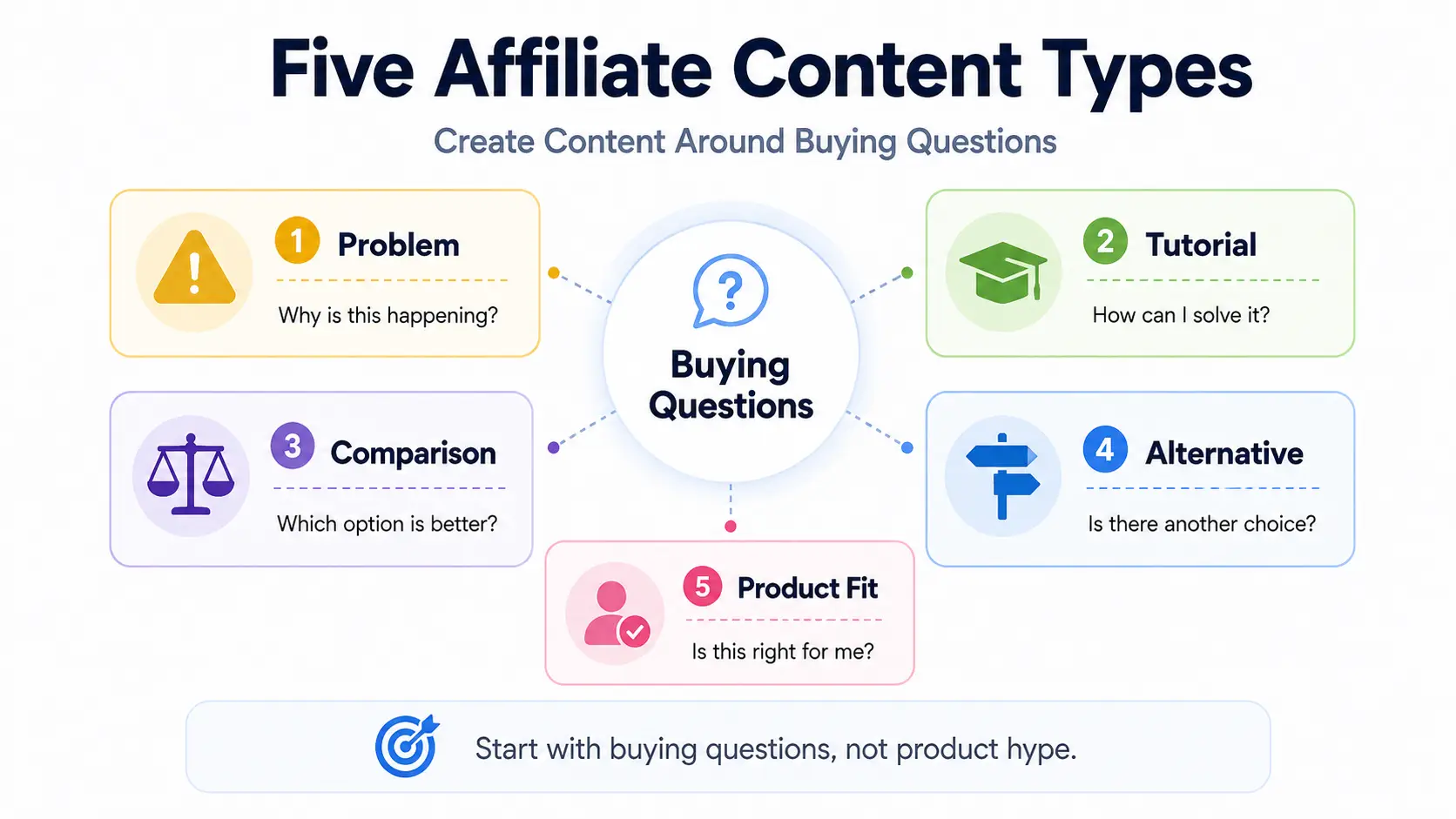
Use these five content types to plan your first topics:
| Content type |
Question it answers |
Example |
| Problem |
Why is this happening? |
Why does video quality drop after uploading? |
| Tutorial |
How can I complete this task? |
How to remove background noise from a video |
| Comparison |
Which option fits me better? |
Tool A vs. Tool B for short-form creators |
| Alternative |
Is there a cheaper or simpler option? |
Best free alternatives to Tool A |
| Product fit |
Is this product right for my situation? |
Is Tool A worth it for a new YouTube channel? |
These formats are more useful than publishing general product descriptions because they connect the recommendation to a real decision.
When learning how to create affiliate content, start with the questions closest to your own experience. A detailed tutorial based on a task you understand is usually more credible than a broad “best products” list covering tools you barely know.
You can also turn one user problem into several related topics. For example, someone promoting an email tool could create a beginner setup guide, a comparison with a free alternative, and an explanation of when the paid plan becomes useful. Each piece serves a different decision without promoting unrelated products.
Make the Recommendation Useful, Not Promotional
Knowing how to promote affiliate products does not mean making every product sound perfect. A useful recommendation should explain:
- The problem the product solves
- Other options the user could consider
- The features that matter in this situation
- Important limitations
- Who the product is suitable for
- Who may not need it
A natural recommendation often follows this order:
Problem → possible options → evidence or experience → limitations → suitable users → recommendation.
For example, instead of saying that a video editor is “the best choice for everyone,” explain that its free plan may suit beginners who need basic editing, while creators who need advanced collaboration or export controls may require another option.
This approach makes the product part of the answer rather than the subject of the entire piece. It also gives readers a clear reason to click instead of relying on a generic call to action.
Avoid claiming that you used a product when you did not. When personal experience is limited, clearly separate verified product information from your own observations. Do not present documentation, screenshots, or public reviews as firsthand experience.
Place Affiliate Links and Disclosures Clearly
When deciding where to place affiliate links, add them near the recommendation or next step they support. A tutorial may include the link after explaining the relevant feature, while a comparison may place it beside the final recommendation.
Do not repeat the same link in every paragraph. More links do not fix weak purchase intent, and excessive promotion can make useful content feel like an advertisement.
An affiliate disclosure should also be easy to notice and understand. For content aimed at U.S. consumers, FTC guidance says disclosures should appear with the endorsement, use clear language, and not be hidden on a profile page, behind a “more” button, or inside a crowded group of hashtags. Video endorsements should include the disclosure in the video rather than relying only on the description.
A simple statement such as “This post contains affiliate links, which means I may earn a commission if you purchase through them” is clearer than vague wording.
Good affiliate content gives readers enough information to make their own decision. The link should offer a useful next step, not replace the explanation that earns the click.
Validate What Is Working Before You Scale
Publishing content is only the beginning. Before adding more products, platforms, or accounts, you need to understand which part of the setup is working and where potential buyers are dropping out.
The goal is not to wait for a fixed number of days. It is to collect enough signals to make a better decision.
Read the Funnel in the Right Order
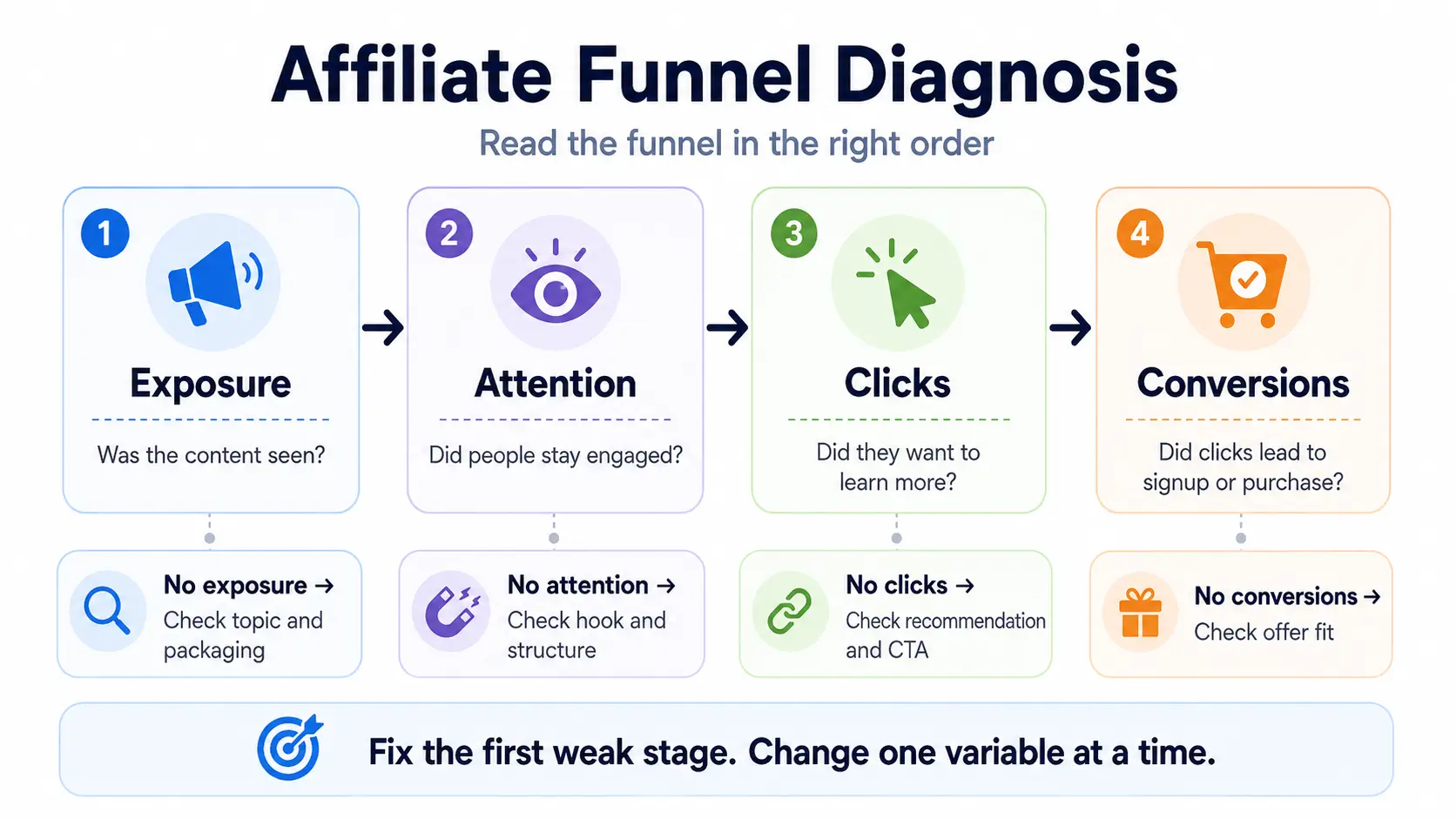
The most useful affiliate marketing metrics follow the path a potential buyer takes:
- Exposure: Was the content shown to anyone?
- Attention: Did people continue watching, reading, or engaging?
- Clicks: Did they want to learn more about the recommended product?
- Conversions: Did those clicks lead to a signup or purchase?
Each stage answers a different question.
Low impressions do not prove that the affiliate offer is bad. The audience may not have seen the recommendation yet. Strong views with few affiliate link clicks usually point to the content, product connection, or call to action. Clicks without conversions move the problem further down the funnel, where the offer, price, sales page, or buyer intent may need closer attention.
This order matters because beginners often change the wrong part of the setup. Someone with no traffic may switch products, while someone with many clicks but no sales may keep publishing more of the same content. Neither action fixes the stage that is actually failing.
Fix the Stage That Is Failing
Use the first weak signal to decide what to adjust:
| Current result |
More likely problem |
What to adjust first |
| Little or no exposure |
Topic, title, format, or channel fit |
Test a clearer problem or stronger content angle |
| Exposure but weak attention |
Opening, structure, or relevance |
Improve the hook and explain the value earlier |
| Attention but few clicks |
Weak product connection or recommendation |
Clarify the use case, product fit, and next step |
| Clicks but no conversions |
Offer, price, buyer intent, tracking, or sales page |
Review the offer before creating more content |
| Several posts produce related clicks |
The audience–problem direction may be valid |
Create more content around the same decision |
| Some content produces conversions |
The setup has a useful signal |
Test whether the result can be repeated |
When you see affiliate clicks but no sales, do not immediately assume that affiliate marketing does not work. Check whether the content attracted people who were ready to consider a product or only people looking for free information.
For example, a post titled “How to edit videos for free” may attract users who have no intention of paying. It can still receive many views and clicks, but the offer may not fit their current goal. A comparison such as “Free Plan vs. Paid Plan for Client Projects” may reach fewer people but attract stronger buying intent.
Also check the recommendation itself:
- Does the product solve the exact problem discussed?
- Is the price suitable for this audience?
- Did the content explain why someone should choose it?
- Is the affiliate link working correctly?
- Does the sales page match the promise made in the content?
- Are there unexpected fees, regional limits, or signup requirements?
When reviewing why affiliate links are not converting, change one major variable at a time. If you replace the offer, switch platforms, change the audience, and rewrite the content format together, you will not know which change affected the result.
Know When You Have Enough Signal to Continue
There is no universal number of days, views, or clicks that proves an affiliate setup will succeed. A new YouTube tutorial, a short TikTok video, and a written guide may receive useful feedback at very different speeds.
Instead, look for repeated patterns.
A setup may deserve more work when:
- Several pieces of content attract the intended type of user
- The same problem repeatedly receives stronger attention
- Product-related content produces relevant clicks
- Users ask questions that show buying interest
- One or more recommendations lead to signups or sales
- You can identify which topic should be covered next
You may need to reconsider the setup when different content angles repeatedly fail to reach the intended audience, or when the content that performs well has little connection to products people are willing to buy.
Do not abandon an entire niche because one post fails. At the same time, do not keep producing the same type of content simply because you have already invested time in it.
The purpose of tracking affiliate links is not only to count commissions. It is to understand whether the audience, problem, content, and offer are connected. Once that connection produces repeatable attention, clicks, or conversions, you have a stronger reason to scale.
Scale Only What Is Already Working
Scaling should extend a proven affiliate setup, not multiply an unclear one. Once you know which audience, content topics, and offers produce useful signals, add one related offer, channel, market, or account at a time.
Add One New Variable at a Time
When learning how to scale affiliate marketing, avoid changing several parts of the workflow together.
A successful YouTube tutorial could be adapted into Shorts, or a proven offer could be paired with another product for the same audience. These changes are easier to evaluate than launching several new accounts, channels, and offers at once.
More activity does not fix weak audience–offer fit. Expanding one variable at a time keeps the results readable and prevents an unproven strategy from turning into a larger operational problem.
How DICloak Helps Manage Growing Affiliate Projects
As affiliate operations expand, the challenge is no longer just creating content. Marketers may need to manage separate accounts for different brands, traffic channels, regions, affiliate networks, or client campaigns.
Using all of them in one regular browser can create practical problems:
- Cookies and saved sessions from different projects can overlap
- The wrong account may be opened for a campaign
- Proxy and account assignments become difficult to track
- Repeated logins slow down daily work
- Extensions, bookmarks, and project data become mixed
- Team members may receive more account access than they need
- Repetitive checks take longer as the number of projects grows
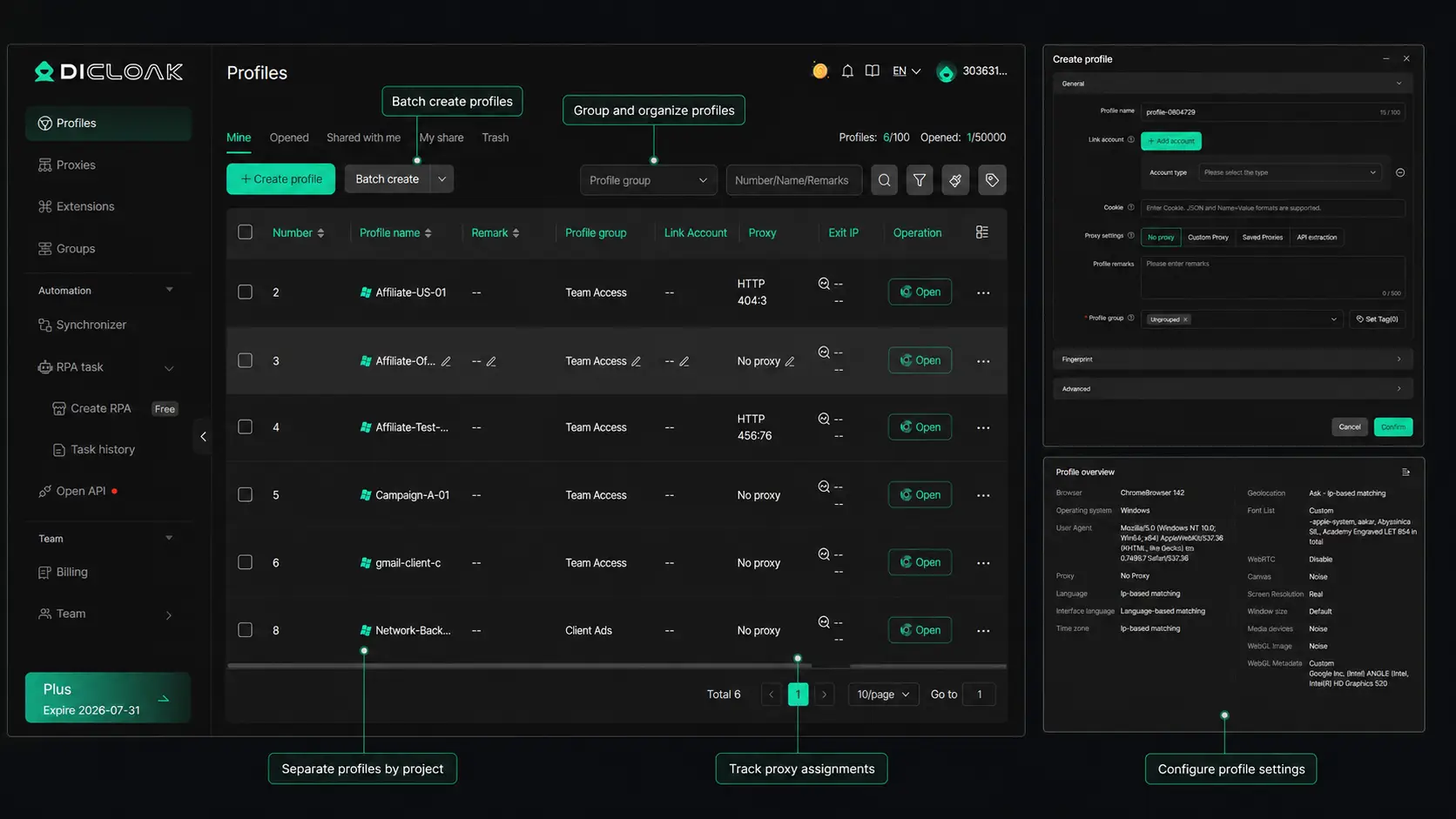
DICloak addresses these issues by giving each project an isolated browser Profile. A Profile can keep its own cookies, login session, browser data, fingerprint settings, and user-configured proxy. This helps marketers separate working environments by brand, platform, market, or campaign instead of managing every account inside the same browser space.
For example, a marketer running two regional content accounts and several affiliate dashboards can assign each project its own Profile. Opening one project does not require logging out of another, and the saved session remains connected to the correct working environment. Profile names, groups, tags, and notes also make it easier to identify the account, market, offer, and person responsible for it.
DICloak also includes bulk operations and built-in RPA. Bulk tools can reduce the time spent opening, importing, editing, or organizing many Profiles. RPA can handle suitable repeatable workflows, such as opening a standard set of research pages, checking assigned dashboards, or following the same internal review sequence across projects.
When more people join the workflow, selected profiles can be shared with assigned team members. Permissions and operation logs help control who can access each project and make account responsibilities easier to review.
FAQs about Start Affiliate Marketing with No Money
Can I Start Affiliate Marketing Without a Website?
Yes. You can use YouTube, TikTok, Instagram, Medium, Substack, LinkedIn, or a relevant online community instead. However, affiliate marketing without a website still requires a clear topic, useful content, and a place where people can find your recommendations. Also check each affiliate program first, since some programs only approve applicants with a website or established content platform.
Can I Start Affiliate Marketing with No Followers?
Yes. Platforms with search, recommendation, or community discovery can show your content to people who do not already follow you. Still, affiliate marketing with no followers does not mean posting links from an empty account. Publish useful content first, make your topic clear, and give people a reason to trust your recommendation before asking them to click.
How Long Does It Take to Make the First Affiliate Sale?
There is no reliable fixed timeline. The first sale depends on how quickly your content reaches the right audience, how close the topic is to a buying decision, and how well the offer fits the user’s needs. Instead of waiting for a set number of days, track exposure, attention, affiliate link clicks, and conversions to see which part of the setup needs improvement.
Do I Need to Buy a Product Before Promoting It?
Not always. You can begin with products you already own, services you have used, software with a free plan, or tools that offer a free trial. You can also discuss verified features and public documentation. However, never claim personal experience you do not have. Honest limits and clear evidence make a recommendation more useful than pretending every product has been personally tested.
How Many Affiliate Programs Should a Beginner Join?
There is no perfect number, but joining many programs at once usually creates more confusion than opportunity. Start with one main audience and one or two closely related offers that solve the same problem. This makes it easier to create focused content and compare results. Add another program only when it gives the audience a meaningful alternative or fills a clear gap.
Learning how to start affiliate marketing with no money means focusing on what you can test before paying for more tools, traffic, or accounts. Start with one audience, one recurring problem, one suitable offer, and one free content channel. Then use real signals such as views, clicks, and conversions to decide what should be improved or expanded.
As more affiliate projects, accounts, and team members are added, keeping each workflow separate becomes more important. DICloak helps organize different browser Profiles, login sessions, proxies, and repeated tasks in one place, making growing affiliate operations easier to manage.Try DICloak for Free.
 Web Proxy Tools
 Free Tools
 Cookie Plugin
 UA Generator
 MAC Address Generator
 IP Generator
 IP Address List
 2FA Code Generator
 World Clock
 Anonymous Check
 WebRTC Leak Test
 UUID Generator
 Free Web Proxy Site
 Proxy Checker
 FB Ad Checker
 AI Web Scraping
 Free SMM Tools
 Twitter Shadowban Checker
 Instagram Name Checker
 UTM Generator
 Username Generator
 AI Hashtag Generator
 LinkedIn Headline Generator
 Social Media Image Resizer