The Mechanics of Fingerprinting in Modern Digital Infrastructure
In contemporary cybersecurity landscapes, platform security systems have moved far beyond simple IP-based blacklisting. Modern browser fingerprinting leverages high-entropy hardware identifiers to construct a unique device "hash." Technologies such as Canvas, WebGL, AudioContext, and WebRTC allow platforms to probe GPU rendering nuances, font stacks, and local network configurations.
This infrastructure is the primary driver behind "association" flags, where platforms link multiple ostensibly separate accounts to a single hardware ID. For practitioners involved in high-stakes traffic arbitrage, affiliate marketing, and automated account farming, these associations lead to chain bans—the simultaneous termination of an entire profile network. To mitigate exposure, technical teams must adopt a dual-layer isolation strategy that addresses both the network reputation and the hardware identity.
Leveraging proxy4u to Mitigate Identity Leakage
Network isolation is a key component of multi-account operations. IP reputation and consistency play an important role in account stability. proxy4u offers residential and mobile IP options that can help reduce reputation-related issues compared to generic IP sources.
The Technical Logic of the 85/15 Rule
Effective infrastructure follows the 85/15 rule of isolation: approximately 15% of the browser's technical markers are responsible for 85% of account bans. These markers include high-entropy variables like Canvas and WebGL.
- Canvas Fingerprinting: This forces the browser to render a hidden image. Because individual GPU/driver configurations handle pixel interpolation differently, the resulting hash is unique.
- WebGL Probing: This extracts specific hardware specs from the graphics card.
Rotating an IP via proxy4u provides the necessary network reputation, but without browser isolation, the hardware hash remains static. If a single Canvas hash is observed across multiple residential IPs, the platform identifies the user as a single entity attempting to circumvent security. Therefore, proxy4u provides the reputation layer, while the antidetect environment provides the identity layer.
Deep Dive into the proxy4u Network Architecture
Choosing the correct proxy type depends on the target platform’s sensitivity and the required trust score.
Residential vs. Mobile Proxies: A Latency and Trust Score Analysis
- Residential Proxies ($2.5/GB): Assigned by ISPs to home users, these offer the highest legitimacy for general account management.
- Mobile Proxies ($3.5/GB): Utilizing 4G/5G cellular gateways, these IPs are often shared by thousands of genuine users via CGNAT. Platforms like Facebook and TikTok are hesitant to ban mobile IPs because doing so would result in significant collateral damage to legitimate users.
Sticky vs. Rotating IP Strategies for Account Farming
proxy4u facilitates two primary operational modes:
- Rotating Proxies: Optimized for data scraping or initial account warming where maximum anonymity is required.
- Sticky Sessions: Allows for a persistent IP for up to 30 minutes.
Operational Scenario: A 30-minute sticky session is mandatory for multi-step e-commerce checkouts. An IP change mid-transaction triggers "Impossible Travel" flags, leading to immediate order cancellation or account checkpoints. By utilizing ASN and Zip code targeting, an analyst can ensure the IP matches the suspected geographic location of the resident, further bypassing geo-fencing.
Global Coverage Features:
- 5M+ Residential Pool: High availability for large-scale operations.
- Granular Targeting: Selection by Country, State, City, Zip, and ASN.
- Protocol Support: Native HTTP, HTTPS, and SOCKS5.
Pro Tip: For managing high-value social media assets, residential proxies with specific ASN targeting are industry practice for bypassing "suspicious login" verification steps.

Why Standard Browsers Fail and How DICloak Protects Assets
Standard browsing environments are designed for transparency, leaking hardware signatures by default. DICloak provides a robust framework for managing 1,000+ accounts on a single physical machine by virtualizing the browser core.
Based on the Chrome engine, DICloak enables the simulation of various operating systems (Windows, Mac, iOS, Android, Linux). This allows a single device to appear as a fleet of diverse mobile and desktop units.
Strategic Integration of proxy4u within DICloak Profiles
To maintain account integrity on platforms like Facebook, Instagram, and TikTok, the network layer must be integrated directly into the browser profile.
Protocol Selection: HTTP vs. SOCKS5
While HTTP/S is standard, SOCKS5 is the preferred protocol for multi-account management due to its ability to handle more complex traffic types and its demonstrated efficacy in high-performance automation.
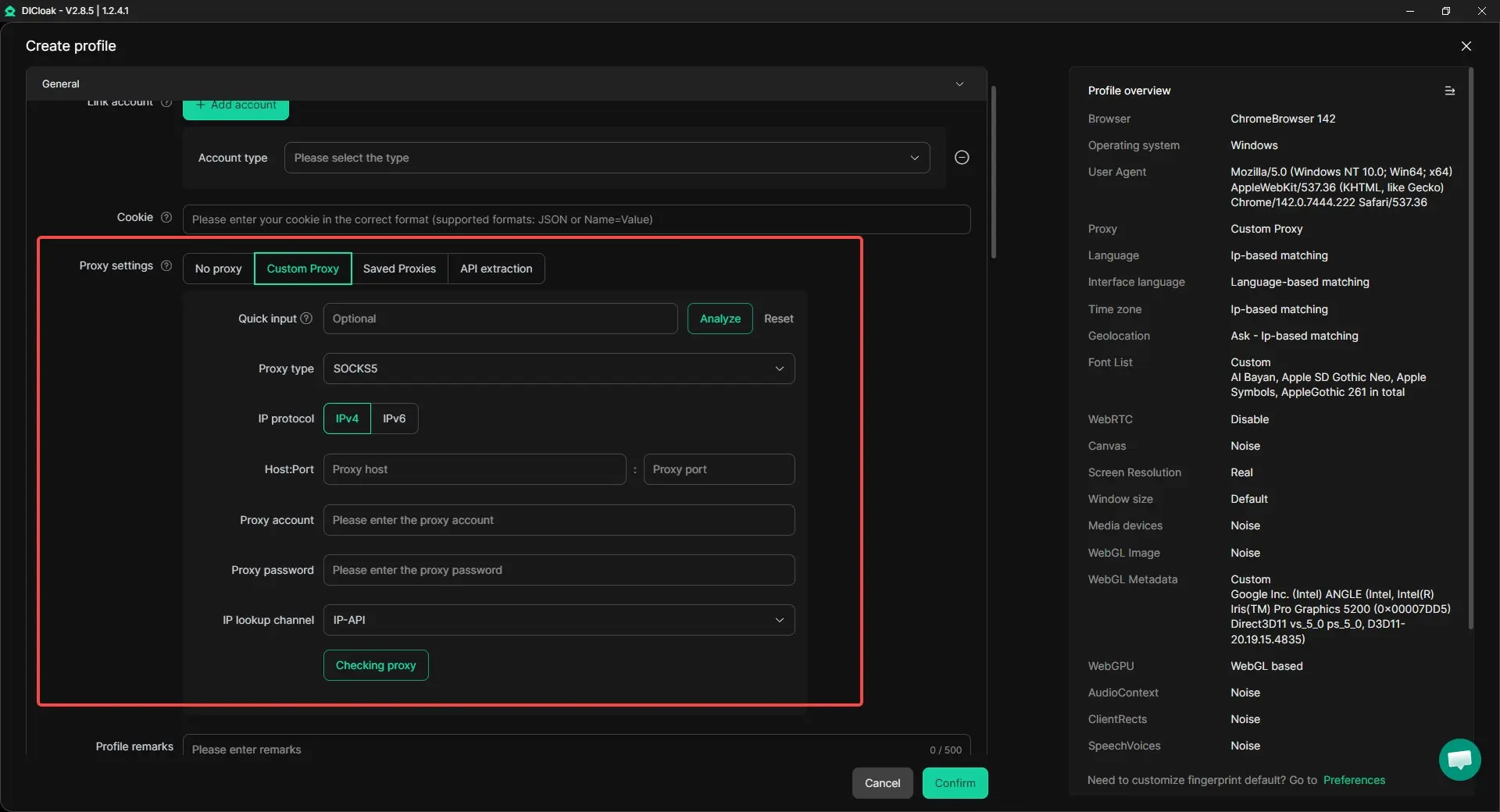
Active Command for Profile Configuration: To implement a resilient profile, use the following industry-standard string for proxy integration:
- Create Profile: Initialize a new profile in DICloak.
- Input Proxy: Use the syntax: Login:Password@Hostname:Port.
- Check Connection: Execute a proxy check to confirm the node is live.
- Generate Fingerprint: Select "New Fingerprints" to randomize the 15% high-entropy markers (Canvas, WebGL, AudioContext).
Team Permissions and Data Isolation Frameworks
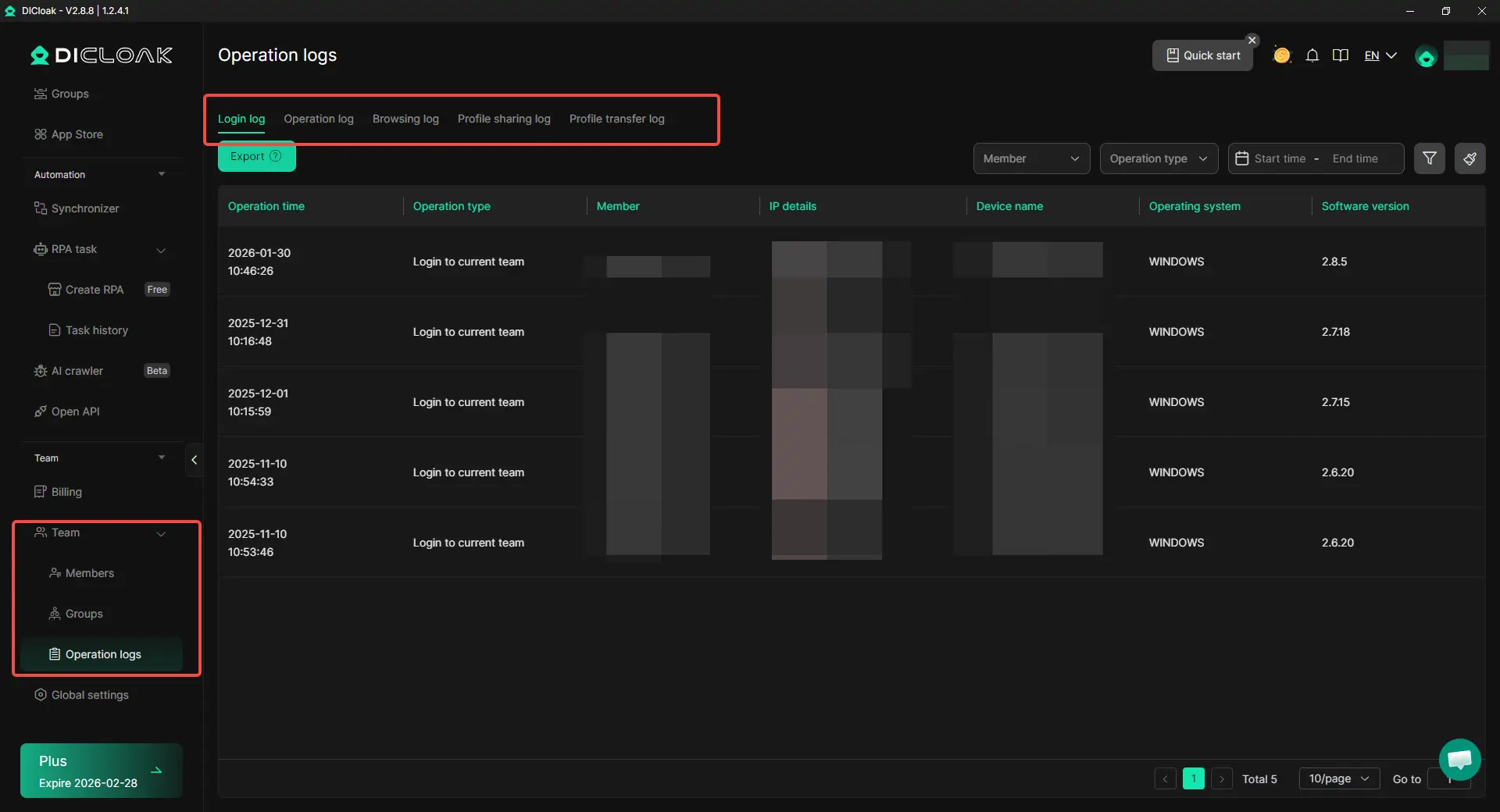
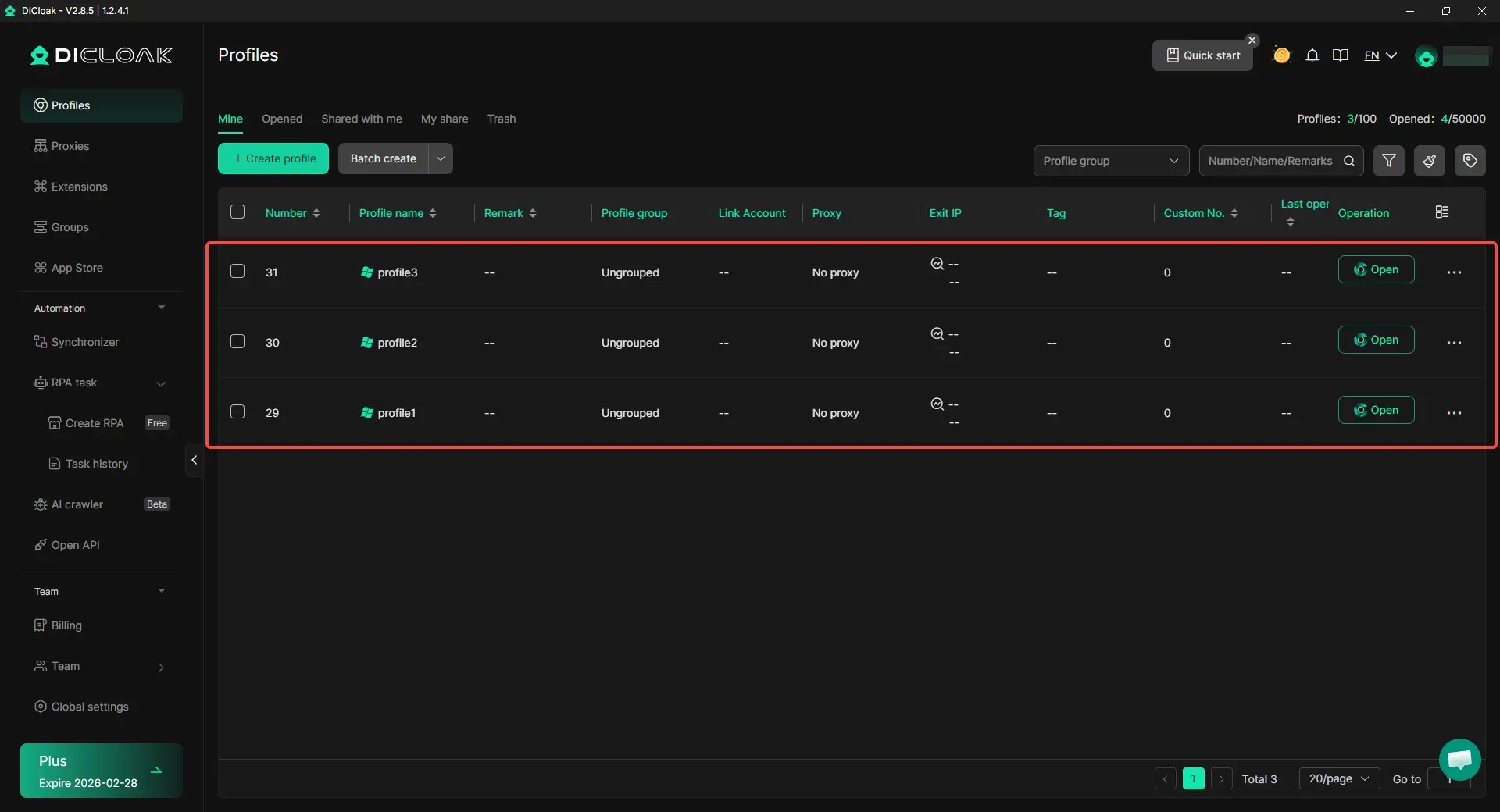
DICloak facilitates organizational scaling through granular permission settings and operation logs. This helps that different operators cannot overlap account access, reducing the risk of accidental "association" by internal staff and ensuring data isolation across the team.
Scaling Operations via RPA and proxy4u Automation
The combination of proxy4u’s bandwidth and DICloak’s automation tools allows for rapid scaling in traffic arbitrage or airdrop participation.
Profile Synchronization and Bulk Operation Logic
The Synchronizer feature allows a master action (e.g., clicking a link or entering text) to be replicated across dozens of windows simultaneously. When paired with Bulk Create and Bulk Import tools, practitioners can deploy hundreds of unique identities with distinct hardware hashes and residential IPs in minutes rather than hours.
Objective Performance Analysis: Evaluating proxy4u
The infrastructure must be evaluated based on both technical flexibility and operational costs.
Pros:
- Extensive Pool: 5M+ IPs reduce the probability of encountering "burnt" or blacklisted addresses.
- Protocol Diversity: Full support for HTTP/S and SOCKS5 allows for versatile bot integration.
- Transparent Tiering: Clear pricing ($1.5/GB Datacenter, $2.5/GB Residential) allows for predictable overhead.
Cons:
- Sticky Duration: Sessions are capped at 30 minutes, which may be a bottleneck for very long-tail automated tasks.
- Bandwidth Sensitivity: As a $/GB service, data-heavy workflows require strict monitoring. However, the cost-benefit ratio remains high when compared to the risk of losing a high-value account with thousands of dollars in associated ad spend or assets.
Comparison: Conventional Use vs. Integrated Environments
| Feature |
Standard Browser + Proxy |
DICloak + proxy4u Integration |
| Fingerprint Isolation |
Non-existent; hardware leaks |
Isolated per profile (Canvas/WebGL) |
| IP Management |
Manual configuration |
Bulk import and automated proxy check |
| Team Scaling |
Shared logins (high risk) |
Granular permissions and data isolation |
| OS Simulation |
Limited to host machine |
Multi-OS (iOS, Android, Windows, etc.) |
| Workflow |
Manual / Repetitive |
RPA and Synchronizer-enabled |
| Recovery/Audit |
None |
Operation Logs |
Operational Appendix (FAQ)
How does proxy4u ensure global coverage for e-commerce?
By offering ASN and Zip code targeting, the service allows users to bypass geo-fencing by appearing to originate from the specific local ISP required by the platform's fraud detection system.
Does proxy4u offer a free trial?
Yes, a free trial is available to verify the network's latency and trust scores before committing to a larger data plan.
Can I use proxy4u with SOCKS5?
Yes, the service is fully compatible with SOCKS5, HTTP, and HTTPS protocols.
What is the cost of mobile proxies?
Mobile proxies, which offer the highest trust score for platforms like Instagram and TikTok, are priced at $3.5/GB.
 Web Proxy Tools
 Free Tools
 Cookie Plugin
 UA Generator
 MAC Address Generator
 IP Generator
 IP Address List
 2FA Code Generator
 World Clock
 Anonymous Check
 WebRTC Leak Test
 UUID Generator
 Free Web Proxy Site
 Proxy Checker
 FB Ad Checker
 AI Web Scraping
 Free SMM Tools
 Twitter Shadowban Checker
 Instagram Name Checker
 UTM Generator
 Username Generator
 AI Hashtag Generator
 LinkedIn Headline Generator
 Social Media Image Resizer